
DEPARTMENT OF
ELECTRONICS AND
COMMUNICATION
ENGINEERING
SEMINAR ON
Presented By
Umesh.R.D
(2KD10EC419)
UNDER THE GUIDANCE OF
Prof.D.D.Billur
Asst.Professor Dept.Of E&C
KLE CET Chikkodi
Content…..
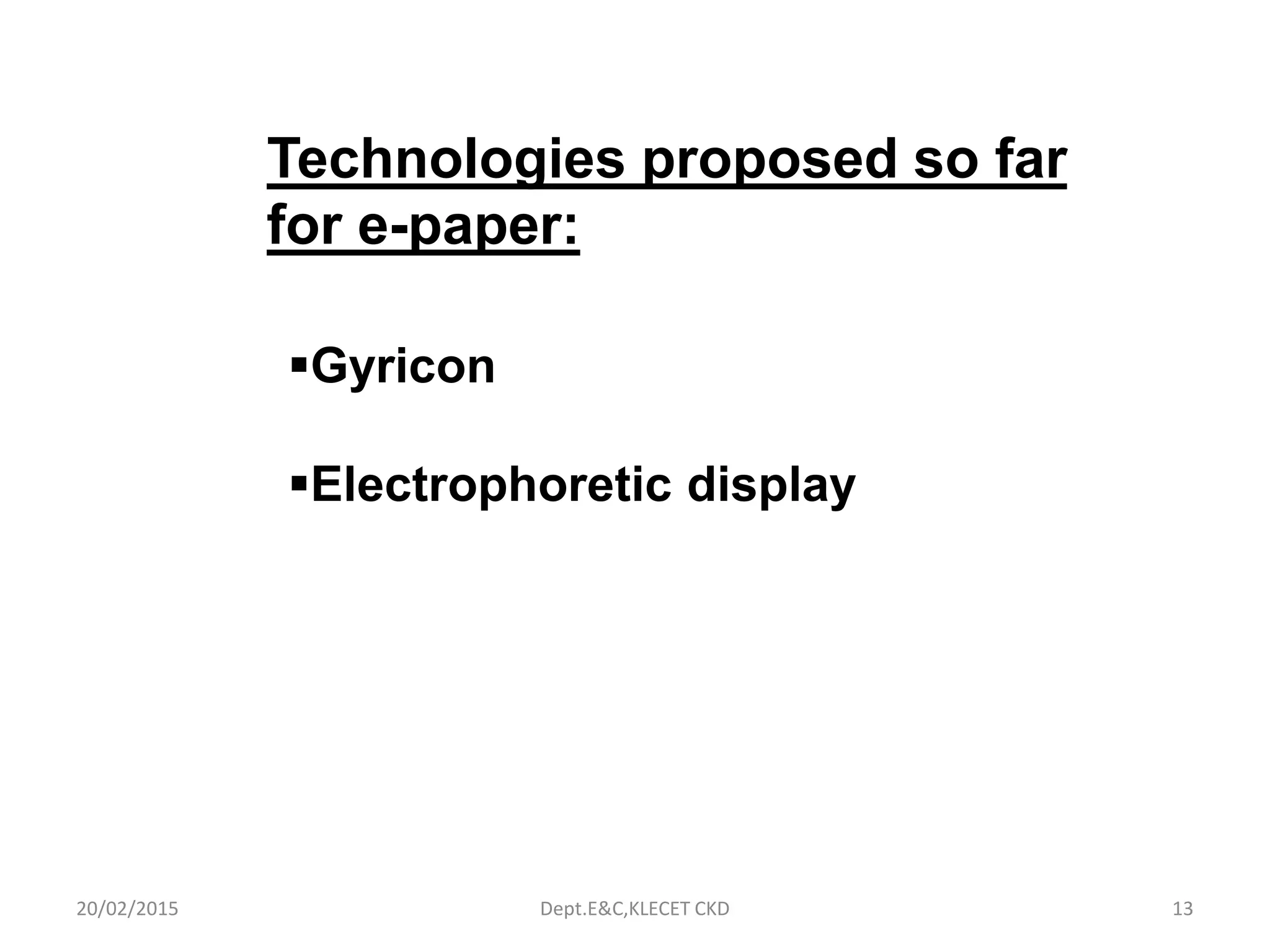
 Introduction
 History
 Scheme
 Working
 Application
 Advantages
 Disadvantages
 Future
 Conclusion
 References
20/02/2015 Dept.E&C,KLECET CKD 2
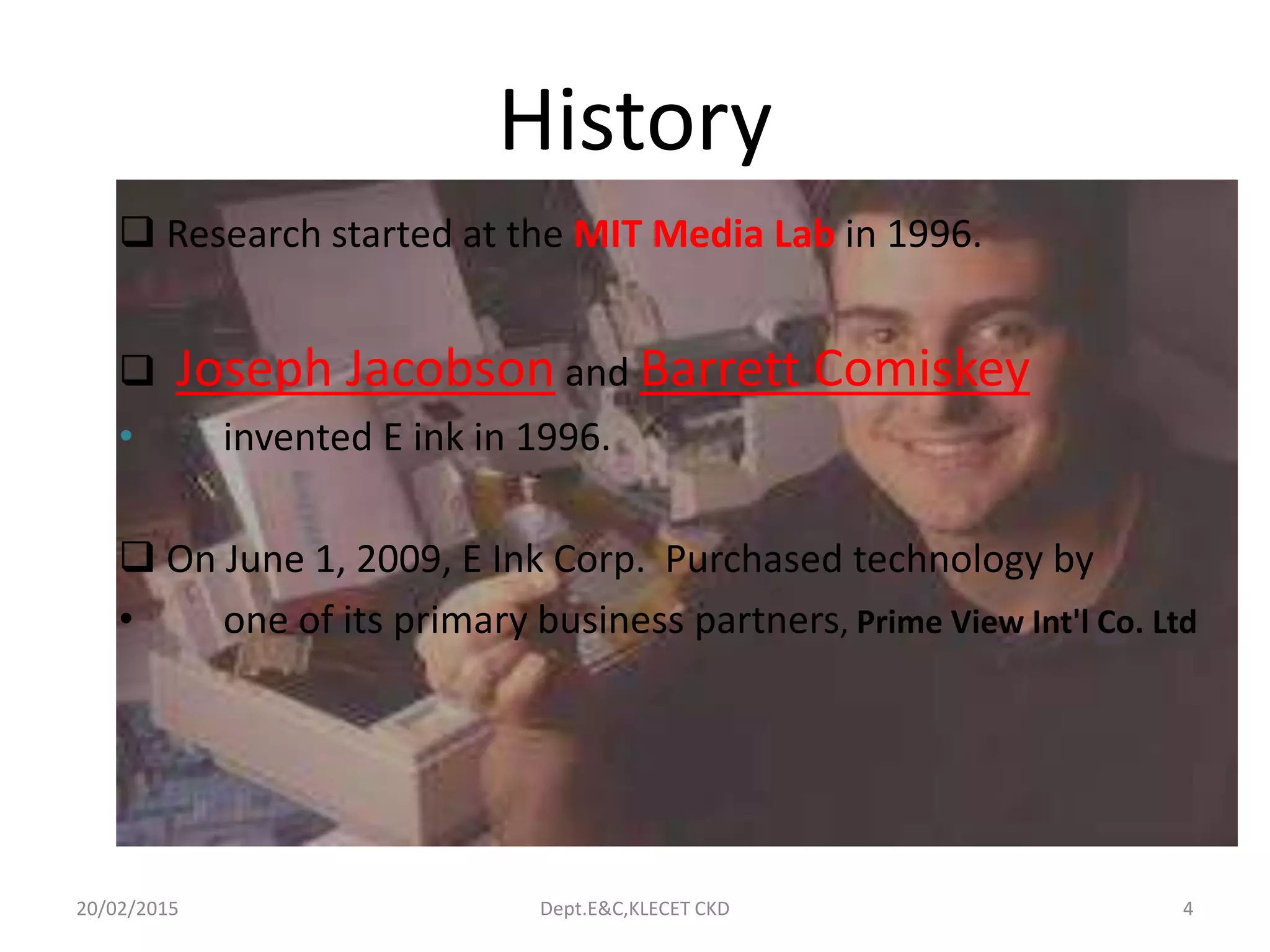
What is E ink???
E Ink is the creator of
electrophoretic or electronic ink.
Electronic ink is actually a
straightforward fusion of
chemistry, physics and electronics.
It's so much like paper.
20/02/2015 Dept.E&C,KLECET CKD 3
History
 Research started at the MIT Media Lab in 1996.
 Joseph Jacobson and Barrett Comiskey
• invented E ink in 1996.
 On June 1, 2009, E Ink Corp. Purchased technology by
• one of its primary business partners, Prime View Int'l Co. Ltd
20/02/2015 Dept.E&C,KLECET CKD 4
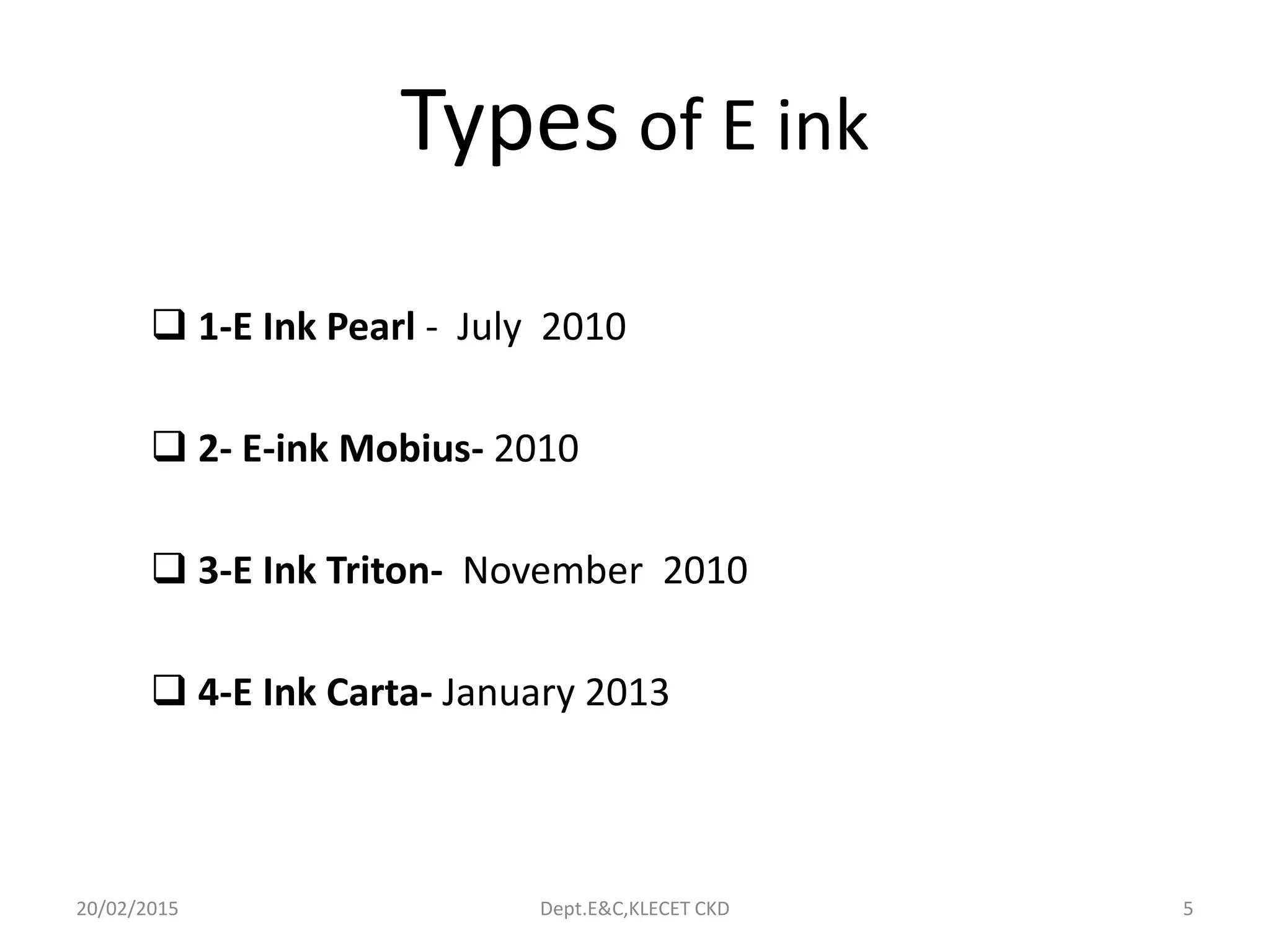
Types of E ink
 1-E Ink Pearl - July 2010
 2- E-ink Mobius- 2010
 3-E Ink Triton- November 2010
 4-E Ink Carta- January 2013
20/02/2015 Dept.E&C,KLECET CKD 5
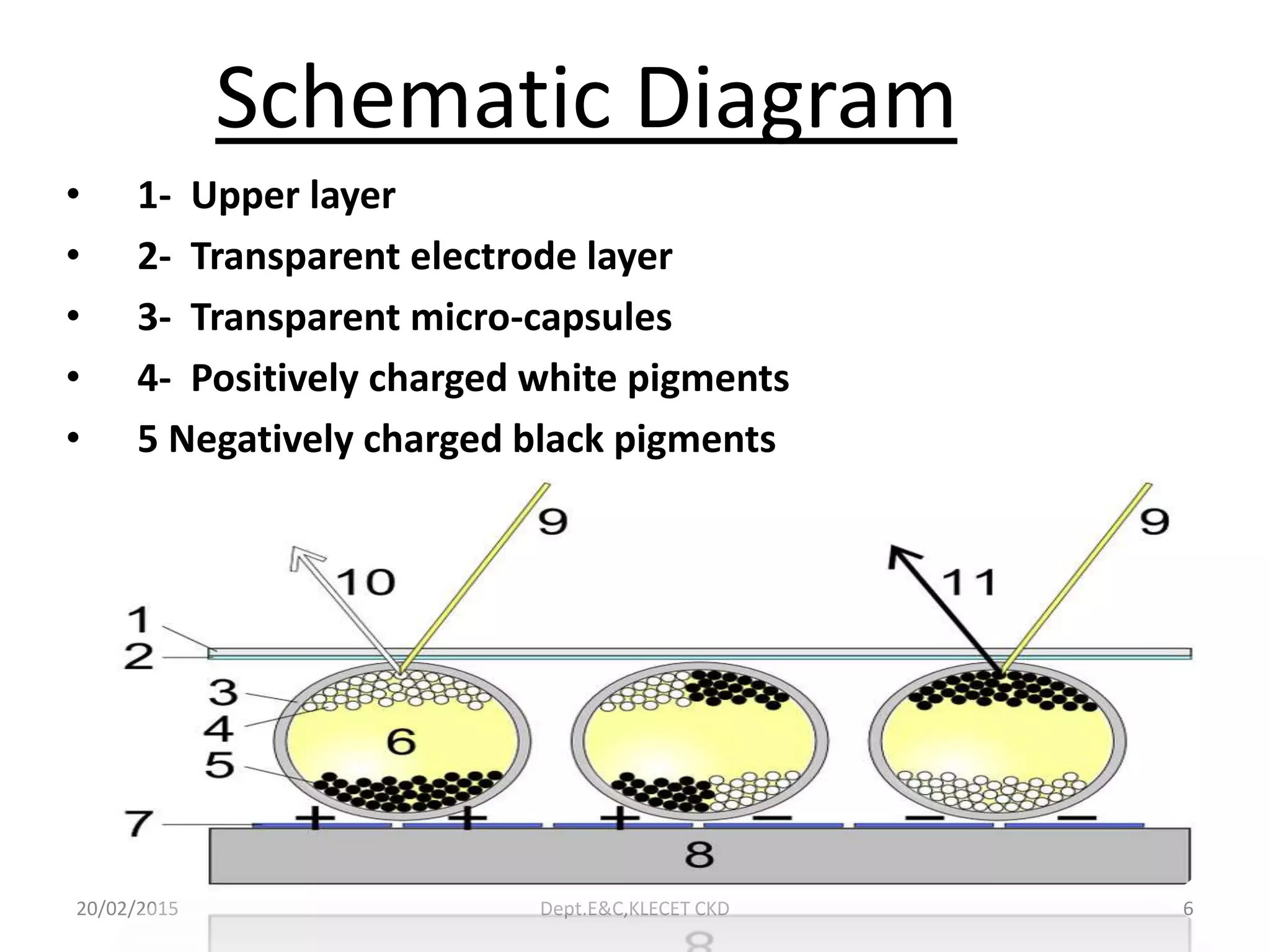
Schematic Diagram
• 1- Upper layer
• 2- Transparent electrode layer
• 3- Transparent micro-capsules
• 4- Positively charged white pigments
• 5 Negatively charged black pigments
20/02/2015 Dept.E&C,KLECET CKD 6
20/02/2015 Dept.E&C,KLECET CKD 7
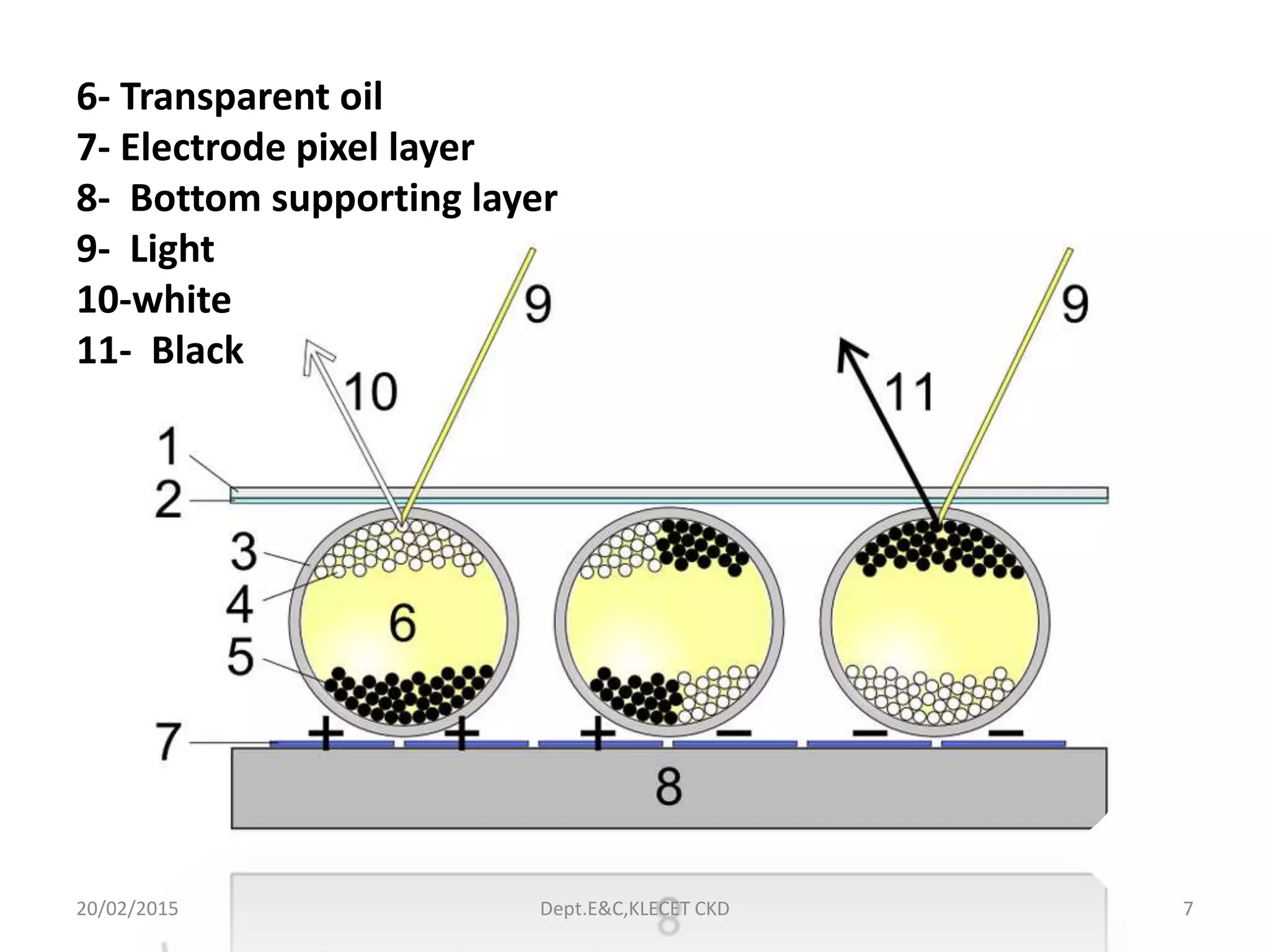
6- Transparent oil
7- Electrode pixel layer
8- Bottom supporting layer
9- Light
10-white
11- Black
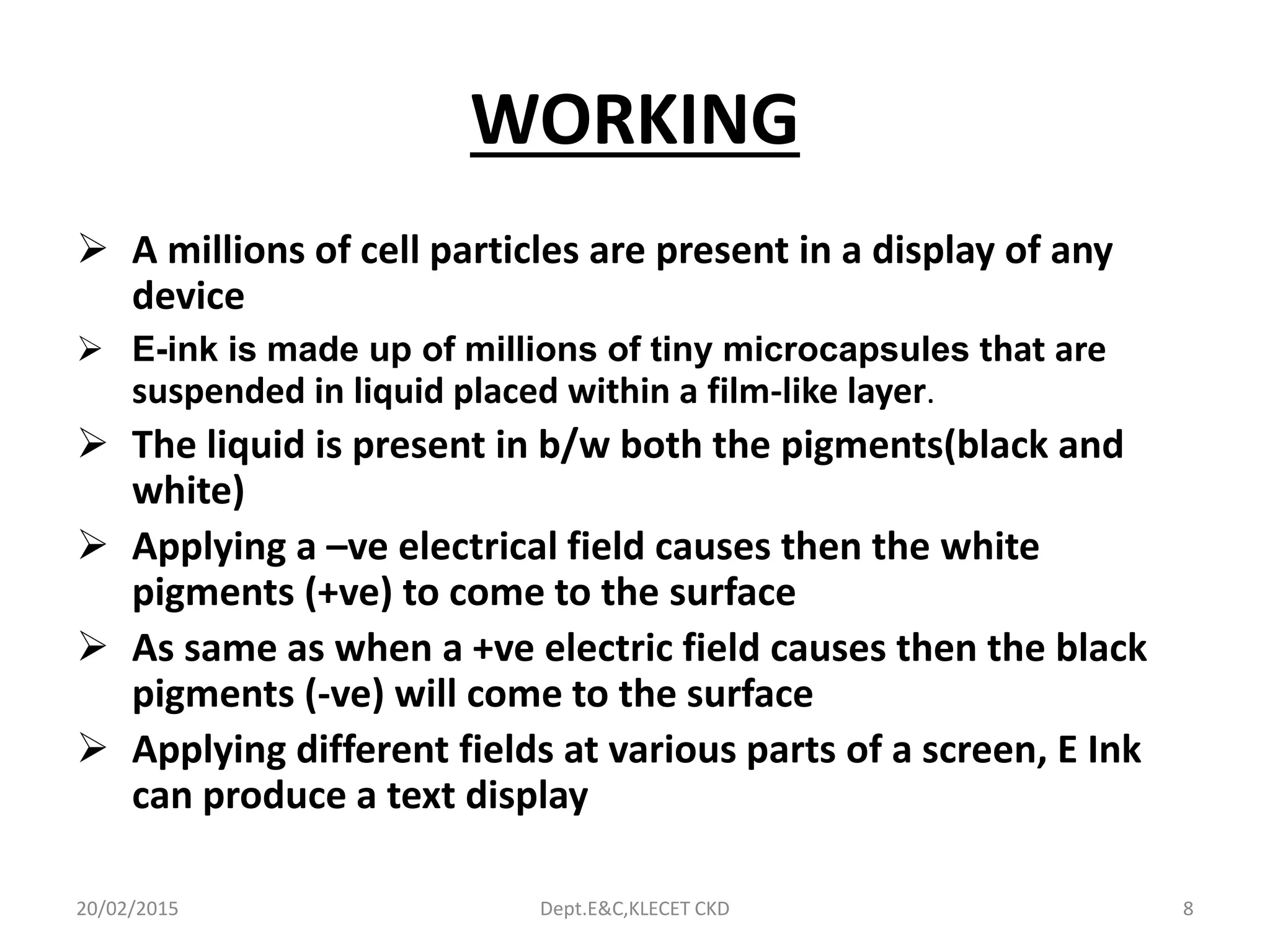
WORKING
 A millions of cell particles are present in a display of any
device
 E-ink is made up of millions of tiny microcapsules that are
suspended in liquid placed within a film-like layer.
 The liquid is present in b/w both the pigments(black and
white)
 Applying a –ve electrical field causes then the white
pigments (+ve) to come to the surface
 As same as when a +ve electric field causes then the black
pigments (-ve) will come to the surface
 Applying different fields at various parts of a screen, E Ink
can produce a text display
20/02/2015 Dept.E&C,KLECET CKD 8
Comparison of e-paper & lcd
20/02/2015 Dept.E&C,KLECET CKD 9
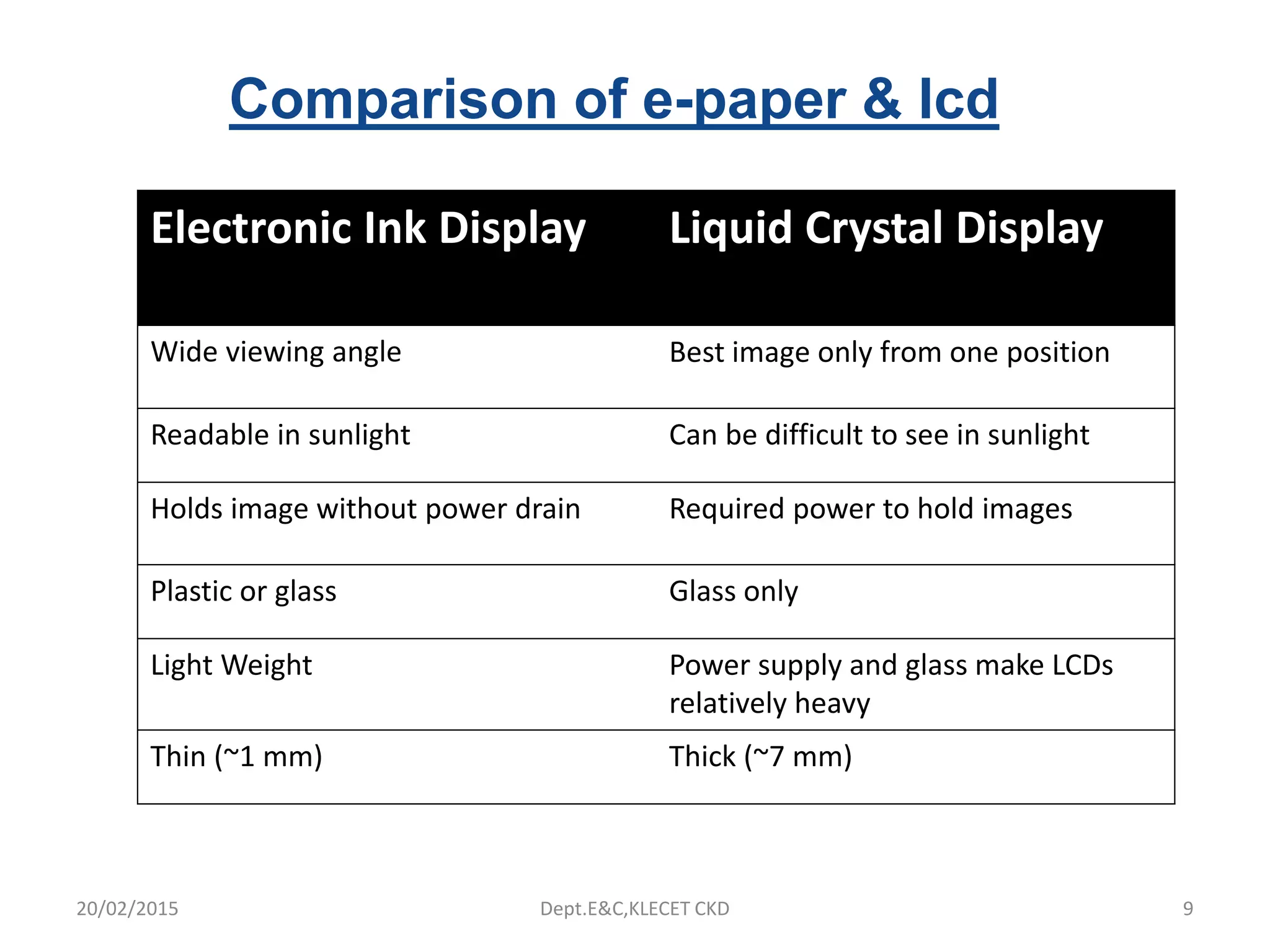
Electronic Ink Display Liquid Crystal Display
Wide viewing angle Best image only from one position
Readable in sunlight Can be difficult to see in sunlight
Holds image without power drain Required power to hold images
Plastic or glass Glass only
Light Weight Power supply and glass make LCDs
relatively heavy
Thin (~1 mm) Thick (~7 mm)
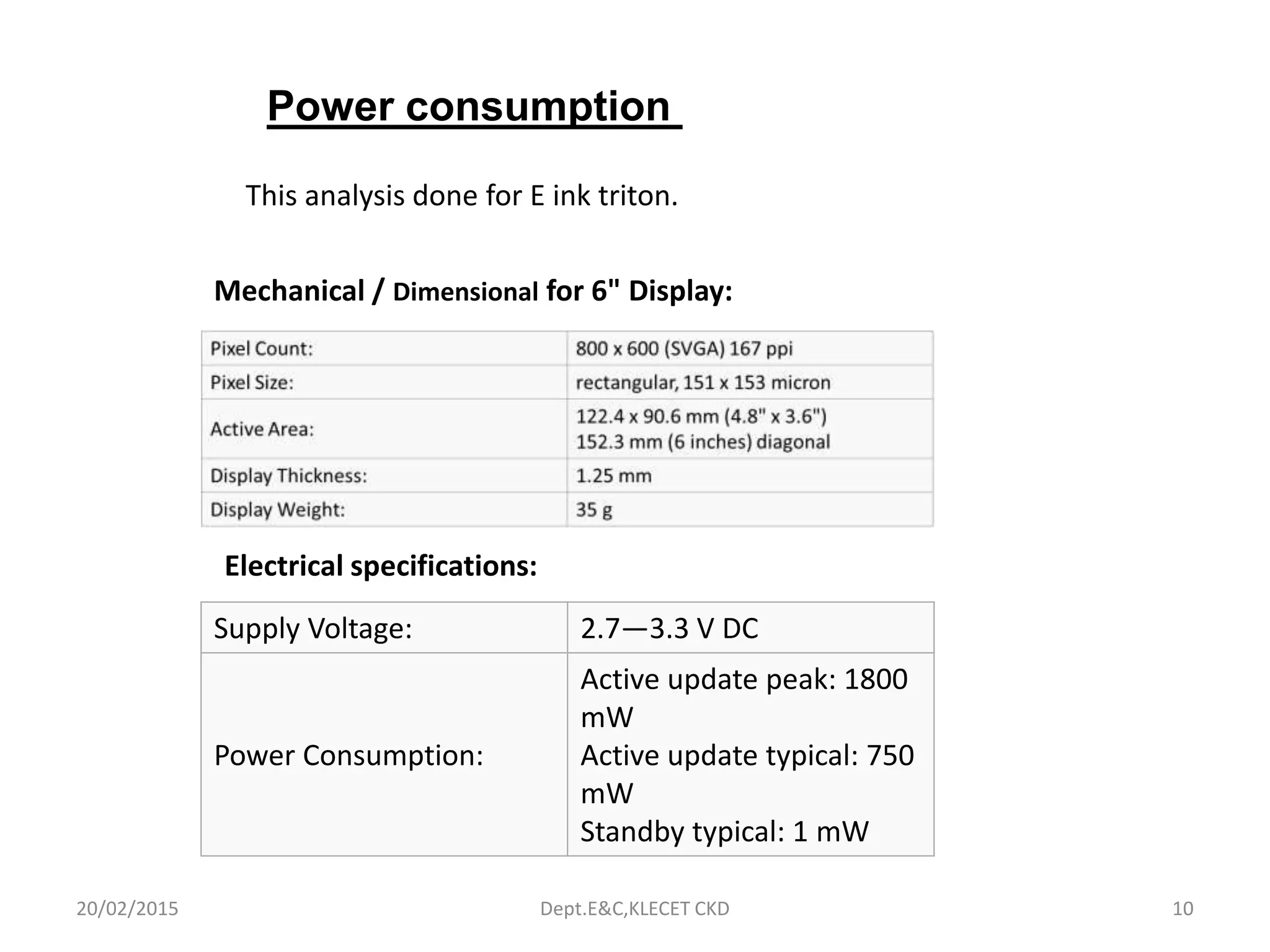
Supply Voltage: 2.7—3.3 V DC
Power Consumption:
Active update peak: 1800
mW
Active update typical: 750
mW
Standby typical: 1 mW
Mechanical / Dimensional for 6" Display:
Electrical specifications:
This analysis done for E ink triton.
Power consumption
20/02/2015 Dept.E&C,KLECET CKD 10
Construction of E-paper
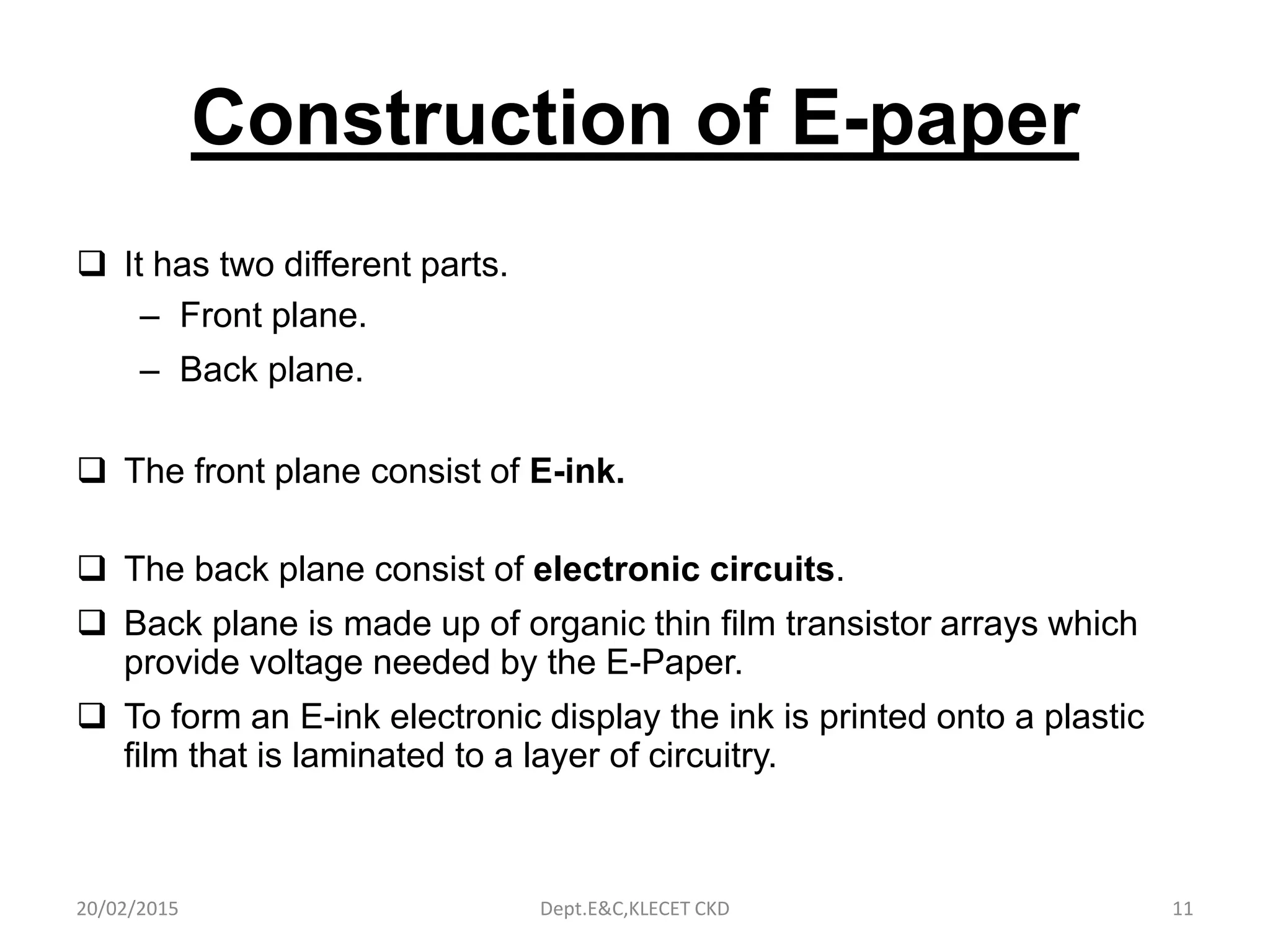
 It has two different parts.
– Front plane.
– Back plane.
 The front plane consist of E-ink.
 The back plane consist of electronic circuits.
 Back plane is made up of organic thin film transistor arrays which
provide voltage needed by the E-Paper.
 To form an E-ink electronic display the ink is printed onto a plastic
film that is laminated to a layer of circuitry.
20/02/2015 Dept.E&C,KLECET CKD 11
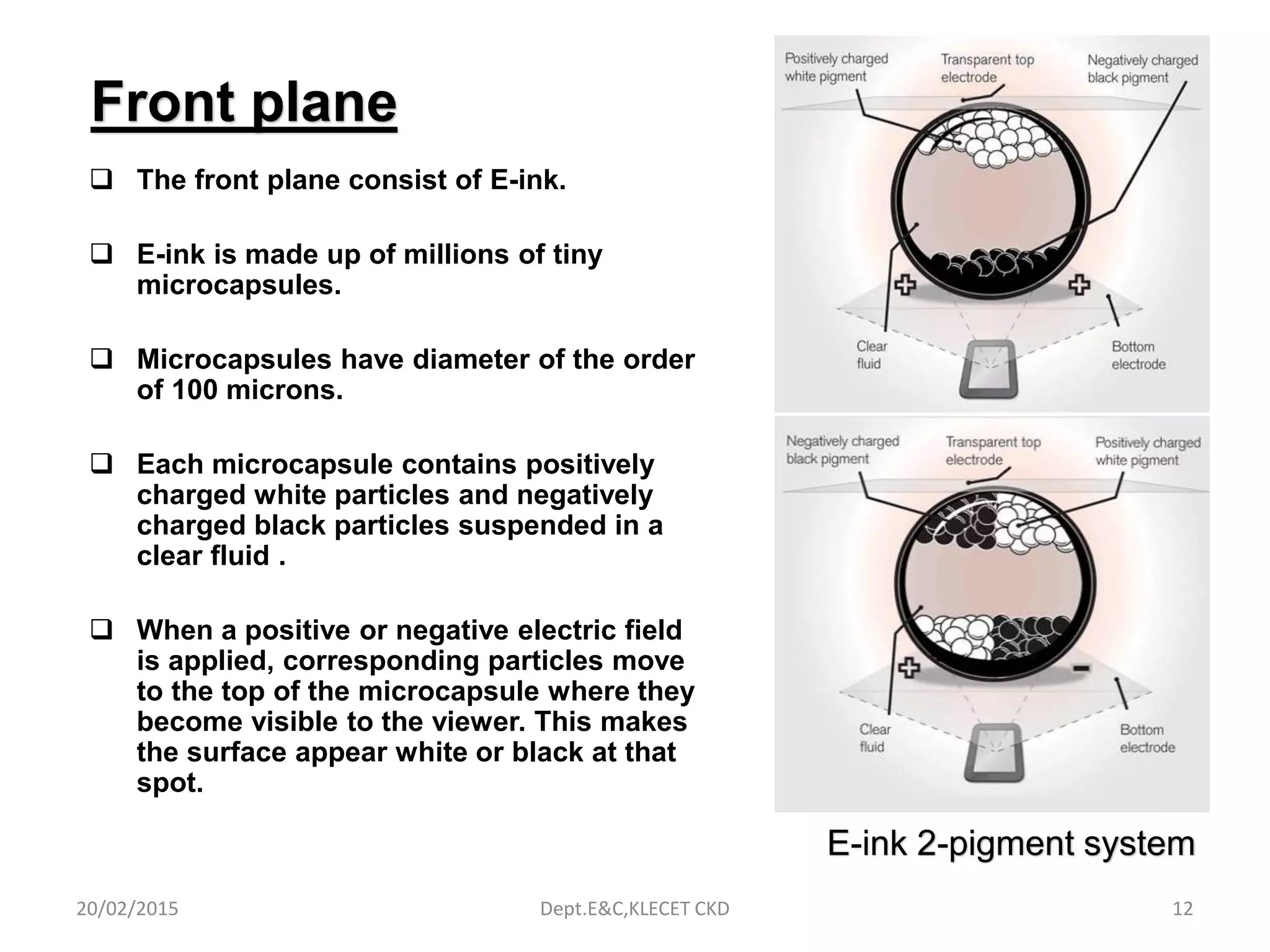
 The front plane consist of E-ink.
 E-ink is made up of millions of tiny
microcapsules.
 Microcapsules have diameter of the order
of 100 microns.
 Each microcapsule contains positively
charged white particles and negatively
charged black particles suspended in a
clear fluid .
 When a positive or negative electric field
is applied, corresponding particles move
to the top of the microcapsule where they
become visible to the viewer. This makes
the surface appear white or black at that
spot.
20/02/2015 Dept.E&C,KLECET CKD 12
Front plane
E-ink 2-pigment system
Gyricon
Electrophoretic display
Technologies proposed so far
for e-paper:
20/02/2015 Dept.E&C,KLECET CKD 13
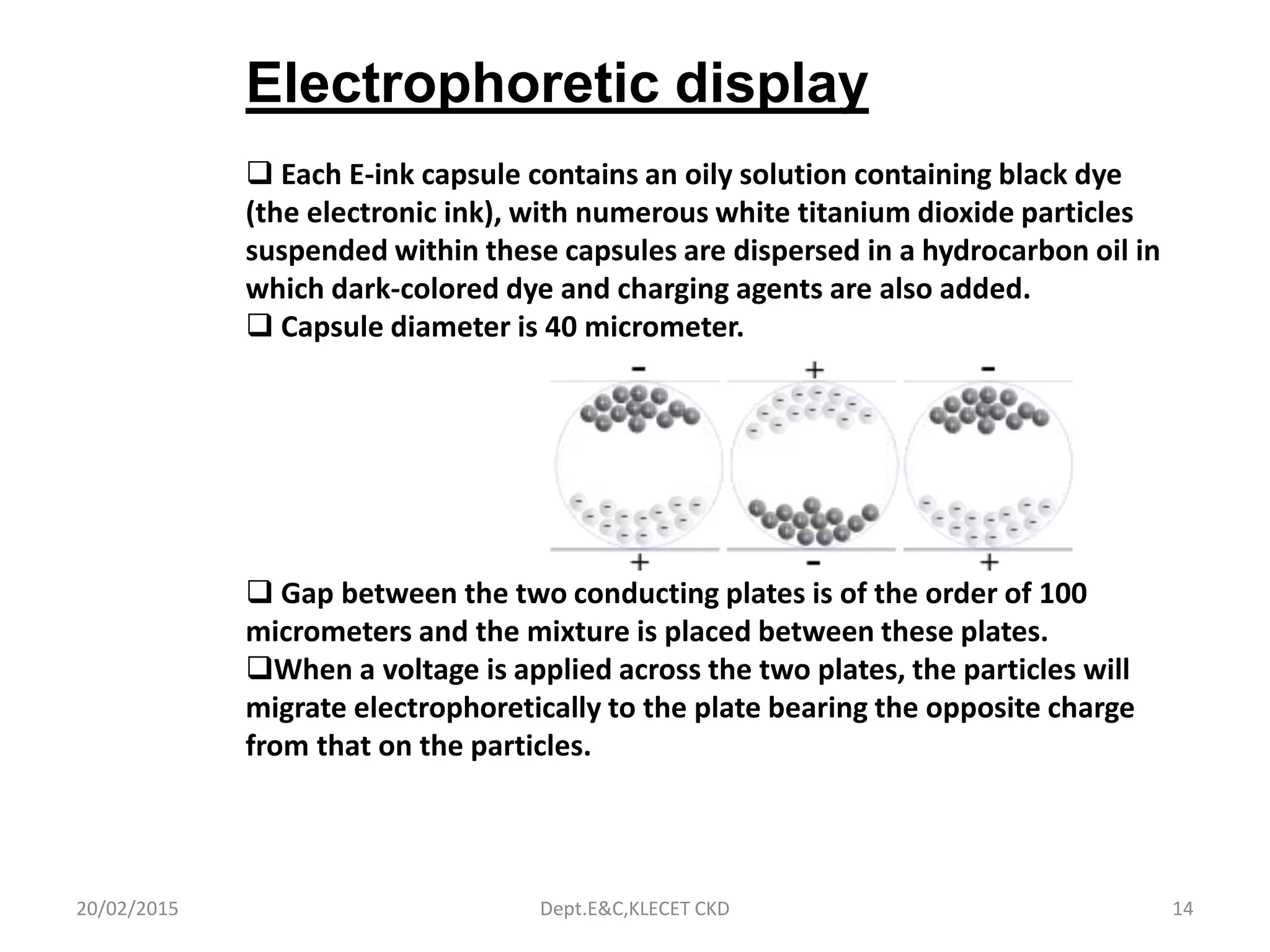
 Each E-ink capsule contains an oily solution containing black dye
(the electronic ink), with numerous white titanium dioxide particles
suspended within these capsules are dispersed in a hydrocarbon oil in
which dark-colored dye and charging agents are also added.
 Capsule diameter is 40 micrometer.
 Gap between the two conducting plates is of the order of 100
micrometers and the mixture is placed between these plates.
When a voltage is applied across the two plates, the particles will
migrate electrophoretically to the plate bearing the opposite charge
from that on the particles.
Electrophoretic display
20/02/2015 Dept.E&C,KLECET CKD 14
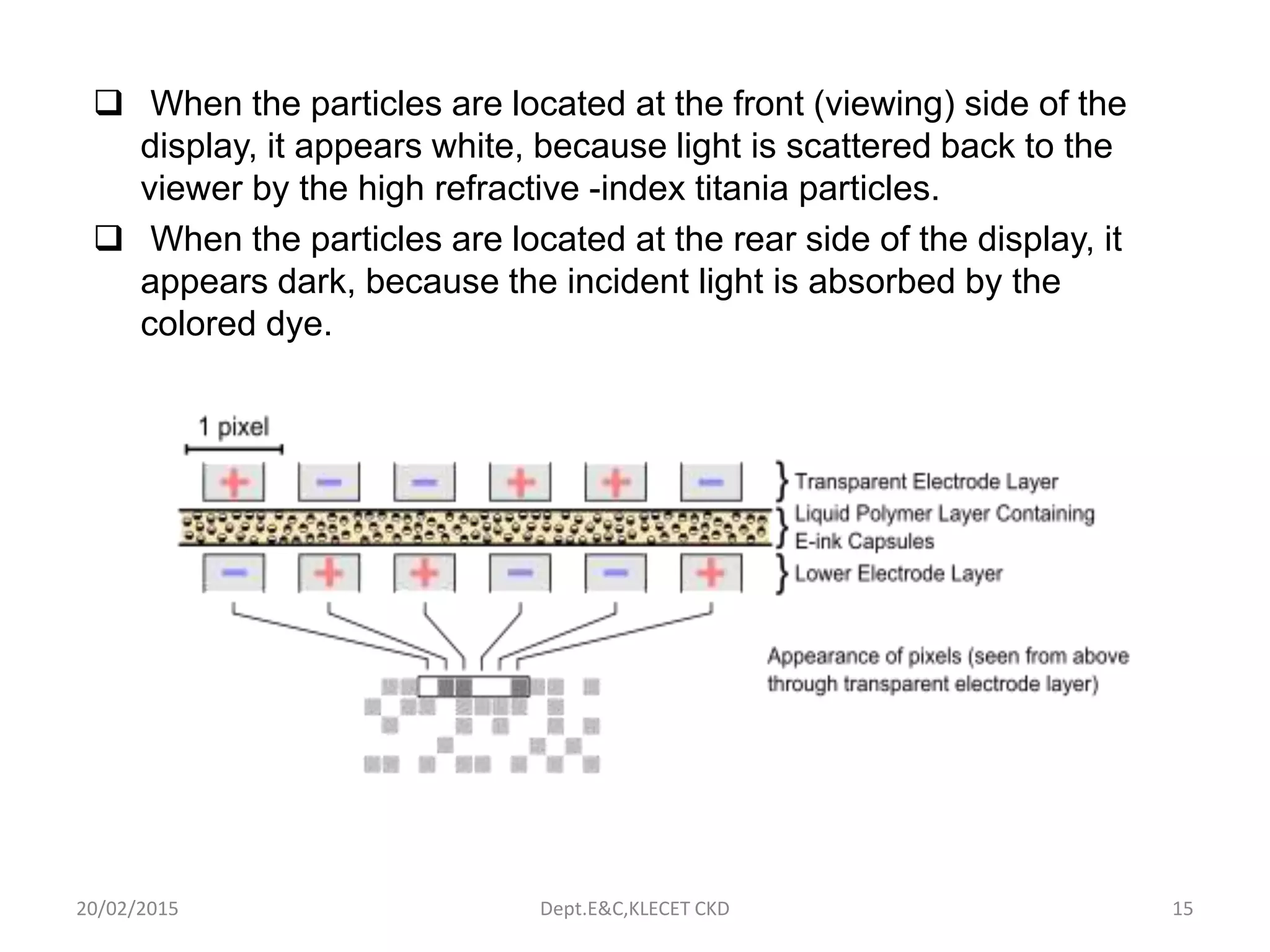
 When the particles are located at the front (viewing) side of the
display, it appears white, because light is scattered back to the
viewer by the high refractive -index titania particles.
 When the particles are located at the rear side of the display, it
appears dark, because the incident light is absorbed by the
colored dye.
20/02/2015 Dept.E&C,KLECET CKD 15
Applications
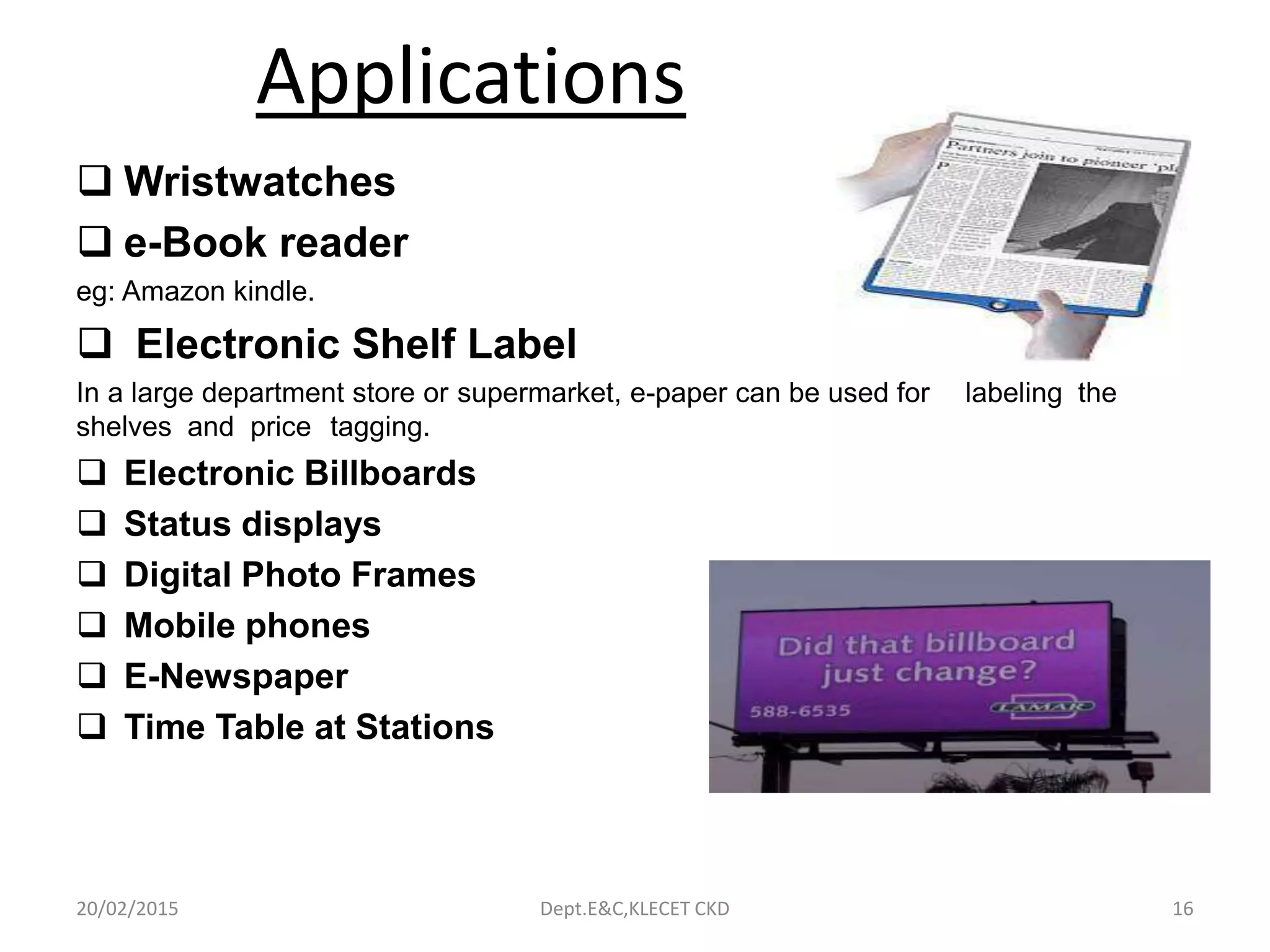
 Wristwatches
 e-Book reader
eg: Amazon kindle.
 Electronic Shelf Label
In a large department store or supermarket, e-paper can be used for labeling the
shelves and price tagging.
 Electronic Billboards
 Status displays
 Digital Photo Frames
 Mobile phones
 E-Newspaper
 Time Table at Stations
20/02/2015 Dept.E&C,KLECET CKD 16
Applications
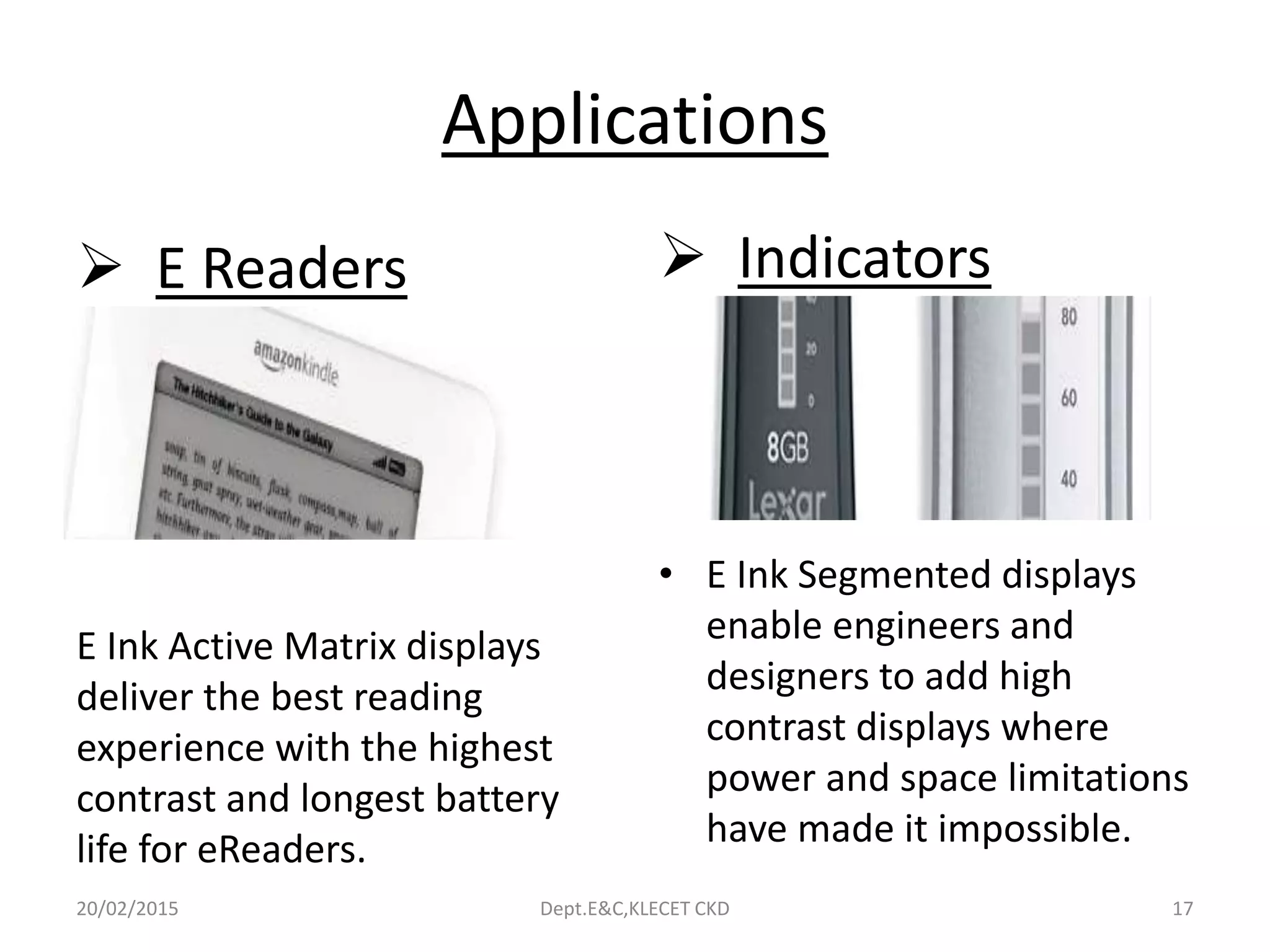
 E Readers
E Ink Active Matrix displays
deliver the best reading
experience with the highest
contrast and longest battery
life for eReaders.
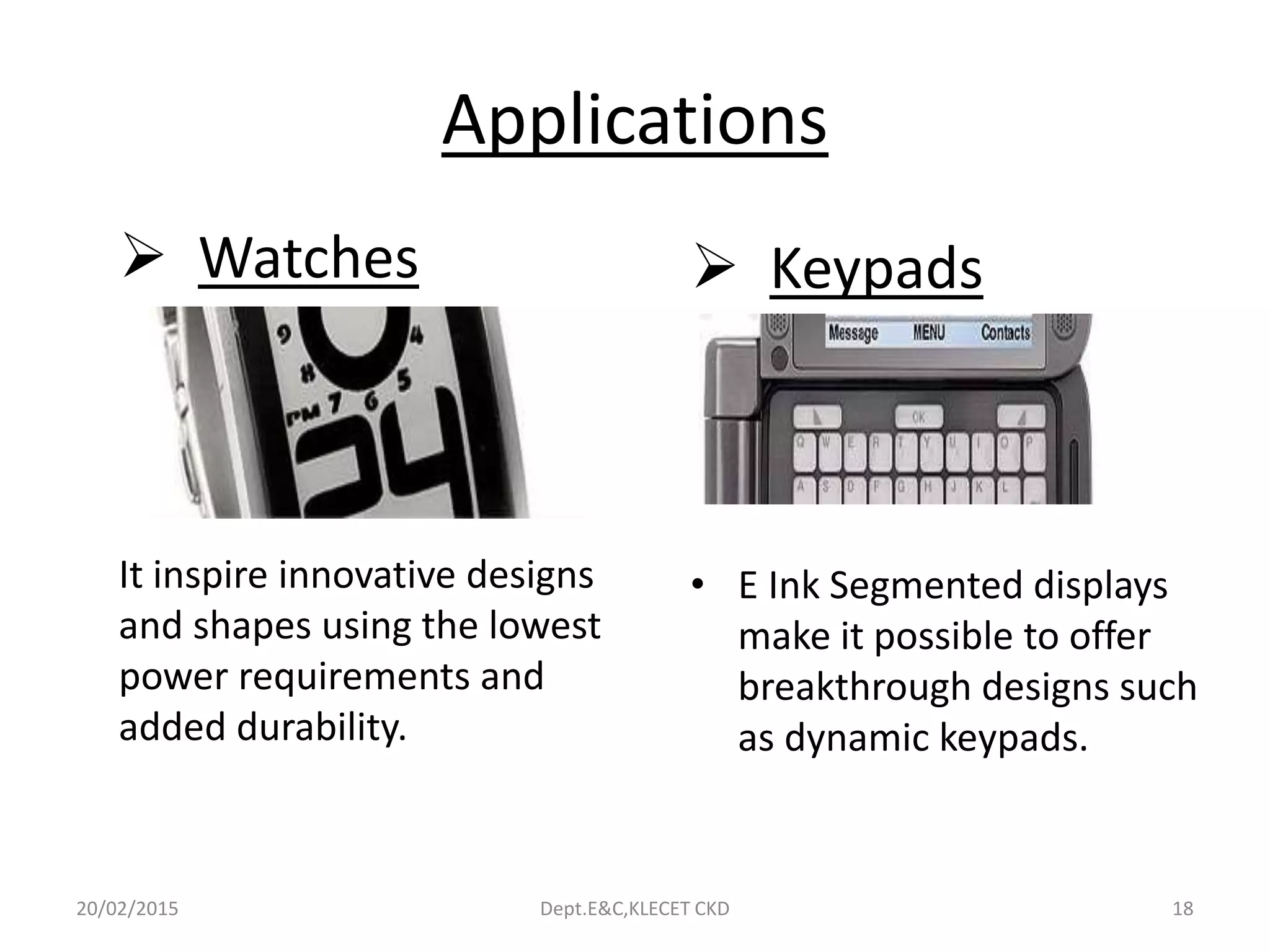
 Indicators
• E Ink Segmented displays
enable engineers and
designers to add high
contrast displays where
power and space limitations
have made it impossible.
20/02/2015 Dept.E&C,KLECET CKD 17
Applications
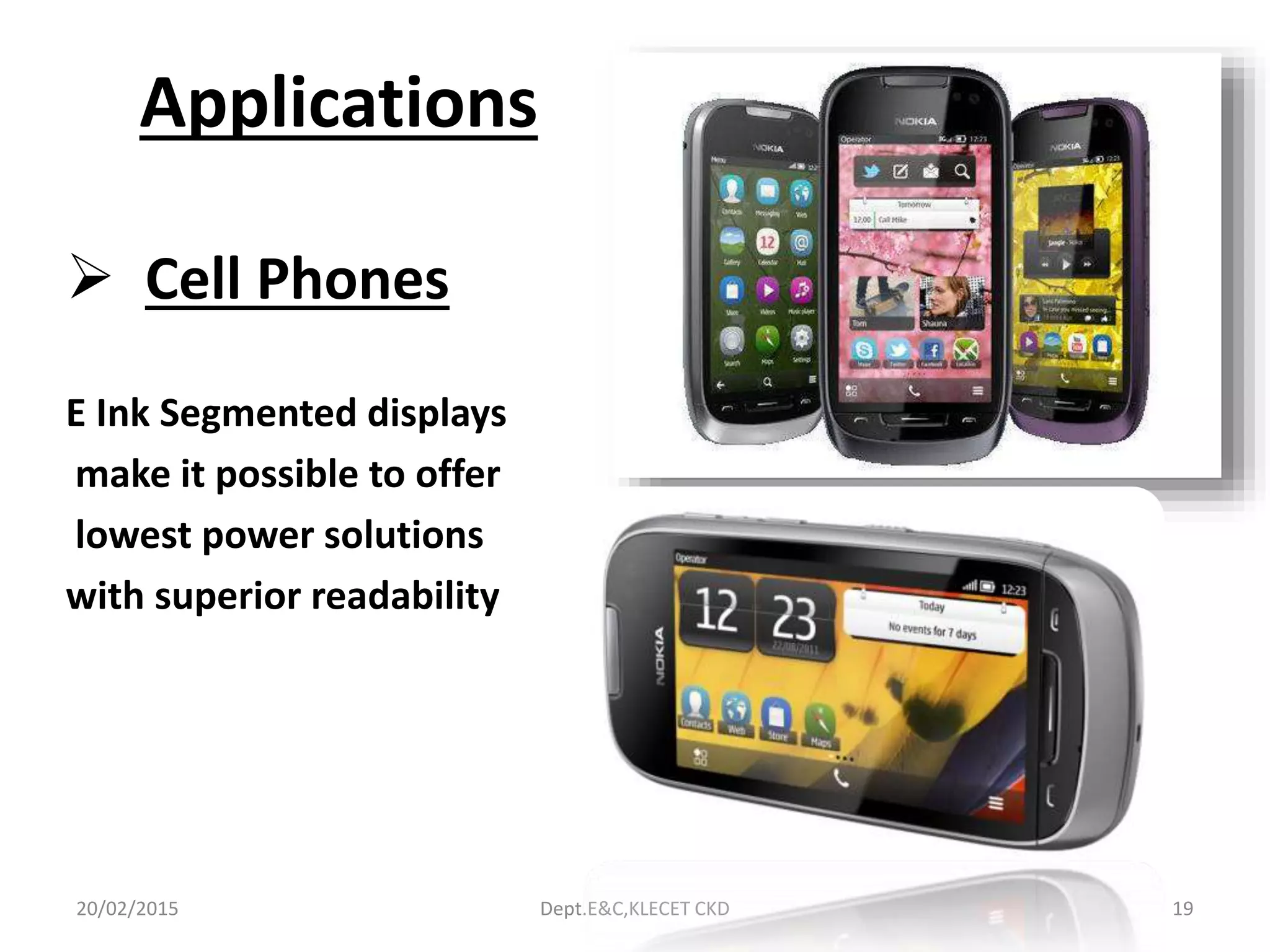
 Watches
It inspire innovative designs
and shapes using the lowest
power requirements and
added durability.
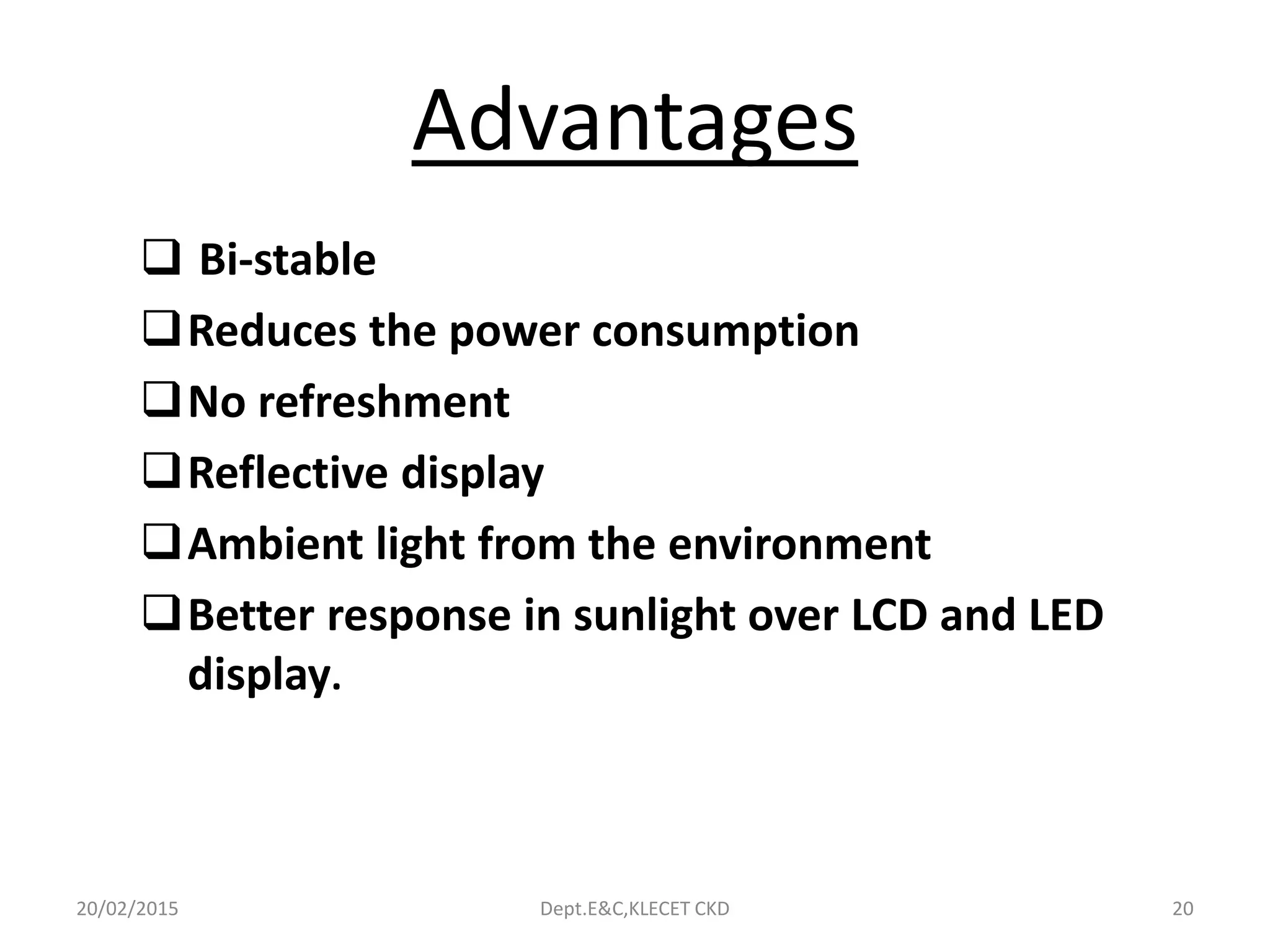
 Keypads
• E Ink Segmented displays
make it possible to offer
breakthrough designs such
as dynamic keypads.
20/02/2015 Dept.E&C,KLECET CKD 18
Applications
 Cell Phones
E Ink Segmented displays
make it possible to offer
lowest power solutions
with superior readability
20/02/2015 Dept.E&C,KLECET CKD 19
Advantages
 Bi-stable
Reduces the power consumption
No refreshment
Reflective display
Ambient light from the environment
Better response in sunlight over LCD and LED
display.
20/02/2015 Dept.E&C,KLECET CKD 20
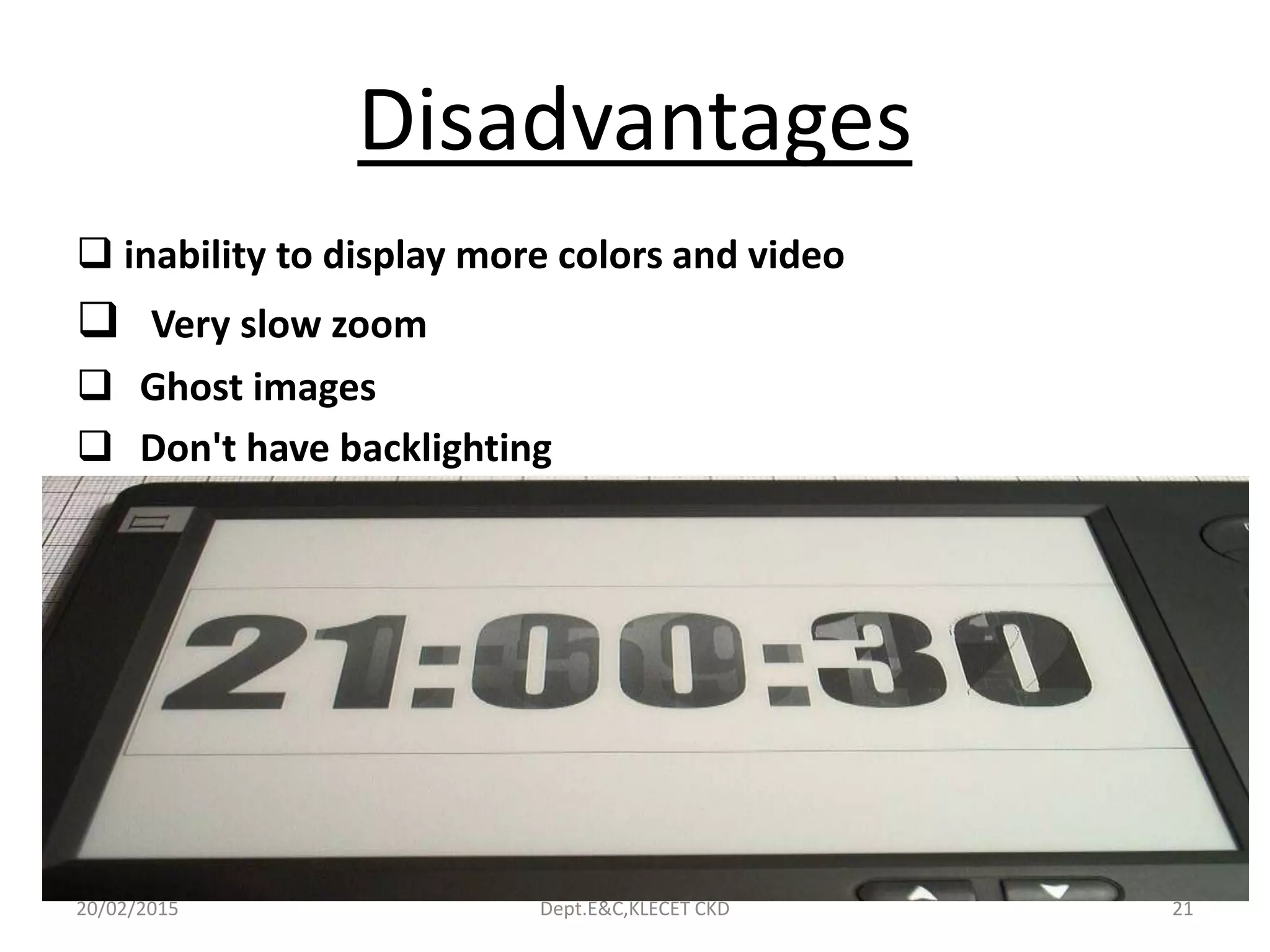
Disadvantages
 inability to display more colors and video
 Very slow zoom
 Ghost images
 Don't have backlighting
20/02/2015 Dept.E&C,KLECET CKD 21
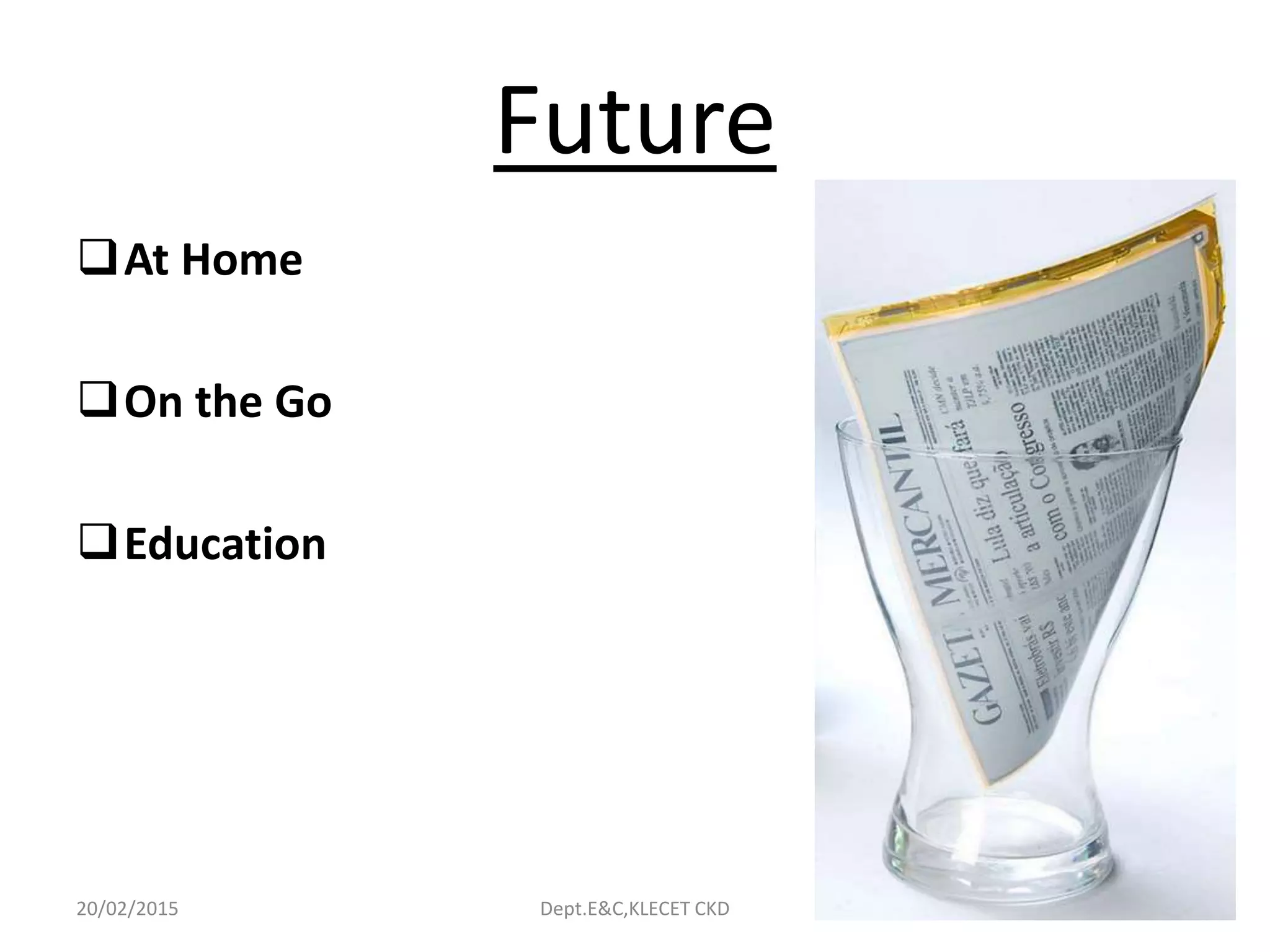
Future
At Home
On the Go
Education
20/02/2015 Dept.E&C,KLECET CKD 22
Future
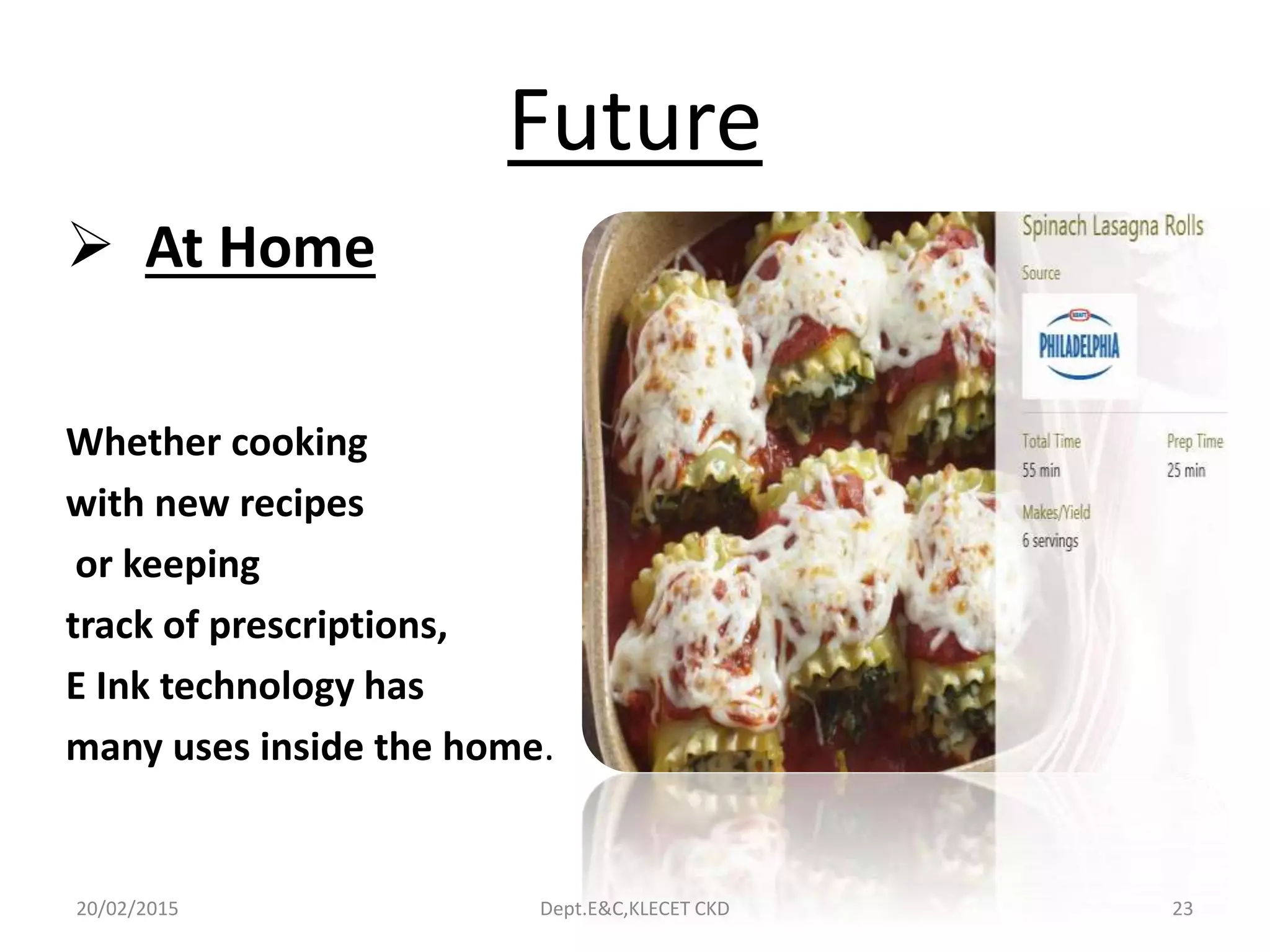
 At Home
Whether cooking
with new recipes
or keeping
track of prescriptions,
E Ink technology has
many uses inside the home.
20/02/2015 Dept.E&C,KLECET CKD 23
Future
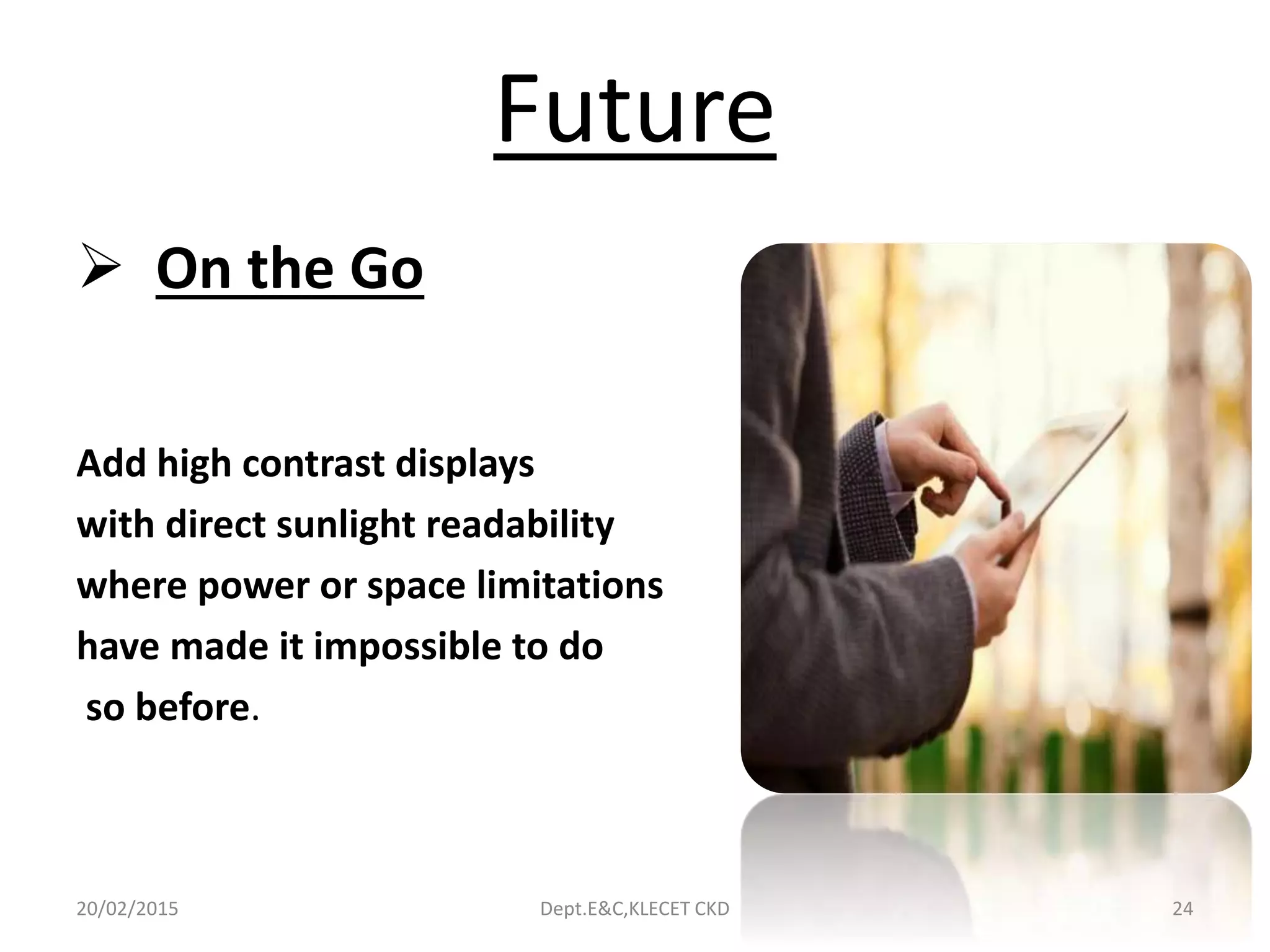
 On the Go
Add high contrast displays
with direct sunlight readability
where power or space limitations
have made it impossible to do
so before.
20/02/2015 Dept.E&C,KLECET CKD 24
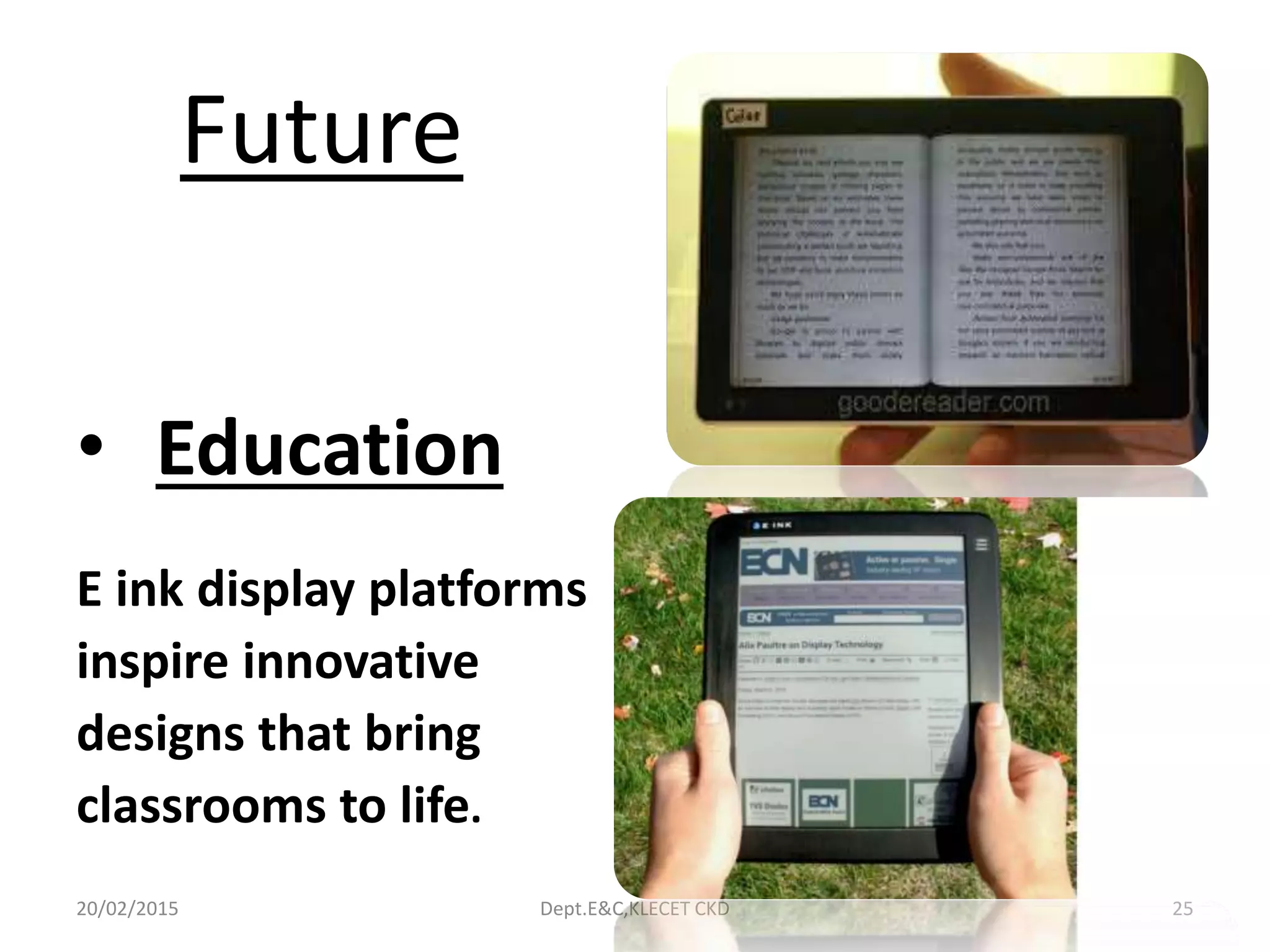
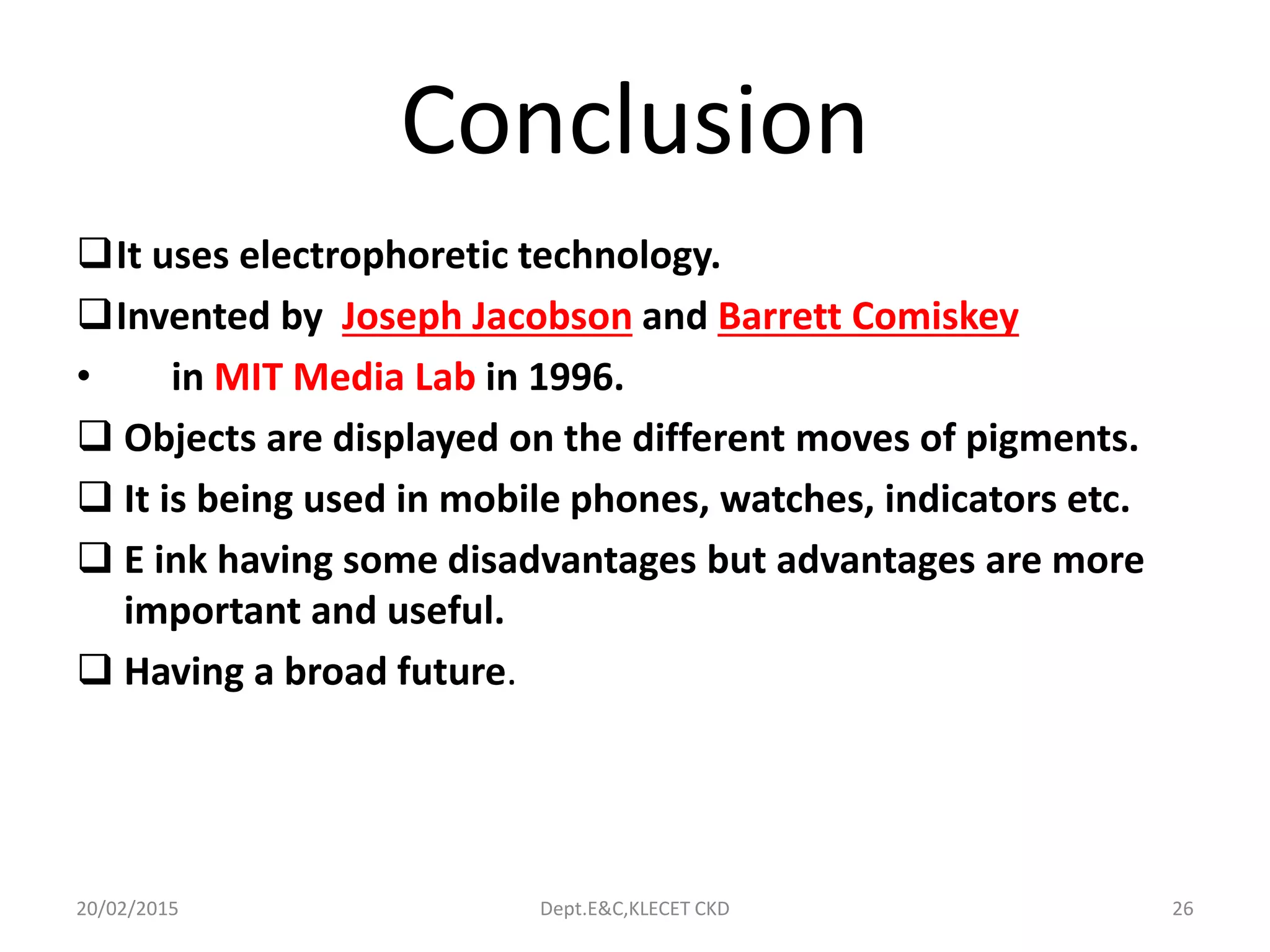
Future
• Education
E ink display platforms
inspire innovative
designs that bring
classrooms to life.
20/02/2015 Dept.E&C,KLECET CKD 25
Conclusion
It uses electrophoretic technology.
Invented by Joseph Jacobson and Barrett Comiskey
• in MIT Media Lab in 1996.
 Objects are displayed on the different moves of pigments.
 It is being used in mobile phones, watches, indicators etc.
 E ink having some disadvantages but advantages are more
important and useful.
 Having a broad future.
20/02/2015 Dept.E&C,KLECET CKD 26
References
 Flexible and Roll-able Displays/Electronic Paper A Brief Technology Overview Rong-
Chang (R.C.) Liang
 Paper Electronics and Electronic Paper
• by Magnus Berggren*'**, Thomas Kugler*'**, Tommi Remonen*, David
Nilsson**,Miaoxiang Chen**, Petronella Norberg"*The Research
Institute ACRE0 AB, Bredgatan 34, SE-602 21 Norrkoping, Sweden
**Organic Electronics Group, Campus Norrkoping, SE-601 74, Sweden
 E-paper: Clarifying future R&D needs by a fundamental understanding of the
maximum performance of current technologies
• Author(s): Heikenfeld, J.
Novel Devices Lab., Univ. of Cincinnati, Cincinnati, OH, USA
 http://spectrum.ieee.org/consumer-electronics/portable-devices/lighter-brighter-
displays
 Image taken from: http://www.eink.com/technology.html
• http://www.amazon.in/gp/product/B007RF5F0Q/ref=famstripe_kp3
 MIT Media Laboratory. http://www.media.mit.edu/micromedia
(January2001). — Perry Romanowski
 http://en.wikipedia.org/wiki/Electronic_paper
20/02/2015 Dept.E&C,KLECET CKD 27
20/02/2015 Dept.E&C,KLECET CKD 28
QUESTIONS???
20/02/2015 Dept.E&C,KLECET CKD 29

E inkpresentation by me 1 - copy

  • 1.
    DEPARTMENT OF ELECTRONICS AND COMMUNICATION ENGINEERING SEMINARON Presented By Umesh.R.D (2KD10EC419) UNDER THE GUIDANCE OF Prof.D.D.Billur Asst.Professor Dept.Of E&C KLE CET Chikkodi
  • 2.
    Content…..  Introduction  History Scheme  Working  Application  Advantages  Disadvantages  Future  Conclusion  References 20/02/2015 Dept.E&C,KLECET CKD 2
  • 3.
    What is Eink??? E Ink is the creator of electrophoretic or electronic ink. Electronic ink is actually a straightforward fusion of chemistry, physics and electronics. It's so much like paper. 20/02/2015 Dept.E&C,KLECET CKD 3
  • 4.
    History  Research startedat the MIT Media Lab in 1996.  Joseph Jacobson and Barrett Comiskey • invented E ink in 1996.  On June 1, 2009, E Ink Corp. Purchased technology by • one of its primary business partners, Prime View Int'l Co. Ltd 20/02/2015 Dept.E&C,KLECET CKD 4
  • 5.
    Types of Eink  1-E Ink Pearl - July 2010  2- E-ink Mobius- 2010  3-E Ink Triton- November 2010  4-E Ink Carta- January 2013 20/02/2015 Dept.E&C,KLECET CKD 5
  • 6.
    Schematic Diagram • 1-Upper layer • 2- Transparent electrode layer • 3- Transparent micro-capsules • 4- Positively charged white pigments • 5 Negatively charged black pigments 20/02/2015 Dept.E&C,KLECET CKD 6
  • 7.
    20/02/2015 Dept.E&C,KLECET CKD7 6- Transparent oil 7- Electrode pixel layer 8- Bottom supporting layer 9- Light 10-white 11- Black
  • 8.
    WORKING  A millionsof cell particles are present in a display of any device  E-ink is made up of millions of tiny microcapsules that are suspended in liquid placed within a film-like layer.  The liquid is present in b/w both the pigments(black and white)  Applying a –ve electrical field causes then the white pigments (+ve) to come to the surface  As same as when a +ve electric field causes then the black pigments (-ve) will come to the surface  Applying different fields at various parts of a screen, E Ink can produce a text display 20/02/2015 Dept.E&C,KLECET CKD 8
  • 9.
    Comparison of e-paper& lcd 20/02/2015 Dept.E&C,KLECET CKD 9 Electronic Ink Display Liquid Crystal Display Wide viewing angle Best image only from one position Readable in sunlight Can be difficult to see in sunlight Holds image without power drain Required power to hold images Plastic or glass Glass only Light Weight Power supply and glass make LCDs relatively heavy Thin (~1 mm) Thick (~7 mm)
  • 10.
    Supply Voltage: 2.7—3.3V DC Power Consumption: Active update peak: 1800 mW Active update typical: 750 mW Standby typical: 1 mW Mechanical / Dimensional for 6" Display: Electrical specifications: This analysis done for E ink triton. Power consumption 20/02/2015 Dept.E&C,KLECET CKD 10
  • 11.
    Construction of E-paper It has two different parts. – Front plane. – Back plane.  The front plane consist of E-ink.  The back plane consist of electronic circuits.  Back plane is made up of organic thin film transistor arrays which provide voltage needed by the E-Paper.  To form an E-ink electronic display the ink is printed onto a plastic film that is laminated to a layer of circuitry. 20/02/2015 Dept.E&C,KLECET CKD 11
  • 12.
     The frontplane consist of E-ink.  E-ink is made up of millions of tiny microcapsules.  Microcapsules have diameter of the order of 100 microns.  Each microcapsule contains positively charged white particles and negatively charged black particles suspended in a clear fluid .  When a positive or negative electric field is applied, corresponding particles move to the top of the microcapsule where they become visible to the viewer. This makes the surface appear white or black at that spot. 20/02/2015 Dept.E&C,KLECET CKD 12 Front plane E-ink 2-pigment system
  • 13.
    Gyricon Electrophoretic display Technologies proposedso far for e-paper: 20/02/2015 Dept.E&C,KLECET CKD 13
  • 14.
     Each E-inkcapsule contains an oily solution containing black dye (the electronic ink), with numerous white titanium dioxide particles suspended within these capsules are dispersed in a hydrocarbon oil in which dark-colored dye and charging agents are also added.  Capsule diameter is 40 micrometer.  Gap between the two conducting plates is of the order of 100 micrometers and the mixture is placed between these plates. When a voltage is applied across the two plates, the particles will migrate electrophoretically to the plate bearing the opposite charge from that on the particles. Electrophoretic display 20/02/2015 Dept.E&C,KLECET CKD 14
  • 15.
     When theparticles are located at the front (viewing) side of the display, it appears white, because light is scattered back to the viewer by the high refractive -index titania particles.  When the particles are located at the rear side of the display, it appears dark, because the incident light is absorbed by the colored dye. 20/02/2015 Dept.E&C,KLECET CKD 15
  • 16.
    Applications  Wristwatches  e-Bookreader eg: Amazon kindle.  Electronic Shelf Label In a large department store or supermarket, e-paper can be used for labeling the shelves and price tagging.  Electronic Billboards  Status displays  Digital Photo Frames  Mobile phones  E-Newspaper  Time Table at Stations 20/02/2015 Dept.E&C,KLECET CKD 16
  • 17.
    Applications  E Readers EInk Active Matrix displays deliver the best reading experience with the highest contrast and longest battery life for eReaders.  Indicators • E Ink Segmented displays enable engineers and designers to add high contrast displays where power and space limitations have made it impossible. 20/02/2015 Dept.E&C,KLECET CKD 17
  • 18.
    Applications  Watches It inspireinnovative designs and shapes using the lowest power requirements and added durability.  Keypads • E Ink Segmented displays make it possible to offer breakthrough designs such as dynamic keypads. 20/02/2015 Dept.E&C,KLECET CKD 18
  • 19.
    Applications  Cell Phones EInk Segmented displays make it possible to offer lowest power solutions with superior readability 20/02/2015 Dept.E&C,KLECET CKD 19
  • 20.
    Advantages  Bi-stable Reduces thepower consumption No refreshment Reflective display Ambient light from the environment Better response in sunlight over LCD and LED display. 20/02/2015 Dept.E&C,KLECET CKD 20
  • 21.
    Disadvantages  inability todisplay more colors and video  Very slow zoom  Ghost images  Don't have backlighting 20/02/2015 Dept.E&C,KLECET CKD 21
  • 22.
    Future At Home On theGo Education 20/02/2015 Dept.E&C,KLECET CKD 22
  • 23.
    Future  At Home Whethercooking with new recipes or keeping track of prescriptions, E Ink technology has many uses inside the home. 20/02/2015 Dept.E&C,KLECET CKD 23
  • 24.
    Future  On theGo Add high contrast displays with direct sunlight readability where power or space limitations have made it impossible to do so before. 20/02/2015 Dept.E&C,KLECET CKD 24
  • 25.
    Future • Education E inkdisplay platforms inspire innovative designs that bring classrooms to life. 20/02/2015 Dept.E&C,KLECET CKD 25
  • 26.
    Conclusion It uses electrophoretictechnology. Invented by Joseph Jacobson and Barrett Comiskey • in MIT Media Lab in 1996.  Objects are displayed on the different moves of pigments.  It is being used in mobile phones, watches, indicators etc.  E ink having some disadvantages but advantages are more important and useful.  Having a broad future. 20/02/2015 Dept.E&C,KLECET CKD 26
  • 27.
    References  Flexible andRoll-able Displays/Electronic Paper A Brief Technology Overview Rong- Chang (R.C.) Liang  Paper Electronics and Electronic Paper • by Magnus Berggren*'**, Thomas Kugler*'**, Tommi Remonen*, David Nilsson**,Miaoxiang Chen**, Petronella Norberg"*The Research Institute ACRE0 AB, Bredgatan 34, SE-602 21 Norrkoping, Sweden **Organic Electronics Group, Campus Norrkoping, SE-601 74, Sweden  E-paper: Clarifying future R&D needs by a fundamental understanding of the maximum performance of current technologies • Author(s): Heikenfeld, J. Novel Devices Lab., Univ. of Cincinnati, Cincinnati, OH, USA  http://spectrum.ieee.org/consumer-electronics/portable-devices/lighter-brighter- displays  Image taken from: http://www.eink.com/technology.html • http://www.amazon.in/gp/product/B007RF5F0Q/ref=famstripe_kp3  MIT Media Laboratory. http://www.media.mit.edu/micromedia (January2001). — Perry Romanowski  http://en.wikipedia.org/wiki/Electronic_paper 20/02/2015 Dept.E&C,KLECET CKD 27
  • 28.
  • 29.