A SEMINAR ON
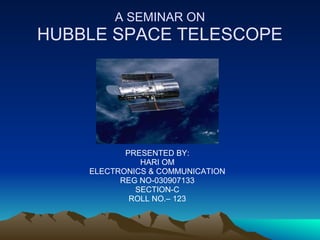
HUBBLE SPACE TELESCOPE


           PRESENTED BY:
              HARI OM
    ELECTRONICS & COMMUNICATION
          REG NO-030907133
             SECTION-C
            ROLL NO.– 123
CONTENTS
•   Overview
•   Spacecraft System
•   Operation
•   Parts
•   Outer structure
•   Pointing control system
•   Optical assembly
•   Scientific instruments
•   Colours & filters
•   Application fields
•   Features
•   Limitations
•   Conclusion
•   References
OVERVIEW

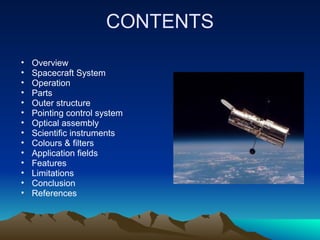
• Hubble—a space telescope
• 600km above earth
• Excellent pointing precision,powerful
  optics,state of the art instruments
• Designed -1970s & launched-1990
• Moduler design
• Goal—knowledge of our cosmic roots
SPACECRAFT SYSTEM

• POWER
• COMMUNICATIONS
• STEERING-To remain fixed on an object HST has three
  onboard systems:
• Gyroscopes-Sense small to large motions
• Reaction Wheels-Move the telescope
• FGS-Sense fine motion
• COMPUTING
• STRUCTURE
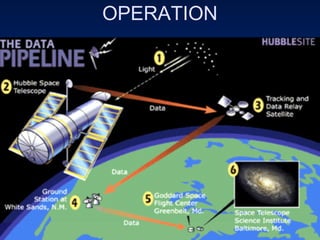
OPERATION
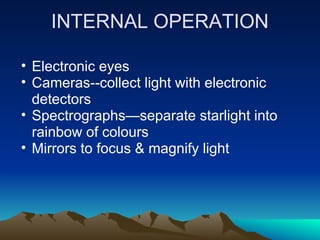
INTERNAL OPERATION

• Electronic eyes
• Cameras--collect light with electronic
  detectors
• Spectrographs—separate starlight into
  rainbow of colours
• Mirrors to focus & magnify light
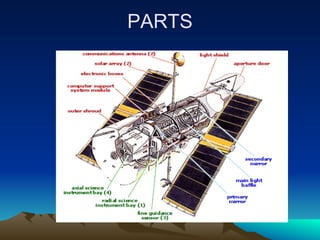
PARTS
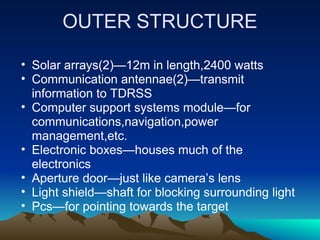
OUTER STRUCTURE

• Solar arrays(2)—12m in length,2400 watts
• Communication antennae(2)—transmit
  information to TDRSS
• Computer support systems module—for
  communications,navigation,power
  management,etc.
• Electronic boxes—houses much of the
  electronics
• Aperture door—just like camera’s lens
• Light shield—shaft for blocking surrounding light
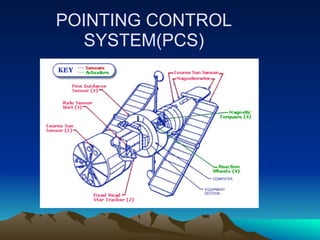
• Pcs—for pointing towards the target
POINTING CONTROL
  SYSTEM(PCS)
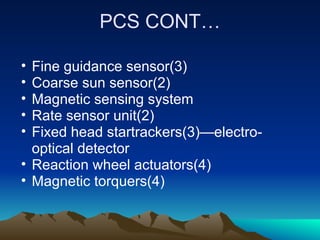
PCS CONT…

• Fine guidance sensor(3)
• Coarse sun sensor(2)
• Magnetic sensing system
• Rate sensor unit(2)
• Fixed head startrackers(3)—electro-
  optical detector
• Reaction wheel actuators(4)
• Magnetic torquers(4)
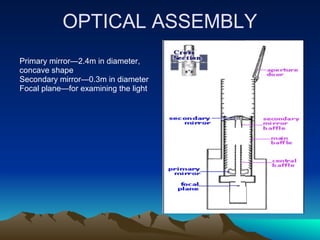
OPTICAL ASSEMBLY
Primary mirror—2.4m in diameter,
concave shape
Secondary mirror—0.3m in diameter
Focal plane—for examining the light
SCIENTIFIC INSTRUMENTS

• AXIAL BAYS(4)-Four instruments aligned with the main
    opticalaxis & are mounted just behind the primary mirror.
•   1>ACS--wide field of view,better light sensitivity
•   2>NICMOS—infrared instrument
•   3>STIS—separates light into component wavelengths
•   4>COSTER—for correction of spherical aberration
• WFPC2(Wide Field/Planetary Camera 2)-It is
    responsible for taking nearly all of HUBBLE’s famous pictures
• FINE GUIDANCE SENSORS(3)-It measures relative
    positions,providing data to the spacecraft’s targeting system
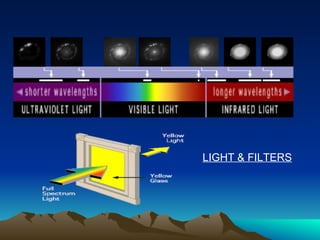
LIGHT & FILTERS
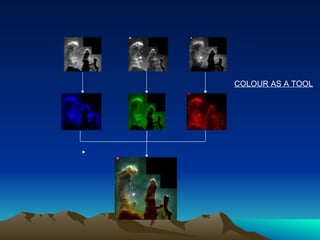
COLOUR AS A TOOL
FEATURES

• 3 observations/hour
• Each observation requires 100 computer
  functions
• 2 observations at a time
• 100,000 instructions/week
• Generates 10 billion bits of scientific data/week
• Can move 90 degrees/15 minutes
• 17,000mph around the earth
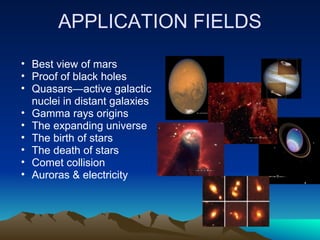
APPLICATION FIELDS
• Best view of mars
• Proof of black holes
• Quasars—active galactic
  nuclei in distant galaxies
• Gamma rays origins
• The expanding universe
• The birth of stars
• The death of stars
• Comet collision
• Auroras & electricity
LIMITATION

• Can’t observe the sun—intense light &
  heat
• Can’t observe mercury or venus
• Can’t observe some stars—too bright
• Orbit of HST—target obstructed by earth
• Van allen radiation belt—charged particles
  from solar winds trapped by earth’s
  magnetic field
CONCLUSION
 Despite its flawed early history, the HST has performed
 well, yielding much scientific data and beautiful images.
     However, the HST will not last forever. Plans are
  underway for a new space telescope, called the Next
 Generation Space Telescope (NGST). NGST will be
even more sensitive than HST and provide better images
  of even more distant objects.The age of optical space
   telescopes started by HST promises to revolutionize
astronomy as much or more than Galileo's first use of the
                 telescope did long ago.
REFERENCES

•   http://hubble.nasa.gov
•   http://hubblesite.org
•   http://heritage.stsci.edu/2000/01
•   http://science.howstuffwoks.com
?

Hubble Telescope

  • 1.
    A SEMINAR ON HUBBLESPACE TELESCOPE PRESENTED BY: HARI OM ELECTRONICS & COMMUNICATION REG NO-030907133 SECTION-C ROLL NO.– 123
  • 2.
    CONTENTS • Overview • Spacecraft System • Operation • Parts • Outer structure • Pointing control system • Optical assembly • Scientific instruments • Colours & filters • Application fields • Features • Limitations • Conclusion • References
  • 3.
    OVERVIEW • Hubble—a spacetelescope • 600km above earth • Excellent pointing precision,powerful optics,state of the art instruments • Designed -1970s & launched-1990 • Moduler design • Goal—knowledge of our cosmic roots
  • 4.
    SPACECRAFT SYSTEM • POWER •COMMUNICATIONS • STEERING-To remain fixed on an object HST has three onboard systems: • Gyroscopes-Sense small to large motions • Reaction Wheels-Move the telescope • FGS-Sense fine motion • COMPUTING • STRUCTURE
  • 5.
  • 6.
    INTERNAL OPERATION • Electroniceyes • Cameras--collect light with electronic detectors • Spectrographs—separate starlight into rainbow of colours • Mirrors to focus & magnify light
  • 7.
  • 8.
    OUTER STRUCTURE • Solararrays(2)—12m in length,2400 watts • Communication antennae(2)—transmit information to TDRSS • Computer support systems module—for communications,navigation,power management,etc. • Electronic boxes—houses much of the electronics • Aperture door—just like camera’s lens • Light shield—shaft for blocking surrounding light • Pcs—for pointing towards the target
  • 9.
    POINTING CONTROL SYSTEM(PCS)
  • 10.
    PCS CONT… • Fineguidance sensor(3) • Coarse sun sensor(2) • Magnetic sensing system • Rate sensor unit(2) • Fixed head startrackers(3)—electro- optical detector • Reaction wheel actuators(4) • Magnetic torquers(4)
  • 11.
    OPTICAL ASSEMBLY Primary mirror—2.4min diameter, concave shape Secondary mirror—0.3m in diameter Focal plane—for examining the light
  • 12.
    SCIENTIFIC INSTRUMENTS • AXIALBAYS(4)-Four instruments aligned with the main opticalaxis & are mounted just behind the primary mirror. • 1>ACS--wide field of view,better light sensitivity • 2>NICMOS—infrared instrument • 3>STIS—separates light into component wavelengths • 4>COSTER—for correction of spherical aberration • WFPC2(Wide Field/Planetary Camera 2)-It is responsible for taking nearly all of HUBBLE’s famous pictures • FINE GUIDANCE SENSORS(3)-It measures relative positions,providing data to the spacecraft’s targeting system
  • 13.
  • 14.
  • 15.
    FEATURES • 3 observations/hour •Each observation requires 100 computer functions • 2 observations at a time • 100,000 instructions/week • Generates 10 billion bits of scientific data/week • Can move 90 degrees/15 minutes • 17,000mph around the earth
  • 16.
    APPLICATION FIELDS • Bestview of mars • Proof of black holes • Quasars—active galactic nuclei in distant galaxies • Gamma rays origins • The expanding universe • The birth of stars • The death of stars • Comet collision • Auroras & electricity
  • 22.
    LIMITATION • Can’t observethe sun—intense light & heat • Can’t observe mercury or venus • Can’t observe some stars—too bright • Orbit of HST—target obstructed by earth • Van allen radiation belt—charged particles from solar winds trapped by earth’s magnetic field
  • 23.
    CONCLUSION Despite itsflawed early history, the HST has performed well, yielding much scientific data and beautiful images. However, the HST will not last forever. Plans are underway for a new space telescope, called the Next Generation Space Telescope (NGST). NGST will be even more sensitive than HST and provide better images of even more distant objects.The age of optical space telescopes started by HST promises to revolutionize astronomy as much or more than Galileo's first use of the telescope did long ago.
  • 24.
    REFERENCES • http://hubble.nasa.gov • http://hubblesite.org • http://heritage.stsci.edu/2000/01 • http://science.howstuffwoks.com
  • 25.