SEMINAR ON 
E-PAPER 
TECHNOLOGY
 Introduction 
 What is E-paper ? 
 Construction of E-paper 
 Working 
 Properties 
 Comparision of E-paper & LCD 
 Advantages 
 Dis-advantages 
 Apllication 
 Future Scope 
 Conclusion
The first E-Paper is developed in 1974’s by 
Nicholas K Sheridon at Xerox’s Palo Alto 
Research Centre. 
E-Paper is also called Electronic Paper or 
Electronic ink Display. 
It is a display unit. 
E-Paper is flexible. 
E-paper have a wide viewing angle. 
A digital pen is also used to create handwritten 
document.
 E-Paper is an electronic ink display unit. 
 It reflect light like ordinary paper. 
 It is capable of holding text and images. 
 It is flexible while using plastic materials and 
electronics. 
 It is more comfortable to read than conventional 
display. 
 A wider viewing angle. 
 It can read directly from sunlight without fading 
images.
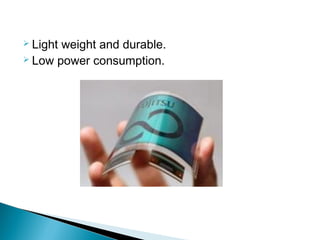
 Light weight and durable. 
 Low power consumption.
 It has two different parts. 
◦ Front plane. 
◦ Back plane. 
 The front plane consist of E-ink. 
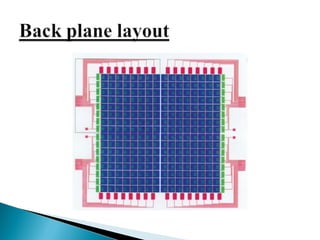
 The back plane consist of electronic circuits. 
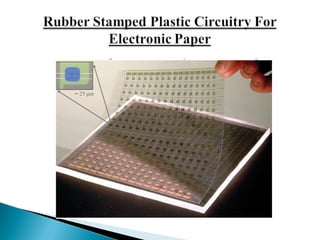
 To form an E-ink electronic display the ink is 
printed onto a plastic film that is laminated to a 
layer of circuitry.
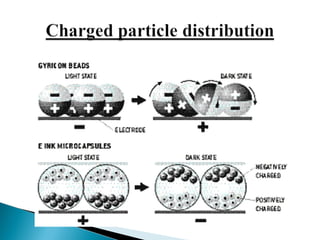
GYRICON 
 The first Gyricon E-ink developed in 1974s by “Nick 
Sheridon” at Xerox. 
 It based on a thin sheet of flexible plastic containing a 
layer of tiny plastic beads each encapsulated in oil and 
it rotate freely. 
 Each hemisphere of a bead has different colour and 
different electric charge. 
 Electric field is applied the beads are rotate, creat two-coloured 
pattern.
 This method have some limitations. 
1. Low brightness and resolution. 
2. Lack of color. 
Other form of E-ink with improve propertys 
compared to Gyricon is Electrophorestic.
Electrophorestic 
 Electrophorestic frontplane consist of millions of 
micro capsules. 
 Each approximately 100 microns in dia. 
 Each micro capsule is filled with a clear fluid 
containing positivaly charged white particle and 
black particle.
 How Electronic Ink Works:- Basically, this form of 
e-paper is created by sandwiching millions of tiny 
plastic wells between two sheets of flexible plastic. 
 Each well contains both white and black particles, 
suspended within a clear fluid. 
 The key to this technology is that the white and 
black particles have opposite charges, so when an 
electric voltage is applied to individual wells -- 
through circuitry embedded underneath -- the 
black and white particles can be separated to 
opposite sides.
 In this way, the face-up side of each well can be 
set to appear either as black or white as seen 
through the top layer of clear plastic. 
 Each well functions as a separate pixel on the E 
ink display.. 
 The disadvantage of this technology is it take 
time for the particle to move from one side to 
another. 
 Drawing a new text or image is too slow and creat 
a flicker.
 Ultra-thin and flexible energy cell. 
 Eliminates the cost of the battery,weight and 
volume of the battery holder. 
 Can be made into almost any shape. 
 Can be integrated on almost any surface.
 Low cost and simple to produce, using printing 
process. 
 Environmentally friendly, non-caustic, no 
possibility of explosion, burns, or overheating.
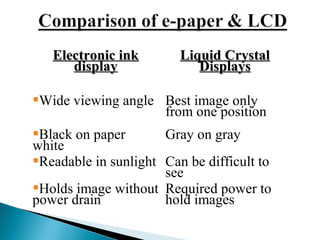
EElleeccttrroonniicc iinnkk 
ddiissppllaayy 
LLiiqquuiidd CCrryyssttaall 
DDiissppllaayyss 
Wide viewing angle Best image only 
from one position 
Black on paper 
white 
Gray on gray 
Readable in sunlight Can be difficult to 
see 
Holds image without 
power drain 
Required power to 
hold images
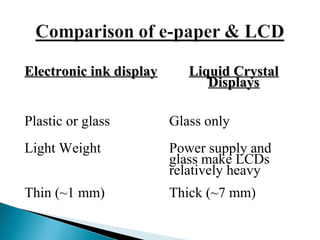
EElleeccttrroonniicc iinnkk ddiissppllaayy LLiiqquuiidd CCrryyssttaall 
DDiissppllaayyss 
Plastic or glass Glass only 
Light Weight Power supply and 
glass make LCDs 
relatively heavy 
Thin (~1 mm) Thick (~7 mm)
 Paper-like Readability. 
 Ultra-Low Power Consumption. 
 Clarity. 
 Reduced Eyestrain. 
 Mobile Display Solution. 
 Hypertext. 
 Multimedia Information. 
 Include Graphics. 
 Inexpensive.
 Very low switching speed 
 Electrochemical complexity 
 Slow response to change 
 Too slow for video 
 Problems in extremes temperatures,humidity
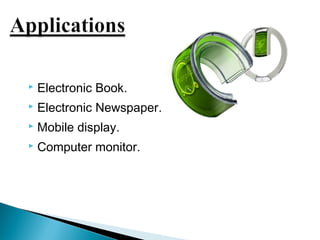
 Electronic Book. 
 Electronic Newspaper. 
 Mobile display. 
 Computer monitor.
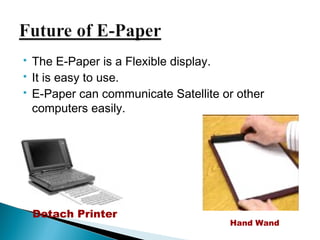
 The E-Paper is a Flexible display. 
 It is easy to use. 
 E-Paper can communicate Satellite or other 
computers easily. 
Hand Wand 
Detach Printer
Researches found that in 
just few years this technology 
can replace paper in many situations, leading 
us to think of a truly paperless world.
E-PAPER TECHNOLOGY

E-PAPER TECHNOLOGY

  • 1.
    SEMINAR ON E-PAPER TECHNOLOGY
  • 2.
     Introduction What is E-paper ?  Construction of E-paper  Working  Properties  Comparision of E-paper & LCD  Advantages  Dis-advantages  Apllication  Future Scope  Conclusion
  • 3.
    The first E-Paperis developed in 1974’s by Nicholas K Sheridon at Xerox’s Palo Alto Research Centre. E-Paper is also called Electronic Paper or Electronic ink Display. It is a display unit. E-Paper is flexible. E-paper have a wide viewing angle. A digital pen is also used to create handwritten document.
  • 4.
     E-Paper isan electronic ink display unit.  It reflect light like ordinary paper.  It is capable of holding text and images.  It is flexible while using plastic materials and electronics.  It is more comfortable to read than conventional display.  A wider viewing angle.  It can read directly from sunlight without fading images.
  • 5.
     Light weightand durable.  Low power consumption.
  • 6.
     It hastwo different parts. ◦ Front plane. ◦ Back plane.  The front plane consist of E-ink.  The back plane consist of electronic circuits.  To form an E-ink electronic display the ink is printed onto a plastic film that is laminated to a layer of circuitry.
  • 9.
    GYRICON  Thefirst Gyricon E-ink developed in 1974s by “Nick Sheridon” at Xerox.  It based on a thin sheet of flexible plastic containing a layer of tiny plastic beads each encapsulated in oil and it rotate freely.  Each hemisphere of a bead has different colour and different electric charge.  Electric field is applied the beads are rotate, creat two-coloured pattern.
  • 11.
     This methodhave some limitations. 1. Low brightness and resolution. 2. Lack of color. Other form of E-ink with improve propertys compared to Gyricon is Electrophorestic.
  • 12.
    Electrophorestic  Electrophoresticfrontplane consist of millions of micro capsules.  Each approximately 100 microns in dia.  Each micro capsule is filled with a clear fluid containing positivaly charged white particle and black particle.
  • 13.
     How ElectronicInk Works:- Basically, this form of e-paper is created by sandwiching millions of tiny plastic wells between two sheets of flexible plastic.  Each well contains both white and black particles, suspended within a clear fluid.  The key to this technology is that the white and black particles have opposite charges, so when an electric voltage is applied to individual wells -- through circuitry embedded underneath -- the black and white particles can be separated to opposite sides.
  • 14.
     In thisway, the face-up side of each well can be set to appear either as black or white as seen through the top layer of clear plastic.  Each well functions as a separate pixel on the E ink display..  The disadvantage of this technology is it take time for the particle to move from one side to another.  Drawing a new text or image is too slow and creat a flicker.
  • 16.
     Ultra-thin andflexible energy cell.  Eliminates the cost of the battery,weight and volume of the battery holder.  Can be made into almost any shape.  Can be integrated on almost any surface.
  • 17.
     Low costand simple to produce, using printing process.  Environmentally friendly, non-caustic, no possibility of explosion, burns, or overheating.
  • 18.
    EElleeccttrroonniicc iinnkk ddiissppllaayy LLiiqquuiidd CCrryyssttaall DDiissppllaayyss Wide viewing angle Best image only from one position Black on paper white Gray on gray Readable in sunlight Can be difficult to see Holds image without power drain Required power to hold images
  • 19.
    EElleeccttrroonniicc iinnkk ddiissppllaayyLLiiqquuiidd CCrryyssttaall DDiissppllaayyss Plastic or glass Glass only Light Weight Power supply and glass make LCDs relatively heavy Thin (~1 mm) Thick (~7 mm)
  • 20.
     Paper-like Readability.  Ultra-Low Power Consumption.  Clarity.  Reduced Eyestrain.  Mobile Display Solution.  Hypertext.  Multimedia Information.  Include Graphics.  Inexpensive.
  • 21.
     Very lowswitching speed  Electrochemical complexity  Slow response to change  Too slow for video  Problems in extremes temperatures,humidity
  • 22.
     Electronic Book.  Electronic Newspaper.  Mobile display.  Computer monitor.
  • 23.
     The E-Paperis a Flexible display.  It is easy to use.  E-Paper can communicate Satellite or other computers easily. Hand Wand Detach Printer
  • 24.
    Researches found thatin just few years this technology can replace paper in many situations, leading us to think of a truly paperless world.