SUBMITTED BY:-
VIKAS GUPTA (EN)
3rd year
SUBMITTED TO:-
ANJALI GUPTA
 Introduction
 History
 Scheme
 Working
 Application
 Advantages
 Disadvantages
 Future
 Conclusion
 References
Content…..
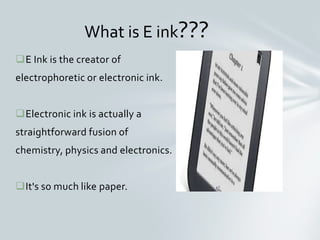
E Ink is the creator of
electrophoretic or electronic ink.
Electronic ink is actually a
straightforward fusion of
chemistry, physics and electronics.
It's so much like paper.
What is E ink???
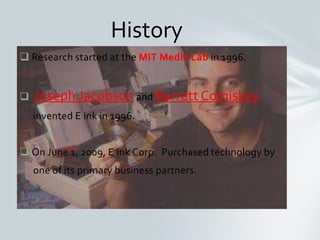
 Research started at the MIT Media Lab in 1996.
 Joseph Jacobson and Barrett Comiskey
invented E ink in 1996.
 On June 1, 2009, E Ink Corp. Purchased technology by
one of its primary business partners.
History
1.E Ink Pearl - July 2010
2.E-ink Mobius- 2010
3.E Ink Triton- November 2010
4.E Ink Carta- January 2013
Typesof E ink
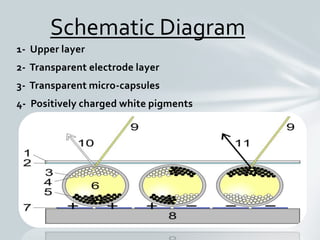
1- Upper layer
2- Transparent electrode layer
3- Transparent micro-capsules
4- Positively charged white pigments
Schematic Diagram
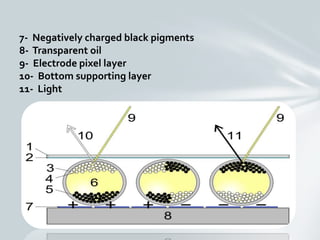
7- Negatively charged black pigments
8- Transparent oil
9- Electrode pixel layer
10- Bottom supporting layer
11- Light
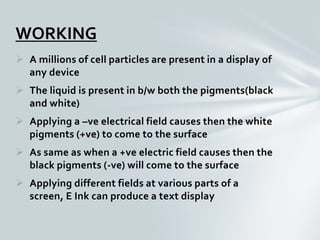
 A millions of cell particles are present in a display of
any device
 The liquid is present in b/w both the pigments(black
and white)
 Applying a –ve electrical field causes then the white
pigments (+ve) to come to the surface
 As same as when a +ve electric field causes then the
black pigments (-ve) will come to the surface
 Applying different fields at various parts of a
screen, E Ink can produce a text display
WORKING
 E Readers
 Indicators
 Watches
 Keypads
 Cell Phones
Applications
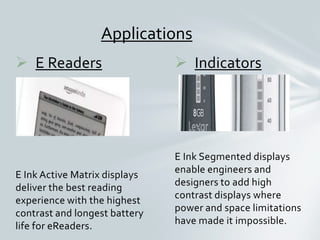
 Indicators
E Ink Segmented displays
enable engineers and
designers to add high
contrast displays where
power and space limitations
have made it impossible.
 E Readers
E Ink Active Matrix displays
deliver the best reading
experience with the highest
contrast and longest battery
life for eReaders.
Applications
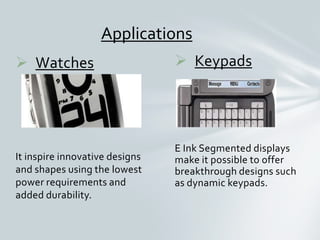
 Keypads
E Ink Segmented displays
make it possible to offer
breakthrough designs such
as dynamic keypads.
 Watches
It inspire innovative designs
and shapes using the lowest
power requirements and
added durability.
Applications
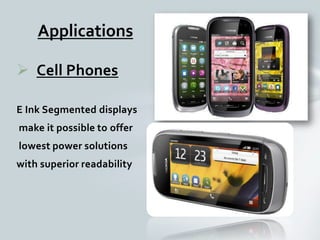
 Cell Phones
E Ink Segmented displays
make it possible to offer
lowest power solutions
with superior readability
Applications
 Bi-stable
Reduces the power consumption
No refreshment
Reflective display
Ambient light from the environment
Better response in sunlight over LCD and LED
display.
Advantages
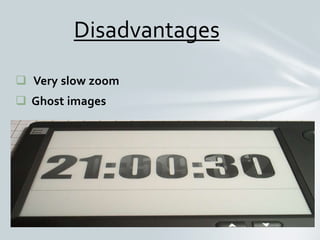
 Very slow zoom
 Ghost images
Disadvantages
At Home
On the Go
Education
Future
 At Home
Whether cooking
with new recipes
or keeping
track of prescriptions,
E Ink technology has
many uses inside the home.
Future
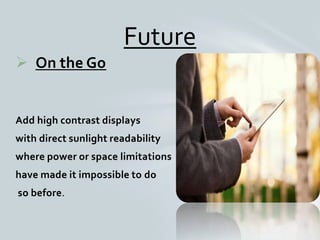
 On the Go
Add high contrast displays
with direct sunlight readability
where power or space limitations
have made it impossible to do
so before.
Future
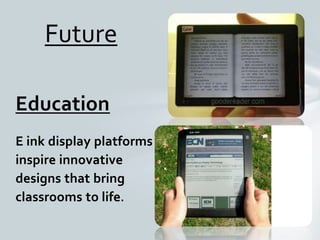
Education
E ink display platforms
inspire innovative
designs that bring
classrooms to life.
Future
It uses electrophoretic technology.
Invented by Joseph Jacobson and Barrett Comiskey
in MIT Media Lab in 1996.
 Objects are displayed on the different moves of
pigments.
 It is being used in mobile
phones, watches, indicators etc.
 E ink having some disadvantages but advantages are
more important and useful.
 Having a broad future.
Conclusion
http://www.eink.com/technology.html
http://en.wikipedia.org/wiki/E_Ink
References
E ink presentation by vikas

E ink presentation by vikas

  • 1.
    SUBMITTED BY:- VIKAS GUPTA(EN) 3rd year SUBMITTED TO:- ANJALI GUPTA
  • 2.
     Introduction  History Scheme  Working  Application  Advantages  Disadvantages  Future  Conclusion  References Content…..
  • 3.
    E Ink isthe creator of electrophoretic or electronic ink. Electronic ink is actually a straightforward fusion of chemistry, physics and electronics. It's so much like paper. What is E ink???
  • 4.
     Research startedat the MIT Media Lab in 1996.  Joseph Jacobson and Barrett Comiskey invented E ink in 1996.  On June 1, 2009, E Ink Corp. Purchased technology by one of its primary business partners. History
  • 5.
    1.E Ink Pearl- July 2010 2.E-ink Mobius- 2010 3.E Ink Triton- November 2010 4.E Ink Carta- January 2013 Typesof E ink
  • 6.
    1- Upper layer 2-Transparent electrode layer 3- Transparent micro-capsules 4- Positively charged white pigments Schematic Diagram
  • 7.
    7- Negatively chargedblack pigments 8- Transparent oil 9- Electrode pixel layer 10- Bottom supporting layer 11- Light
  • 8.
     A millionsof cell particles are present in a display of any device  The liquid is present in b/w both the pigments(black and white)  Applying a –ve electrical field causes then the white pigments (+ve) to come to the surface  As same as when a +ve electric field causes then the black pigments (-ve) will come to the surface  Applying different fields at various parts of a screen, E Ink can produce a text display WORKING
  • 9.
     E Readers Indicators  Watches  Keypads  Cell Phones Applications
  • 10.
     Indicators E InkSegmented displays enable engineers and designers to add high contrast displays where power and space limitations have made it impossible.  E Readers E Ink Active Matrix displays deliver the best reading experience with the highest contrast and longest battery life for eReaders. Applications
  • 11.
     Keypads E InkSegmented displays make it possible to offer breakthrough designs such as dynamic keypads.  Watches It inspire innovative designs and shapes using the lowest power requirements and added durability. Applications
  • 12.
     Cell Phones EInk Segmented displays make it possible to offer lowest power solutions with superior readability Applications
  • 13.
     Bi-stable Reduces thepower consumption No refreshment Reflective display Ambient light from the environment Better response in sunlight over LCD and LED display. Advantages
  • 14.
     Very slowzoom  Ghost images Disadvantages
  • 15.
    At Home On theGo Education Future
  • 16.
     At Home Whethercooking with new recipes or keeping track of prescriptions, E Ink technology has many uses inside the home. Future
  • 17.
     On theGo Add high contrast displays with direct sunlight readability where power or space limitations have made it impossible to do so before. Future
  • 18.
    Education E ink displayplatforms inspire innovative designs that bring classrooms to life. Future
  • 19.
    It uses electrophoretictechnology. Invented by Joseph Jacobson and Barrett Comiskey in MIT Media Lab in 1996.  Objects are displayed on the different moves of pigments.  It is being used in mobile phones, watches, indicators etc.  E ink having some disadvantages but advantages are more important and useful.  Having a broad future. Conclusion
  • 20.