MONITORS
PRESENTED BY –
CHETAN MALVIYA
INTRODUCTION
 A computer monitor is an output
device that displays information in
pictorial form.
 A monitor usually comprises the
display device, circuitry, casing,
and power supply.
 Monitors are very important
because without them you wouldn't
be able to view your output.
HISTORY
 Originally, Monitors were used for data processing while
Television sets were used for entertainment .
 As technology developed engineers realized that the output of a
CRT display was more flexible than a panel of light bulbs and
eventually, by giving control of what was displayed in the
program itself, the monitor itself became a powerful output
device in its own right.
 Computer monitors were formerly known as visual display units
(VDU), but this term had mostly fallen out of use by the 1990s.
TECHNOLOGY
Cathode Ray Tube monitors
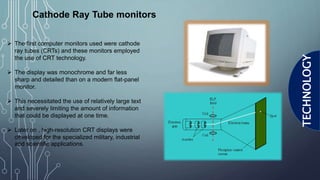
 The first computer monitors used were cathode
ray tubes (CRTs) and these monitors employed
the use of CRT technology.
 The display was monochrome and far less
sharp and detailed than on a modern flat-panel
monitor.
 This necessitated the use of relatively large text
and severely limiting the amount of information
that could be displayed at one time.
 Later on , high-resolution CRT displays were
developed for the specialized military, industrial
and scientific applications.
TECHNOLOGY
Liquid crystal display
 The LCD monitor makes use of one of the
most advanced tech available today by using
CCFL(cold cathode fluorescent) for back
lighting.
 The advantages of LCDs include their
compact size which makes them lightweight.
 The images transmitted by LCDs do not get
geometrically distorted and they do not
consume much electricity and can be run off
of batteries.
 They also have a larger viewing area , with
a typical widescreen monitor having a 16:9
aspect ratio ,compared to 4:3 aspect ratio of
a typical standard width monitor.
TECHNOLOGY
Organic LED (light-emitting diode) monitors
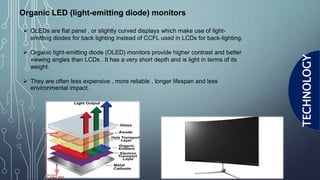
 OLEDs are flat panel , or slightly curved displays which make use of light-
emitting diodes for back lighting instead of CCFL used in LCDs for back-lighting.
 Organic light-emitting diode (OLED) monitors provide higher contrast and better
viewing angles than LCDs . It has a very short depth and is light in terms of its
weight.
 They are often less expensive , more reliable , longer lifespan and less
environmental impact.
ADVANCEMENT
Some other types of Monitors:-
THANK YOU

Monitors.ppt

  • 1.
  • 2.
    INTRODUCTION  A computermonitor is an output device that displays information in pictorial form.  A monitor usually comprises the display device, circuitry, casing, and power supply.  Monitors are very important because without them you wouldn't be able to view your output.
  • 3.
    HISTORY  Originally, Monitorswere used for data processing while Television sets were used for entertainment .  As technology developed engineers realized that the output of a CRT display was more flexible than a panel of light bulbs and eventually, by giving control of what was displayed in the program itself, the monitor itself became a powerful output device in its own right.  Computer monitors were formerly known as visual display units (VDU), but this term had mostly fallen out of use by the 1990s.
  • 4.
    TECHNOLOGY Cathode Ray Tubemonitors  The first computer monitors used were cathode ray tubes (CRTs) and these monitors employed the use of CRT technology.  The display was monochrome and far less sharp and detailed than on a modern flat-panel monitor.  This necessitated the use of relatively large text and severely limiting the amount of information that could be displayed at one time.  Later on , high-resolution CRT displays were developed for the specialized military, industrial and scientific applications.
  • 5.
    TECHNOLOGY Liquid crystal display The LCD monitor makes use of one of the most advanced tech available today by using CCFL(cold cathode fluorescent) for back lighting.  The advantages of LCDs include their compact size which makes them lightweight.  The images transmitted by LCDs do not get geometrically distorted and they do not consume much electricity and can be run off of batteries.  They also have a larger viewing area , with a typical widescreen monitor having a 16:9 aspect ratio ,compared to 4:3 aspect ratio of a typical standard width monitor.
  • 6.
    TECHNOLOGY Organic LED (light-emittingdiode) monitors  OLEDs are flat panel , or slightly curved displays which make use of light- emitting diodes for back lighting instead of CCFL used in LCDs for back-lighting.  Organic light-emitting diode (OLED) monitors provide higher contrast and better viewing angles than LCDs . It has a very short depth and is light in terms of its weight.  They are often less expensive , more reliable , longer lifespan and less environmental impact.
  • 7.
  • 8.