CHEMOTHERAPY IN ORTHOPAEDICS

Dr . SUDHEER KUMAR

1
INTRODUCTION
• Surgical resection remains the mainstay
of treatment in musculoskeletal tumors
• But it is difficult to treat a patient with a
certain high grade tumors by surgery
alone.
• Adjuvant modalities like
CHEMOTHERAPY & RADIOTHERAPY
play an essential part in the integrated
management of these patients

2
WHAT IS CHEMOTHERAPY
Chemotherapy is the treatment of cancer with one or
more cytotoxic anti-neoplastic drugs as part of a standard
regimen
Treatments like radiation and surgery are considered
local treatments as they usually target the cancer directly
Chemotherapy differs from surgery or radiation in that it’s
almost always used as a systemic treatment

chemotherapy drugs are used today either alone or in
combination with other drugs or treatments

3
Goals of chemotherapy
Curative intent:
Though cure may be the goal, it
doesn’t always work out that way
Control:to shrink any cancerous
tumors and/or stop the cancer
from growing and spreading
Palliation: at an advanced stage,
drugs may be used to relieve
symptoms.
to improve the quality of life but
not treat the disease itself
4
TYPES OF CHEMOTHERAPY
•
•
•
•

Neo adjuvant chemo therapy
Adjuvant chemotherapy
Palliative
Intra arterial

5
Neo adjuvant chemo therapy
•
•
•
•
•

•
•
•
•
•
•

Before surgery
Kills micro metastasis
Kills tumor emboli at the time of surgery
Decreases drug resistant clones in micro metastasis
Decreases tumor size
Less chance of viable tumor spread at surgery
DISADVANTAGES
High tumor burden
Loss of limb sparing option
Drug resistant cells may metastasize
Delay in control of bulk disease
Increased chance of systemic dissemination
6
ADJUVANT CHEMOTHERAPY
•
•
•
•

After surgery
Improved survival rates for patients
Decreased bulk and specific agents more active
Decreased drug resistance

DISADVANTAGES
• As delay of systemic therapy-micro metastasis chance to
establish
• No pre op in vivo assay
• Spread of tumor by surgery may have occured

7
PALLIATIVE CHEMOTHERAPY
•
•
•
•
•
•
•
•
•
•
•

When not combined with surgery
Poor general condition
Not willing for surgery
Disease free state for many months
Improves 5yr. Survival rate
Destroys microscopic foci
Prevents metastasis in 60%.
Disease free in 40%
Decreases tumor size
Short cyclical course decrease toxic effects
Combination of drugs increases interval between drugs—
decreases toxicity
8
INTRA ARTERIAL
• Pre-op chemo administered directly into arterial supply of
tumor
• This gives a very high dose of chemotherapy to the
tumour, but less to the rest of the body
• Pre-op angiogram
– Arterial supply
– Tumor extent
– Neo vascularisation
• Catheter preferably in the feeder vessel or proximal to first
tumor vessel

9
MECHANISM OF ACTION
Most chemotherapeutic drugs work by impairing mitosis
(cell division), effectively targeting fast-dividing cells (both
normal cells and cancer cells)
This means normal cells are damaged and this results in
side effects
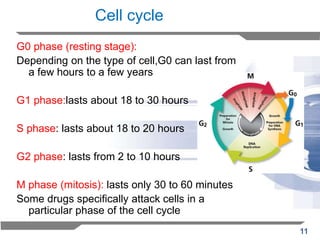
Cell cycle:
a series of steps that both normal cells and cancer cells go
through in order to form new cells
The cell cycle has 5 phases
10
Cell cycle
G0 phase (resting stage):
Depending on the type of cell,G0 can last from
a few hours to a few years
G1 phase:lasts about 18 to 30 hours

S phase: lasts about 18 to 20 hours
G2 phase: lasts from 2 to 10 hours

M phase (mitosis): lasts only 30 to 60 minutes
Some drugs specifically attack cells in a
particular phase of the cell cycle
11
DRUGS
• ALKYLATING AGENTS
– Cyclophosphamide, melphalan, ifosfamide
• ANTIMETABOLITES
– Methotrexate,5fluorouracil
• VINCA ALKALIODS
– vincristine
• ANTIBIOTICS
– Doxorubicin, bleomycin
• MISCELLANEOUS
-cisplatin

12
DRUG TOXICITY
• BONE MARROW
– suppression
• LYMPHORETICULAR TISSUE
- Suppression of immunity
• GIT
• Stomatitis, vomiting
• SKIN
• Alopecia
• GONADS
– Oligospermia, amennorrhoea,mutation

13
DRUG TOXICITY
• FETUS
– Abortion, teratogenesis
• HYPERURICEMIA
– Gout ,ureteric stones
• NEUROPATHY
• CARDIOMYOPATHY
• CYSTITIS

14
ASSESSMENT OF TUMOR RESPONSE
• Clinical
• Radiographic
• Histological

15
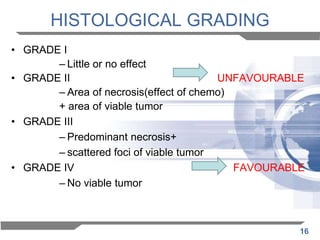
HISTOLOGICAL GRADING
• GRADE I
– Little or no effect
• GRADE II
UNFAVOURABLE
– Area of necrosis(effect of chemo)
+ area of viable tumor
• GRADE III
– Predominant necrosis+
– scattered foci of viable tumor
• GRADE IV
FAVOURABLE
– No viable tumor

16
TAILORING OF THERAPY
• Pre surgical chemo
Responsive

Unresponsive

continue same regime

change chemo

17
CHEMO SENSITIVITY OF BONE SARCOMAS
• Highly sensitive
» Ewing's sarcoma
• Moderately sensitive
» myeloma
• Relatively resistant
» osteosarcoma

18
OSTEOGENIC SARCOMA
General treatment recommendations for patients with
osteosarcoma
low-grade osteogenic sarcoma
Primary treatment includes wide excision only
Chemotherapy is not typically recommended
high-grade osteogenic sarcomas
Chemotherapy is warranted for all stages
For non-metastatic osteosarcoma,
2-3 cycles of chemotherapy are typically given preoperatively;
3-4 cycles of chemotherapy are given postoperatively
19
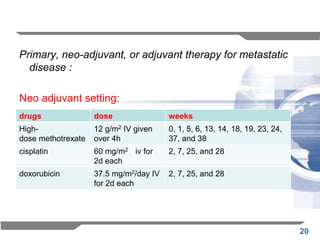
Primary, neo-adjuvant, or adjuvant therapy for metastatic
disease :
Neo adjuvant setting:
drugs

dose

weeks

Highdose methotrexate

12 g/m2 IV given
over 4h

0, 1, 5, 6, 13, 14, 18, 19, 23, 24,
37, and 38

cisplatin

60 mg/m2 iv for
2d each

2, 7, 25, and 28

doxorubicin

37.5 mg/m2/day IV
for 2d each

2, 7, 25, and 28

20
Adjuvant setting
drugs

dose

weeks

High-dose
methotrexate

12 g/m2 IV given
over 4h

3, 4, 8, 9, 13, 14, 18, 19, 23,
24, 37, and 38

cisplatin

60 mg/m2 IV for 2d
each

5, 10, 25, and 28

doxorubicin

37.5 mg/m2/day IV
for 2d each

5, 10, 25, and 28

2 cycles are given preoperatively, and 4 cycles are usually
given postoperatively
For patients with particularly poor pathologic response to
chemotherapy, ifosfamide and etoposide has been added to
the postoperative chemotherapy regimen
Requires administration of 15 mg leucovorin every 6h for 10
doses, starting 24h after initiation of high-dose methotrexate

21
Second-line therapy for relapsed or refractory disease
• Docetaxel and gemcitabine: Docetaxel 100 mg/m2 on
day 1 of every 21-d cycle plus gemcitabine 675
mg/m2 on days 1 and 8
• For localized, unresectable osteosarcoma, radiation
therapy can occasionally provide long-term, local control
•
For localized, resectable osteosarcoma, radiation
therapy is used as adjuvant therapy only when there is
microscopic or gross residual disease

22
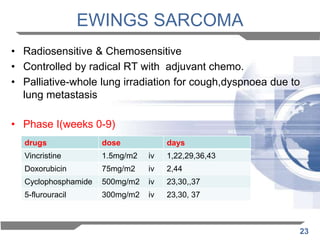
EWINGS SARCOMA
• Radiosensitive & Chemosensitive
• Controlled by radical RT with adjuvant chemo.
• Palliative-whole lung irradiation for cough,dyspnoea due to
lung metastasis

• Phase I(weeks 0-9)
drugs

dose

days

Vincristine

1.5mg/m2

iv

1,22,29,36,43

Doxorubicin

75mg/m2

iv

2,44

Cyclophosphamide

500mg/m2

iv

23,30,,37

5-flurouracil

300mg/m2

iv

23,30, 37

23
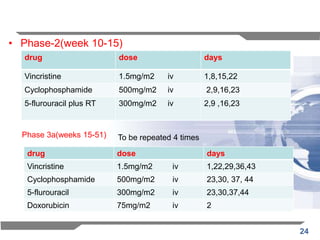
• Phase-2(week 10-15)
drug

dose

Vincristine

1.5mg/m2

iv

1,8,15,22

Cyclophosphamide

500mg/m2

iv

2,9,16,23

5-flurouracil plus RT

300mg/m2

iv

2,9 ,16,23

Phase 3a(weeks 15-51)

days

To be repeated 4 times

drug

dose

days

Vincristine

1.5mg/m2

iv

1,22,29,36,43

Cyclophosphamide

500mg/m2

iv

23,30, 37, 44

5-flurouracil

300mg/m2

iv

23,30,37,44

Doxorubicin

75mg/m2

iv

2
24
• Phase-3b(weeks 52-103)
• To be repeated 6 times
drug

dose

days

Vincristine

1.5mg/m2

iv

1,22, 29, 36, 43

Cyclophosphamide 500mg/m2

iv

23,30,37,44

5-flurouracil

300mg/m2

iv

23,30,37,44

Dactinomycin

2mg/m2

iv

2

25
MYELOMA
• Aim of RX.
– Alleviating symptoms
– Controlling advance of disease
– Preventing complications
– Palliative-relief from bony deposits,patho. #s &
spinal cord compression
• Solitary lesion
– Aggressive RT
• Disseminated lesion
•
-Rx. For symptomatic lesion
• 40-50Gy in 4-5Wk
26
• Chemo. Improves symptoms
• Rib deposits
• 7Gy single fraction at ortho voltage
• Lower dorsal cervical spine & path. #s
• 20Gy in 5 daily fractions over a week
– Spinal cord compression
• 20-25 Gy at depth of cord 5 daily fractions over a
week

27
General treatment recommendations for multiple
myeloma
• The first decision made in the management of patients with
myeloma who require systemic therapy is whether stem cell
transplantation is part of the strategy
• In general, alkylator and nitrosourea therapy is deferred or
reduced in patients who may require autologous stem cell
collection to avoid injury to the stem cells
• A single autologous stem cell transplant has been
associated with superior event-free survival compared with
chemotherapy and is considered the preferred approach

28
Primary therapy (transplant candidates)
• Patients who present with active (symptomatic) multiple
myeloma are treated with induction therapy
28d cycle for 3-4 cycles
drugs

dose

days

Bortezomib

1.3 mg/m2

cyclophosphamide

300 mg/m2/day PO

1, 8, 15

dexamethasone

40 mg PO daily

1-4, 9-12, and 17-20

IVP

1, 4, 8

• Alternative regimen: VAD REGIME
Pegylated liposomal doxorubicin 40 mg/m2plus vincristine 1.4
mg/m2 (maximum, 2.0 mg) as an IV infusion on day
1 plus reduced-dose dexamethasone 40 mg PO on days 1-4
29
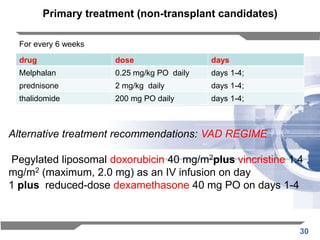
Primary treatment (non-transplant candidates)
For every 6 weeks
drug

dose

days

Melphalan

0.25 mg/kg PO daily

days 1-4;

prednisone

2 mg/kg daily

days 1-4;

thalidomide

200 mg PO daily

days 1-4;

Alternative treatment recommendations: VAD REGIME
Pegylated liposomal doxorubicin 40 mg/m2plus vincristine 1.4
mg/m2 (maximum, 2.0 mg) as an IV infusion on day
1 plus reduced-dose dexamethasone 40 mg PO on days 1-4

30
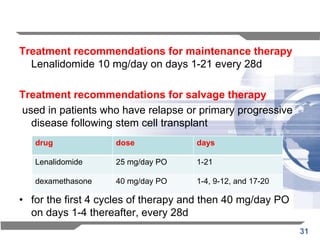
Treatment recommendations for maintenance therapy
Lenalidomide 10 mg/day on days 1-21 every 28d
Treatment recommendations for salvage therapy
used in patients who have relapse or primary progressive
disease following stem cell transplant
drug

dose

days

Lenalidomide

25 mg/day PO

1-21

dexamethasone

40 mg/day PO

1-4, 9-12, and 17-20

• for the first 4 cycles of therapy and then 40 mg/day PO
on days 1-4 thereafter, every 28d
31
METASTATIC BONE TUMOR
•
•
•
•

MOST COMMON FORM
SKELETON ONE OF THE COMMONEST SITE
AXIAL SKELETON-MORE PRONE
APPENDICULAR SKELETON-RELATIVELY IMMUNE
(proximal femur metaphysis, proximal humerus)

• Essentially palliative
• Aim
– Relieve symptoms-pain
– Improve quality of life
• Symptomatic relief is satisfactory from RT and chemo
32
• Systemic chemotherapy useful in high grade lesions of
•
•
•
•

CHONDROSARCOMA
FIBROSARCOMA
LIPOSARCOMA
Malignant fibrous histiocytoma

33
34

Chemotherapy in orthopaedics

  • 1.
  • 2.
    INTRODUCTION • Surgical resectionremains the mainstay of treatment in musculoskeletal tumors • But it is difficult to treat a patient with a certain high grade tumors by surgery alone. • Adjuvant modalities like CHEMOTHERAPY & RADIOTHERAPY play an essential part in the integrated management of these patients 2
  • 3.
    WHAT IS CHEMOTHERAPY Chemotherapyis the treatment of cancer with one or more cytotoxic anti-neoplastic drugs as part of a standard regimen Treatments like radiation and surgery are considered local treatments as they usually target the cancer directly Chemotherapy differs from surgery or radiation in that it’s almost always used as a systemic treatment chemotherapy drugs are used today either alone or in combination with other drugs or treatments 3
  • 4.
    Goals of chemotherapy Curativeintent: Though cure may be the goal, it doesn’t always work out that way Control:to shrink any cancerous tumors and/or stop the cancer from growing and spreading Palliation: at an advanced stage, drugs may be used to relieve symptoms. to improve the quality of life but not treat the disease itself 4
  • 5.
    TYPES OF CHEMOTHERAPY • • • • Neoadjuvant chemo therapy Adjuvant chemotherapy Palliative Intra arterial 5
  • 6.
    Neo adjuvant chemotherapy • • • • • • • • • • • Before surgery Kills micro metastasis Kills tumor emboli at the time of surgery Decreases drug resistant clones in micro metastasis Decreases tumor size Less chance of viable tumor spread at surgery DISADVANTAGES High tumor burden Loss of limb sparing option Drug resistant cells may metastasize Delay in control of bulk disease Increased chance of systemic dissemination 6
  • 7.
    ADJUVANT CHEMOTHERAPY • • • • After surgery Improvedsurvival rates for patients Decreased bulk and specific agents more active Decreased drug resistance DISADVANTAGES • As delay of systemic therapy-micro metastasis chance to establish • No pre op in vivo assay • Spread of tumor by surgery may have occured 7
  • 8.
    PALLIATIVE CHEMOTHERAPY • • • • • • • • • • • When notcombined with surgery Poor general condition Not willing for surgery Disease free state for many months Improves 5yr. Survival rate Destroys microscopic foci Prevents metastasis in 60%. Disease free in 40% Decreases tumor size Short cyclical course decrease toxic effects Combination of drugs increases interval between drugs— decreases toxicity 8
  • 9.
    INTRA ARTERIAL • Pre-opchemo administered directly into arterial supply of tumor • This gives a very high dose of chemotherapy to the tumour, but less to the rest of the body • Pre-op angiogram – Arterial supply – Tumor extent – Neo vascularisation • Catheter preferably in the feeder vessel or proximal to first tumor vessel 9
  • 10.
    MECHANISM OF ACTION Mostchemotherapeutic drugs work by impairing mitosis (cell division), effectively targeting fast-dividing cells (both normal cells and cancer cells) This means normal cells are damaged and this results in side effects Cell cycle: a series of steps that both normal cells and cancer cells go through in order to form new cells The cell cycle has 5 phases 10
  • 11.
    Cell cycle G0 phase(resting stage): Depending on the type of cell,G0 can last from a few hours to a few years G1 phase:lasts about 18 to 30 hours S phase: lasts about 18 to 20 hours G2 phase: lasts from 2 to 10 hours M phase (mitosis): lasts only 30 to 60 minutes Some drugs specifically attack cells in a particular phase of the cell cycle 11
  • 12.
    DRUGS • ALKYLATING AGENTS –Cyclophosphamide, melphalan, ifosfamide • ANTIMETABOLITES – Methotrexate,5fluorouracil • VINCA ALKALIODS – vincristine • ANTIBIOTICS – Doxorubicin, bleomycin • MISCELLANEOUS -cisplatin 12
  • 13.
    DRUG TOXICITY • BONEMARROW – suppression • LYMPHORETICULAR TISSUE - Suppression of immunity • GIT • Stomatitis, vomiting • SKIN • Alopecia • GONADS – Oligospermia, amennorrhoea,mutation 13
  • 14.
    DRUG TOXICITY • FETUS –Abortion, teratogenesis • HYPERURICEMIA – Gout ,ureteric stones • NEUROPATHY • CARDIOMYOPATHY • CYSTITIS 14
  • 15.
    ASSESSMENT OF TUMORRESPONSE • Clinical • Radiographic • Histological 15
  • 16.
    HISTOLOGICAL GRADING • GRADEI – Little or no effect • GRADE II UNFAVOURABLE – Area of necrosis(effect of chemo) + area of viable tumor • GRADE III – Predominant necrosis+ – scattered foci of viable tumor • GRADE IV FAVOURABLE – No viable tumor 16
  • 17.
    TAILORING OF THERAPY •Pre surgical chemo Responsive Unresponsive continue same regime change chemo 17
  • 18.
    CHEMO SENSITIVITY OFBONE SARCOMAS • Highly sensitive » Ewing's sarcoma • Moderately sensitive » myeloma • Relatively resistant » osteosarcoma 18
  • 19.
    OSTEOGENIC SARCOMA General treatmentrecommendations for patients with osteosarcoma low-grade osteogenic sarcoma Primary treatment includes wide excision only Chemotherapy is not typically recommended high-grade osteogenic sarcomas Chemotherapy is warranted for all stages For non-metastatic osteosarcoma, 2-3 cycles of chemotherapy are typically given preoperatively; 3-4 cycles of chemotherapy are given postoperatively 19
  • 20.
    Primary, neo-adjuvant, oradjuvant therapy for metastatic disease : Neo adjuvant setting: drugs dose weeks Highdose methotrexate 12 g/m2 IV given over 4h 0, 1, 5, 6, 13, 14, 18, 19, 23, 24, 37, and 38 cisplatin 60 mg/m2 iv for 2d each 2, 7, 25, and 28 doxorubicin 37.5 mg/m2/day IV for 2d each 2, 7, 25, and 28 20
  • 21.
    Adjuvant setting drugs dose weeks High-dose methotrexate 12 g/m2IV given over 4h 3, 4, 8, 9, 13, 14, 18, 19, 23, 24, 37, and 38 cisplatin 60 mg/m2 IV for 2d each 5, 10, 25, and 28 doxorubicin 37.5 mg/m2/day IV for 2d each 5, 10, 25, and 28 2 cycles are given preoperatively, and 4 cycles are usually given postoperatively For patients with particularly poor pathologic response to chemotherapy, ifosfamide and etoposide has been added to the postoperative chemotherapy regimen Requires administration of 15 mg leucovorin every 6h for 10 doses, starting 24h after initiation of high-dose methotrexate 21
  • 22.
    Second-line therapy forrelapsed or refractory disease • Docetaxel and gemcitabine: Docetaxel 100 mg/m2 on day 1 of every 21-d cycle plus gemcitabine 675 mg/m2 on days 1 and 8 • For localized, unresectable osteosarcoma, radiation therapy can occasionally provide long-term, local control • For localized, resectable osteosarcoma, radiation therapy is used as adjuvant therapy only when there is microscopic or gross residual disease 22
  • 23.
    EWINGS SARCOMA • Radiosensitive& Chemosensitive • Controlled by radical RT with adjuvant chemo. • Palliative-whole lung irradiation for cough,dyspnoea due to lung metastasis • Phase I(weeks 0-9) drugs dose days Vincristine 1.5mg/m2 iv 1,22,29,36,43 Doxorubicin 75mg/m2 iv 2,44 Cyclophosphamide 500mg/m2 iv 23,30,,37 5-flurouracil 300mg/m2 iv 23,30, 37 23
  • 24.
    • Phase-2(week 10-15) drug dose Vincristine 1.5mg/m2 iv 1,8,15,22 Cyclophosphamide 500mg/m2 iv 2,9,16,23 5-flurouracilplus RT 300mg/m2 iv 2,9 ,16,23 Phase 3a(weeks 15-51) days To be repeated 4 times drug dose days Vincristine 1.5mg/m2 iv 1,22,29,36,43 Cyclophosphamide 500mg/m2 iv 23,30, 37, 44 5-flurouracil 300mg/m2 iv 23,30,37,44 Doxorubicin 75mg/m2 iv 2 24
  • 25.
    • Phase-3b(weeks 52-103) •To be repeated 6 times drug dose days Vincristine 1.5mg/m2 iv 1,22, 29, 36, 43 Cyclophosphamide 500mg/m2 iv 23,30,37,44 5-flurouracil 300mg/m2 iv 23,30,37,44 Dactinomycin 2mg/m2 iv 2 25
  • 26.
    MYELOMA • Aim ofRX. – Alleviating symptoms – Controlling advance of disease – Preventing complications – Palliative-relief from bony deposits,patho. #s & spinal cord compression • Solitary lesion – Aggressive RT • Disseminated lesion • -Rx. For symptomatic lesion • 40-50Gy in 4-5Wk 26
  • 27.
    • Chemo. Improvessymptoms • Rib deposits • 7Gy single fraction at ortho voltage • Lower dorsal cervical spine & path. #s • 20Gy in 5 daily fractions over a week – Spinal cord compression • 20-25 Gy at depth of cord 5 daily fractions over a week 27
  • 28.
    General treatment recommendationsfor multiple myeloma • The first decision made in the management of patients with myeloma who require systemic therapy is whether stem cell transplantation is part of the strategy • In general, alkylator and nitrosourea therapy is deferred or reduced in patients who may require autologous stem cell collection to avoid injury to the stem cells • A single autologous stem cell transplant has been associated with superior event-free survival compared with chemotherapy and is considered the preferred approach 28
  • 29.
    Primary therapy (transplantcandidates) • Patients who present with active (symptomatic) multiple myeloma are treated with induction therapy 28d cycle for 3-4 cycles drugs dose days Bortezomib 1.3 mg/m2 cyclophosphamide 300 mg/m2/day PO 1, 8, 15 dexamethasone 40 mg PO daily 1-4, 9-12, and 17-20 IVP 1, 4, 8 • Alternative regimen: VAD REGIME Pegylated liposomal doxorubicin 40 mg/m2plus vincristine 1.4 mg/m2 (maximum, 2.0 mg) as an IV infusion on day 1 plus reduced-dose dexamethasone 40 mg PO on days 1-4 29
  • 30.
    Primary treatment (non-transplantcandidates) For every 6 weeks drug dose days Melphalan 0.25 mg/kg PO daily days 1-4; prednisone 2 mg/kg daily days 1-4; thalidomide 200 mg PO daily days 1-4; Alternative treatment recommendations: VAD REGIME Pegylated liposomal doxorubicin 40 mg/m2plus vincristine 1.4 mg/m2 (maximum, 2.0 mg) as an IV infusion on day 1 plus reduced-dose dexamethasone 40 mg PO on days 1-4 30
  • 31.
    Treatment recommendations formaintenance therapy Lenalidomide 10 mg/day on days 1-21 every 28d Treatment recommendations for salvage therapy used in patients who have relapse or primary progressive disease following stem cell transplant drug dose days Lenalidomide 25 mg/day PO 1-21 dexamethasone 40 mg/day PO 1-4, 9-12, and 17-20 • for the first 4 cycles of therapy and then 40 mg/day PO on days 1-4 thereafter, every 28d 31
  • 32.
    METASTATIC BONE TUMOR • • • • MOSTCOMMON FORM SKELETON ONE OF THE COMMONEST SITE AXIAL SKELETON-MORE PRONE APPENDICULAR SKELETON-RELATIVELY IMMUNE (proximal femur metaphysis, proximal humerus) • Essentially palliative • Aim – Relieve symptoms-pain – Improve quality of life • Symptomatic relief is satisfactory from RT and chemo 32
  • 33.
    • Systemic chemotherapyuseful in high grade lesions of • • • • CHONDROSARCOMA FIBROSARCOMA LIPOSARCOMA Malignant fibrous histiocytoma 33
  • 34.