

The knee is a mechanism of three joints and
Four bones - the femur, tibia, patella and
fibula



Interact in separate joints - the tibiofemoral &
patellofemoral



The function of these joints is to allow certain
movements, restrict others, and to provide
load transfer through the lower limb.
Tibiofemoral joint
rotations
translations
screw home mechanism
 Axial & rotational alignment of knee
 Patello femoral joint
 Joint forces



Rotations
› Flexion/extension-0 to

1350
› varus valgus - 6-8o in
extension
› Int/ext rotation - 25 – 300
in flexion


Translations
› AP 5 - 10mm
› comp/dist 2 - 5mm
› medio-lateral 1-2mm


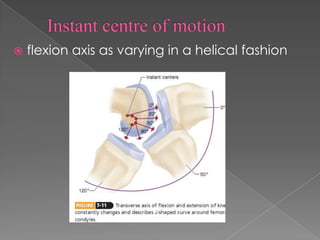
flexion axis varies in a helical fashion in a normal
knee, with an average of 2 mm of posterior
translation of the medial femoral condyle on the tibia
during flexion compared with 21 mm of translation
of the lateral femoral condyle.



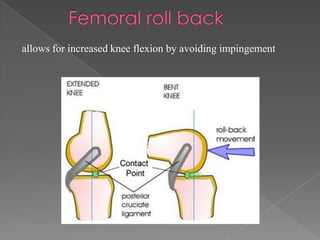
Relevance :posterior rollback
› as the knee flexes, the instant center of rotation on
the femur moves posteriorly


flexion axis as varying in a helical fashion
allows for increased knee flexion by avoiding impingement






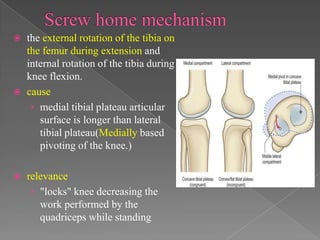
the external rotation of the tibia on
the femur during extension and
internal rotation of the tibia during
knee flexion.
cause
› medial tibial plateau articular
surface is longer than lateral
tibial plateau(Medially based
pivoting of the knee.)
relevance
› "locks" knee decreasing the
work performed by the
quadriceps while standing


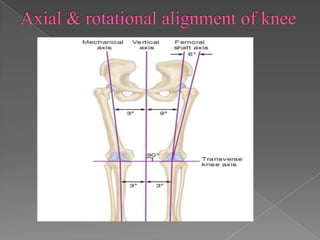
mechanical axis of the lower limb is defined as the
line drawn on a standing long leg antero posterior
radiograph from the center of the femoral head to
the center of the talar dome



anatomical axes of the femur and the tibia form a
valgus angle of 6 2 degrees.



the tibial articular surface is in approximately 3 0of
varus with respect to the mechanical axis, and the
femoral articular surface is in 90 of valgus.
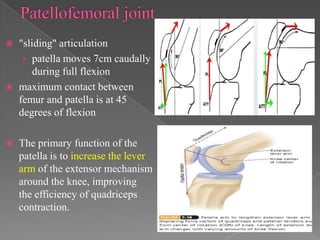
"sliding" articulation
› patella moves 7cm caudally
during full flexion
 maximum contact between
femur and patella is at 45
degrees of flexion




The primary function of the
patella is to increase the lever
arm of the extensor mechanism
around the knee, improving
the efficiency of quadriceps
contraction.


The quadriceps and patellar tendons insert anteriorly
on the patella, with the thickness of the patella
displacing their respective force vectors away from the
center of rotation of the knee .



This displacement or lengthening of the extensor lever
arm changes throughout the arc of knee motion.



the extensor lever arm is greatest at 20 degrees of
flexion, and the quadriceps force required for knee
extension increases significantly in the last 20 degrees
of extension


The length of the lever arm varies as a function
of the geometry of the trochlea, the varying
patellofemoral contact areas, and the varying
center of rotation of the knee.
passive restraints to lateral
subluxation
› medial patellofemoral
ligament
 primary passive restraint to
lateral translation in 20
degrees of flexion
 60% of total restraining force
› medial patellomeniscal
ligament
 13% of total restraining force
› lateral retinaculum
 10% of total restraining force
 dynamic restraint
› quadriceps muscles





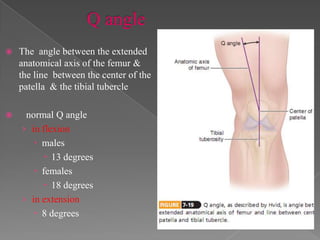
The angle between the extended
anatomical axis of the femur &
the line between the center of the
patella & the tibial tubercle
normal Q angle
› in flexion
 males
 13 degrees
 females
 18 degrees
› in extension
 8 degrees


Limbs with larger Q angles have a greater tendency
for lateral patellar subluxation.



Because the patella does not contact the trochlea in
early flexion, lateral subluxation of the patella in
this range is resisted primarily by the vastus
medialis obliquus fibers.
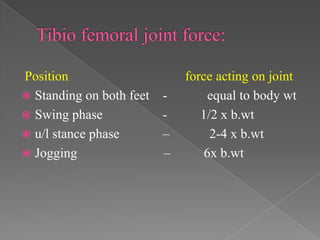
Position
 Standing on both feet  Swing phase
 u/l stance phase
–
 Jogging
–

force acting on joint
equal to body wt
1/2 x b.wt
2-4 x b.wt
6x b.wt


Walking
› 0.3 x body weight



Ascending Stairs
› 2.5 x body weight



Descending Stairs
› 3.5 x body weight



Squatting
› 7 x body weight
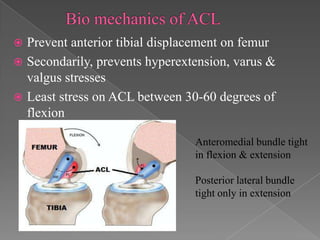
Prevent anterior tibial displacement on femur
 Secondarily, prevents hyperextension, varus &
valgus stresses
 Least stress on ACL between 30-60 degrees of
flexion


Anteromedial bundle tight
in flexion & extension
Posterior lateral bundle
tight only in extension
Primary stabilizer of the knee against posterior
movement of the tibia on the femur
 resists rotation, esp.internal rotation of tibia on
femur


Two bundles
 Anterolateral, taut in flexion
 Posteromedial, taut in extension
knee biomechanics

knee biomechanics

  • 2.
     The knee isa mechanism of three joints and Four bones - the femur, tibia, patella and fibula  Interact in separate joints - the tibiofemoral & patellofemoral  The function of these joints is to allow certain movements, restrict others, and to provide load transfer through the lower limb.
  • 3.
    Tibiofemoral joint rotations translations screw homemechanism  Axial & rotational alignment of knee  Patello femoral joint  Joint forces 
  • 4.
     Rotations › Flexion/extension-0 to 1350 ›varus valgus - 6-8o in extension › Int/ext rotation - 25 – 300 in flexion  Translations › AP 5 - 10mm › comp/dist 2 - 5mm › medio-lateral 1-2mm
  • 6.
     flexion axis variesin a helical fashion in a normal knee, with an average of 2 mm of posterior translation of the medial femoral condyle on the tibia during flexion compared with 21 mm of translation of the lateral femoral condyle.  Relevance :posterior rollback › as the knee flexes, the instant center of rotation on the femur moves posteriorly
  • 7.
     flexion axis asvarying in a helical fashion
  • 8.
    allows for increasedknee flexion by avoiding impingement
  • 9.
       the external rotationof the tibia on the femur during extension and internal rotation of the tibia during knee flexion. cause › medial tibial plateau articular surface is longer than lateral tibial plateau(Medially based pivoting of the knee.) relevance › "locks" knee decreasing the work performed by the quadriceps while standing
  • 10.
     mechanical axis ofthe lower limb is defined as the line drawn on a standing long leg antero posterior radiograph from the center of the femoral head to the center of the talar dome  anatomical axes of the femur and the tibia form a valgus angle of 6 2 degrees.  the tibial articular surface is in approximately 3 0of varus with respect to the mechanical axis, and the femoral articular surface is in 90 of valgus.
  • 12.
    "sliding" articulation › patellamoves 7cm caudally during full flexion  maximum contact between femur and patella is at 45 degrees of flexion   The primary function of the patella is to increase the lever arm of the extensor mechanism around the knee, improving the efficiency of quadriceps contraction.
  • 13.
     The quadriceps andpatellar tendons insert anteriorly on the patella, with the thickness of the patella displacing their respective force vectors away from the center of rotation of the knee .  This displacement or lengthening of the extensor lever arm changes throughout the arc of knee motion.  the extensor lever arm is greatest at 20 degrees of flexion, and the quadriceps force required for knee extension increases significantly in the last 20 degrees of extension
  • 14.
     The length ofthe lever arm varies as a function of the geometry of the trochlea, the varying patellofemoral contact areas, and the varying center of rotation of the knee.
  • 15.
    passive restraints tolateral subluxation › medial patellofemoral ligament  primary passive restraint to lateral translation in 20 degrees of flexion  60% of total restraining force › medial patellomeniscal ligament  13% of total restraining force › lateral retinaculum  10% of total restraining force  dynamic restraint › quadriceps muscles 
  • 16.
      The angle betweenthe extended anatomical axis of the femur & the line between the center of the patella & the tibial tubercle normal Q angle › in flexion  males  13 degrees  females  18 degrees › in extension  8 degrees
  • 17.
     Limbs with largerQ angles have a greater tendency for lateral patellar subluxation.  Because the patella does not contact the trochlea in early flexion, lateral subluxation of the patella in this range is resisted primarily by the vastus medialis obliquus fibers.
  • 18.
    Position  Standing onboth feet  Swing phase  u/l stance phase –  Jogging – force acting on joint equal to body wt 1/2 x b.wt 2-4 x b.wt 6x b.wt
  • 19.
     Walking › 0.3 xbody weight  Ascending Stairs › 2.5 x body weight  Descending Stairs › 3.5 x body weight  Squatting › 7 x body weight
  • 20.
    Prevent anterior tibialdisplacement on femur  Secondarily, prevents hyperextension, varus & valgus stresses  Least stress on ACL between 30-60 degrees of flexion  Anteromedial bundle tight in flexion & extension Posterior lateral bundle tight only in extension
  • 21.
    Primary stabilizer ofthe knee against posterior movement of the tibia on the femur  resists rotation, esp.internal rotation of tibia on femur  Two bundles  Anterolateral, taut in flexion  Posteromedial, taut in extension