Assessment of Balance
Seminar by:
Odeyoyin Yusuph Abiodun
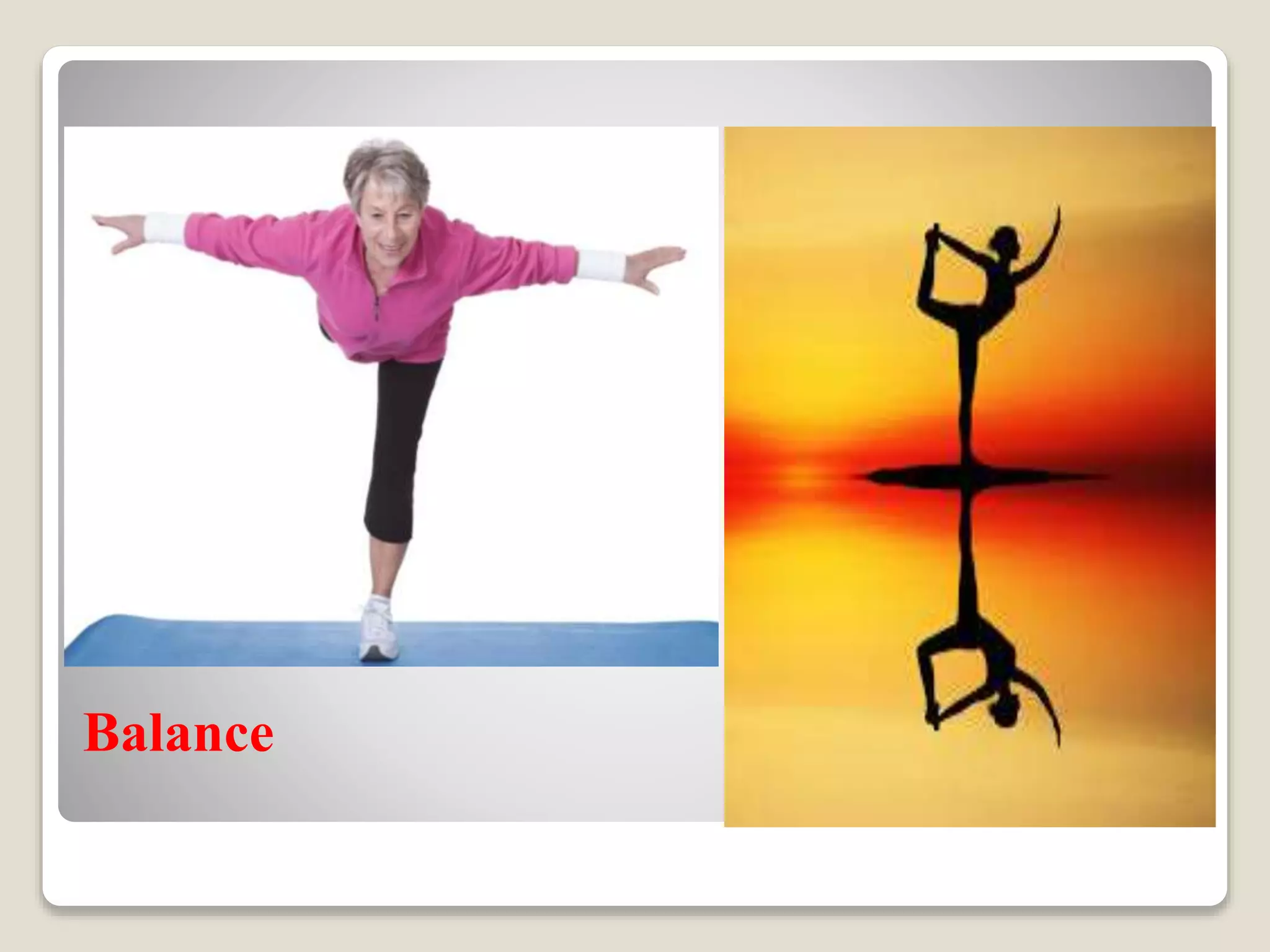
Balance
Center of Gravity
www.travelingyogaman.com
mobilitymgmt.com
www.slideshare.net
Base of Support
5koshasyoga.com
freshietosuperstar.wordpress.co
m
Dynamic Systems Overview
lookfordiagnosis.com
Peripheral Sensory Reception
1. Somatosensory Receptors
◦ Joints, Muscles, Tendons, Ligaments, Connective Tissue, Skin
2. Vision
◦ Focal
◦ Ambient
3. Vestibular
◦ Semicircular canals
◦ Otoliths (utricle,saccule)
www.stlouisear.com www.drwolgin.com
Motor Components of Balance
 Reflexes
◦ Vestibuloocular Reflex (VOR)
◦ Vestibulospinal Reflex (VSR)
 Postural Responses
◦ Automatic- Ankle, Hip, Suspensory, Stepping
◦ Anticipatory
 Volitional Postural Movements
EXAMINATION
1. Safety—The First Concern
2. Examining the Effect of Balance on Participation
3. Examining the Effect of Balance on Functional
Activities:
- Examination of balance from a functional perspective
uses tests and measures that indicate how well a patient can
perform a variety of functional tasks that require postural
control.
- There are a number of tests available to measure
functional skills related to postural control.
- Many of these tests have been used to determine the
risk for falls as well.
ASSESSMENTS OF BALANCE
Self-Report Measures of Balance Confidence
(Screening tools for balance):
1. Activities-specific Balance Confidence (Abc) Scale
2. Falls Efficacy Scale
3. Timed Up and Go Test (TUG)
4. Reach Tests (Functional Reach Test, Multi-
Directional Reach Test.)
ACTIVITIES-SPECIFIC BALANCE CONFIDENCE (ABC)
SCALE
Rate confidence in ability to carry out the following activities (0 = no
confidence, 100 = complete confidence). Total score is average of 16
individual scores.
1. Walk around house
2. Up and down stairs
3. Pick up slipper from floor
4. Reach at eye level
5. Reach up on tiptoes
6. Stand on chair to reach
7. Sweep floor
8. Walk outside to nearby car
9. Get in/out of car
10. Walk across parking lot
11. Walk up and down ramp
12. Walk in crowded mall, 13. Walk in crowd/bumped
14. Ride escalator holding on, 15. Ride escalator not holding rail
16. Walk on icy sidewalk
FALLS EFFICACY SCALE
Rate level of confidence in doing each of the activities without
falling (0 = not at all, 10 = completely confident). Total score is
sum of 10 individual scores (range: 0 [low self-efficacy] to 100
[high self- efficacy]).
1. Cleaning house
2. Getting dressed and undressed
3. Preparing simple meals
4. Taking a bath or shower
5. Simple shopping
6. Getting in and out of car
7. Going up and down stairs
8. Walking around neighborhood
9. Reaching into cabinets and closets
10. Hurrying to answer the phone
The Get Up and Go test
The Get Up and Go test (Mathias et al., 1986) was
developed as a quick screening tool for detecting
balance problems affecting daily mobility skills in
elderly patients. The test requires that subjects stand up
from a chair, walk 3 ms, turn around, and return.
Performance is scored according to the following scale:
1 = normal;
2 = very slightly abnormal;
3 = mildly abnormal;
4 = moderately abnormal; and
5 = severely abnormal.
Testing scores in 10 seconds.
Functional Reach Test. The Functional Reach Test is a
single-item test developed as a quick screen for balance
problems and falls risk in older adults (Duncan et al.,
1990).
Testing procedure:
Subjects stand with feet shoulder distance apart and
with one arm (hand in a fist) raised to 90 degrees of
flexion.
Without moving their feet, subjects reach as far forward
as they can while still maintaining their balance. The
distance reached is measured and compared with that of
age-related norms
Modified version of the Functional Reach test
(modified Functional Reach Test [MFRT]) has been
developed. The test involves measuring unsupported
reaching in the forward and lateral direction in the
seated position.
Multi-Directional Reach Test.
MDRT Was proposed to examine the limits of stability in
not only the forward and backward direction, but also in the
medial and lateral directions.
Positions for the Multi-Directional Reach Test:
A, Position for the forward and backward reach. B, Position
for the right lateral lean (yardstick would be repositioned for
left lateral lean).
Performance-Oriented Mobility Assessment
(POMA)
Mary Tinetti, published a test to measure balance and
mobility skills in older adults and to determine the
likelihood for falls and mobility scale, which rates
performance on a three-point scale. The maximum score
is 28 points.
It evaluates steady-state balance in sitting and standing
(items 1and 5), proactive balance (items 2, 3, 6, and 9),
reactive balance (item 6), and includes a sensory
component (item 7).
A score of less than 19 indicates a high risk for falls.
Scores in the range of 19 to 24 indicate a moderate risk
for falls. The test takes about 10 to 15 minutes to
administer with good interrater reliability (Tinetti &
Ginter, 1988).
Berg Balance Scale
The Berg Balance Scale (BBS) was developed by
Kathy Berg, a Canadian physical therapist. The test
uses 14 different items, which are rated 0 to 4.
Short Physical Performance Battery
SPPB is an increasingly common test used to measure
lower extremity performance in older adults. It includes
a strength, balance, and mobility component.
The SPPB involves timing performance on the
following items:
- five chair stands (no arms),
- 8-ft walk test, and
- three hierarchical balance tests (side-by-side stance,
modified tandem stance, or tandem stance).
Time measurements for each of the three tests
(strength, balance, and gait) are then converted to
ordinal-scale values (0 to 4). Scores from the three
areas are summed, for a total score range from 0
(lowest performance) to 12 (highest performance).
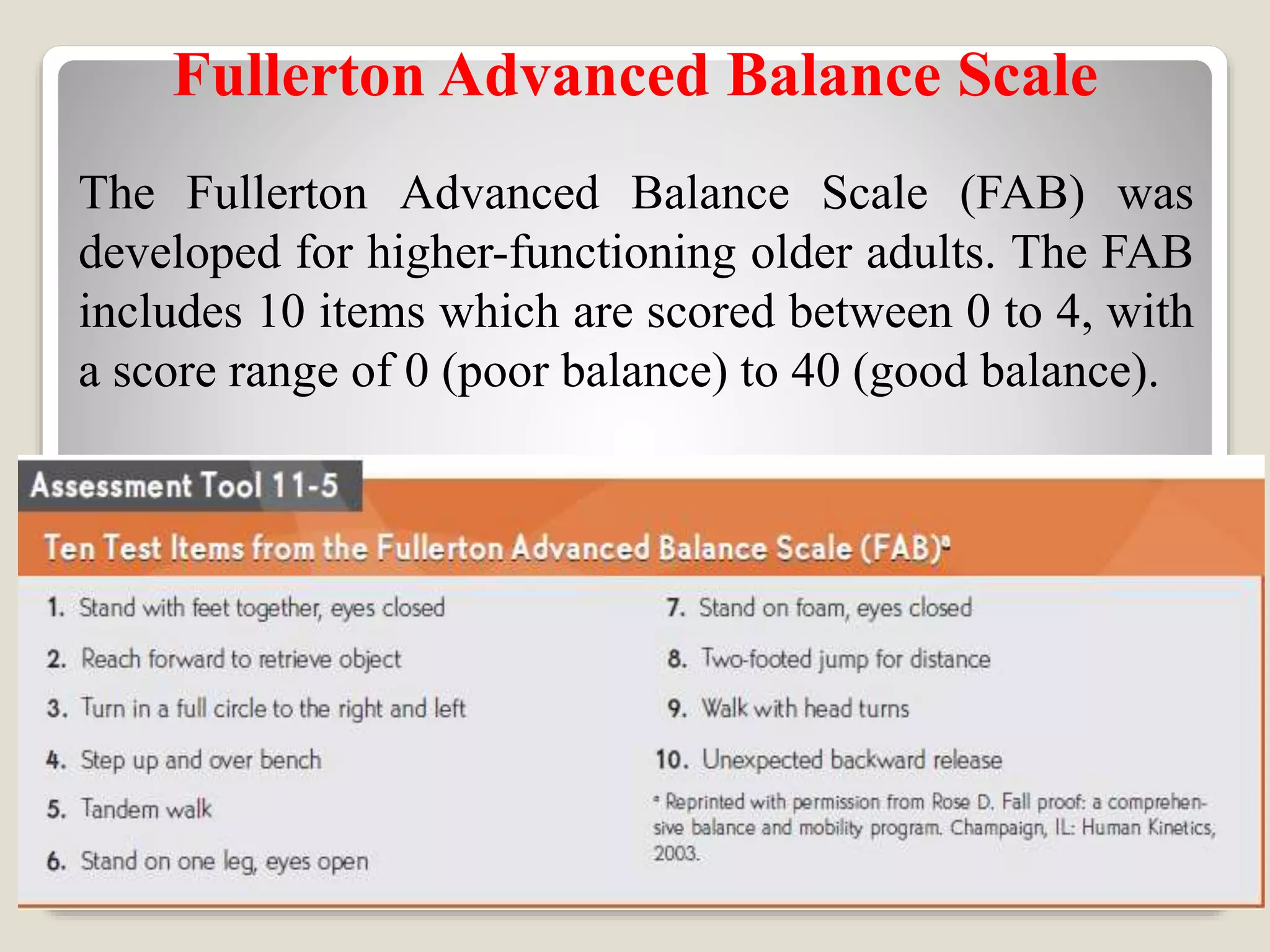
Fullerton Advanced Balance Scale
The Fullerton Advanced Balance Scale (FAB) was
developed for higher-functioning older adults. The FAB
includes 10 items which are scored between 0 to 4, with
a score range of 0 (poor balance) to 40 (good balance).
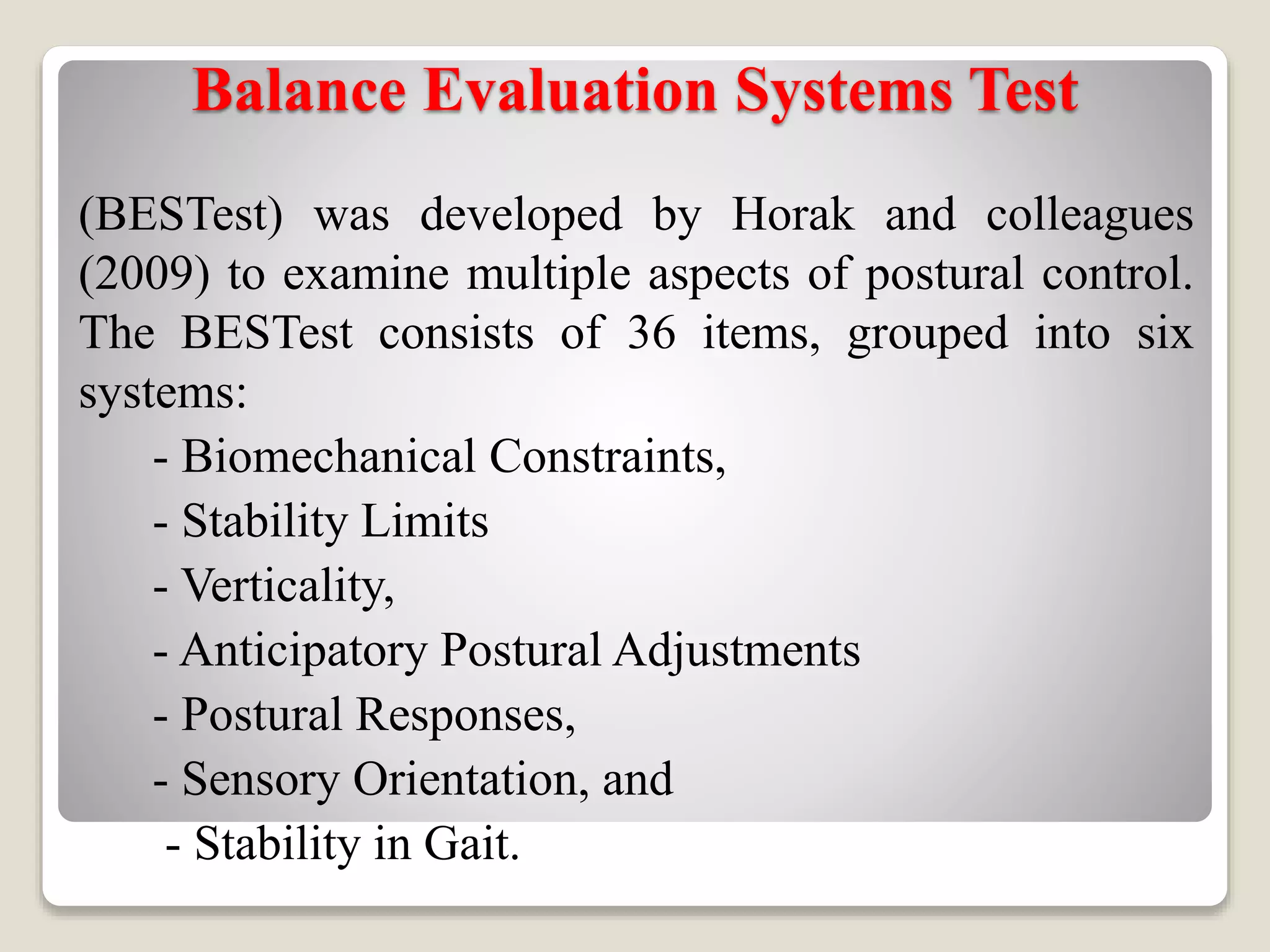
Balance Evaluation Systems Test
(BESTest) was developed by Horak and colleagues
(2009) to examine multiple aspects of postural control.
The BESTest consists of 36 items, grouped into six
systems:
- Biomechanical Constraints,
- Stability Limits
- Verticality,
- Anticipatory Postural Adjustments
- Postural Responses,
- Sensory Orientation, and
- Stability in Gait.
The mini-BESTest contains 14 items that group into
four of the original six sections.
References
 Pedretti’s Occupational Therapy: Practice Skills For
Physical Dysfunction, pg 471.
 Occupational therapy for physical dysfunction editors,
Mary Vining Radomski, Catherine A. Trombly
Latham. –7th ed. p. 258, 261 and 262.
 Motor control : translating research into clinical
practice / Anne Shumway— 4th, ed. Chap 11, pg 271

Assessment of balance

  • 1.
    Assessment of Balance Seminarby: Odeyoyin Yusuph Abiodun
  • 2.
  • 3.
  • 4.
  • 5.
  • 6.
    Peripheral Sensory Reception 1.Somatosensory Receptors ◦ Joints, Muscles, Tendons, Ligaments, Connective Tissue, Skin 2. Vision ◦ Focal ◦ Ambient 3. Vestibular ◦ Semicircular canals ◦ Otoliths (utricle,saccule) www.stlouisear.com www.drwolgin.com
  • 7.
    Motor Components ofBalance  Reflexes ◦ Vestibuloocular Reflex (VOR) ◦ Vestibulospinal Reflex (VSR)  Postural Responses ◦ Automatic- Ankle, Hip, Suspensory, Stepping ◦ Anticipatory  Volitional Postural Movements
  • 8.
    EXAMINATION 1. Safety—The FirstConcern 2. Examining the Effect of Balance on Participation 3. Examining the Effect of Balance on Functional Activities: - Examination of balance from a functional perspective uses tests and measures that indicate how well a patient can perform a variety of functional tasks that require postural control. - There are a number of tests available to measure functional skills related to postural control. - Many of these tests have been used to determine the risk for falls as well.
  • 9.
    ASSESSMENTS OF BALANCE Self-ReportMeasures of Balance Confidence (Screening tools for balance): 1. Activities-specific Balance Confidence (Abc) Scale 2. Falls Efficacy Scale 3. Timed Up and Go Test (TUG) 4. Reach Tests (Functional Reach Test, Multi- Directional Reach Test.)
  • 10.
    ACTIVITIES-SPECIFIC BALANCE CONFIDENCE(ABC) SCALE Rate confidence in ability to carry out the following activities (0 = no confidence, 100 = complete confidence). Total score is average of 16 individual scores. 1. Walk around house 2. Up and down stairs 3. Pick up slipper from floor 4. Reach at eye level 5. Reach up on tiptoes 6. Stand on chair to reach 7. Sweep floor 8. Walk outside to nearby car 9. Get in/out of car 10. Walk across parking lot 11. Walk up and down ramp 12. Walk in crowded mall, 13. Walk in crowd/bumped 14. Ride escalator holding on, 15. Ride escalator not holding rail 16. Walk on icy sidewalk
  • 11.
    FALLS EFFICACY SCALE Ratelevel of confidence in doing each of the activities without falling (0 = not at all, 10 = completely confident). Total score is sum of 10 individual scores (range: 0 [low self-efficacy] to 100 [high self- efficacy]). 1. Cleaning house 2. Getting dressed and undressed 3. Preparing simple meals 4. Taking a bath or shower 5. Simple shopping 6. Getting in and out of car 7. Going up and down stairs 8. Walking around neighborhood 9. Reaching into cabinets and closets 10. Hurrying to answer the phone
  • 12.
    The Get Upand Go test The Get Up and Go test (Mathias et al., 1986) was developed as a quick screening tool for detecting balance problems affecting daily mobility skills in elderly patients. The test requires that subjects stand up from a chair, walk 3 ms, turn around, and return. Performance is scored according to the following scale: 1 = normal; 2 = very slightly abnormal; 3 = mildly abnormal; 4 = moderately abnormal; and 5 = severely abnormal. Testing scores in 10 seconds.
  • 14.
    Functional Reach Test.The Functional Reach Test is a single-item test developed as a quick screen for balance problems and falls risk in older adults (Duncan et al., 1990). Testing procedure: Subjects stand with feet shoulder distance apart and with one arm (hand in a fist) raised to 90 degrees of flexion. Without moving their feet, subjects reach as far forward as they can while still maintaining their balance. The distance reached is measured and compared with that of age-related norms
  • 15.
    Modified version ofthe Functional Reach test (modified Functional Reach Test [MFRT]) has been developed. The test involves measuring unsupported reaching in the forward and lateral direction in the seated position.
  • 16.
    Multi-Directional Reach Test. MDRTWas proposed to examine the limits of stability in not only the forward and backward direction, but also in the medial and lateral directions. Positions for the Multi-Directional Reach Test: A, Position for the forward and backward reach. B, Position for the right lateral lean (yardstick would be repositioned for left lateral lean).
  • 17.
    Performance-Oriented Mobility Assessment (POMA) MaryTinetti, published a test to measure balance and mobility skills in older adults and to determine the likelihood for falls and mobility scale, which rates performance on a three-point scale. The maximum score is 28 points. It evaluates steady-state balance in sitting and standing (items 1and 5), proactive balance (items 2, 3, 6, and 9), reactive balance (item 6), and includes a sensory component (item 7).
  • 18.
    A score ofless than 19 indicates a high risk for falls. Scores in the range of 19 to 24 indicate a moderate risk for falls. The test takes about 10 to 15 minutes to administer with good interrater reliability (Tinetti & Ginter, 1988).
  • 19.
    Berg Balance Scale TheBerg Balance Scale (BBS) was developed by Kathy Berg, a Canadian physical therapist. The test uses 14 different items, which are rated 0 to 4.
  • 20.
    Short Physical PerformanceBattery SPPB is an increasingly common test used to measure lower extremity performance in older adults. It includes a strength, balance, and mobility component. The SPPB involves timing performance on the following items: - five chair stands (no arms), - 8-ft walk test, and - three hierarchical balance tests (side-by-side stance, modified tandem stance, or tandem stance).
  • 21.
    Time measurements foreach of the three tests (strength, balance, and gait) are then converted to ordinal-scale values (0 to 4). Scores from the three areas are summed, for a total score range from 0 (lowest performance) to 12 (highest performance).
  • 22.
    Fullerton Advanced BalanceScale The Fullerton Advanced Balance Scale (FAB) was developed for higher-functioning older adults. The FAB includes 10 items which are scored between 0 to 4, with a score range of 0 (poor balance) to 40 (good balance).
  • 23.
    Balance Evaluation SystemsTest (BESTest) was developed by Horak and colleagues (2009) to examine multiple aspects of postural control. The BESTest consists of 36 items, grouped into six systems: - Biomechanical Constraints, - Stability Limits - Verticality, - Anticipatory Postural Adjustments - Postural Responses, - Sensory Orientation, and - Stability in Gait.
  • 24.
    The mini-BESTest contains14 items that group into four of the original six sections.
  • 25.
    References  Pedretti’s OccupationalTherapy: Practice Skills For Physical Dysfunction, pg 471.  Occupational therapy for physical dysfunction editors, Mary Vining Radomski, Catherine A. Trombly Latham. –7th ed. p. 258, 261 and 262.  Motor control : translating research into clinical practice / Anne Shumway— 4th, ed. Chap 11, pg 271