1
‫ر‬َ‫ـد‬ْ‫ق‬‫ِـ‬‫ن‬،،،‫لما‬‫اننا‬ ‫نصدق‬ْْ‫ق‬ِ‫ن‬‫ر‬َ‫د‬
Faculty of Engineering - Helwan University
2
 Good software development organizations normally
require their programmers to adhere to some well-
defined and standard style of coding called coding
standards.
 All Engineers have to follow these standards rigorously.
 The purpose of requiring all engineers of an organization
to adhere to a standard style of coding is the following:
 A coding standard gives a uniform appearance to the codes
written by different engineers.
 It enhances code understanding.
 It encourages good programming practices.
3
 The following are some representative coding standards:
 Rules for limiting the use of global:
• These rules list what types of data can be declared global
and what cannot.
 Contents of the headers preceding codes for different
modules:
• The information contained in the headers of different
modules should be standard for an organization. The
following are some standard header data:
 Name of the module.
 Date on which the module was created.
 Modification history.
 Different functions supported, along with their input/output parameters.
 Global variables accessed/modified by the module.
 Author’s name.
 Summary of the module.
4
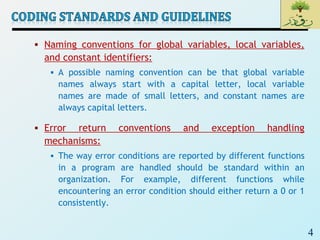
 Naming conventions for global variables, local variables,
and constant identifiers:
 A possible naming convention can be that global variable
names always start with a capital letter, local variable
names are made of small letters, and constant names are
always capital letters.
 Error return conventions and exception handling
mechanisms:
 The way error conditions are reported by different functions
in a program are handled should be standard within an
organization. For example, different functions while
encountering an error condition should either return a 0 or 1
consistently.
5
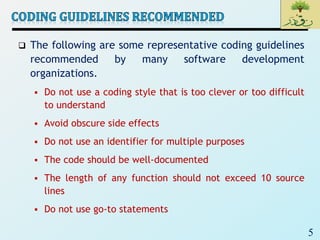
 The following are some representative coding guidelines
recommended by many software development
organizations.
 Do not use a coding style that is too clever or too difficult
to understand
 Avoid obscure side effects
 Do not use an identifier for multiple purposes
 The code should be well-documented
 The length of any function should not exceed 10 source
lines
 Do not use go-to statements
6
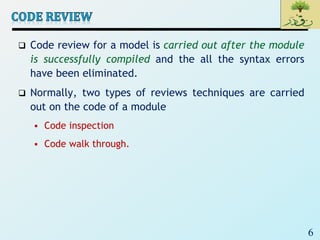
 Code review for a model is carried out after the module
is successfully compiled and the all the syntax errors
have been eliminated.
 Normally, two types of reviews techniques are carried
out on the code of a module
 Code inspection
 Code walk through.
7
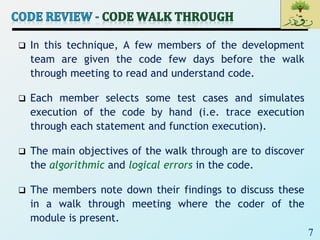
 In this technique, A few members of the development
team are given the code few days before the walk
through meeting to read and understand code.
 Each member selects some test cases and simulates
execution of the code by hand (i.e. trace execution
through each statement and function execution).
 The main objectives of the walk through are to discover
the algorithmic and logical errors in the code.
 The members note down their findings to discuss these
in a walk through meeting where the coder of the
module is present.
8
 The aim of code inspection is to discover some common types of
errors caused due to oversight and improper programming.
 In code inspection: the code is examined for the presence of
certain kinds of errors (the classical error).
 Following is a list of some classical programming errors which
can be checked during code inspection:
 Use of uninitialized variables.
 Jumps into loops.
 Non-terminating loops.
 Incompatible assignments.
 Array indices out of bounds.
 Improper storage allocation and deallocation.
 Mismatches between actual and formal parameter in procedure calls.
 Use of incorrect logical operators or incorrect precedence among
operators.
 Improper modification of loop variables.
 Comparison of equally of floating point variables, etc.
9

SE2018_Lec 17_ Coding

  • 1.
  • 2.
    2  Good softwaredevelopment organizations normally require their programmers to adhere to some well- defined and standard style of coding called coding standards.  All Engineers have to follow these standards rigorously.  The purpose of requiring all engineers of an organization to adhere to a standard style of coding is the following:  A coding standard gives a uniform appearance to the codes written by different engineers.  It enhances code understanding.  It encourages good programming practices.
  • 3.
    3  The followingare some representative coding standards:  Rules for limiting the use of global: • These rules list what types of data can be declared global and what cannot.  Contents of the headers preceding codes for different modules: • The information contained in the headers of different modules should be standard for an organization. The following are some standard header data:  Name of the module.  Date on which the module was created.  Modification history.  Different functions supported, along with their input/output parameters.  Global variables accessed/modified by the module.  Author’s name.  Summary of the module.
  • 4.
    4  Naming conventionsfor global variables, local variables, and constant identifiers:  A possible naming convention can be that global variable names always start with a capital letter, local variable names are made of small letters, and constant names are always capital letters.  Error return conventions and exception handling mechanisms:  The way error conditions are reported by different functions in a program are handled should be standard within an organization. For example, different functions while encountering an error condition should either return a 0 or 1 consistently.
  • 5.
    5  The followingare some representative coding guidelines recommended by many software development organizations.  Do not use a coding style that is too clever or too difficult to understand  Avoid obscure side effects  Do not use an identifier for multiple purposes  The code should be well-documented  The length of any function should not exceed 10 source lines  Do not use go-to statements
  • 6.
    6  Code reviewfor a model is carried out after the module is successfully compiled and the all the syntax errors have been eliminated.  Normally, two types of reviews techniques are carried out on the code of a module  Code inspection  Code walk through.
  • 7.
    7  In thistechnique, A few members of the development team are given the code few days before the walk through meeting to read and understand code.  Each member selects some test cases and simulates execution of the code by hand (i.e. trace execution through each statement and function execution).  The main objectives of the walk through are to discover the algorithmic and logical errors in the code.  The members note down their findings to discuss these in a walk through meeting where the coder of the module is present.
  • 8.
    8  The aimof code inspection is to discover some common types of errors caused due to oversight and improper programming.  In code inspection: the code is examined for the presence of certain kinds of errors (the classical error).  Following is a list of some classical programming errors which can be checked during code inspection:  Use of uninitialized variables.  Jumps into loops.  Non-terminating loops.  Incompatible assignments.  Array indices out of bounds.  Improper storage allocation and deallocation.  Mismatches between actual and formal parameter in procedure calls.  Use of incorrect logical operators or incorrect precedence among operators.  Improper modification of loop variables.  Comparison of equally of floating point variables, etc.
  • 9.