DIGITAL SIGNAL PROCESSING
By
Mrs.R.Chitra,
Assistant Professor(SS),
Department of ECE,
School of Engineering,
Avinashilingam Institute for Home Science and Higher Education
for Women, Coimbatore
Topics to be Covered:
1. OVERLAP SAVE METHOD
2. OVERLAP ADD METHOD
3. LINEAR CONVOLUTION
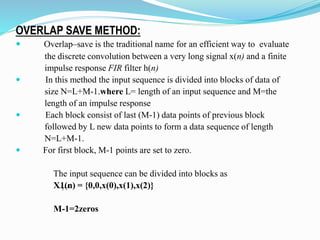
OVERLAP SAVE METHOD:
 Overlap–save is the traditional name for an efficient way to evaluate
the discrete convolution between a very long signal x(n) and a finite
impulse response FIR filter h(n)
 In this method the input sequence is divided into blocks of data of
size N=L+M-1.where L= length of an input sequence and M=the
length of an impulse response
 Each block consist of last (M-1) data points of previous block
followed by L new data points to form a data sequence of length
N=L+M-1.
 For first block, M-1 points are set to zero.
The input sequence can be divided into blocks as
X1(n) = {0,0,x(0),x(1),x(2)}
M-1=2zeros
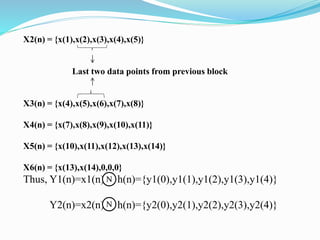
X2(n) = {x(1),x(2),x(3),x(4),x(5)}
Last two data points from previous block
X3(n) = {x(4),x(5),x(6),x(7),x(8)}
X4(n) = {x(7),x(8),x(9),x(10),x(11)}
X5(n) = {x(10),x(11),x(12),x(13),x(14)}
X6(n) = {x(13),x(14),0,0,0}
Thus, Y1(n)=x1(n) h(n)={y1(0),y1(1),y1(2),y1(3),y1(4)}
Y2(n)=x2(n) h(n)={y2(0),y2(1),y2(2),y2(3),y2(4)}N
N
Y3(n)=x3(n) h(n)={y3(0),y3(1),y3(2),y3(3),y3(4)}
Y4(n)=x4(n) h(n)={y4(0),y4(1),y4(2),y4(3),y4(4)}
Y5(n)=x5(n) h(n)={y5(0),y5(1),y5(2),y5(3),y5(4)}
Y6(n)=x6(n) h(n)={y6(0),y6(1),y6(2),y6(3),y6(4)}
Therefore, the output blocks are abutted together to get
Y(n)={y1(2),y1(3),y1(4),y2(2),y2(3),y2(4),y3(2),y3(3),
y3(4),y4(4),y5(2),y5(3),y5(4),y6(2),y6(3)}
N
N
N
N
EXAMPLE 1: Determine the output of linear FIR filter
whose impulse response is h(n)={1,2,3} and the input signal is
x(n)= {1,2,3,4,5,6,7,8,9} using over lap save method.
SOLUTION:
Given, x(n)= {1,2,3,4,5,6,7,8,9} & h(n)={1,2,3}
Therefore, L=9;M=3;
Adding M-1 zeros in x1(n),we get
x1(n)={0,0,1,2,3}
x2(n)={2,3,4,5,6}
x3(n)={5,6,7,8,9}
x4(n)={8,9,0,0,0}
h(n)={1,2,3,0,0}
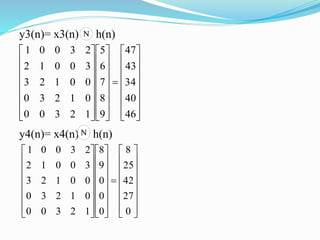
By circular convolution,
y1(n)= x1(n) h(n)
y2(n)= x2(n) h(n)
N
N

















































10
4
1
9
12
3
2
1
0
0
13300
01230
00123
30012
23001

















































28
22
16
25
29
6
5
4
3
2
13300
01230
00123
30012
23001
y3(n)= x3(n) h(n)
y4(n)= x4(n) h(n)
N
N

















































46
40
34
43
47
9
8
7
6
5
12300
01230
00123
30012
23001

















































0
27
42
25
8
0
0
0
9
8
12300
01230
00123
30012
23001
y(n)=
Therefore,
y(n)={1,4,10,16,22,28,34,40,46,42,27}
12 9 1 4 10
29 25 16 22 28
8 25 42 27 0
Add
y3(n)
y2(n)
y1(n)
47 43 34 40 46
y4(n)
Discard
Discard
Discard
Discard
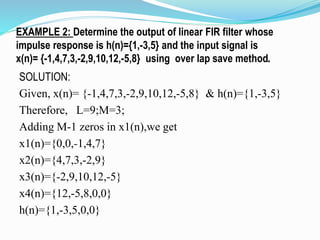
EXAMPLE 2: Determine the output of linear FIR filter whose
impulse response is h(n)={1,-3,5} and the input signal is
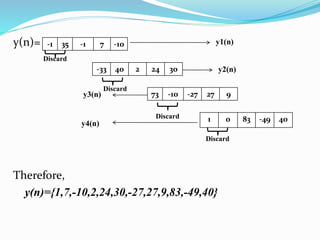
x(n)= {-1,4,7,3,-2,9,10,12,-5,8} using over lap save method.
SOLUTION:
Given, x(n)= {-1,4,7,3,-2,9,10,12,-5,8} & h(n)={1,-3,5}
Therefore, L=9;M=3;
Adding M-1 zeros in x1(n),we get
x1(n)={0,0,-1,4,7}
x2(n)={4,7,3,-2,9}
x3(n)={-2,9,10,12,-5}
x4(n)={12,-5,8,0,0}
h(n)={1,-3,5,0,0}
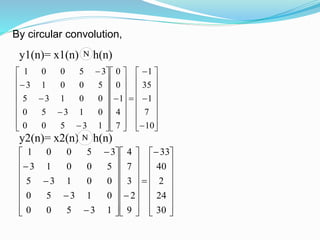
By circular convolution,
y1(n)= x1(n) h(n)
y2(n)= x2(n) h(n)
N
N


























































10
7
1
35
1
7
4
1
0
0
13500
01350
00135
50013
35001























































30
24
2
40
33
9
2
3
7
4
13500
01350
00135
50013
35001
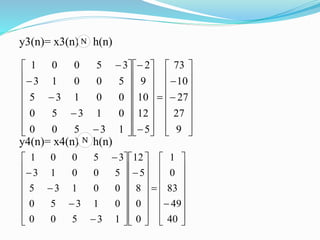
y3(n)= x3(n) h(n)
y4(n)= x4(n) h(n)
N
N


























































9
27
27
10
73
5
12
10
9
2
13500
01350
00135
50013
35001
























































40
49
83
0
1
0
0
8
5
12
13500
01350
00135
50013
35001
y(n)=
Therefore,
y(n)={1,7,-10,2,24,30,-27,27,9,83,-49,40}
-1 35 -1 7 -10
-33 40 2 24 30
1 0 83 -49 40
Add
y3(n)
y2(n)
y1(n)
73 -10 -27 27 9
y4(n)
Discard
Discard
Discard
Discard
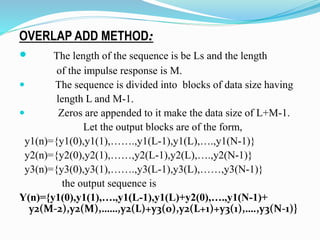
OVERLAP ADD METHOD:
 The length of the sequence is be Ls and the length
of the impulse response is M.
 The sequence is divided into blocks of data size having
length L and M-1.
 Zeros are appended to it make the data size of L+M-1.
Let the output blocks are of the form,
y1(n)={y1(0),y1(1),…….,y1(L-1),y1(L),….,y1(N-1)}
y2(n)={y2(0),y2(1),……,y2(L-1),y2(L),….,y2(N-1)}
y3(n)={y3(0),y3(1),…….,y3(L-1),y3(L),……,y3(N-1)}
the output sequence is
Y(n)={y1(0),y1(1),….,y1(L-1),y1(L)+y2(0),….,y1(N-1)+
y2(M-2),y2(M),……,y2(L)+y3(0),y2(L+1)+y3(1),….,y3(N-1)}
EXAMPLE 1: Determine the output of linear FIR filter
whose impulse response is h(n)={1,2,3} and the input signal
is x(n)= {1,2,3,4,5,6,7,8,9} using over lap add method.
SOLUTION:
Given, x(n)= {1,2,3,4,5,6,7,8,9} & h(n)={1,2,3}
Therefore, L=9;M=3;
Adding M-1 zero,we get
x1(n)={1,2,3,0,0}
x2(n)={4,5,6,0,0}
x3(n)={7,8,9,0,0}
h(n)={1,2,3,0,0}
By circular convolution,
y1(n)= x1(n) h(n)
y2(n)= x2(n) h(n)
N
N

















































18
27
28
13
4
0
0
6
5
4
13300
01230
00123
30012
23001

















































9
12
10
4
1
0
0
3
2
1
13300
01230
00123
30012
23001
y3(n)= x3(n) h(n)
y(n)=
Therefore,
y(n)={1,4,10,16,22,28,34,40,46,42,27}
N

















































27
42
46
22
7
0
0
9
8
7
13300
01230
00123
30012
23001
1 4 10 12 9
4 13 28 27 18
7 22 46 42 27
Add
Add
y3(n)
y2(n)
y1(n)
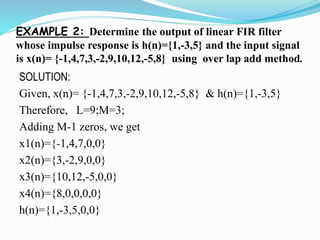
EXAMPLE 2: Determine the output of linear FIR filter
whose impulse response is h(n)={1,-3,5} and the input signal
is x(n)= {-1,4,7,3,-2,9,10,12,-5,8} using over lap add method.
SOLUTION:
Given, x(n)= {-1,4,7,3,-2,9,10,12,-5,8} & h(n)={1,-3,5}
Therefore, L=9;M=3;
Adding M-1 zeros, we get
x1(n)={-1,4,7,0,0}
x2(n)={3,-2,9,0,0}
x3(n)={10,12,-5,0,0}
x4(n)={8,0,0,0,0}
h(n)={1,-3,5,0,0}
By circular convolution,
y1(n)= x1(n) h(n)
y2(n)= x2(n) h(n)
N
N

























































45
37
30
11
3
0
0
9
2
3
13500
01350
00135
50013
35001























































35
1
10
7
1
0
0
7
4
1
13500
01350
00135
50013
35001
y3(n)= x3(n) h(n)
y4(n)= x4(n) h(n)
N
N

























































25
75
9
18
10
0
0
5
12
10
13500
01350
00135
50013
35001























































0
0
40
24
8
0
0
0
0
8
13500
01350
00135
50013
35001
y(n)=
Therefore,
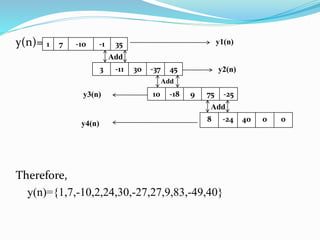
y(n)={1,7,-10,2,24,30,-27,27,9,83,-49,40}
1 7 -10 -1 35
3 -11 30 -37 45
8 -24 40 0 0
Add
Add
y3(n)
y2(n)
y1(n)
10 -18 9 75 -25
Add
Add
y4(n)
LINEAR CONVOLUTION FROM CIRCULAR CONVOLUTION:
• Let us consider two finite duration sequences x(n) and h(n). The duration of
x(n) is L and y(n) is M samples. The linear convolution of x(n) and h(n) is given
by the formula
where y(n) is a finite duration of sequence of L+M-1 samples.
The circular convolution of x(n) and h(n) give N samples where N=Max(L,M).
Consider two sequences x(n) and h(n) having sequence length L=5
and M=3 respectively as shown in the figure.
x(n) L=5
0 1 2 3 4




k
knhkxny )()()(
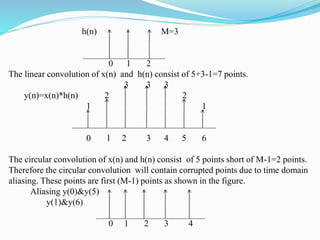
h(n) M=3
0 1 2
The linear convolution of x(n) and h(n) consist of 5+3-1=7 points.
3 3 3
y(n)=x(n)*h(n) 2 2
1 1
0 1 2 3 4 5 6
The circular convolution of x(n) and h(n) consist of 5 points short of M-1=2 points.
Therefore the circular convolution will contain corrupted points due to time domain
aliasing. These points are first (M-1) points as shown in the figure.
Aliasing y(0)&y(5)
y(1)&y(6)
0 1 2 3 4
EXAMPLE:
Thus, linear convolution is done.
THANK
YOU!!!

Overlap save method and overlap add method in dsp

  • 1.
    DIGITAL SIGNAL PROCESSING By Mrs.R.Chitra, AssistantProfessor(SS), Department of ECE, School of Engineering, Avinashilingam Institute for Home Science and Higher Education for Women, Coimbatore
  • 2.
    Topics to beCovered: 1. OVERLAP SAVE METHOD 2. OVERLAP ADD METHOD 3. LINEAR CONVOLUTION
  • 3.
    OVERLAP SAVE METHOD: Overlap–save is the traditional name for an efficient way to evaluate the discrete convolution between a very long signal x(n) and a finite impulse response FIR filter h(n)  In this method the input sequence is divided into blocks of data of size N=L+M-1.where L= length of an input sequence and M=the length of an impulse response  Each block consist of last (M-1) data points of previous block followed by L new data points to form a data sequence of length N=L+M-1.  For first block, M-1 points are set to zero. The input sequence can be divided into blocks as X1(n) = {0,0,x(0),x(1),x(2)} M-1=2zeros
  • 4.
    X2(n) = {x(1),x(2),x(3),x(4),x(5)} Lasttwo data points from previous block X3(n) = {x(4),x(5),x(6),x(7),x(8)} X4(n) = {x(7),x(8),x(9),x(10),x(11)} X5(n) = {x(10),x(11),x(12),x(13),x(14)} X6(n) = {x(13),x(14),0,0,0} Thus, Y1(n)=x1(n) h(n)={y1(0),y1(1),y1(2),y1(3),y1(4)} Y2(n)=x2(n) h(n)={y2(0),y2(1),y2(2),y2(3),y2(4)}N N
  • 5.
    Y3(n)=x3(n) h(n)={y3(0),y3(1),y3(2),y3(3),y3(4)} Y4(n)=x4(n) h(n)={y4(0),y4(1),y4(2),y4(3),y4(4)} Y5(n)=x5(n)h(n)={y5(0),y5(1),y5(2),y5(3),y5(4)} Y6(n)=x6(n) h(n)={y6(0),y6(1),y6(2),y6(3),y6(4)} Therefore, the output blocks are abutted together to get Y(n)={y1(2),y1(3),y1(4),y2(2),y2(3),y2(4),y3(2),y3(3), y3(4),y4(4),y5(2),y5(3),y5(4),y6(2),y6(3)} N N N N
  • 6.
    EXAMPLE 1: Determinethe output of linear FIR filter whose impulse response is h(n)={1,2,3} and the input signal is x(n)= {1,2,3,4,5,6,7,8,9} using over lap save method. SOLUTION: Given, x(n)= {1,2,3,4,5,6,7,8,9} & h(n)={1,2,3} Therefore, L=9;M=3; Adding M-1 zeros in x1(n),we get x1(n)={0,0,1,2,3} x2(n)={2,3,4,5,6} x3(n)={5,6,7,8,9} x4(n)={8,9,0,0,0} h(n)={1,2,3,0,0}
  • 7.
    By circular convolution, y1(n)=x1(n) h(n) y2(n)= x2(n) h(n) N N                                                  10 4 1 9 12 3 2 1 0 0 13300 01230 00123 30012 23001                                                  28 22 16 25 29 6 5 4 3 2 13300 01230 00123 30012 23001
  • 8.
    y3(n)= x3(n) h(n) y4(n)=x4(n) h(n) N N                                                  46 40 34 43 47 9 8 7 6 5 12300 01230 00123 30012 23001                                                  0 27 42 25 8 0 0 0 9 8 12300 01230 00123 30012 23001
  • 9.
    y(n)= Therefore, y(n)={1,4,10,16,22,28,34,40,46,42,27} 12 9 14 10 29 25 16 22 28 8 25 42 27 0 Add y3(n) y2(n) y1(n) 47 43 34 40 46 y4(n) Discard Discard Discard Discard
  • 10.
    EXAMPLE 2: Determinethe output of linear FIR filter whose impulse response is h(n)={1,-3,5} and the input signal is x(n)= {-1,4,7,3,-2,9,10,12,-5,8} using over lap save method. SOLUTION: Given, x(n)= {-1,4,7,3,-2,9,10,12,-5,8} & h(n)={1,-3,5} Therefore, L=9;M=3; Adding M-1 zeros in x1(n),we get x1(n)={0,0,-1,4,7} x2(n)={4,7,3,-2,9} x3(n)={-2,9,10,12,-5} x4(n)={12,-5,8,0,0} h(n)={1,-3,5,0,0}
  • 11.
    By circular convolution, y1(n)=x1(n) h(n) y2(n)= x2(n) h(n) N N                                                           10 7 1 35 1 7 4 1 0 0 13500 01350 00135 50013 35001                                                        30 24 2 40 33 9 2 3 7 4 13500 01350 00135 50013 35001
  • 12.
    y3(n)= x3(n) h(n) y4(n)=x4(n) h(n) N N                                                           9 27 27 10 73 5 12 10 9 2 13500 01350 00135 50013 35001                                                         40 49 83 0 1 0 0 8 5 12 13500 01350 00135 50013 35001
  • 13.
    y(n)= Therefore, y(n)={1,7,-10,2,24,30,-27,27,9,83,-49,40} -1 35 -17 -10 -33 40 2 24 30 1 0 83 -49 40 Add y3(n) y2(n) y1(n) 73 -10 -27 27 9 y4(n) Discard Discard Discard Discard
  • 14.
    OVERLAP ADD METHOD: The length of the sequence is be Ls and the length of the impulse response is M.  The sequence is divided into blocks of data size having length L and M-1.  Zeros are appended to it make the data size of L+M-1. Let the output blocks are of the form, y1(n)={y1(0),y1(1),…….,y1(L-1),y1(L),….,y1(N-1)} y2(n)={y2(0),y2(1),……,y2(L-1),y2(L),….,y2(N-1)} y3(n)={y3(0),y3(1),…….,y3(L-1),y3(L),……,y3(N-1)} the output sequence is Y(n)={y1(0),y1(1),….,y1(L-1),y1(L)+y2(0),….,y1(N-1)+ y2(M-2),y2(M),……,y2(L)+y3(0),y2(L+1)+y3(1),….,y3(N-1)}
  • 15.
    EXAMPLE 1: Determinethe output of linear FIR filter whose impulse response is h(n)={1,2,3} and the input signal is x(n)= {1,2,3,4,5,6,7,8,9} using over lap add method. SOLUTION: Given, x(n)= {1,2,3,4,5,6,7,8,9} & h(n)={1,2,3} Therefore, L=9;M=3; Adding M-1 zero,we get x1(n)={1,2,3,0,0} x2(n)={4,5,6,0,0} x3(n)={7,8,9,0,0} h(n)={1,2,3,0,0}
  • 16.
    By circular convolution, y1(n)=x1(n) h(n) y2(n)= x2(n) h(n) N N                                                  18 27 28 13 4 0 0 6 5 4 13300 01230 00123 30012 23001                                                  9 12 10 4 1 0 0 3 2 1 13300 01230 00123 30012 23001
  • 17.
  • 18.
    EXAMPLE 2: Determinethe output of linear FIR filter whose impulse response is h(n)={1,-3,5} and the input signal is x(n)= {-1,4,7,3,-2,9,10,12,-5,8} using over lap add method. SOLUTION: Given, x(n)= {-1,4,7,3,-2,9,10,12,-5,8} & h(n)={1,-3,5} Therefore, L=9;M=3; Adding M-1 zeros, we get x1(n)={-1,4,7,0,0} x2(n)={3,-2,9,0,0} x3(n)={10,12,-5,0,0} x4(n)={8,0,0,0,0} h(n)={1,-3,5,0,0}
  • 19.
    By circular convolution, y1(n)=x1(n) h(n) y2(n)= x2(n) h(n) N N                                                          45 37 30 11 3 0 0 9 2 3 13500 01350 00135 50013 35001                                                        35 1 10 7 1 0 0 7 4 1 13500 01350 00135 50013 35001
  • 20.
    y3(n)= x3(n) h(n) y4(n)=x4(n) h(n) N N                                                          25 75 9 18 10 0 0 5 12 10 13500 01350 00135 50013 35001                                                        0 0 40 24 8 0 0 0 0 8 13500 01350 00135 50013 35001
  • 21.
    y(n)= Therefore, y(n)={1,7,-10,2,24,30,-27,27,9,83,-49,40} 1 7 -10-1 35 3 -11 30 -37 45 8 -24 40 0 0 Add Add y3(n) y2(n) y1(n) 10 -18 9 75 -25 Add Add y4(n)
  • 22.
    LINEAR CONVOLUTION FROMCIRCULAR CONVOLUTION: • Let us consider two finite duration sequences x(n) and h(n). The duration of x(n) is L and y(n) is M samples. The linear convolution of x(n) and h(n) is given by the formula where y(n) is a finite duration of sequence of L+M-1 samples. The circular convolution of x(n) and h(n) give N samples where N=Max(L,M). Consider two sequences x(n) and h(n) having sequence length L=5 and M=3 respectively as shown in the figure. x(n) L=5 0 1 2 3 4     k knhkxny )()()(
  • 23.
    h(n) M=3 0 12 The linear convolution of x(n) and h(n) consist of 5+3-1=7 points. 3 3 3 y(n)=x(n)*h(n) 2 2 1 1 0 1 2 3 4 5 6 The circular convolution of x(n) and h(n) consist of 5 points short of M-1=2 points. Therefore the circular convolution will contain corrupted points due to time domain aliasing. These points are first (M-1) points as shown in the figure. Aliasing y(0)&y(5) y(1)&y(6) 0 1 2 3 4
  • 24.
  • 27.
  • 28.