Data Structures
Lecture 3
RUBYA AFRIN
NORTHERN UNIVERSITY OF BUSINESS AND TECHNOLOGY
Stack
 A stack is a collection of items into which items can be
inserted or deleted at one end.
 A stack implements the LIFO (Last In First Out)protocol
2
Stacks
 Stacks in real life: stack of books, stack of plates
 Add new items at the top
 Remove an item at the top
 Stack data structure similar to real life: collection of elements
arranged in a linear order.
 Can only access element at the top
3
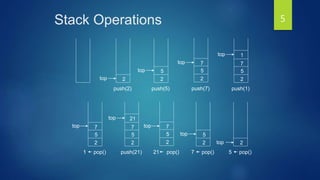
Stack Operations
 Push(X) – insert X as the top element of the stack
 Pop() – remove the top element of the stack and return it.
 Top() – return the top element without removing it from the stack.
4
Stack Operations
push(2)
top 2
push(5)
top
2
5
push(7)
top
2
5
7
push(1)
top
2
5
7
1
1 pop()
top
2
5
7
push(21)
top
2
5
7
21
21 pop()
top
2
5
7
7 pop()
2
5top
5 pop()
2top
5
Stack Operation
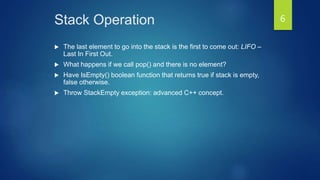
 The last element to go into the stack is the first to come out: LIFO –
Last In First Out.
 What happens if we call pop() and there is no element?
 Have IsEmpty() boolean function that returns true if stack is empty,
false otherwise.
 Throw StackEmpty exception: advanced C++ concept.
6
Stack Operation
 Overflow: occurs if we try to insert an item into an array
which is full
 Underflow: occurs when we try to retrieve an item form
an empty list
7
Push Operation
 If the stack is full, print an error message (overflow)
 Make place for new item by incrementing top
 Put the item in place
8
Pop Operation
 If the stack is empty, print an error message an halt
execution (underflow)
 Remove the top element from the stack
 Return the element to the calling program
9
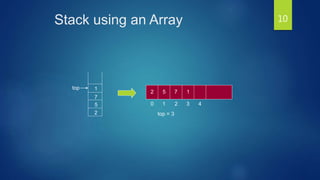
Stack using an Array
top
2
5
7
1
2 5 7 1
0 1 32 4
top = 3
10
Stack using an Array
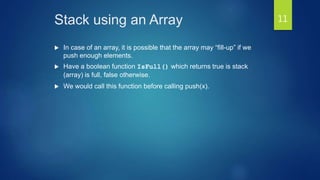
 In case of an array, it is possible that the array may “fill-up” if we
push enough elements.
 Have a boolean function IsFull() which returns true is stack
(array) is full, false otherwise.
 We would call this function before calling push(x).
11
Stack Operations with Array
int pop()
{
return A[current--];
}
void push(int x)
{
A[++current] = x;
}
12
Stack Operations with Array
int top()
{
return A[current];
}
int IsEmpty()
{
return ( current == -1 );
}
int IsFull()
{
return ( current == size-1);
}
 A quick examination shows that all five operations take constant
time.
13
Stack Using Linked List
 We can avoid the size limitation of a stack implemented with an
array by using a linked list to hold the stack elements.
 As with array, however, we need to decide where to insert elements
in the list and where to delete them so that push and pop will run the
fastest.
14
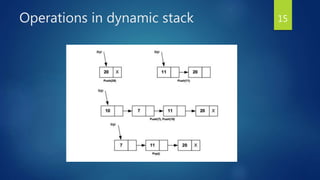
Operations in dynamic stack 15
Use of Stack
 Example of use: prefix, infix, postfix expressions.
 Consider the expression A+B: we think of applying the operator “+”
to the operands A and B.
 “+” is termed a binary operator: it takes two operands.
 Writing the sum as A+B is called the infix form of the expression.
16
Prefix, Infix, Postfix
 Two other ways of writing the expression are
+ A B prefix
A B + postfix
 The prefixes “pre” and “post” refer to the position of the operator with
respect to the two operands.
17
Prefix, Infix, Postfix
 Consider the infix expression
A + B * C
 We “know” that multiplication is done before addition.
 The expression is interpreted as
A + ( B * C )
 Multiplication has precedence over addition.
18
Prefix, Infix, Postfix
 Conversion to postfix
(A + B ) * C infix form
19
Prefix, Infix, Postfix
 Conversion to postfix
(A + B ) * C infix form
( A B + ) * C convert addition
20
Prefix, Infix, Postfix
 Conversion to postfix
(A + B ) * C infix form
( A B + ) * C convert addition
( A B + ) C * convert multiplication
21
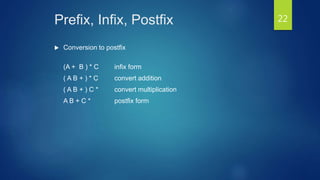
Prefix, Infix, Postfix
 Conversion to postfix
(A + B ) * C infix form
( A B + ) * C convert addition
( A B + ) C * convert multiplication
A B + C * postfix form
22
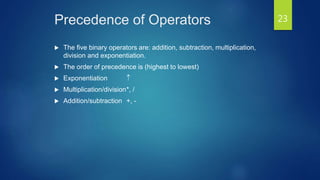
Precedence of Operators
 The five binary operators are: addition, subtraction, multiplication,
division and exponentiation.
 The order of precedence is (highest to lowest)
 Exponentiation 
 Multiplication/division*, /
 Addition/subtraction +, -
23
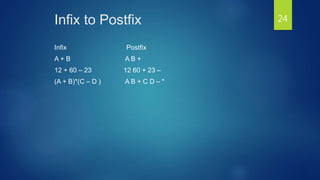
Infix to Postfix
Infix Postfix
A + B A B +
12 + 60 – 23 12 60 + 23 –
(A + B)*(C – D ) A B + C D – *
24
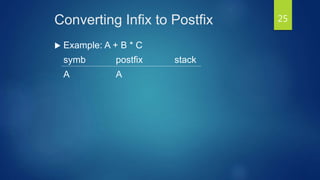
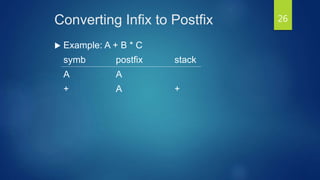
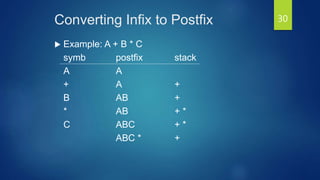
Converting Infix to Postfix
 Example: A + B * C
symb postfix stack
A A
25
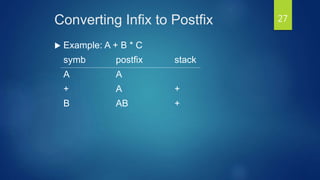
Converting Infix to Postfix
 Example: A + B * C
symb postfix stack
A A
+ A +
26
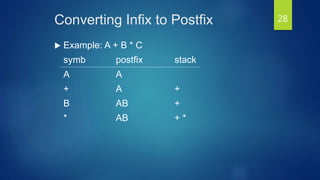
Converting Infix to Postfix
 Example: A + B * C
symb postfix stack
A A
+ A +
B AB +
27
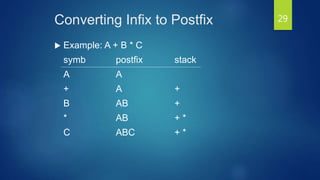
Converting Infix to Postfix
 Example: A + B * C
symb postfix stack
A A
+ A +
B AB +
* AB + *
28
Converting Infix to Postfix
 Example: A + B * C
symb postfix stack
A A
+ A +
B AB +
* AB + *
C ABC + *
29
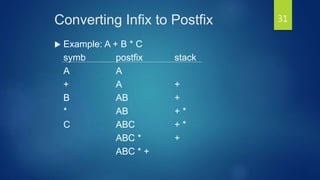
Converting Infix to Postfix
 Example: A + B * C
symb postfix stack
A A
+ A +
B AB +
* AB + *
C ABC + *
ABC * +
30
Converting Infix to Postfix
 Example: A + B * C
symb postfix stack
A A
+ A +
B AB +
* AB + *
C ABC + *
ABC * +
ABC * +
31
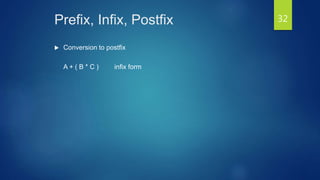
Prefix, Infix, Postfix
 Conversion to postfix
A + ( B * C ) infix form
32
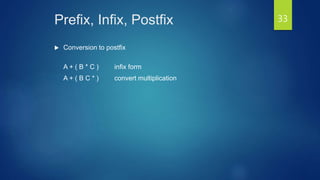
Prefix, Infix, Postfix
 Conversion to postfix
A + ( B * C ) infix form
A + ( B C * ) convert multiplication
33
Prefix, Infix, Postfix
 Conversion to postfix
A + ( B * C ) infix form
A + ( B C * ) convert multiplication
A ( B C * ) + convert addition
34
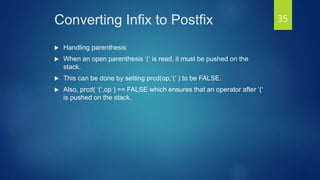
Converting Infix to Postfix
 Handling parenthesis
 When an open parenthesis ‘(‘ is read, it must be pushed on the
stack.
 This can be done by setting prcd(op,‘(‘ ) to be FALSE.
 Also, prcd( ‘(‘,op ) == FALSE which ensures that an operator after ‘(‘
is pushed on the stack.
35
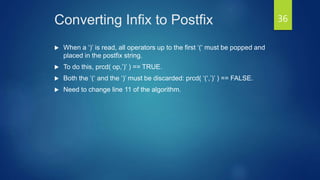
Converting Infix to Postfix
 When a ‘)’ is read, all operators up to the first ‘(‘ must be popped and
placed in the postfix string.
 To do this, prcd( op,’)’ ) == TRUE.
 Both the ‘(‘ and the ‘)’ must be discarded: prcd( ‘(‘,’)’ ) == FALSE.
 Need to change line 11 of the algorithm.
36
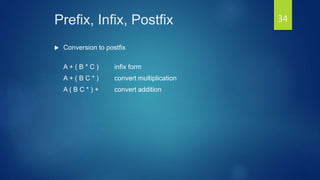
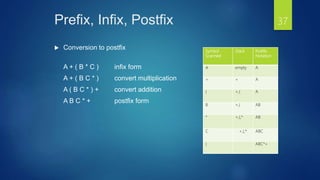
Prefix, Infix, Postfix
 Conversion to postfix
A + ( B * C ) infix form
A + ( B C * ) convert multiplication
A ( B C * ) + convert addition
A B C * + postfix form
Symbol
Scanned
Stack Postfix
Notation
A empty A
+ + A
( +,( A
B +,( AB
* +,(,* AB
C +,(,* ABC
) ABC*+
37

Data structures

  • 1.
    Data Structures Lecture 3 RUBYAAFRIN NORTHERN UNIVERSITY OF BUSINESS AND TECHNOLOGY
  • 2.
    Stack  A stackis a collection of items into which items can be inserted or deleted at one end.  A stack implements the LIFO (Last In First Out)protocol 2
  • 3.
    Stacks  Stacks inreal life: stack of books, stack of plates  Add new items at the top  Remove an item at the top  Stack data structure similar to real life: collection of elements arranged in a linear order.  Can only access element at the top 3
  • 4.
    Stack Operations  Push(X)– insert X as the top element of the stack  Pop() – remove the top element of the stack and return it.  Top() – return the top element without removing it from the stack. 4
  • 5.
    Stack Operations push(2) top 2 push(5) top 2 5 push(7) top 2 5 7 push(1) top 2 5 7 1 1pop() top 2 5 7 push(21) top 2 5 7 21 21 pop() top 2 5 7 7 pop() 2 5top 5 pop() 2top 5
  • 6.
    Stack Operation  Thelast element to go into the stack is the first to come out: LIFO – Last In First Out.  What happens if we call pop() and there is no element?  Have IsEmpty() boolean function that returns true if stack is empty, false otherwise.  Throw StackEmpty exception: advanced C++ concept. 6
  • 7.
    Stack Operation  Overflow:occurs if we try to insert an item into an array which is full  Underflow: occurs when we try to retrieve an item form an empty list 7
  • 8.
    Push Operation  Ifthe stack is full, print an error message (overflow)  Make place for new item by incrementing top  Put the item in place 8
  • 9.
    Pop Operation  Ifthe stack is empty, print an error message an halt execution (underflow)  Remove the top element from the stack  Return the element to the calling program 9
  • 10.
    Stack using anArray top 2 5 7 1 2 5 7 1 0 1 32 4 top = 3 10
  • 11.
    Stack using anArray  In case of an array, it is possible that the array may “fill-up” if we push enough elements.  Have a boolean function IsFull() which returns true is stack (array) is full, false otherwise.  We would call this function before calling push(x). 11
  • 12.
    Stack Operations withArray int pop() { return A[current--]; } void push(int x) { A[++current] = x; } 12
  • 13.
    Stack Operations withArray int top() { return A[current]; } int IsEmpty() { return ( current == -1 ); } int IsFull() { return ( current == size-1); }  A quick examination shows that all five operations take constant time. 13
  • 14.
    Stack Using LinkedList  We can avoid the size limitation of a stack implemented with an array by using a linked list to hold the stack elements.  As with array, however, we need to decide where to insert elements in the list and where to delete them so that push and pop will run the fastest. 14
  • 15.
  • 16.
    Use of Stack Example of use: prefix, infix, postfix expressions.  Consider the expression A+B: we think of applying the operator “+” to the operands A and B.  “+” is termed a binary operator: it takes two operands.  Writing the sum as A+B is called the infix form of the expression. 16
  • 17.
    Prefix, Infix, Postfix Two other ways of writing the expression are + A B prefix A B + postfix  The prefixes “pre” and “post” refer to the position of the operator with respect to the two operands. 17
  • 18.
    Prefix, Infix, Postfix Consider the infix expression A + B * C  We “know” that multiplication is done before addition.  The expression is interpreted as A + ( B * C )  Multiplication has precedence over addition. 18
  • 19.
    Prefix, Infix, Postfix Conversion to postfix (A + B ) * C infix form 19
  • 20.
    Prefix, Infix, Postfix Conversion to postfix (A + B ) * C infix form ( A B + ) * C convert addition 20
  • 21.
    Prefix, Infix, Postfix Conversion to postfix (A + B ) * C infix form ( A B + ) * C convert addition ( A B + ) C * convert multiplication 21
  • 22.
    Prefix, Infix, Postfix Conversion to postfix (A + B ) * C infix form ( A B + ) * C convert addition ( A B + ) C * convert multiplication A B + C * postfix form 22
  • 23.
    Precedence of Operators The five binary operators are: addition, subtraction, multiplication, division and exponentiation.  The order of precedence is (highest to lowest)  Exponentiation   Multiplication/division*, /  Addition/subtraction +, - 23
  • 24.
    Infix to Postfix InfixPostfix A + B A B + 12 + 60 – 23 12 60 + 23 – (A + B)*(C – D ) A B + C D – * 24
  • 25.
    Converting Infix toPostfix  Example: A + B * C symb postfix stack A A 25
  • 26.
    Converting Infix toPostfix  Example: A + B * C symb postfix stack A A + A + 26
  • 27.
    Converting Infix toPostfix  Example: A + B * C symb postfix stack A A + A + B AB + 27
  • 28.
    Converting Infix toPostfix  Example: A + B * C symb postfix stack A A + A + B AB + * AB + * 28
  • 29.
    Converting Infix toPostfix  Example: A + B * C symb postfix stack A A + A + B AB + * AB + * C ABC + * 29
  • 30.
    Converting Infix toPostfix  Example: A + B * C symb postfix stack A A + A + B AB + * AB + * C ABC + * ABC * + 30
  • 31.
    Converting Infix toPostfix  Example: A + B * C symb postfix stack A A + A + B AB + * AB + * C ABC + * ABC * + ABC * + 31
  • 32.
    Prefix, Infix, Postfix Conversion to postfix A + ( B * C ) infix form 32
  • 33.
    Prefix, Infix, Postfix Conversion to postfix A + ( B * C ) infix form A + ( B C * ) convert multiplication 33
  • 34.
    Prefix, Infix, Postfix Conversion to postfix A + ( B * C ) infix form A + ( B C * ) convert multiplication A ( B C * ) + convert addition 34
  • 35.
    Converting Infix toPostfix  Handling parenthesis  When an open parenthesis ‘(‘ is read, it must be pushed on the stack.  This can be done by setting prcd(op,‘(‘ ) to be FALSE.  Also, prcd( ‘(‘,op ) == FALSE which ensures that an operator after ‘(‘ is pushed on the stack. 35
  • 36.
    Converting Infix toPostfix  When a ‘)’ is read, all operators up to the first ‘(‘ must be popped and placed in the postfix string.  To do this, prcd( op,’)’ ) == TRUE.  Both the ‘(‘ and the ‘)’ must be discarded: prcd( ‘(‘,’)’ ) == FALSE.  Need to change line 11 of the algorithm. 36
  • 37.
    Prefix, Infix, Postfix Conversion to postfix A + ( B * C ) infix form A + ( B C * ) convert multiplication A ( B C * ) + convert addition A B C * + postfix form Symbol Scanned Stack Postfix Notation A empty A + + A ( +,( A B +,( AB * +,(,* AB C +,(,* ABC ) ABC*+ 37