
 STACK
Introduction
Application
Conclusion
Khadijatul Kobra Shila
I.D:142-15-3616
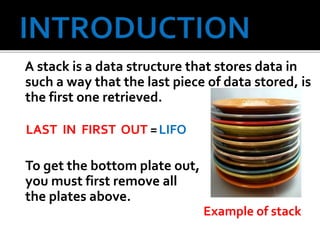
A stack is a data structure that stores data in
such a way that the last piece of data stored, is
the first one retrieved.
LAST IN FIRST OUT =LIFO
To get the bottom plate out,
you must first remove all
the plates above.
Example of stack
All these applications follow the LIFO logic.
REAL LIFE: Stacks are present everyday life.From
the books in a library, to the blank sheets of paper in a
printer tray systems are used STACK to complete their
acts.
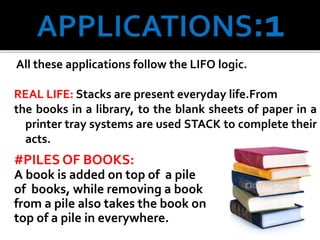
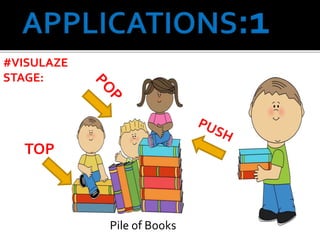
#PILES OF BOOKS:
A book is added on top of a pile
of books, while removing a book
from a pile also takes the book on
top of a pile in everywhere.
#VISULAZE
STAGE:
TOP
Pile of Books
#SOURCE CODE:
void push(int *top, element
item)
{
/* add an item to the global
stack */
if (*top >=
MAX_STACK_SIZE-1) {
stack_full( );
return;
}
stack[++*top] = item;
}
Push
element pop(int *top)
{
/* return the top element
from the stack */
if (*top == -1)
return
stack_empty( );
/* returns and error key */
return stack[(*top)--];
}
Pop
Rahul Debnath
ID: 142-15-3484
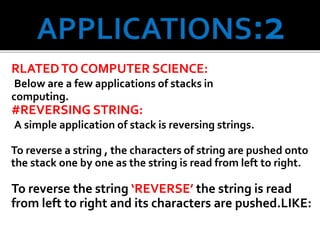
RLATEDTO COMPUTER SCIENCE:
Below are a few applications of stacks in
computing.
#REVERSING STRING:
A simple application of stack is reversing strings.
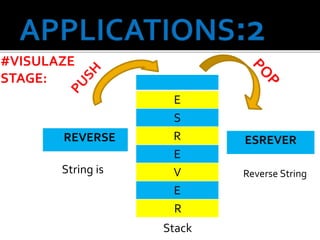
To reverse a string , the characters of string are pushed onto
the stack one by one as the string is read from left to right.
To reverse the string ‘REVERSE’ the string is read
from left to right and its characters are pushed.LIKE:
E
S
R
E
V
E
R
REVERSE ESREVER
String is Reverse String
Stack
#VISULAZE
STAGE:
#define MAX 20
int top = -1;
char stack[MAX];
char pop();
void push(char);
main()
{
char str[20];
int i;
printf(“Enter the string : ” );
gets(str);
for(i=0;i<strlen(str);i++)
push(str[i]);
for(i=0;i<strlen(str);i++)
str[i]=pop();
printf(“Reversed string is : “);
puts(str);
void push(char item){
if(top == (MAX-1))
{
printf(“Stack Overflown”);
return;
}
stack[++top] =item;
}/*End of push()*/
char pop(){
if(top == -1)
{
printf(“Stack Underflown”);
exit(1);
}
return stack[top–];
}
Abu Zafor Tomal
I.D:142-15-3816
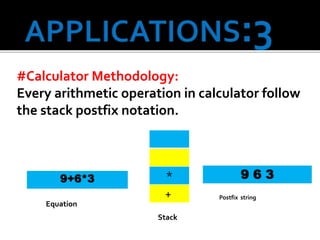
#Calculator Methodology:
Every arithmetic operation in calculator follow
the stack postfix notation.
*
+
9 6 39+6*3
Equation
Postfix string
Stack
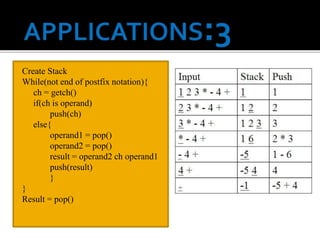
Create Stack
While(not end of postfix notation){
ch = getch()
if(ch is operand)
push(ch)
else{
operand1 = pop()
operand2 = pop()
result = operand2 ch operand1
push(result)
}
}
Result = pop()
Abul Hasnath Limon
ID:142-15-3532
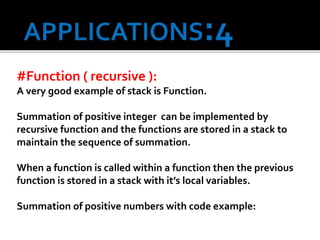
#Function ( recursive ):
A very good example of stack is Function.
Summation of positive integer can be implemented by
recursive function and the functions are stored in a stack to
maintain the sequence of summation.
When a function is called within a function then the previous
function is stored in a stack with it’s local variables.
Summation of positive numbers with code example:
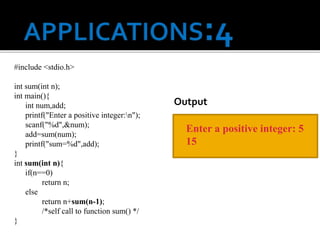
#include <stdio.h>
int sum(int n);
int main(){
int num,add;
printf("Enter a positive integer:n");
scanf("%d",&num);
add=sum(num);
printf("sum=%d",add);
}
int sum(int n){
if(n==0)
return n;
else
return n+sum(n-1);
/*self call to function sum() */
}
Enter a positive integer: 5
15
Output
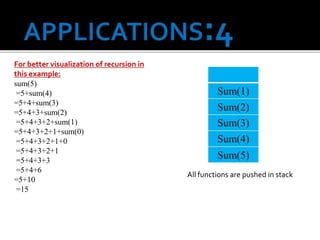
For better visualization of recursion in
this example:
sum(5)
=5+sum(4)
=5+4+sum(3)
=5+4+3+sum(2)
=5+4+3+2+sum(1)
=5+4+3+2+1+sum(0)
=5+4+3+2+1+0
=5+4+3+2+1
=5+4+3+3
=5+4+6
=5+10
=15
Sum(1)
Sum(2)
Sum(3)
Sum(4)
Sum(5)
All functions are pushed in stack
Umme Habiba
ID:142-15-3677
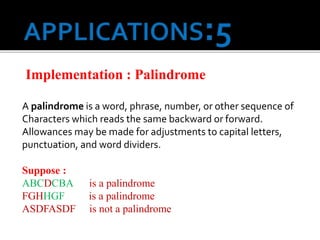
Implementation : Palindrome
A palindrome is a word, phrase, number, or other sequence of
Characters which reads the same backward or forward.
Allowances may be made for adjustments to capital letters,
punctuation, and word dividers.
Suppose :
ABCDCBA is a palindrome
FGHHGF is a palindrome
ASDFASDF is not a palindrome
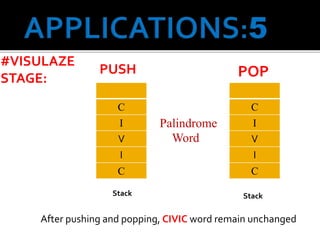
C
I
V
I
C
C
I
V
I
C
PUSH POP
Stack Stack
Palindrome
Word
After pushing and popping, CIVIC word remain unchanged
#VISULAZE
STAGE:
Source code:
char stk[50];
int top=-1;
void push(char c){
top++;
stk[top]=c;
}
char pop(){
char c;
c=stk[top];
top–;
return c;
}
void main(){
char in[30],b[30];
int i;
printf(“nn ENTER UR STRINGt”);
gets(in);
for(i=0;in[i]!=‘’;i++){
push(in[i]);
}
i=0;
while(top!=-1){
b[i]=pop();
i++;
}
b[i]=‘’;
if(strcmp(in,b)==0){
printf (“n STRING is
PALLINDROME”);
}
else{
printf (“n STRING IS NOT
PALLNDROME”);
}
}
ThankYou

Project of data structure

  • 2.
  • 3.
  • 4.
  • 5.
    A stack isa data structure that stores data in such a way that the last piece of data stored, is the first one retrieved. LAST IN FIRST OUT =LIFO To get the bottom plate out, you must first remove all the plates above. Example of stack
  • 6.
    All these applicationsfollow the LIFO logic. REAL LIFE: Stacks are present everyday life.From the books in a library, to the blank sheets of paper in a printer tray systems are used STACK to complete their acts. #PILES OF BOOKS: A book is added on top of a pile of books, while removing a book from a pile also takes the book on top of a pile in everywhere.
  • 7.
  • 8.
    #SOURCE CODE: void push(int*top, element item) { /* add an item to the global stack */ if (*top >= MAX_STACK_SIZE-1) { stack_full( ); return; } stack[++*top] = item; } Push element pop(int *top) { /* return the top element from the stack */ if (*top == -1) return stack_empty( ); /* returns and error key */ return stack[(*top)--]; } Pop
  • 9.
  • 10.
    RLATEDTO COMPUTER SCIENCE: Beloware a few applications of stacks in computing. #REVERSING STRING: A simple application of stack is reversing strings. To reverse a string , the characters of string are pushed onto the stack one by one as the string is read from left to right. To reverse the string ‘REVERSE’ the string is read from left to right and its characters are pushed.LIKE:
  • 11.
    E S R E V E R REVERSE ESREVER String isReverse String Stack #VISULAZE STAGE:
  • 12.
    #define MAX 20 inttop = -1; char stack[MAX]; char pop(); void push(char); main() { char str[20]; int i; printf(“Enter the string : ” ); gets(str); for(i=0;i<strlen(str);i++) push(str[i]); for(i=0;i<strlen(str);i++) str[i]=pop(); printf(“Reversed string is : “); puts(str); void push(char item){ if(top == (MAX-1)) { printf(“Stack Overflown”); return; } stack[++top] =item; }/*End of push()*/ char pop(){ if(top == -1) { printf(“Stack Underflown”); exit(1); } return stack[top–]; }
  • 13.
  • 14.
    #Calculator Methodology: Every arithmeticoperation in calculator follow the stack postfix notation. * + 9 6 39+6*3 Equation Postfix string Stack
  • 15.
    Create Stack While(not endof postfix notation){ ch = getch() if(ch is operand) push(ch) else{ operand1 = pop() operand2 = pop() result = operand2 ch operand1 push(result) } } Result = pop()
  • 16.
  • 17.
    #Function ( recursive): A very good example of stack is Function. Summation of positive integer can be implemented by recursive function and the functions are stored in a stack to maintain the sequence of summation. When a function is called within a function then the previous function is stored in a stack with it’s local variables. Summation of positive numbers with code example:
  • 18.
    #include <stdio.h> int sum(intn); int main(){ int num,add; printf("Enter a positive integer:n"); scanf("%d",&num); add=sum(num); printf("sum=%d",add); } int sum(int n){ if(n==0) return n; else return n+sum(n-1); /*self call to function sum() */ } Enter a positive integer: 5 15 Output
  • 19.
    For better visualizationof recursion in this example: sum(5) =5+sum(4) =5+4+sum(3) =5+4+3+sum(2) =5+4+3+2+sum(1) =5+4+3+2+1+sum(0) =5+4+3+2+1+0 =5+4+3+2+1 =5+4+3+3 =5+4+6 =5+10 =15 Sum(1) Sum(2) Sum(3) Sum(4) Sum(5) All functions are pushed in stack
  • 20.
  • 21.
    Implementation : Palindrome Apalindrome is a word, phrase, number, or other sequence of Characters which reads the same backward or forward. Allowances may be made for adjustments to capital letters, punctuation, and word dividers. Suppose : ABCDCBA is a palindrome FGHHGF is a palindrome ASDFASDF is not a palindrome
  • 22.
    C I V I C C I V I C PUSH POP Stack Stack Palindrome Word Afterpushing and popping, CIVIC word remain unchanged #VISULAZE STAGE:
  • 23.
    Source code: char stk[50]; inttop=-1; void push(char c){ top++; stk[top]=c; } char pop(){ char c; c=stk[top]; top–; return c; } void main(){ char in[30],b[30]; int i; printf(“nn ENTER UR STRINGt”); gets(in); for(i=0;in[i]!=‘’;i++){ push(in[i]); } i=0; while(top!=-1){ b[i]=pop(); i++; } b[i]=‘’; if(strcmp(in,b)==0){ printf (“n STRING is PALLINDROME”); } else{ printf (“n STRING IS NOT PALLNDROME”); } }
  • 24.