Stack
Abstract Data Types
 In computing, an abstract data type is a mathematical model for a certain class of data
structures that have similar behavior; or for certain data types of one or more programming
languages that have similar semantics.
 An abstract data type is defined indirectly, only by the operations that may be performed on it
and by mathematical constraints on the effects (and possibly cost) of those operations
 An abstract data type is defined indirectly, only by the operations that may be performed on it
and by mathematical constraints on the effects (and possibly cost) of those operations
Abstract Data Types (ADTs)
 For example, an abstract stack data structure could be defined by two operations: push, that inserts
some data item into the structure, and pop, that extracts an item from it; with the constraint that each
pop always returns the most recently pushed item that has not been popped yet.
 Abstract data types are purely theoretical entities, used (among other things) to simplify the
description of abstract algorithms, to classify and evaluate data structures, and to formally describe
the type systems of programming languages
Stack
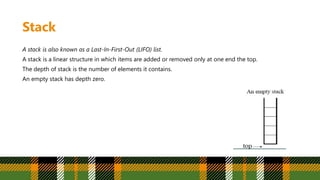
A stack is also known as a Last-In-First-Out (LIFO) list.
A stack is a linear structure in which items are added or removed only at one end the top.
The depth of stack is the number of elements it contains.
An empty stack has depth zero.
Stack –Real world examples
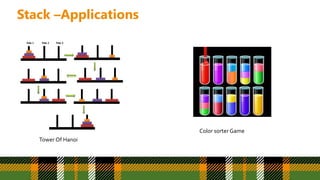
Stack –Applications
Evaluation of Arithmetic Expressions
Backtracking
Delimiter Checking
Reverse a Data
Processing Function Calls
Undo/Redo operations
Stack –Applications
Tower Of Hanoi Color sorter Game
Tower Of Hanoi
Color sorter Game
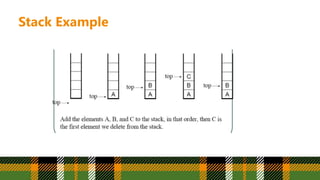
Stack Example
Stack Operations
A stack is an ADT that supports following operations:
 Push(S:ADT,O:Element):ADT-Inserts object O onto top of stack S.
 Pop(S:ADT):ADT-Removes the top object of stack S; if the stack is empty an error occur.
 Top/peek (S:ADT):element – Returns the top object of the stack, without removing it; if the stack
is empty an error occurs
 Stack Overflow-Insert an element into the full stack/Insert an element while stack reaches to max
size.
 Stack Underflow-Pop an element from an empty stack
 size(): how many items are in the stack?
 isEmpty(): false if there are 1 or more items in stack, true otherwise
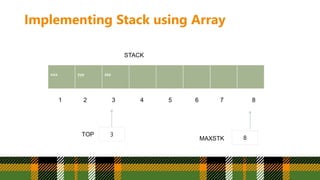
Implementing Stack using Array
STACK
3
TOP
8
MAXSTK
Push()
This procedure pushes an ITEM onto a stack
PUSH(STACK,TOP,MAXSTK,ITEM)
1. If TOP = MAXSTK, then
Print : Overflow, and Return
2. Set TOP = TOP + 1 [Increase TOP by 1]
3. Set STACK[TOP]= ITEM [Insert ITEM in new TOP position]
4. Return
Pop()
This procedure deletes the top element of stack and assigns it to the variable ITEM
POP(STACK,TOP,ITEM)
1. IF TOP = 0, then
Print : Underflow, and Return
2. Set ITEM = STACK[TOP] [Assigns TOP element to ITEM]
3. Set TOP= TOP - 1 [Decreases TOP by 1]
4. Return
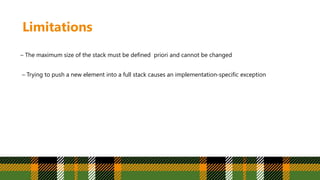
Limitations
– The maximum size of the stack must be defined priori and cannot be changed
– Trying to push a new element into a full stack causes an implementation-specific exception
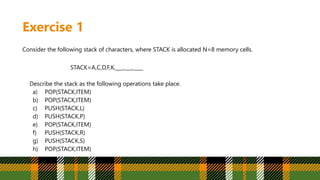
Exercise 1
Consider the following stack of characters, where STACK is allocated N=8 memory cells.
STACK=A,C,D,F,K,___,___,____
Describe the stack as the following operations take place.
a) POP(STACK,ITEM)
b) POP(STACK,ITEM)
c) PUSH(STACK,L)
d) PUSH(STACK,P)
e) POP(STACK,ITEM)
f) PUSH(STACK,R)
g) PUSH(STACK,S)
h) POP(STACK,ITEM)
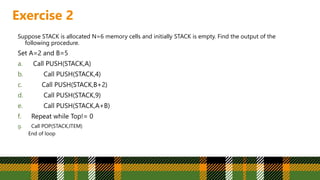
Exercise 2
Suppose STACK is allocated N=6 memory cells and initially STACK is empty. Find the output of the
following procedure.
Set A=2 and B=5
a. Call PUSH(STACK,A)
b. Call PUSH(STACK,4)
c. Call PUSH(STACK,B+2)
d. Call PUSH(STACK,9)
e. Call PUSH(STACK,A+B)
f. Repeat while Top!= 0
g. Call POP(STACK,ITEM)
End of loop
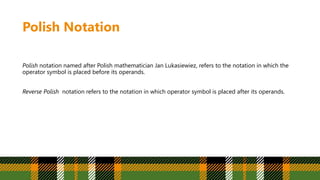
Polish Notation
Polish notation named after Polish mathematician Jan Lukasiewiez, refers to the notation in which the
operator symbol is placed before its operands.
Reverse Polish notation refers to the notation in which operator symbol is placed after its operands.
Evaluation of expression
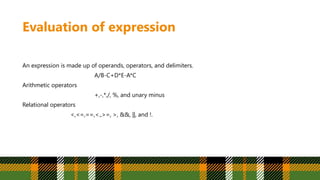
An expression is made up of operands, operators, and delimiters.
A/B-C+D*E-A*C
Arithmetic operators
+,-,*,/, %, and unary minus
Relational operators
<,<=,==,<.,>=, >, &&, ||, and !.
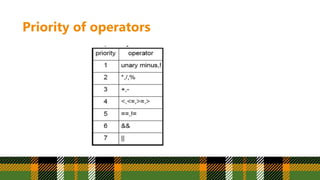
Priority of operators
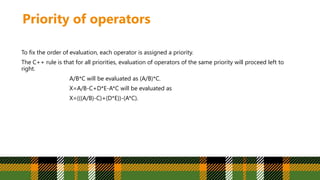
To fix the order of evaluation, each operator is assigned a priority.
The C++ rule is that for all priorities, evaluation of operators of the same priority will proceed left to
right.
A/B*C will be evaluated as (A/B)*C.
X=A/B-C+D*E-A*C will be evaluated as
X=(((A/B)-C)+(D*E))-(A*C).
Priority of operators
Postfix notation
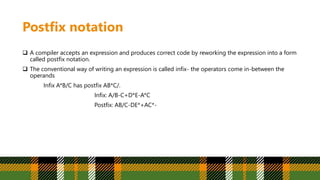
 A compiler accepts an expression and produces correct code by reworking the expression into a form
called postfix notation.
 The conventional way of writing an expression is called infix- the operators come in-between the
operands
Infix A*B/C has postfix AB*C/.
Infix: A/B-C+D*E-A*C
Postfix: AB/C-DE*+AC*-
Postfix Evaluation algorithm
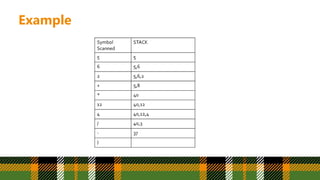
This algorithm finds the VALUE of an arithmetic expression P written in post fix notation.
1. Add a right parenthesis ”)” at the end of P [This acts as sentinel]
2. Scan P from left to right and repeat Step 3 and 4 for each element of P until the sentinel “)” is encountered.
3. If an operand is encountered, put it on STACK.
4. If an operator ɸ is encountered then
a. Remove the two top elements of STACK, where A is the top element and B is the next to top element.
b. Evaluate B ɸ A
c. Place the result of b back to the STACK
[End of if structure]
[End of step 2 loop]
5. Set VALUE equal to the top element on STACK
6. Exit
Example
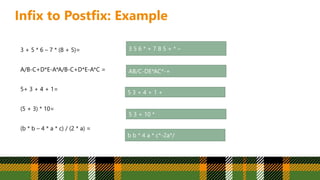
Infix to Postfix: Example
3 5 6 * + 7 8 5 + * –
AB/C-DE*AC*-+
5 3 + 4 + 1 +
5 3 + 10 *
b b * 4 a * c*-2a*/
3 + 5 * 6 – 7 * (8 + 5)=
A/B-C+D*E-A*A/B-C+D*E-A*C =
5+ 3 + 4 + 1=
(5 + 3) * 10=
(b * b – 4 * a * c) / (2 * a) =
Evaluating Arithmetic Expression
The computer usually evaluate an arithmetic expression written in infix notation in two steps:
First it converts the expression to postfix notation, and
Then it evaluates the postfix expression.
Infix to postfix conversion algorithm
 There is an algorithm to convert an infix expression into a postfix expression. It uses a stack; but in
this case, the stack is used to hold operators rather than numbers.
 The purpose of the stack is to reverse the order of the operators in the expression. It also serves as a
storage structure, since no operator can be printed until both of its operands have appeared.
 In this algorithm, all operands are printed (or sent to output) when they are read. There are more
complicated rules to handle operators and parentheses.
Infix to postfix conversion algorithm
POLISH(Q,P)
Suppose Q is an arithmetic expression written in infix notation. This algorithm finds the equivalent postfix expression P.
1. Push “(“ onto STACK , add “)” to the end of Q.
2. Scan Q from left to right and repeat Step 3 to 6 for each element Q until the STACK is empty:
3. If an operand is encountered, add it to P.
4. If a left parenthesis is countered push it onto the STACK.
5. If an operator ɸ is encountered then
a. Repeatedly pop from the STACK and add to P each operator (on the top of the STACK) which has the same
precedence as or higher precedence than ɸ.
b. Add ɸ to STACK
[End of If Structure]
Infix to postfix conversion algorithm (con’d)
6. If a right parenthesis is encountered, then:
a. Repeatedly pop from the STACK and add to P each operator (on the top of the STACK) until a left parenthesis
is encountered.
b. Remove the left parenthesis. [Do not add the left parenthesis to P].
[End of if structure]
[End of If structure]
7. Exit
Example
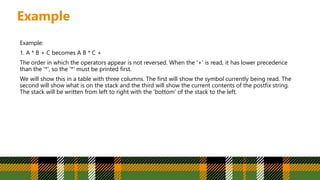
Example:
1. A * B + C becomes A B * C +
The order in which the operators appear is not reversed. When the '+' is read, it has lower precedence
than the '*', so the '*' must be printed first.
We will show this in a table with three columns. The first will show the symbol currently being read. The
second will show what is on the stack and the third will show the current contents of the postfix string.
The stack will be written from left to right with the 'bottom' of the stack to the left.
Example
A * B + C
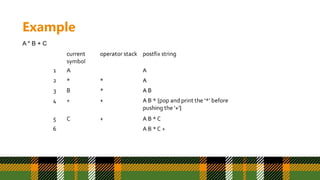
Example
A + B * C
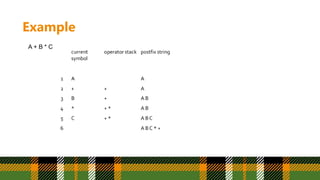
Example
A * (B + C)
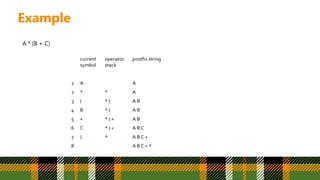
Example
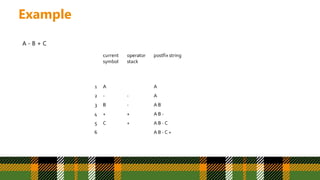
A - B + C
Example
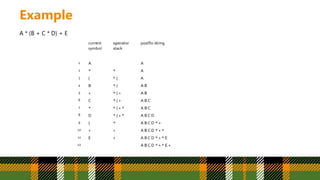
A * (B + C * D) + E

Lec5-Stack-bukc-28022024-112316am (1) .pptx

  • 1.
  • 2.
    Abstract Data Types In computing, an abstract data type is a mathematical model for a certain class of data structures that have similar behavior; or for certain data types of one or more programming languages that have similar semantics.  An abstract data type is defined indirectly, only by the operations that may be performed on it and by mathematical constraints on the effects (and possibly cost) of those operations  An abstract data type is defined indirectly, only by the operations that may be performed on it and by mathematical constraints on the effects (and possibly cost) of those operations
  • 3.
    Abstract Data Types(ADTs)  For example, an abstract stack data structure could be defined by two operations: push, that inserts some data item into the structure, and pop, that extracts an item from it; with the constraint that each pop always returns the most recently pushed item that has not been popped yet.  Abstract data types are purely theoretical entities, used (among other things) to simplify the description of abstract algorithms, to classify and evaluate data structures, and to formally describe the type systems of programming languages
  • 4.
    Stack A stack isalso known as a Last-In-First-Out (LIFO) list. A stack is a linear structure in which items are added or removed only at one end the top. The depth of stack is the number of elements it contains. An empty stack has depth zero.
  • 5.
  • 6.
    Stack –Applications Evaluation ofArithmetic Expressions Backtracking Delimiter Checking Reverse a Data Processing Function Calls Undo/Redo operations
  • 7.
    Stack –Applications Tower OfHanoi Color sorter Game Tower Of Hanoi Color sorter Game
  • 8.
  • 9.
    Stack Operations A stackis an ADT that supports following operations:  Push(S:ADT,O:Element):ADT-Inserts object O onto top of stack S.  Pop(S:ADT):ADT-Removes the top object of stack S; if the stack is empty an error occur.  Top/peek (S:ADT):element – Returns the top object of the stack, without removing it; if the stack is empty an error occurs  Stack Overflow-Insert an element into the full stack/Insert an element while stack reaches to max size.  Stack Underflow-Pop an element from an empty stack  size(): how many items are in the stack?  isEmpty(): false if there are 1 or more items in stack, true otherwise
  • 10.
    Implementing Stack usingArray STACK 3 TOP 8 MAXSTK
  • 11.
    Push() This procedure pushesan ITEM onto a stack PUSH(STACK,TOP,MAXSTK,ITEM) 1. If TOP = MAXSTK, then Print : Overflow, and Return 2. Set TOP = TOP + 1 [Increase TOP by 1] 3. Set STACK[TOP]= ITEM [Insert ITEM in new TOP position] 4. Return
  • 12.
    Pop() This procedure deletesthe top element of stack and assigns it to the variable ITEM POP(STACK,TOP,ITEM) 1. IF TOP = 0, then Print : Underflow, and Return 2. Set ITEM = STACK[TOP] [Assigns TOP element to ITEM] 3. Set TOP= TOP - 1 [Decreases TOP by 1] 4. Return
  • 13.
    Limitations – The maximumsize of the stack must be defined priori and cannot be changed – Trying to push a new element into a full stack causes an implementation-specific exception
  • 14.
    Exercise 1 Consider thefollowing stack of characters, where STACK is allocated N=8 memory cells. STACK=A,C,D,F,K,___,___,____ Describe the stack as the following operations take place. a) POP(STACK,ITEM) b) POP(STACK,ITEM) c) PUSH(STACK,L) d) PUSH(STACK,P) e) POP(STACK,ITEM) f) PUSH(STACK,R) g) PUSH(STACK,S) h) POP(STACK,ITEM)
  • 15.
    Exercise 2 Suppose STACKis allocated N=6 memory cells and initially STACK is empty. Find the output of the following procedure. Set A=2 and B=5 a. Call PUSH(STACK,A) b. Call PUSH(STACK,4) c. Call PUSH(STACK,B+2) d. Call PUSH(STACK,9) e. Call PUSH(STACK,A+B) f. Repeat while Top!= 0 g. Call POP(STACK,ITEM) End of loop
  • 16.
    Polish Notation Polish notationnamed after Polish mathematician Jan Lukasiewiez, refers to the notation in which the operator symbol is placed before its operands. Reverse Polish notation refers to the notation in which operator symbol is placed after its operands.
  • 17.
    Evaluation of expression Anexpression is made up of operands, operators, and delimiters. A/B-C+D*E-A*C Arithmetic operators +,-,*,/, %, and unary minus Relational operators <,<=,==,<.,>=, >, &&, ||, and !.
  • 18.
    Priority of operators Tofix the order of evaluation, each operator is assigned a priority. The C++ rule is that for all priorities, evaluation of operators of the same priority will proceed left to right. A/B*C will be evaluated as (A/B)*C. X=A/B-C+D*E-A*C will be evaluated as X=(((A/B)-C)+(D*E))-(A*C).
  • 19.
  • 20.
    Postfix notation  Acompiler accepts an expression and produces correct code by reworking the expression into a form called postfix notation.  The conventional way of writing an expression is called infix- the operators come in-between the operands Infix A*B/C has postfix AB*C/. Infix: A/B-C+D*E-A*C Postfix: AB/C-DE*+AC*-
  • 21.
    Postfix Evaluation algorithm Thisalgorithm finds the VALUE of an arithmetic expression P written in post fix notation. 1. Add a right parenthesis ”)” at the end of P [This acts as sentinel] 2. Scan P from left to right and repeat Step 3 and 4 for each element of P until the sentinel “)” is encountered. 3. If an operand is encountered, put it on STACK. 4. If an operator ɸ is encountered then a. Remove the two top elements of STACK, where A is the top element and B is the next to top element. b. Evaluate B ɸ A c. Place the result of b back to the STACK [End of if structure] [End of step 2 loop] 5. Set VALUE equal to the top element on STACK 6. Exit
  • 22.
  • 23.
    Infix to Postfix:Example 3 5 6 * + 7 8 5 + * – AB/C-DE*AC*-+ 5 3 + 4 + 1 + 5 3 + 10 * b b * 4 a * c*-2a*/ 3 + 5 * 6 – 7 * (8 + 5)= A/B-C+D*E-A*A/B-C+D*E-A*C = 5+ 3 + 4 + 1= (5 + 3) * 10= (b * b – 4 * a * c) / (2 * a) =
  • 24.
    Evaluating Arithmetic Expression Thecomputer usually evaluate an arithmetic expression written in infix notation in two steps: First it converts the expression to postfix notation, and Then it evaluates the postfix expression.
  • 25.
    Infix to postfixconversion algorithm  There is an algorithm to convert an infix expression into a postfix expression. It uses a stack; but in this case, the stack is used to hold operators rather than numbers.  The purpose of the stack is to reverse the order of the operators in the expression. It also serves as a storage structure, since no operator can be printed until both of its operands have appeared.  In this algorithm, all operands are printed (or sent to output) when they are read. There are more complicated rules to handle operators and parentheses.
  • 26.
    Infix to postfixconversion algorithm POLISH(Q,P) Suppose Q is an arithmetic expression written in infix notation. This algorithm finds the equivalent postfix expression P. 1. Push “(“ onto STACK , add “)” to the end of Q. 2. Scan Q from left to right and repeat Step 3 to 6 for each element Q until the STACK is empty: 3. If an operand is encountered, add it to P. 4. If a left parenthesis is countered push it onto the STACK. 5. If an operator ɸ is encountered then a. Repeatedly pop from the STACK and add to P each operator (on the top of the STACK) which has the same precedence as or higher precedence than ɸ. b. Add ɸ to STACK [End of If Structure]
  • 27.
    Infix to postfixconversion algorithm (con’d) 6. If a right parenthesis is encountered, then: a. Repeatedly pop from the STACK and add to P each operator (on the top of the STACK) until a left parenthesis is encountered. b. Remove the left parenthesis. [Do not add the left parenthesis to P]. [End of if structure] [End of If structure] 7. Exit
  • 28.
    Example Example: 1. A *B + C becomes A B * C + The order in which the operators appear is not reversed. When the '+' is read, it has lower precedence than the '*', so the '*' must be printed first. We will show this in a table with three columns. The first will show the symbol currently being read. The second will show what is on the stack and the third will show the current contents of the postfix string. The stack will be written from left to right with the 'bottom' of the stack to the left.
  • 29.
  • 30.
  • 31.
  • 32.
  • 33.
    Example A * (B+ C * D) + E