A
Data Structure
 What is a Stack
 Stack Operations
 LIFO Stack
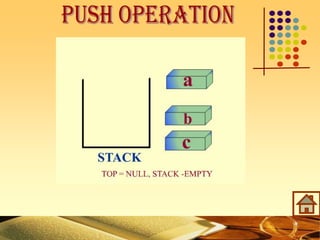
 Animation Depicting Push Operation
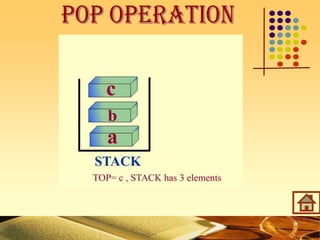
 Animation Depicting Pop Operation
 Array Implementation of Stack
 Applications of stack
Checking for balanced braces
Converting Infix Expression to Postfix
Postfix calculator
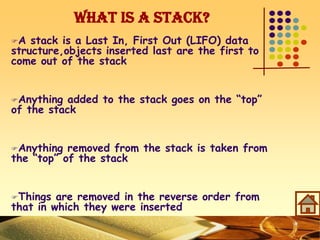
What is a Stack?
A stack is a Last In, First Out (LIFO) data
structure,objects inserted last are the first to
come out of the stack
Anything added to the stack goes on the “top”
of the stack
Anything removed from the stack is taken from
the “top” of the stack
Things are removed in the reverse order from
that in which they were inserted
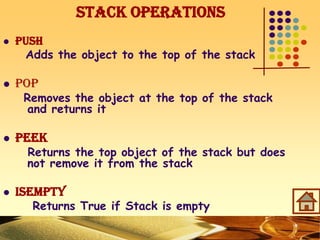
Stack Operations
 PUSH
Adds the object to the top of the stack
 POP
Removes the object at the top of the stack
and returns it
 PEEK
Returns the top object of the stack but does
not remove it from the stack
 ISEMPTY
Returns True if Stack is empty
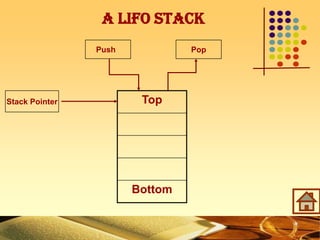
A LIFO Stack
Top
Bottom
Stack Pointer
Push Pop
array Implementation of Stack
A[1] A[2] …. …. …. A[n]
w y
Pop
Stack pointer
J=n
Stack Full
Stack pointer
J=2
Before Push
Stack pointer
J=3
After Push
After many
Push Ops
Push X w y x
Stack Pointer
J=0
Stack Empty
After many Pop ops
Stack Pointer
J=3
Before Pop
Stack Pointer
J=2
After Pop
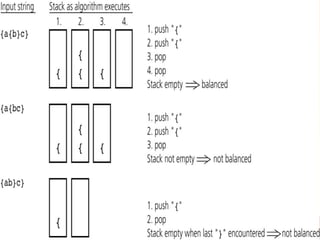
Checking for Balanced Braces
 ([]({()}[()])) is balanced; ([]({()}[())]) is not
 Simple counting is not enough to check
balance
 You can do it with a stack: going left to
right,
 If you see a (, [, or {, push it on the
stack
 If you see a ), ], or }, pop the stack
and check whether you got the
corresponding (, [, or {
 When you reach the end, check that the
stack is empty
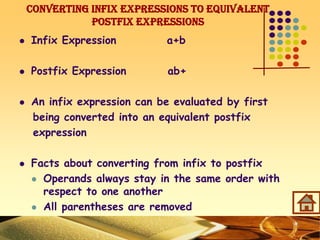
Converting Infix Expressions to Equivalent
Postfix Expressions
 Infix Expression a+b
 Postfix Expression ab+
 An infix expression can be evaluated by first
being converted into an equivalent postfix
expression
 Facts about converting from infix to postfix
 Operands always stay in the same order with
respect to one another
 All parentheses are removed
Algorithm : Converting Infix Expression to
Postfix using stack
Suppose X is an arithmetic expression written in infix notation.
This algorithm finds the equivalent postfix expression Y.
1. Push "(" onto STACK, and add ")" to the end of X.
2. Scan X from left to right and REPEAT Steps 3 to 6 for each element of X UNTIL the
STACK is empty :
3. If an operand is encountered, add it to Y.
4. If a left parenthesis is encountered, push it onto STACK.
5. If an operator is encountered, then :
(a) Repeatedly pop from STACK and add to Y each operator (on the top of STACK) which has
the same precedence as or higher precedence than operator.
(b) Add operator to STACK.
/* End of If structure * /
6. If a right parenthesis is encountered, then :
(a) Repeatedly pop from STACK and add to Y each operator (on the top of STACK)
until a left parenthesis is encountered.
(b) Remove the left parenthesis. [Do not add the left parenthesis to Y].
/* End of If structure * /
/* End of Step 2 loop * /
7. END.
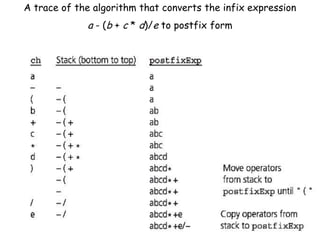
A trace of the algorithm that converts the infix expression
a - (b + c * d)/e to postfix form
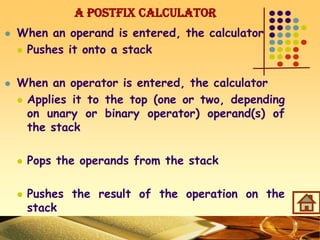
A postfix calculator
 When an operand is entered, the calculator
 Pushes it onto a stack
 When an operator is entered, the calculator
 Applies it to the top (one or two, depending
on unary or binary operator) operand(s) of
the stack
 Pops the operands from the stack
 Pushes the result of the operation on the
stack
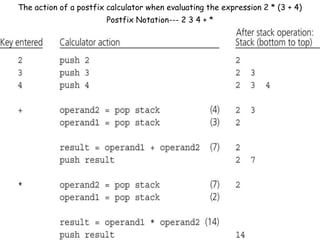
The action of a postfix calculator when evaluating the expression 2 * (3 + 4)
Postfix Notation--- 2 3 4 + *
Acknowledgement
 Data Structures BY Tanenbaum
 Internet
 Computer Science C++ A textbook for class XII -By
Sumita Arora
prepared by-
Seema kaushik,
Computer science department,
DAV public school, sector-14, gurgaon

stack-111104232459-phpapp02.pdf

  • 1.
  • 2.
     What isa Stack  Stack Operations  LIFO Stack  Animation Depicting Push Operation  Animation Depicting Pop Operation  Array Implementation of Stack  Applications of stack Checking for balanced braces Converting Infix Expression to Postfix Postfix calculator
  • 3.
    What is aStack? A stack is a Last In, First Out (LIFO) data structure,objects inserted last are the first to come out of the stack Anything added to the stack goes on the “top” of the stack Anything removed from the stack is taken from the “top” of the stack Things are removed in the reverse order from that in which they were inserted
  • 4.
    Stack Operations  PUSH Addsthe object to the top of the stack  POP Removes the object at the top of the stack and returns it  PEEK Returns the top object of the stack but does not remove it from the stack  ISEMPTY Returns True if Stack is empty
  • 5.
  • 8.
    array Implementation ofStack A[1] A[2] …. …. …. A[n] w y Pop Stack pointer J=n Stack Full Stack pointer J=2 Before Push Stack pointer J=3 After Push After many Push Ops Push X w y x Stack Pointer J=0 Stack Empty After many Pop ops Stack Pointer J=3 Before Pop Stack Pointer J=2 After Pop
  • 9.
    Checking for BalancedBraces  ([]({()}[()])) is balanced; ([]({()}[())]) is not  Simple counting is not enough to check balance  You can do it with a stack: going left to right,  If you see a (, [, or {, push it on the stack  If you see a ), ], or }, pop the stack and check whether you got the corresponding (, [, or {  When you reach the end, check that the stack is empty
  • 11.
    Converting Infix Expressionsto Equivalent Postfix Expressions  Infix Expression a+b  Postfix Expression ab+  An infix expression can be evaluated by first being converted into an equivalent postfix expression  Facts about converting from infix to postfix  Operands always stay in the same order with respect to one another  All parentheses are removed
  • 12.
    Algorithm : ConvertingInfix Expression to Postfix using stack Suppose X is an arithmetic expression written in infix notation. This algorithm finds the equivalent postfix expression Y. 1. Push "(" onto STACK, and add ")" to the end of X. 2. Scan X from left to right and REPEAT Steps 3 to 6 for each element of X UNTIL the STACK is empty : 3. If an operand is encountered, add it to Y. 4. If a left parenthesis is encountered, push it onto STACK. 5. If an operator is encountered, then : (a) Repeatedly pop from STACK and add to Y each operator (on the top of STACK) which has the same precedence as or higher precedence than operator. (b) Add operator to STACK. /* End of If structure * / 6. If a right parenthesis is encountered, then : (a) Repeatedly pop from STACK and add to Y each operator (on the top of STACK) until a left parenthesis is encountered. (b) Remove the left parenthesis. [Do not add the left parenthesis to Y]. /* End of If structure * / /* End of Step 2 loop * / 7. END.
  • 13.
    A trace ofthe algorithm that converts the infix expression a - (b + c * d)/e to postfix form
  • 14.
    A postfix calculator When an operand is entered, the calculator  Pushes it onto a stack  When an operator is entered, the calculator  Applies it to the top (one or two, depending on unary or binary operator) operand(s) of the stack  Pops the operands from the stack  Pushes the result of the operation on the stack
  • 15.
    The action ofa postfix calculator when evaluating the expression 2 * (3 + 4) Postfix Notation--- 2 3 4 + *
  • 16.
    Acknowledgement  Data StructuresBY Tanenbaum  Internet  Computer Science C++ A textbook for class XII -By Sumita Arora prepared by- Seema kaushik, Computer science department, DAV public school, sector-14, gurgaon