A
Data Structure
 What is a Stack
 Stack Operations
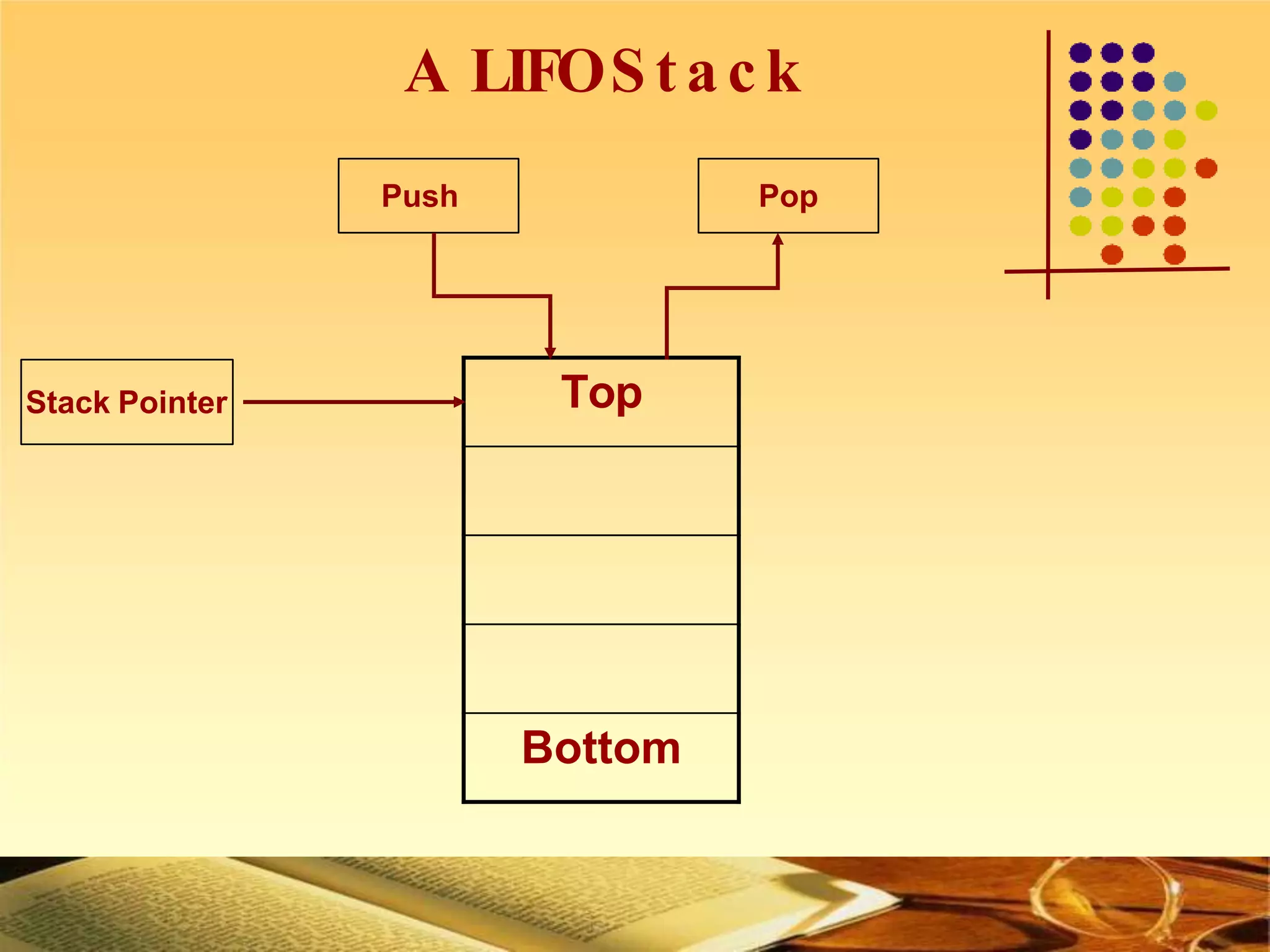
 LIFO Stack
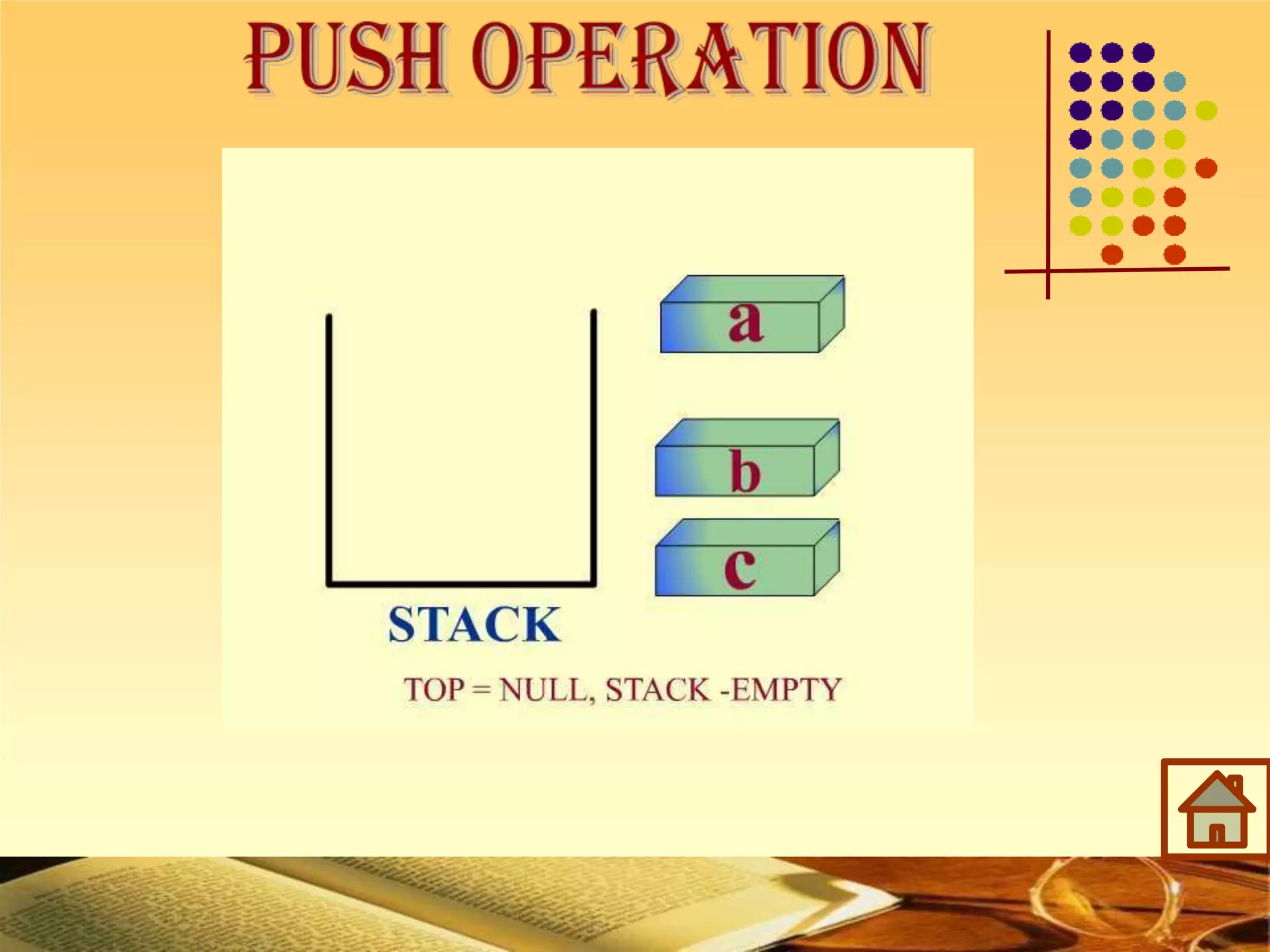
 Animation Depicting Push Operation
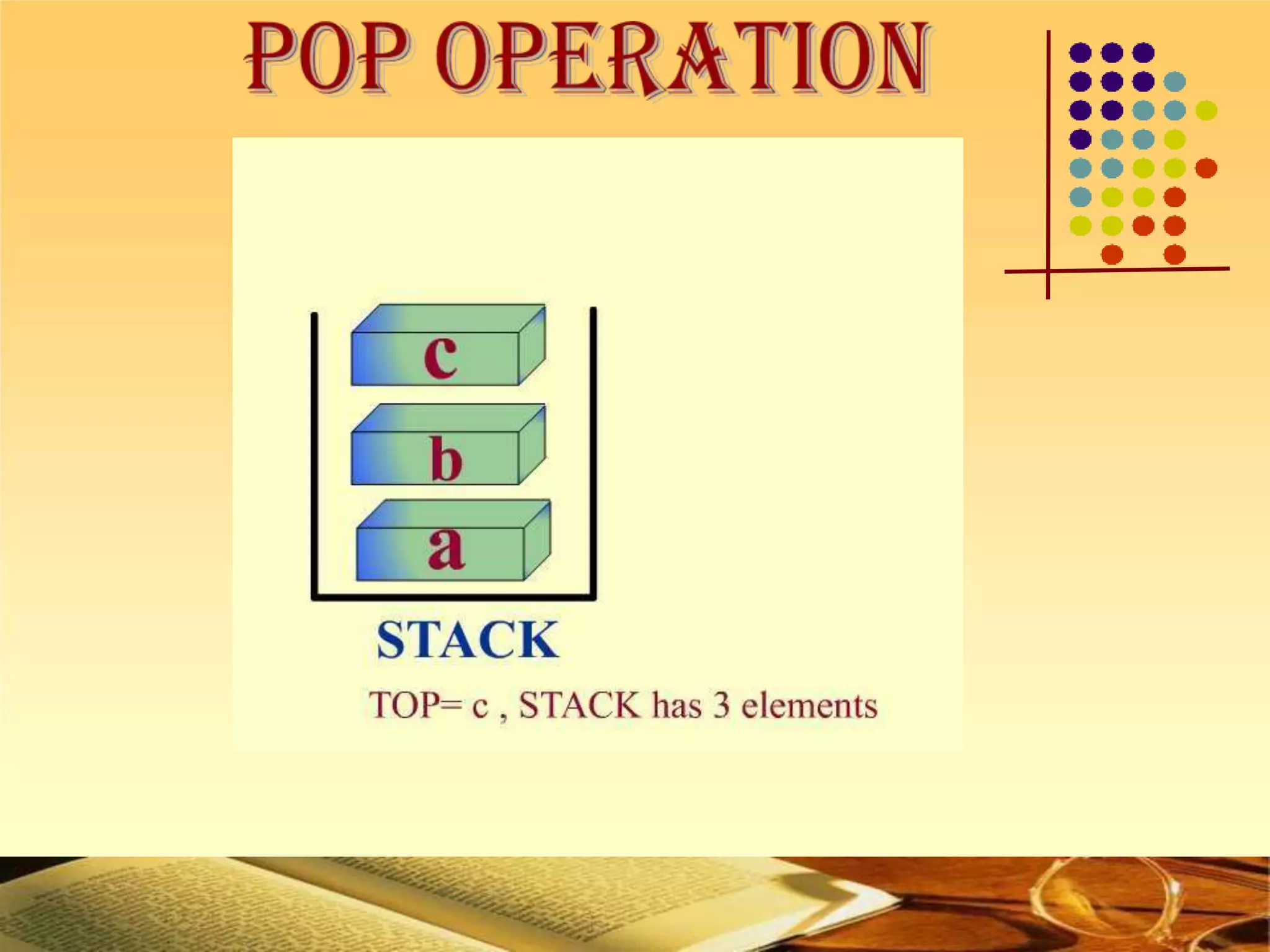
 Animation Depicting Pop Operation
 A r r a y Implementation of Stack
 Applications of s t a c k
Checking f o r balanced br aces
Converting Infix Expression t o Postfix
Postfix c a l c u l a t o r
What is a Stack
A stack is a Last In, First Out (LIFO) data structure,
objects inserted last are the first to come out of the stack
Anything added to the stack goes on the “top” of the stack
Anything removed from the stack is taken from the “top” of
the stack
Things are removed in the reverse order from that in which
they were inserted
S t a c k Operations
 PUSH
Adds the object to the top of the stack
 POP
Removes the object at the top of the stack
and returns it
 PEEK
Returns the top object of the stack but does
not remove it from the stack
 ISEMPTY
Returns True if Stack is empty
A LIFOS t a c k
Top
Bottom
Stack Pointer
Push Pop
Array Implementation o f S t a c k
A[1] A[2] …. …. …. A[n]
w y
Stack pointer
J=n
Stack Full
Stack pointer
J=2
Before Push
Stack pointer
J=3
After Push
After many
Push Ops
Push X w y x
Stack Pointer
J=0
Stack Empty
Pop
After many Pop ops
Stack Pointer
J=3
Before Pop
Stack Pointer
J=2
After Pop
Implicit and Explicit stack
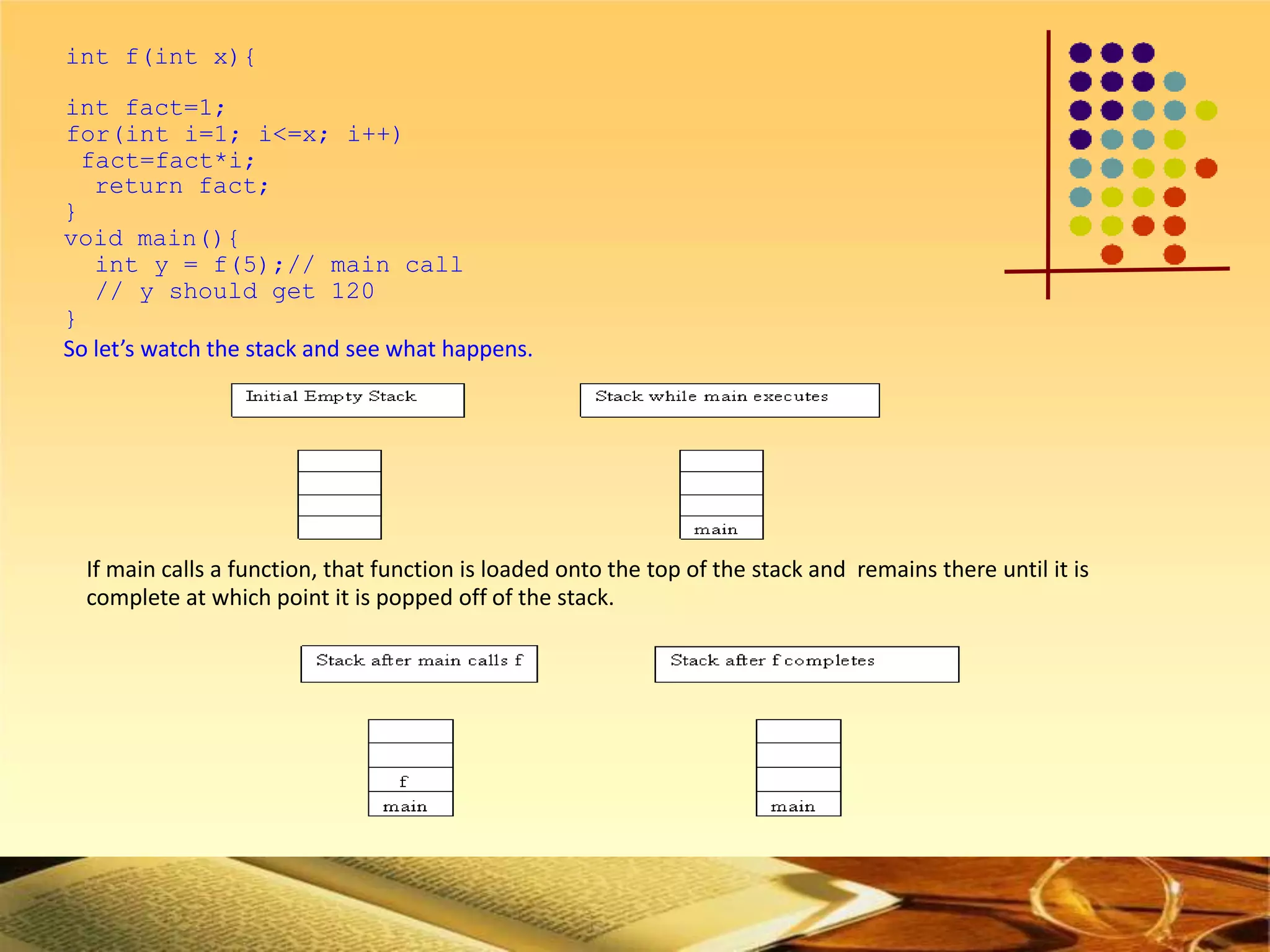
int f(int x){
int fact=1;
for(int i=1; i<=x; i++)
fact=fact*i;
return fact;
}
void main(){
int y = f(5);// main call
// y should get 120
}
So let’s watch the stack and see what happens.
If main calls a function, that function is loaded onto the top of the stack and remains there until it is
complete at which point it is popped off of the stack.
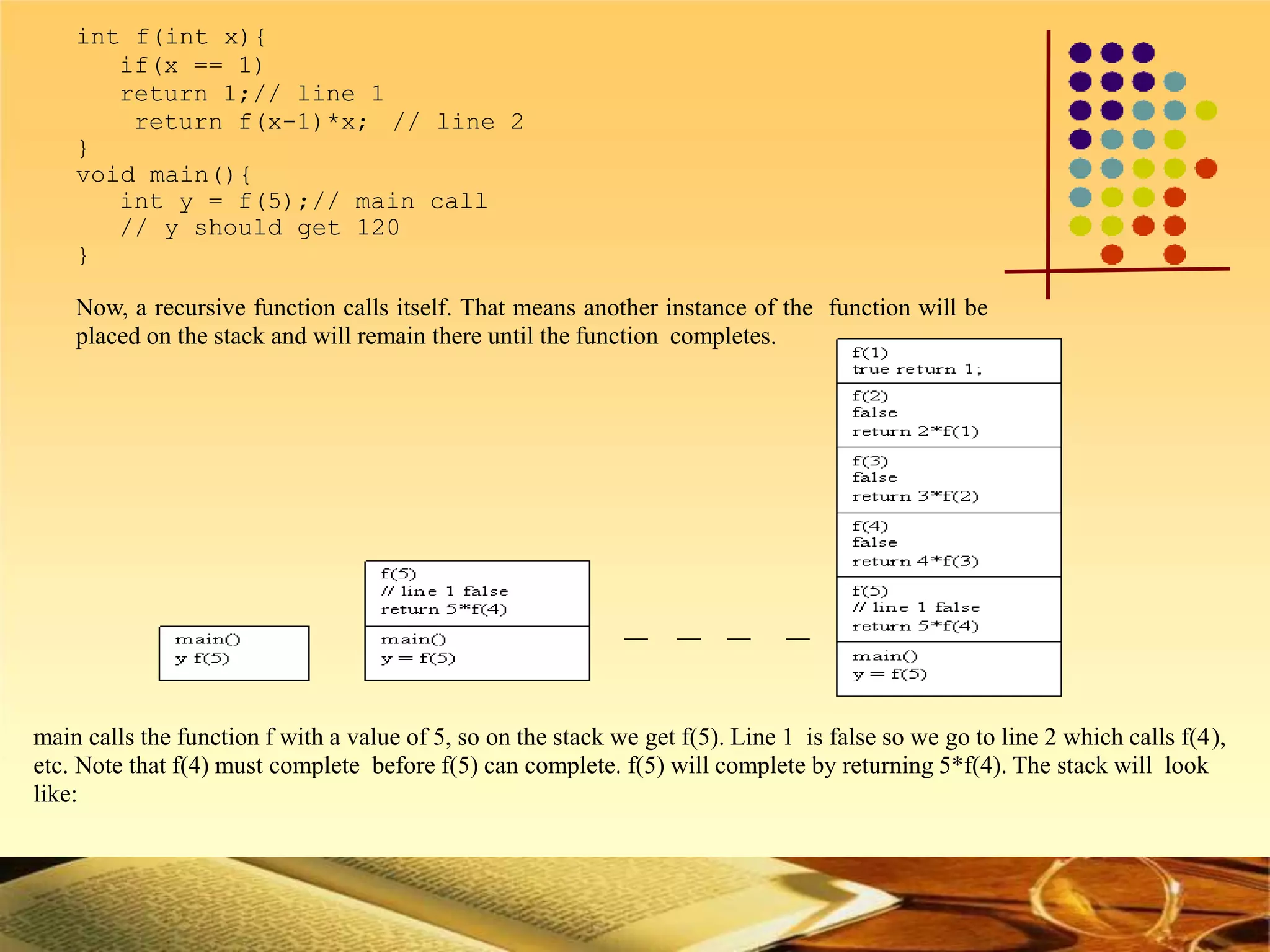
int f(int x){
if(x == 1)
return 1;// line 1
return f(x-1)*x; // line 2
}
void main(){
int y = f(5);// main call
// y should get 120
}
Now, a recursive function calls itself. That means another instance of the function will be
placed on the stack and will remain there until the function completes.
main calls the function f with a value of 5, so on the stack we get f(5). Line 1 is false so we go to line 2 which calls f(4),
etc. Note that f(4) must complete before f(5) can complete. f(5) will complete by returning 5*f(4). The stack will look
like:
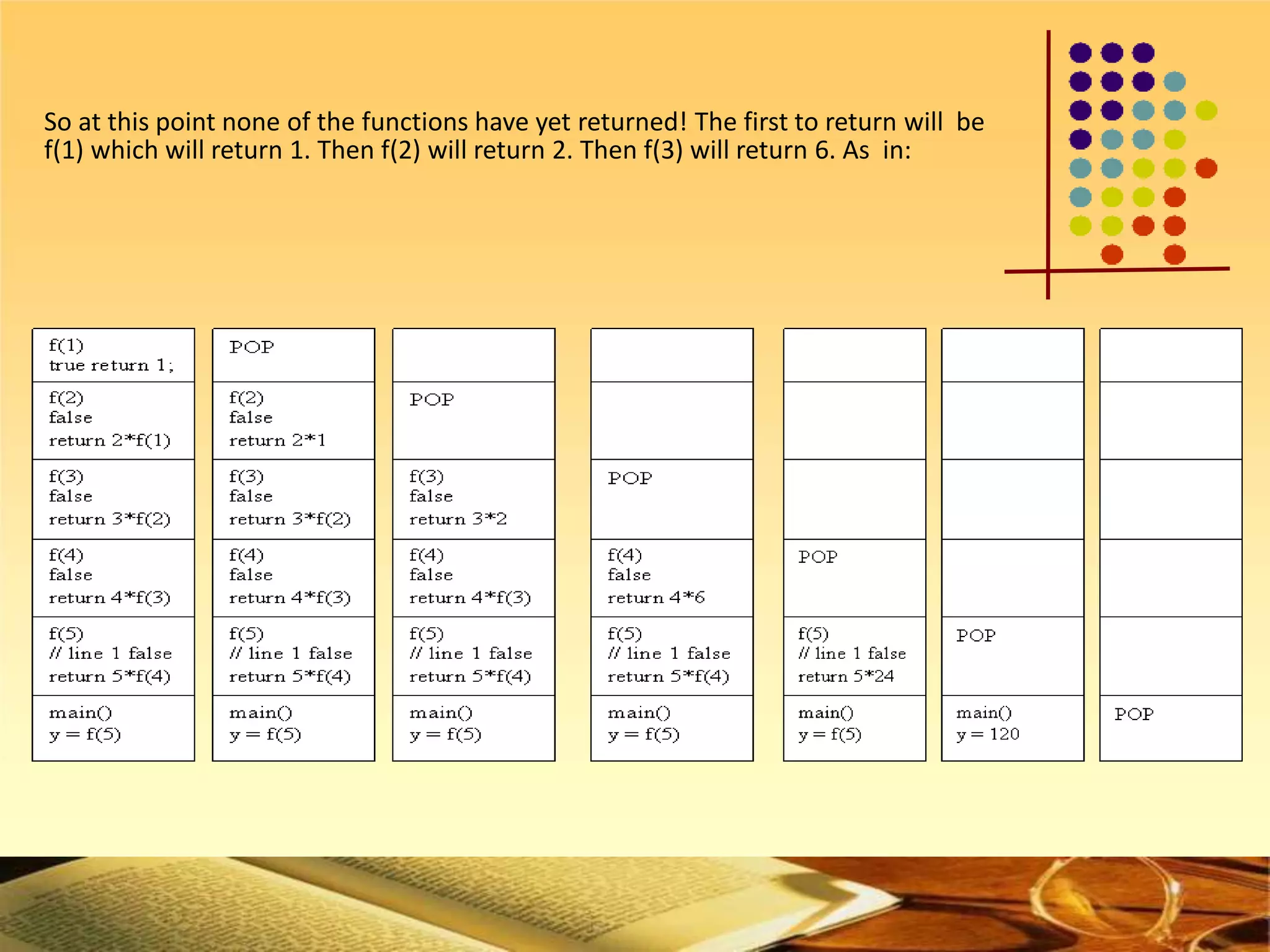
So at this point none of the functions have yet returned! The first to return will be
f(1) which will return 1. Then f(2) will return 2. Then f(3) will return 6. As in:
Application of Stack
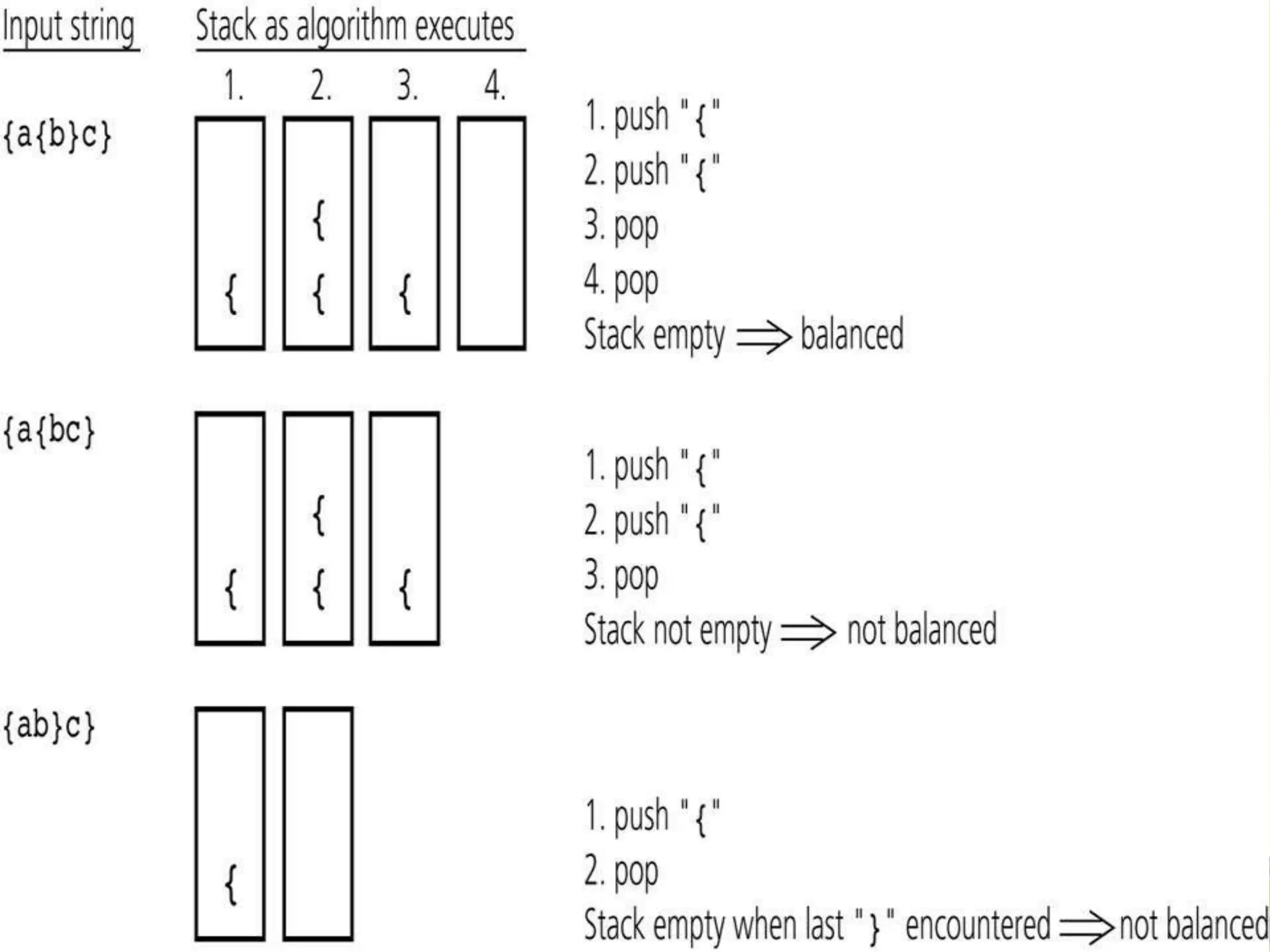
Checking f o r Balanced Bra ces
 ([]({()}[()])) is balanced; ([]({()}[())]) is not
 Simple counting is not enough to check balance
 You can do it with a stack: going left to right,
 If you see a (, [, or {, push it on the stack
 If you see a ), ], or }, pop the stack and check
whether you got the corresponding (, [, or {
 When you reach the end, check that the
stack is empty
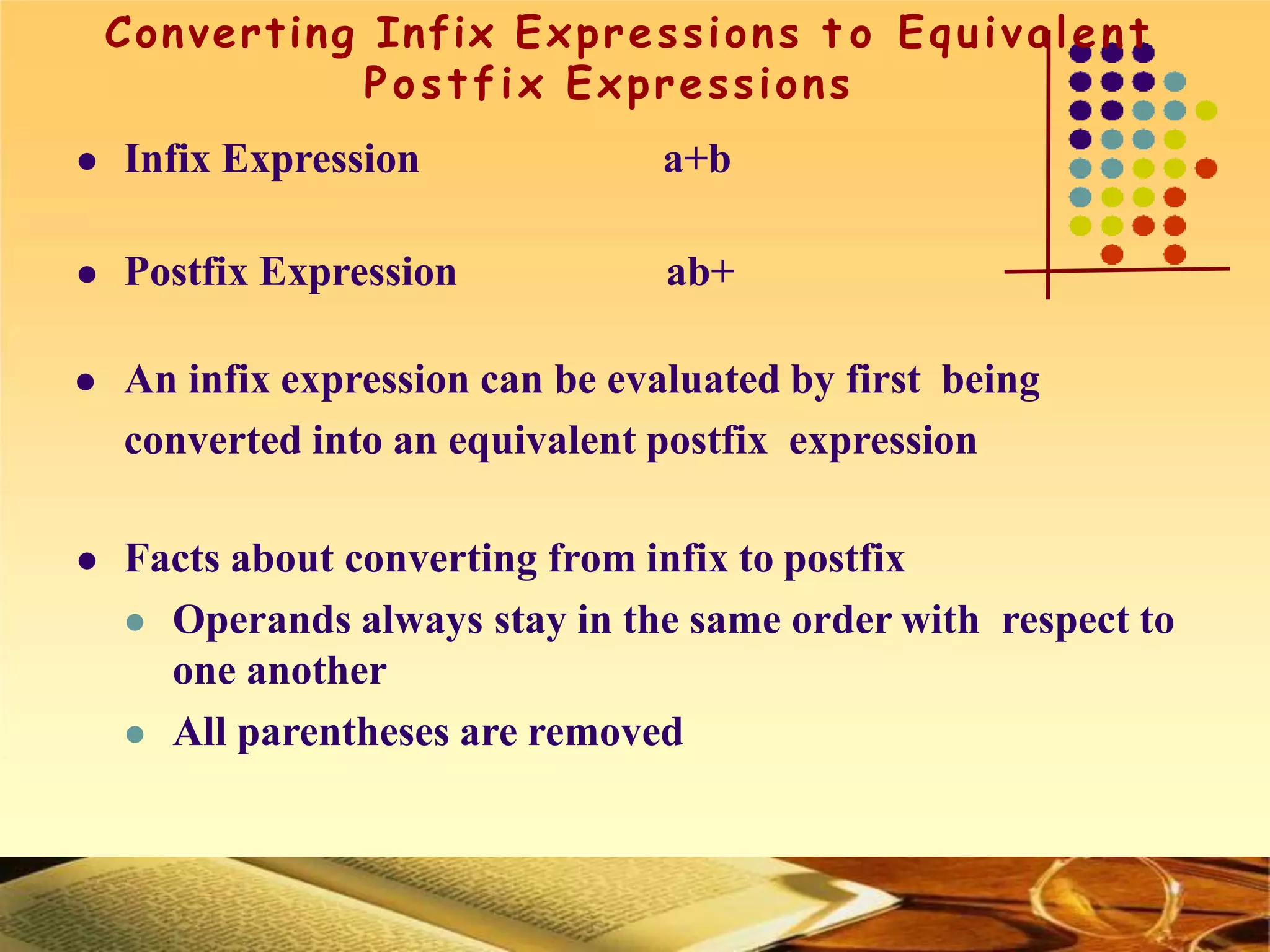
Converting Infix Expressions t o Equivalent
Postfix Expressions
 Infix Expression a+b
 Postfix Expression ab+
 An infix expression can be evaluated by first being
converted into an equivalent postfix expression
 Facts about converting from infix to postfix
 Operands always stay in the same order with respect to
one another
 All parentheses are removed
Algorithm : Converting Infix Expression t o
Postfix using s t a c k
Suppose X is an arithmetic expression written in infix notation.
This algorithm finds the equivalent postfix expression Y.
1. Push "(" onto STACK, and add ")" to the end of X.
2. Scan X from left to right and REPEAT Steps 3 to 6 for each element of X UNTIL the
STACK is empty :
3. If an operand is encountered, add it to Y.
4. If a left parenthesis is encountered, push it onto STACK.
5. If an operator is encountered, then :
(a) Repeatedly pop from STACK and add to Y each operator (on the top of STACK) which has
the same precedence as or higher precedence than operator.
(b) Add operator to STACK.
/* End of If structure * /
6. If a right parenthesis is encountered, then :
(a)Repeatedly pop from STACK and add to Y each operator (on the top of STACK)
until a left parenthesis is encountered.
(b) Remove the left parenthesis. [Do not add the left parenthesis to Y].
/* End of If structure * /
/* End of Step 2 loop * /
7. END.
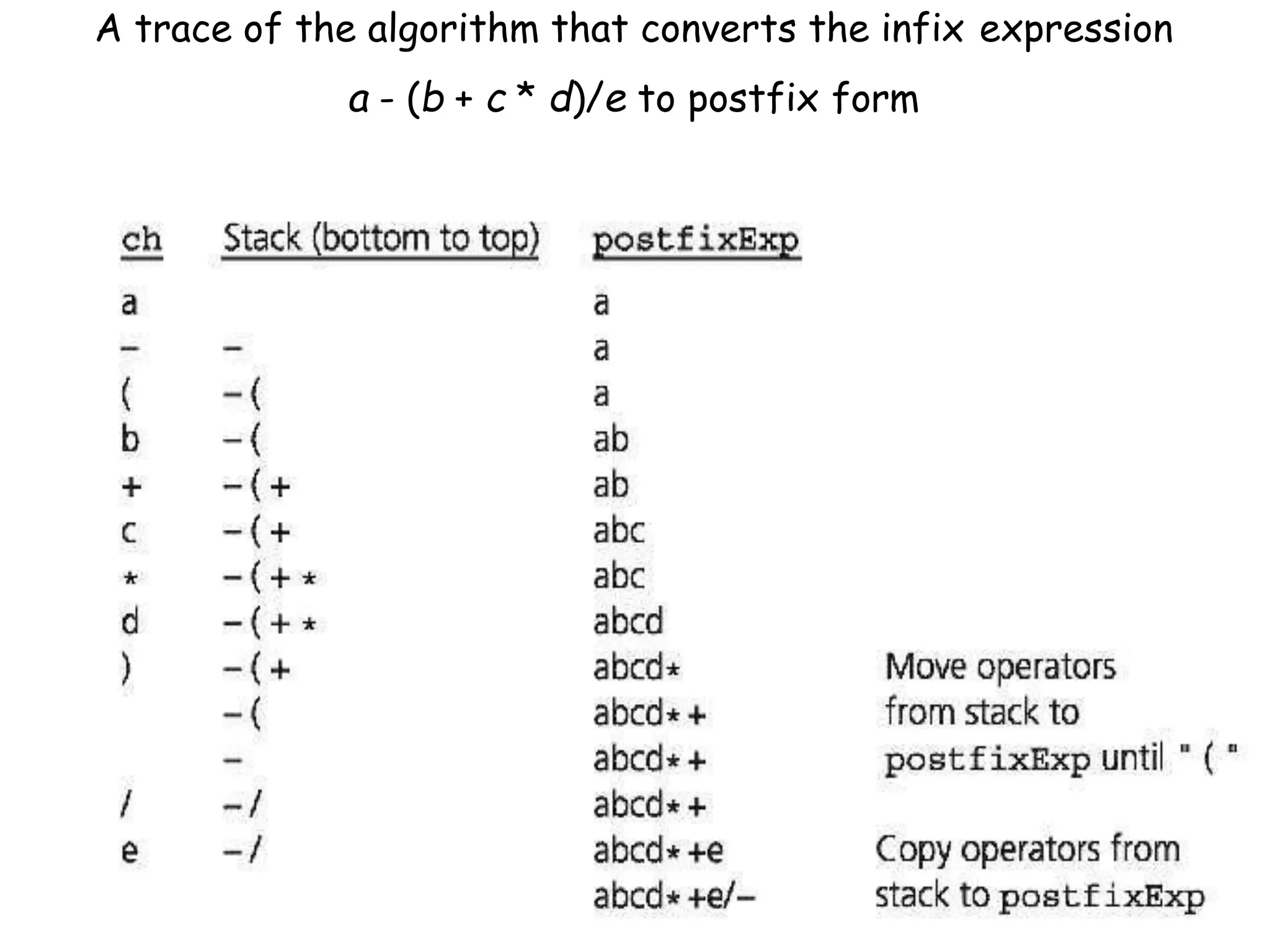
A trace of the algorithm that converts the infix expression
a - (b + c * d)/e to postfix form
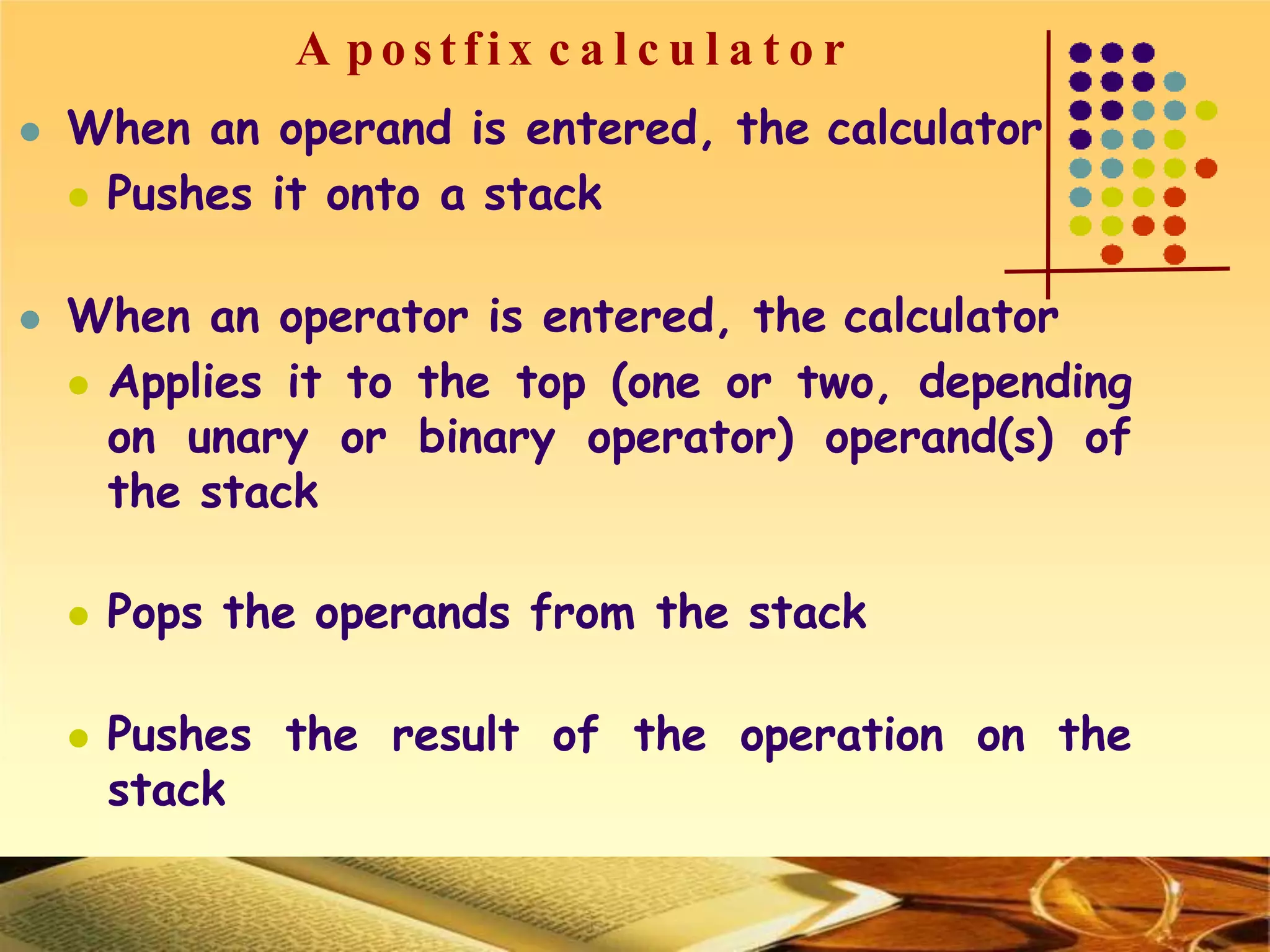
A postfix c a l c u l a t o r
 When an operand is entered, the calculator
 Pushes it onto a stack
 When an operator is entered, the calculator
 Applies it to the top (one or two, depending
on unary or binary operator) operand(s) of
the stack
 Pops the operands from the stack
 Pushes the result of the operation on the
stack
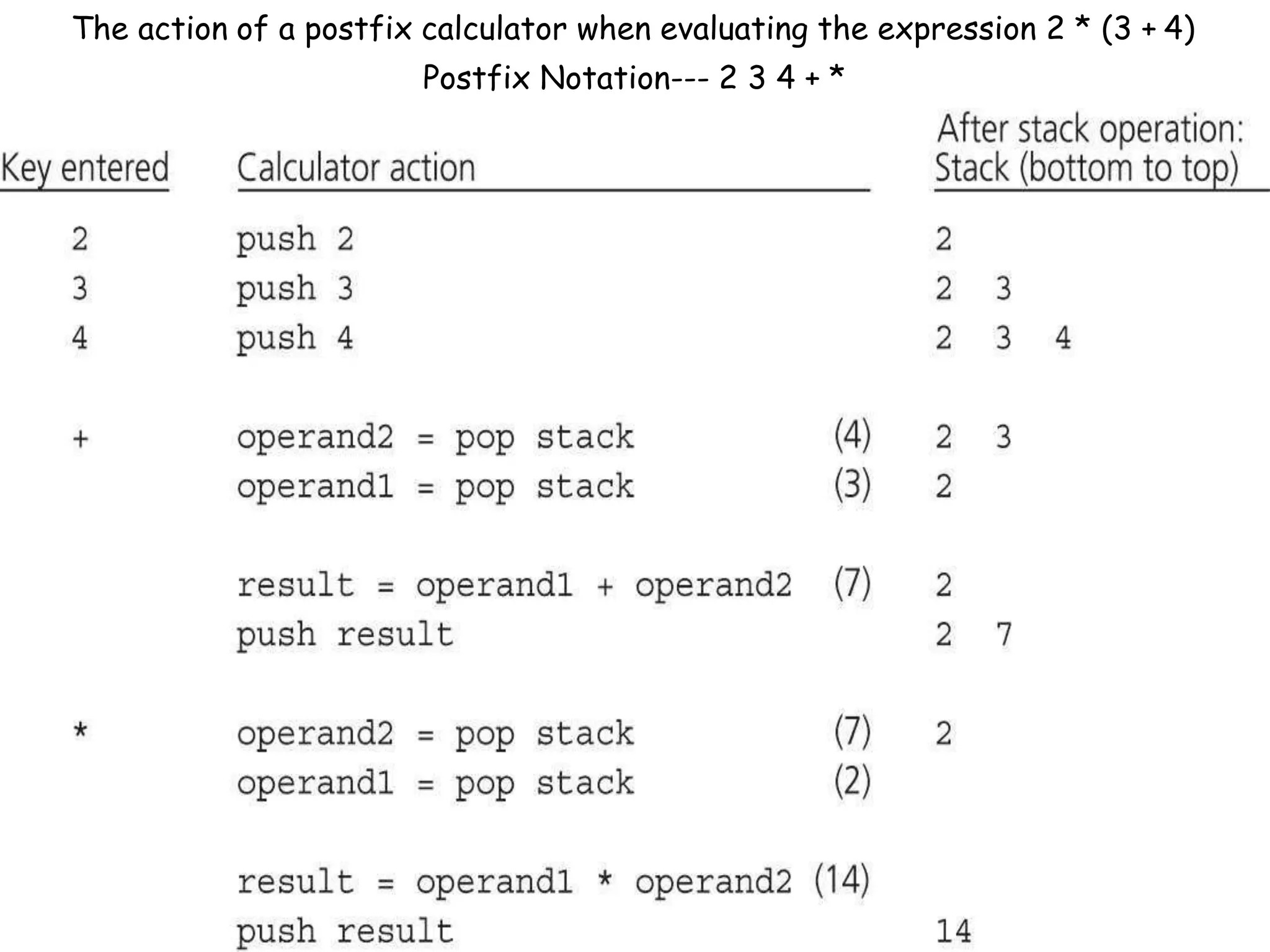
The action of a postfix calculator when evaluating the expression 2 * (3 + 4)
Postfix Notation--- 2 3 4 + *

stack-Intro.pptx

  • 1.
  • 2.
     What isa Stack  Stack Operations  LIFO Stack  Animation Depicting Push Operation  Animation Depicting Pop Operation  A r r a y Implementation of Stack  Applications of s t a c k Checking f o r balanced br aces Converting Infix Expression t o Postfix Postfix c a l c u l a t o r
  • 3.
    What is aStack A stack is a Last In, First Out (LIFO) data structure, objects inserted last are the first to come out of the stack Anything added to the stack goes on the “top” of the stack Anything removed from the stack is taken from the “top” of the stack Things are removed in the reverse order from that in which they were inserted
  • 4.
    S t ac k Operations  PUSH Adds the object to the top of the stack  POP Removes the object at the top of the stack and returns it  PEEK Returns the top object of the stack but does not remove it from the stack  ISEMPTY Returns True if Stack is empty
  • 5.
    A LIFOS ta c k Top Bottom Stack Pointer Push Pop
  • 8.
    Array Implementation of S t a c k A[1] A[2] …. …. …. A[n] w y Stack pointer J=n Stack Full Stack pointer J=2 Before Push Stack pointer J=3 After Push After many Push Ops Push X w y x Stack Pointer J=0 Stack Empty Pop After many Pop ops Stack Pointer J=3 Before Pop Stack Pointer J=2 After Pop
  • 9.
  • 10.
    int f(int x){ intfact=1; for(int i=1; i<=x; i++) fact=fact*i; return fact; } void main(){ int y = f(5);// main call // y should get 120 } So let’s watch the stack and see what happens. If main calls a function, that function is loaded onto the top of the stack and remains there until it is complete at which point it is popped off of the stack.
  • 11.
    int f(int x){ if(x== 1) return 1;// line 1 return f(x-1)*x; // line 2 } void main(){ int y = f(5);// main call // y should get 120 } Now, a recursive function calls itself. That means another instance of the function will be placed on the stack and will remain there until the function completes. main calls the function f with a value of 5, so on the stack we get f(5). Line 1 is false so we go to line 2 which calls f(4), etc. Note that f(4) must complete before f(5) can complete. f(5) will complete by returning 5*f(4). The stack will look like:
  • 12.
    So at thispoint none of the functions have yet returned! The first to return will be f(1) which will return 1. Then f(2) will return 2. Then f(3) will return 6. As in:
  • 13.
  • 14.
    Checking f or Balanced Bra ces  ([]({()}[()])) is balanced; ([]({()}[())]) is not  Simple counting is not enough to check balance  You can do it with a stack: going left to right,  If you see a (, [, or {, push it on the stack  If you see a ), ], or }, pop the stack and check whether you got the corresponding (, [, or {  When you reach the end, check that the stack is empty
  • 16.
    Converting Infix Expressionst o Equivalent Postfix Expressions  Infix Expression a+b  Postfix Expression ab+  An infix expression can be evaluated by first being converted into an equivalent postfix expression  Facts about converting from infix to postfix  Operands always stay in the same order with respect to one another  All parentheses are removed
  • 17.
    Algorithm : ConvertingInfix Expression t o Postfix using s t a c k Suppose X is an arithmetic expression written in infix notation. This algorithm finds the equivalent postfix expression Y. 1. Push "(" onto STACK, and add ")" to the end of X. 2. Scan X from left to right and REPEAT Steps 3 to 6 for each element of X UNTIL the STACK is empty : 3. If an operand is encountered, add it to Y. 4. If a left parenthesis is encountered, push it onto STACK. 5. If an operator is encountered, then : (a) Repeatedly pop from STACK and add to Y each operator (on the top of STACK) which has the same precedence as or higher precedence than operator. (b) Add operator to STACK. /* End of If structure * / 6. If a right parenthesis is encountered, then : (a)Repeatedly pop from STACK and add to Y each operator (on the top of STACK) until a left parenthesis is encountered. (b) Remove the left parenthesis. [Do not add the left parenthesis to Y]. /* End of If structure * / /* End of Step 2 loop * / 7. END.
  • 18.
    A trace ofthe algorithm that converts the infix expression a - (b + c * d)/e to postfix form
  • 19.
    A postfix ca l c u l a t o r  When an operand is entered, the calculator  Pushes it onto a stack  When an operator is entered, the calculator  Applies it to the top (one or two, depending on unary or binary operator) operand(s) of the stack  Pops the operands from the stack  Pushes the result of the operation on the stack
  • 20.
    The action ofa postfix calculator when evaluating the expression 2 * (3 + 4) Postfix Notation--- 2 3 4 + *