PRESENTATION
ON
C PROGRAMMING
Presented By
Rokonuzzaman Rony
CSE 2B
Department of Computer Science &
Engineering
Northern University of Business and Technology Khulna
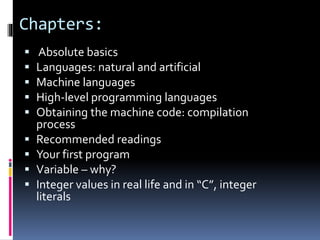
Chapters:
 Absolute basics
 Languages: natural and artificial
 Machine languages
 High-level programming languages
 Obtaining the machine code: compilation
process
 Recommended readings
 Your first program
 Variable – why?
 Integer values in real life and in “C”, integer
literals
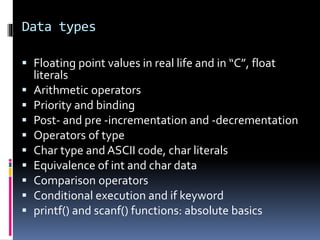
Data types
 Floating point values in real life and in “C”, float
literals
 Arithmetic operators
 Priority and binding
 Post- and pre -incrementation and -decrementation
 Operators of type
 Char type and ASCII code, char literals
 Equivalence of int and char data
 Comparison operators
 Conditional execution and if keyword
 printf() and scanf() functions: absolute basics
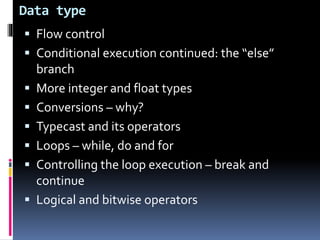
Data type
 Flow control
 Conditional execution continued: the “else”
branch
 More integer and float types
 Conversions – why?
 Typecast and its operators
 Loops – while, do and for
 Controlling the loop execution – break and
continue
 Logical and bitwise operators
Arrays
 Switch: different faces of ‘if’
 Arrays (vectors) – why do you need them?
 Sorting in real life and in a computer memory
 Initiators: a simple way to set an array
 Pointers: another kind of data in “C”
 An address, a reference, a dereference and the
sizeof operator
 Simple pointer and pointer to nothing (NULL) &
operator
 Pointers arithmetic
 Pointers vs. arrays: different forms of the same
phenomenon
Array
 Using strings: basics
 Basic functions dedicated to string manipulation
 Memory management and structures
 The meaning of array indexing
 The usage of pointers: perils and disadvantages
 Void type
 Arrays of arrays and multidimensional arrays
 Memory allocation and deallocation: malloc() and
free() functions
 Arrays of pointers vs. multidimensional arrays
 Structures – why?
 Declaring, using and initializing structures
Array
 Pointers to structures and arrays of structures
 Basics of recursive data collections
Functions
 Functions – why?
 How to declare, define and invoke a function
 Variables' scope, local variables and function
parameters
 Pointers, arrays and structures as function
parameters
 Function result and return statement
 Void as a parameter, pointer and result
 Parameterzing the main function
 External function and the extern declarator
 Header files and their role
Files and streams
 Files vs. streams: where does the difference
lie?
 Header files needed for stream operations
FILE structure
 Opening and closing a stream, open modes, errno
variable
 Reading and writing to/from a stream
 Predefined streams: stdin, stdout and stderr
 Stream manipulation: fgetc(), fputc(), fgets() and
fputs() functions
 Raw input/output: fread() and fwrite() functions
 Preprocessor and complex declarations
 Preprocessor – why?
 #include: how to make use of a header file
 #define: simple and parameterized macros
File structure
 #undef directive
 Predefined preprocessor symbols
 Macro operators: # and ##
 Conditional compilation: #if and #ifdef directives
 Avoiding multiple compilations of the same header
files
 Scopes of declarations, storage classes
 User defined types-why?
 Pointers to functions
 Analyzing and creating complex declarations

Course outline for c programming

  • 1.
    PRESENTATION ON C PROGRAMMING Presented By RokonuzzamanRony CSE 2B Department of Computer Science & Engineering Northern University of Business and Technology Khulna
  • 2.
    Chapters:  Absolute basics Languages: natural and artificial  Machine languages  High-level programming languages  Obtaining the machine code: compilation process  Recommended readings  Your first program  Variable – why?  Integer values in real life and in “C”, integer literals
  • 3.
    Data types  Floatingpoint values in real life and in “C”, float literals  Arithmetic operators  Priority and binding  Post- and pre -incrementation and -decrementation  Operators of type  Char type and ASCII code, char literals  Equivalence of int and char data  Comparison operators  Conditional execution and if keyword  printf() and scanf() functions: absolute basics
  • 4.
    Data type  Flowcontrol  Conditional execution continued: the “else” branch  More integer and float types  Conversions – why?  Typecast and its operators  Loops – while, do and for  Controlling the loop execution – break and continue  Logical and bitwise operators
  • 5.
    Arrays  Switch: differentfaces of ‘if’  Arrays (vectors) – why do you need them?  Sorting in real life and in a computer memory  Initiators: a simple way to set an array  Pointers: another kind of data in “C”  An address, a reference, a dereference and the sizeof operator  Simple pointer and pointer to nothing (NULL) & operator  Pointers arithmetic  Pointers vs. arrays: different forms of the same phenomenon
  • 6.
    Array  Using strings:basics  Basic functions dedicated to string manipulation  Memory management and structures  The meaning of array indexing  The usage of pointers: perils and disadvantages  Void type  Arrays of arrays and multidimensional arrays  Memory allocation and deallocation: malloc() and free() functions  Arrays of pointers vs. multidimensional arrays  Structures – why?  Declaring, using and initializing structures
  • 7.
    Array  Pointers tostructures and arrays of structures  Basics of recursive data collections
  • 8.
    Functions  Functions –why?  How to declare, define and invoke a function  Variables' scope, local variables and function parameters  Pointers, arrays and structures as function parameters  Function result and return statement  Void as a parameter, pointer and result  Parameterzing the main function  External function and the extern declarator  Header files and their role
  • 9.
    Files and streams Files vs. streams: where does the difference lie?  Header files needed for stream operations
  • 10.
    FILE structure  Openingand closing a stream, open modes, errno variable  Reading and writing to/from a stream  Predefined streams: stdin, stdout and stderr  Stream manipulation: fgetc(), fputc(), fgets() and fputs() functions  Raw input/output: fread() and fwrite() functions  Preprocessor and complex declarations  Preprocessor – why?  #include: how to make use of a header file  #define: simple and parameterized macros
  • 11.
    File structure  #undefdirective  Predefined preprocessor symbols  Macro operators: # and ##  Conditional compilation: #if and #ifdef directives  Avoiding multiple compilations of the same header files  Scopes of declarations, storage classes  User defined types-why?  Pointers to functions  Analyzing and creating complex declarations