Stacks
CS 367 – Introduction to Data Structures
Stack
• A stack is a data structure that stores data
in such a way that the last piece of data
stored, is the first one retrieved
– also called last-in, first-out
• Only access to the stack is the top
element
– consider trays in a cafeteria
• to get the bottom tray out, you must first remove all
of the elements above
Stack
• Push
– the operation to place a new item at the top of
the stack
• Pop
– the operation to remove the next item from
the top of the stack
Stack
A
X
R
C
push(M)
A
X
R
C
M
item = pop()
item = M
A
X
R
C
Implementing a Stack
• At least three different ways to implement
a stack
– array
– vector
– linked list
• Which method to use depends on the
application
– what advantages and disadvantages does
each implementation have?
Implementing Stacks: Array
• Advantages
– best performance
• Disadvantage
– fixed size
• Basic implementation
– initially empty array
– field to record where the next data gets placed into
– if array is full, push() returns false
• otherwise adds it into the correct spot
– if array is empty, pop() returns null
• otherwise removes the next item in the stack
Stack Class (array based)
class StackArray {
private Object[ ] stack;
private int nextIn;
public StackArray(int size) {
stack = new Object[size];
nextIn = 0;
}
public boolean push(Object data);
public Object pop();
public void clear();
public boolean isEmpty();
public boolean isFull();
}
push() Method (array based)
public boolean push(Object data) {
if(nextIn == stack.length) { return false; } // stack is full
// add the element and then increment nextIn
stack[nextIn] = data;
nextIn++;
return true;
}
pop() Method (array based)
public Object pop() {
if(nextIn == 0) { return null; } // stack is empty
// decrement nextIn and return the data
nextIn--;
Object data = stack[nextIn];
return data;
}
Notes on push() and pop()
• Other ways to do this even if using arrays
– may want to keep a size variable that tracks
how many items in the list
– may want to keep a maxSize variable that
stores the maximum number of elements the
stack can hold (size of the array)
• you would have to do this in a language like C++
– could add things in the opposite direction
• keep track of nextOut and decrement it on every
push; increment it on every pop
Remaining Methods (array based)
public void clear() {
nextIn = 0;
}
public boolean isEmpty() {
return nextIn == 0;
}
public boolean isFull() {
return nextIn == stack.length;
}
Additional Notes
• Notice that the array is considered empty if
nextIn equals zero
– doesn’t matter if there is more data stored in
the array – it will never be retrieved
• pop() method will automatically return
• For a truly robust implementation
– should set array elements equal to null if they
are not being used
• why? how?
Implementing a Stack: Vector
• Advantages
– grows to accommodate any amount of data
– second fastest implementation when data size is less
than vector size
• Disadvantage
– slowest method if data size exceeds current vector
size
• have to copy everything over and then add data
– wasted space if anomalous growth
• vectors only grow in size – they don’t shrink
– can grow to an unlimited size
• I thought this was an advantage?
• Basic implementation
– virtually identical to array based version
Stack Class (vector based)
class StackVector {
private Object[ ] stack;
private int nextIn;
public StackVector(int initialSize) {
stack = new Object[initialSize];
nextIn = 0;
}
public void push(Object data);
public Object pop();
public void clear();
public boolean isEmpty();
}
push() Method (vector based)
public void push(Object data) {
// see if we need to grow this stack
if(nextIn == stack.length) {
Object [ ] tmp = new Object[stack.length * 2];
for(int i=0; i<stack.length; i++)
tmp[i] = stack[i];
stack = tmp;
}
// now add the element and increment nextIn
stack[nextIn] = data;
nextIn++;
}
pop() Method (vector based)
public Object pop() {
if(nextIn == 0) { return null; } // stack empty
// decrement nextIn, get the data, and return it
nextIn--;
Object data = stack[nextIn];
return data;
}
Notes on push() and pop()
• Notice that the pop() method is identical to
that for an array based version
• Only difference is in push() method
– doesn’t return a boolean because it cannot fail
• unless we run out of memory 
– first checks if the push will exceed the current
array
• if so, create a new array that’s 2x as big, copy
data, and make that the new stack
• this is the case that’s very slow
Remaining Methods (vector based)
• The clear() and isEmpty() methods are
identical to those in an array based stack
implementation
• There is no need for an isFull() method
– why?
Implementing a Stack: Linked List
• Advantages:
– always constant time to push or pop an element
– can grow to an infinite size
• Disadvantages
– the common case is the slowest of all the
implementations
– can grow to an infinite size
• Basic implementation
– list is initially empty
– push() method adds a new item to the head of the list
– pop() method removes the head of the list
Stack Class (list based)
class StackList {
private LinkedList list;
public StackList() { list = new LinkedList(); }
public void push(Object data) { list.addHead(data); }
public Object pop() { return list.deleteHead(); }
public void clear() { list.clear(); }
public boolean isEmpty() { return list.isEmpty(); }
}
Additional Notes
• It should appear obvious that linked lists
are very well suited for stacks
– addHead() and deleteHead() are basically the
push() and pop() methods
• Our original list implementation did not
have a clear() method
– it’s very simple to do
– how would you do it?
• Again, no need for the isFull() method
– list can grow to an infinite size
Stack Applications
• Stacks are a very common data structure
– compilers
• parsing data between delimiters (brackets)
– operating systems
• program stack
– virtual machines
• manipulating numbers
– pop 2 numbers off stack, do work (such as add)
– push result back on stack and repeat
– artificial intelligence
• finding a path
Reverse Polish Notation
• Way of inputting numbers to a calculator
– (5 + 3) * 6 becomes 5 3 + 6 *
– 5 + 3 * 6 becomes 5 3 6 * +
• We can use a stack to implement this
– consider 5 3 + 6 *
5
3
8
+
8
6
*6
48
– try doing 5 3 6 * +
public int rpn(String equation) {
StackList stack = new StackList();
StringTokenizer tok = new StringTokenizer(equation);
while(tok.hasMoreTokens()) {
String element = tok.nextToken();
if(isOperator(element)) {
char op = element.charAt(0);
if(op == ‘=‘) {
int result = ((Integer)stack.pop()).intValue();
if(!stack.isEmpty() || tok.hasMoreTokens()) { return Integer.MAX_VALUE; } // error
else { return result; }
}
else {
Integer op1 = (Integer)stack.pop()
Integer op2 = (Integer)stack.pop();
if((op1 == null) || (op2 == null)) { return Integer.MAX_VALUE; }
stack.push(doOperation(op, op1, op2));
}
}
else {
Integer operand = new Integer(Integer.parseInt(element));
stack.push(operand);
}
}
return Integer.MAX_VALUE;
}
Finding a Path
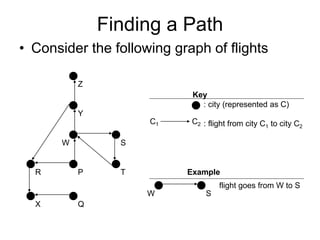
• Consider the following graph of flights
PR
X Q
W
Y
Z
S
T
Key
: city (represented as C)
: flight from city C1 to city C2
C1 C2
flight goes from W to S
W S
Example
Finding a Path
• If it exists, we can find a path from any city C1 to
another city C2 using a stack
– place the starting city on the bottom of the stack
• mark it as visited
• pick any arbitrary arrow out of the city
– city cannot be marked as visited
• place that city on the stack
– also mark it as visited
• if that’s the destination, we’re done
• otherwise, pick an arrow out of the city currently at
– next city must not have been visited before
– if there are no legitimate arrows out, pop it off the stack and go
back to the previous city
• repeat this process until the destination is found or all the
cities have been visited
Example
• Want to go from P to Y
– push P on the stack and mark it as visited
– pick R as the next city to visit (random select)
• push it on the stack and mark it as visited
– pick X as the next city to visit (only choice)
• push it on the stack and mark it as visited
– no available arrows out of X – pop it
– no more available arrows from R – pop it
– pick W as next city to visit (only choice left)
• push it on the stack and mark it as visited
– pick Y as next city to visit (random select)
• this is the destination – all done
Psuedo-Code for the Example
public boolean findPath(City origin, City destination) {
StackArray stack = new Stack(numCities);
clearAllCityMarks();
stack.push(origin);
origin.mark();
while(!stack.isEmpty()) {
City next = pickCity();
if(next == destination) { return true; }
if(next != null) { stack.push(next); }
else { stack.pop(); } // no valid arrows out of city
}
return false;
}

Stacks

  • 1.
    Stacks CS 367 –Introduction to Data Structures
  • 2.
    Stack • A stackis a data structure that stores data in such a way that the last piece of data stored, is the first one retrieved – also called last-in, first-out • Only access to the stack is the top element – consider trays in a cafeteria • to get the bottom tray out, you must first remove all of the elements above
  • 3.
    Stack • Push – theoperation to place a new item at the top of the stack • Pop – the operation to remove the next item from the top of the stack
  • 4.
  • 5.
    Implementing a Stack •At least three different ways to implement a stack – array – vector – linked list • Which method to use depends on the application – what advantages and disadvantages does each implementation have?
  • 6.
    Implementing Stacks: Array •Advantages – best performance • Disadvantage – fixed size • Basic implementation – initially empty array – field to record where the next data gets placed into – if array is full, push() returns false • otherwise adds it into the correct spot – if array is empty, pop() returns null • otherwise removes the next item in the stack
  • 7.
    Stack Class (arraybased) class StackArray { private Object[ ] stack; private int nextIn; public StackArray(int size) { stack = new Object[size]; nextIn = 0; } public boolean push(Object data); public Object pop(); public void clear(); public boolean isEmpty(); public boolean isFull(); }
  • 8.
    push() Method (arraybased) public boolean push(Object data) { if(nextIn == stack.length) { return false; } // stack is full // add the element and then increment nextIn stack[nextIn] = data; nextIn++; return true; }
  • 9.
    pop() Method (arraybased) public Object pop() { if(nextIn == 0) { return null; } // stack is empty // decrement nextIn and return the data nextIn--; Object data = stack[nextIn]; return data; }
  • 10.
    Notes on push()and pop() • Other ways to do this even if using arrays – may want to keep a size variable that tracks how many items in the list – may want to keep a maxSize variable that stores the maximum number of elements the stack can hold (size of the array) • you would have to do this in a language like C++ – could add things in the opposite direction • keep track of nextOut and decrement it on every push; increment it on every pop
  • 11.
    Remaining Methods (arraybased) public void clear() { nextIn = 0; } public boolean isEmpty() { return nextIn == 0; } public boolean isFull() { return nextIn == stack.length; }
  • 12.
    Additional Notes • Noticethat the array is considered empty if nextIn equals zero – doesn’t matter if there is more data stored in the array – it will never be retrieved • pop() method will automatically return • For a truly robust implementation – should set array elements equal to null if they are not being used • why? how?
  • 13.
    Implementing a Stack:Vector • Advantages – grows to accommodate any amount of data – second fastest implementation when data size is less than vector size • Disadvantage – slowest method if data size exceeds current vector size • have to copy everything over and then add data – wasted space if anomalous growth • vectors only grow in size – they don’t shrink – can grow to an unlimited size • I thought this was an advantage? • Basic implementation – virtually identical to array based version
  • 14.
    Stack Class (vectorbased) class StackVector { private Object[ ] stack; private int nextIn; public StackVector(int initialSize) { stack = new Object[initialSize]; nextIn = 0; } public void push(Object data); public Object pop(); public void clear(); public boolean isEmpty(); }
  • 15.
    push() Method (vectorbased) public void push(Object data) { // see if we need to grow this stack if(nextIn == stack.length) { Object [ ] tmp = new Object[stack.length * 2]; for(int i=0; i<stack.length; i++) tmp[i] = stack[i]; stack = tmp; } // now add the element and increment nextIn stack[nextIn] = data; nextIn++; }
  • 16.
    pop() Method (vectorbased) public Object pop() { if(nextIn == 0) { return null; } // stack empty // decrement nextIn, get the data, and return it nextIn--; Object data = stack[nextIn]; return data; }
  • 17.
    Notes on push()and pop() • Notice that the pop() method is identical to that for an array based version • Only difference is in push() method – doesn’t return a boolean because it cannot fail • unless we run out of memory  – first checks if the push will exceed the current array • if so, create a new array that’s 2x as big, copy data, and make that the new stack • this is the case that’s very slow
  • 18.
    Remaining Methods (vectorbased) • The clear() and isEmpty() methods are identical to those in an array based stack implementation • There is no need for an isFull() method – why?
  • 19.
    Implementing a Stack:Linked List • Advantages: – always constant time to push or pop an element – can grow to an infinite size • Disadvantages – the common case is the slowest of all the implementations – can grow to an infinite size • Basic implementation – list is initially empty – push() method adds a new item to the head of the list – pop() method removes the head of the list
  • 20.
    Stack Class (listbased) class StackList { private LinkedList list; public StackList() { list = new LinkedList(); } public void push(Object data) { list.addHead(data); } public Object pop() { return list.deleteHead(); } public void clear() { list.clear(); } public boolean isEmpty() { return list.isEmpty(); } }
  • 21.
    Additional Notes • Itshould appear obvious that linked lists are very well suited for stacks – addHead() and deleteHead() are basically the push() and pop() methods • Our original list implementation did not have a clear() method – it’s very simple to do – how would you do it? • Again, no need for the isFull() method – list can grow to an infinite size
  • 22.
    Stack Applications • Stacksare a very common data structure – compilers • parsing data between delimiters (brackets) – operating systems • program stack – virtual machines • manipulating numbers – pop 2 numbers off stack, do work (such as add) – push result back on stack and repeat – artificial intelligence • finding a path
  • 23.
    Reverse Polish Notation •Way of inputting numbers to a calculator – (5 + 3) * 6 becomes 5 3 + 6 * – 5 + 3 * 6 becomes 5 3 6 * + • We can use a stack to implement this – consider 5 3 + 6 * 5 3 8 + 8 6 *6 48 – try doing 5 3 6 * +
  • 24.
    public int rpn(Stringequation) { StackList stack = new StackList(); StringTokenizer tok = new StringTokenizer(equation); while(tok.hasMoreTokens()) { String element = tok.nextToken(); if(isOperator(element)) { char op = element.charAt(0); if(op == ‘=‘) { int result = ((Integer)stack.pop()).intValue(); if(!stack.isEmpty() || tok.hasMoreTokens()) { return Integer.MAX_VALUE; } // error else { return result; } } else { Integer op1 = (Integer)stack.pop() Integer op2 = (Integer)stack.pop(); if((op1 == null) || (op2 == null)) { return Integer.MAX_VALUE; } stack.push(doOperation(op, op1, op2)); } } else { Integer operand = new Integer(Integer.parseInt(element)); stack.push(operand); } } return Integer.MAX_VALUE; }
  • 25.
    Finding a Path •Consider the following graph of flights PR X Q W Y Z S T Key : city (represented as C) : flight from city C1 to city C2 C1 C2 flight goes from W to S W S Example
  • 26.
    Finding a Path •If it exists, we can find a path from any city C1 to another city C2 using a stack – place the starting city on the bottom of the stack • mark it as visited • pick any arbitrary arrow out of the city – city cannot be marked as visited • place that city on the stack – also mark it as visited • if that’s the destination, we’re done • otherwise, pick an arrow out of the city currently at – next city must not have been visited before – if there are no legitimate arrows out, pop it off the stack and go back to the previous city • repeat this process until the destination is found or all the cities have been visited
  • 27.
    Example • Want togo from P to Y – push P on the stack and mark it as visited – pick R as the next city to visit (random select) • push it on the stack and mark it as visited – pick X as the next city to visit (only choice) • push it on the stack and mark it as visited – no available arrows out of X – pop it – no more available arrows from R – pop it – pick W as next city to visit (only choice left) • push it on the stack and mark it as visited – pick Y as next city to visit (random select) • this is the destination – all done
  • 28.
    Psuedo-Code for theExample public boolean findPath(City origin, City destination) { StackArray stack = new Stack(numCities); clearAllCityMarks(); stack.push(origin); origin.mark(); while(!stack.isEmpty()) { City next = pickCity(); if(next == destination) { return true; } if(next != null) { stack.push(next); } else { stack.pop(); } // no valid arrows out of city } return false; }