Drugs affecting Calcium Balance
Sanjaya Mani Dixit
Assistant Prof of Pharmacology
Why such drugs?
HYPERCALCEMIA
HYPOCALCEMIA--Hypoparathyroidism
HYPERVITAMINOSIS D— Hypercalcemia
VITAMIN D DEFICIENCY
• SPECIFIC DISORDERS OF BONE
– Rickets
– Osteoporosis
– PAGET’S DISEASE
– OSTEOMALACIA AND RENAL OSTEODYSTROPHY
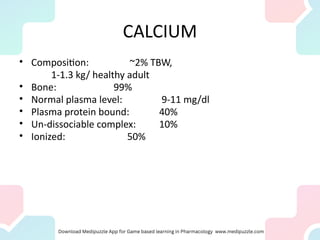
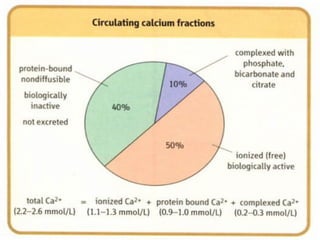
CALCIUM
• Composition: ~2% TBW,
1-1.3 kg/ healthy adult
• Bone: 99%
• Normal plasma level: 9-11 mg/dl
• Plasma protein bound: 40%
• Un-dissociable complex: 10%
• Ionized: 50%
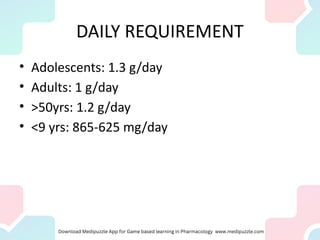
DAILY REQUIREMENT
• Adolescents: 1.3 g/day
• Adults: 1 g/day
• >50yrs: 1.2 g/day
• <9 yrs: 865-625 mg/day
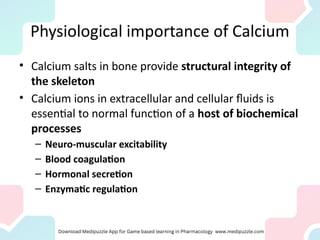
Physiological importance of Calcium
• Calcium salts in bone provide structural integrity of
the skeleton
• Calcium ions in extracellular and cellular fluids is
essential to normal function of a host of biochemical
processes
– Neuro-muscular excitability
– Blood coagulation
– Hormonal secretion
– Enzymatic regulation
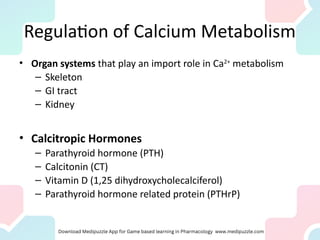
Regulation of Calcium Metabolism
• Organ systems that play an import role in Ca2+
metabolism
– Skeleton
– GI tract
– Kidney
• Calcitropic Hormones
– Parathyroid hormone (PTH)
– Calcitonin (CT)
– Vitamin D (1,25 dihydroxycholecalciferol)
– Parathyroid hormone related protein (PTHrP)
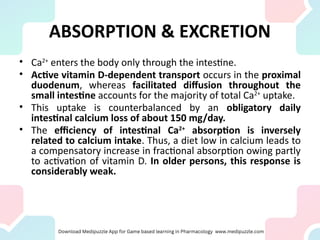
ABSORPTION & EXCRETION
• Ca2+
enters the body only through the intestine.
• Active vitamin D-dependent transport occurs in the proximal
duodenum, whereas facilitated diffusion throughout the
small intestine accounts for the majority of total Ca2+
uptake.
• This uptake is counterbalanced by an obligatory daily
intestinal calcium loss of about 150 mg/day.
• The efficiency of intestinal Ca2+
absorption is inversely
related to calcium intake. Thus, a diet low in calcium leads to
a compensatory increase in fractional absorption owing partly
to activation of vitamin D. In older persons, this response is
considerably weak.
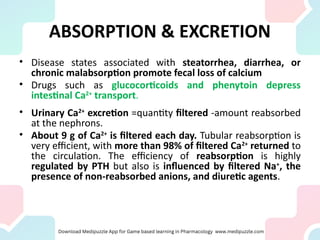
ABSORPTION & EXCRETION
• Disease states associated with steatorrhea, diarrhea, or
chronic malabsorption promote fecal loss of calcium
• Drugs such as glucocorticoids and phenytoin depress
intestinal Ca2+
transport.
• Urinary Ca2+
excretion =quantity filtered -amount reabsorbed
at the nephrons.
• About 9 g of Ca2+
is filtered each day. Tubular reabsorption is
very efficient, with more than 98% of filtered Ca2+
returned to
the circulation. The efficiency of reabsorption is highly
regulated by PTH but also is influenced by filtered Na+
, the
presence of non-reabsorbed anions, and diuretic agents.
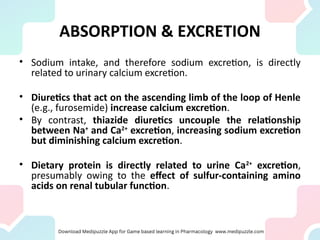
ABSORPTION & EXCRETION
• Sodium intake, and therefore sodium excretion, is directly
related to urinary calcium excretion.
• Diuretics that act on the ascending limb of the loop of Henle
(e.g., furosemide) increase calcium excretion.
• By contrast, thiazide diuretics uncouple the relationship
between Na+
and Ca2+
excretion, increasing sodium excretion
but diminishing calcium excretion.
• Dietary protein is directly related to urine Ca2+
excretion,
presumably owing to the effect of sulfur-containing amino
acids on renal tubular function.
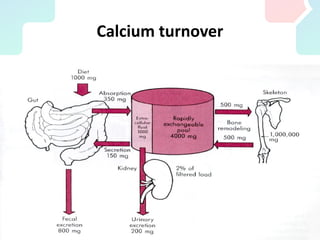
Calcium turnover
USES
• Tetany
• Dietary Supplement
• Osteoporosis
• Antacid (Calcium Carbonate)
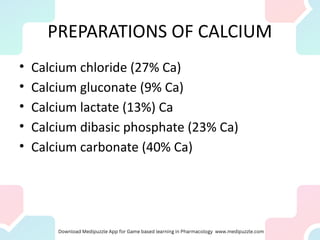
PREPARATIONS OF CALCIUM
• Calcium chloride (27% Ca)
• Calcium gluconate (9% Ca)
• Calcium lactate (13%) Ca
• Calcium dibasic phosphate (23% Ca)
• Calcium carbonate (40% Ca)
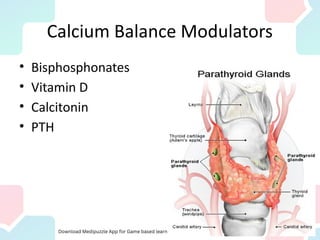
Calcium Balance Modulators
• Bisphosphonates
• Vitamin D
• Calcitonin
• PTH
BISPHOSPHONATES
• Derivatives of Pyrophosphate in which O of the P-O-P is replaced
by carbon
– Etidronate, Pamidronate, Alendronate
• Mechanism is not fully understood but theories have been
proposed for their actions:
– They localize in the acidic regions of bone matrix below
osteoclasts and are taken up by osteoclasts in exchange for
Ca2+
resulting in:
• Accelerated apoptosis of osteoclasts
• Disruption of cytoskeleton and border of osteoclasts
– Also affect osteoclast precursors by inhibiting their
differentiation by suppressing IL-6
– Interferes with certain steps of mevalonate pathway required
for prenylation of certain GTP-proteins involved in maturation
of cytoskeletal maturation
ETIDRONATE
• Also interferes with bone mineralization; should be used
intermittently with a 3 months gap
USES:
• Paget’s Disease, hypercalcemia
Side effects are GI irritation, bone pain, headache, metallic
taste, pyrexia, hypersensitivity
Precaution:
Continuous therapy  Osteomalacia
ALENDRONATE
• More potent, orally active
• Patients must be advised not to lie down after medication to
reduce chances of esophagitis
• USES: Prevention and treatment of Osteoporosis
• S/E: gastric erosion, flatulence, body-ache, initial fall in serum-
Ca2+
level
• Calcium ions, iron, fruit juice, tea, coffee, mineral water
interferes with its absorption
• NSAIDs use is discouraged
Common USES of BPN
• Osteoporosis
• Paget’s Disease
• Osteolytic Bone Metastasis
• Hypercalcemia of Malignancy
Other BPN
• Tiludronate
• Risedronate
• Ibandronate
• Zolendronate
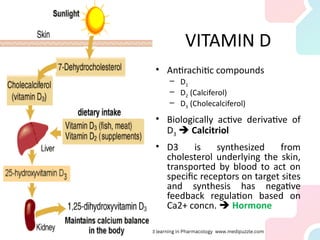
VITAMIN D
• Antirachitic compounds
– D1
– D2 (Calciferol)
– D3 (Cholecalciferol)
• Biologically active derivative of
D3  Calcitriol
• D3 is synthesized from
cholesterol underlying the skin,
transported by blood to act on
specific receptors on target sites
and synthesis has negative
feedback regulation based on
Ca2+ concn.  Hormone
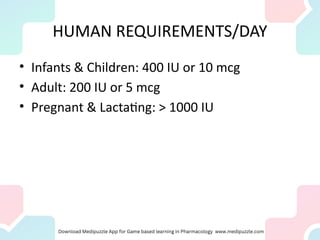
HUMAN REQUIREMENTS/DAY
• Infants & Children: 400 IU or 10 mcg
• Adult: 200 IU or 5 mcg
• Pregnant & Lactating: > 1000 IU
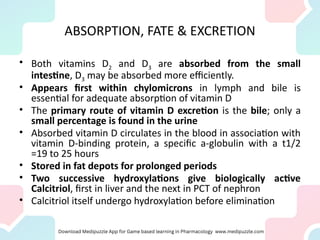
ABSORPTION, FATE & EXCRETION
• Both vitamins D2 and D3 are absorbed from the small
intestine, D3 may be absorbed more efficiently.
• Appears first within chylomicrons in lymph and bile is
essential for adequate absorption of vitamin D
• The primary route of vitamin D excretion is the bile; only a
small percentage is found in the urine
• Absorbed vitamin D circulates in the blood in association with
vitamin D-binding protein, a specific a-globulin with a t1/2
=19 to 25 hours
• Stored in fat depots for prolonged periods
• Two successive hydroxylations give biologically active
Calcitriol, first in liver and the next in PCT of nephron
• Calcitriol itself undergo hydroxylation before elimination
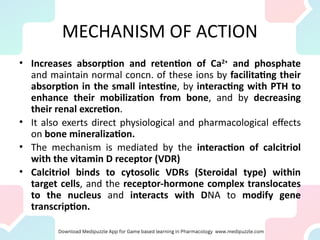
MECHANISM OF ACTION
• Increases absorption and retention of Ca2+
and phosphate
and maintain normal concn. of these ions by facilitating their
absorption in the small intestine, by interacting with PTH to
enhance their mobilization from bone, and by decreasing
their renal excretion.
• It also exerts direct physiological and pharmacological effects
on bone mineralization.
• The mechanism is mediated by the interaction of calcitriol
with the vitamin D receptor (VDR)
• Calcitriol binds to cytosolic VDRs (Steroidal type) within
target cells, and the receptor-hormone complex translocates
to the nucleus and interacts with DNA to modify gene
transcription.
PHYSIOLOGICAL FUNCTIONS
Intestinal Absorption of Ca2+
:
• Increases the transcellular movement of Ca2+
from the
mucosal to the serosal surface of the duodenum involving
three processes:
– Ca2+
entry across the mucosal surface,
– diffusion through the cell, and
– energy-dependent extrusion across the serosal cell membrane
• Calcium is also secreted from serosal to mucosal
compartments. Thus net calcium absorption occurs.
• Calcitriol also up-regulates the calcium-binding protein
calbindin-D9K
PHYSIOLOGICAL FUNCTIONS
Mobilization of Bone Minerals:
• Physiological doses of vitamin D promote mobilization of Ca2+
from bone, and large doses cause excessive bone turnover
• Increases bone turnover by multiple mechanisms  Mature
osteoclasts apparently lack the VDR and thus acting by a
non-VDR mechanism, it moves the osteoclast precursor cells
to resorption sites, as well as the development of
differentiated functions
• Osteoblasts express the VDR, and calcitriol induces their
production of several proteins, including osteocalcin, a
vitamin K-dependent protein and interleukin-1 (IL-1), a
lymphokine that promotes bone resorption
PHYSIOLOGICAL FUNCTIONS
Renal Retention of Ca2+
& PO4
-
• The effects of calcitriol on the renal retention of Ca2+
and
phosphate are of uncertain importance.
• Calcitriol increases retention of Ca2+
(DCT) independently of
phosphate (PCT)
Other Effects:
• Affects maturation and differentiation of mononuclear cells
cytokine production and immune function
• Inhibits epidermal proliferation and promotes epidermal
differentiation  potential treatment for psoriasis vulgaris
• Affects the function of skeletal muscle and brain
USES
• Prophylaxis of Vit. D Deficiency
• Metabolic Rickets:
1. Vit. D Resistant Rickets: High dose of Calcitriol or Alfacalcidiol with
phosphate
2. Vit. D Dependent Rickets: Calcitriol or Alfacalcidiol
3. Renal Rickets: Calcitriol or Alfacalcidiol
• Senile or postmenopausal Osteoporosis : Vit. D3 + Calcium or
Calcitriol or Alfacalcidiol for Vit. D3
• Hypo-PTH: Calcitriol or Alfacalcidiol (expensive than Vit. D2 or
D3)
• Psoriasis
• Fanconi’s Syndrome (Expired Tetracyclines- Kidney)
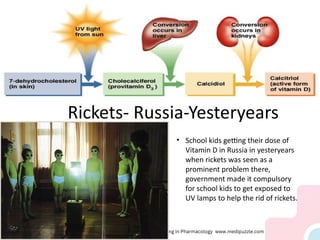
Rickets- Russia-Yesteryears
• School kids getting their dose of
Vitamin D in Russia in yesteryears
when rickets was seen as a
prominent problem there,
government made it compulsory
for school kids to get exposed to
UV lamps to help the rid of rickets.
CALCITONIN
• Hypocalcemic hormone whose actions generally oppose
those of PTH, secreted by C cells of Thyroid glands
• Secretion is regulated by plasma levels of Ca2+; increases
with hypercalcemia and vice-versa
• Secretion is stimulated by a number of agents, including
– catecholamines,
– glucagon,
– gastrin, and
– cholecystokinin
• Mechanism produced via CTR, a GPCRs
PHYSIOLOGIC FUNCTIONS
• The hypocalcemic and hypophosphatemic effects of
calcitonin are caused predominantly by direct inhibition of
osteoclastic bone resorption
• Although calcitonin inhibits the effects of PTH on osteolysis,
it inhibits neither PTH activation of bone cell adenylyl cyclase
nor PTH-induced uptake of Ca2+ into bone
• Calcitonin interacts directly with receptors on osteoclasts to
produce a rapid and profound decrease in ruffled border
surface area, thereby diminishing resorptive activity
• Depressed bone resorption reduces urinary excretion of
Ca2+, Mg2+, and hydroxyproline
PHYSIOLOGIC FUNCTIONS
• Plasma phosphate concentrations are lowered owing also to
increased urinary phosphate excretion
• Direct renal effects of calcitonin vary with species
• Acute administration of pharmacological doses of calcitonin
increases urinary calcium excretion, whereas calcitonin
inhibits renal calcium excretion at physiological
concentrations
• In humans, calcitonin increases fractional urinary calcium
excretion in a dose-dependent manner in subjects given a
modest calcium load
USES
• Hypercalcemic states associated with or without:
– hyper-PTH,
– HyperVitaminosis D,
– osteolytic bony metastasis
• Postmenopausal Osteoporosis
• Paget’s Disease
PARATHYROID HORMONE (Parathormone)
• Polypeptide hormone that helps to regulate plasma Ca2+
by
– affecting bone resorption/formation,
– renal Ca2+
excretion/reabsorption, and
– calcitriol synthesis (thus GI Ca2+
absorption)
• PTH exerts its action via at least two receptors;
– PTH-1 receptor (PTH1R or PTH/PTHrP receptor) and
– PTH-2 receptor
– found in vascular tissues, brain, pancreas, and placenta.
• These are GPCRs that can couple with Gs and Gq in cell-type
specific manners; thus, cells may show one, the other, or
both types of responses.
• Also can activate phospholipase D
Regulation of PTH Secretion
• Plasma Ca2+
is the major factor regulating PTH secretion. As
the concentration of Ca2+
diminishes, PTH secretion
increases.
• Sustained hypocalcemia induces parathyroid hypertrophy
and hyperplasia
• The active vitamin D metabolite (calcitriol), directly
suppresses PTH gene expression
• Severe hypermagnesemia or hypomagnesemia can inhibit
PTH secretion
Physiologic Functions
Effects on Bone:
• Increases bone resorption and thereby increases Ca2+
delivery to the extracellular fluid
• Allows osteoclast precursor cells to form new bone
remodeling units
• Direct in vitro effects of PTH on osteoblasts are inhibitory 
reduced formation of type I collagen, alkaline phosphatase,
and osteocalcin
• PTH in vivo increases total number of active osteoblasts
owing to initiation of new remodeling units.
• Thus plasma levels of osteocalcin and alkaline phosphatase
activity actually may be increased
Physiologic Functions
Effects on Kidney:
• Enhances the efficiency of Ca2+
reabsorption, inhibits tubular
reabsorption of phosphate, and stimulates conversion of
vitamin D to its biologically active form, calcitriol
• Net Result  Hypercalcemia and Hypophosphatemia
• However, the increase excretion of Ca2+
may occur in
hyperparathyroidism and vice-versa due to direct prominent
effect on tubules
• Newly synthesized calcitriol interacts with specific high-
affinity receptors in the intestine to increase the efficiency of
intestinal Ca2+
absorption, thereby also increasing the plasma
Ca2+
concentration
Physiologic Functions
Calcitriol Synthesis:
• The final step in the activation of vitamin D to calcitriol
occurs in kidney proximal tubule cells. Three primary
regulators govern the activity of the 25-hydroxyvitamin D3-1a-
hydroxylase that catalyzes this step: Pi, PTH, and Ca2+
• Reduced circulating or tissue phosphate content rapidly
increases calcitriol production, whereas hyperphosphatemia
or hypercalcemia suppresses it
• PTH powerfully stimulates calcitriol synthesis. Thus, when
hypocalcemia causes a rise in PTH concentration, both the
PTH-dependent lowering of circulating Pi and a more direct
effect of the hormone on the 1a-hydroxylase lead to
increased circulating concentrations of calcitriol
Physiologic Functions
Other Ions:
• Reduces renal excretion of Mg2+ 
the net result is increased renal Mg2+
reabsorption and increased mobilization of the ion from bone
• Increases excretion of water, amino acids, citrate, K+
, bicarbonate, Na+
, Cl-
,
and SO4
2-
, whereas decreases the excretion of H+
Other Actions:
• Decreases Ca2+
in milk, saliva and ocular lens
Calcium homeostasis and its
regulation by PTH
• PTH has stimulatory effects on
bone and kidney, including the
stimulation of 1 alpha-
hydroxylase activity in kidney
mitochondria leading to the
increased production of the
biologically active hormone
1,25-dihydroxyvitamin D
(calcitriol) from 25-
hydroxyvitamin D.
Solid lines indicate a positive effect; dashed lines refer to negative feedback
USES
• To differentiate pseudo-hyper-PTH from true
one.
• No therapeutic value as such
• Problems associated with Ca2+
deficiency can
be overcome by affordable Ca2+
preparations
and Vit. D
www.medipuzzle.com
Trusted by
10K +
Students
That’s All
ENJOY
44
Endo-_Drugs_affecting_Calcium_Balance.pdf

Endo-_Drugs_affecting_Calcium_Balance.pdf

  • 1.
    Drugs affecting CalciumBalance Sanjaya Mani Dixit Assistant Prof of Pharmacology
  • 2.
    Why such drugs? HYPERCALCEMIA HYPOCALCEMIA--Hypoparathyroidism HYPERVITAMINOSISD— Hypercalcemia VITAMIN D DEFICIENCY • SPECIFIC DISORDERS OF BONE – Rickets – Osteoporosis – PAGET’S DISEASE – OSTEOMALACIA AND RENAL OSTEODYSTROPHY
  • 4.
    CALCIUM • Composition: ~2%TBW, 1-1.3 kg/ healthy adult • Bone: 99% • Normal plasma level: 9-11 mg/dl • Plasma protein bound: 40% • Un-dissociable complex: 10% • Ionized: 50%
  • 6.
    DAILY REQUIREMENT • Adolescents:1.3 g/day • Adults: 1 g/day • >50yrs: 1.2 g/day • <9 yrs: 865-625 mg/day
  • 7.
    Physiological importance ofCalcium • Calcium salts in bone provide structural integrity of the skeleton • Calcium ions in extracellular and cellular fluids is essential to normal function of a host of biochemical processes – Neuro-muscular excitability – Blood coagulation – Hormonal secretion – Enzymatic regulation
  • 8.
    Regulation of CalciumMetabolism • Organ systems that play an import role in Ca2+ metabolism – Skeleton – GI tract – Kidney • Calcitropic Hormones – Parathyroid hormone (PTH) – Calcitonin (CT) – Vitamin D (1,25 dihydroxycholecalciferol) – Parathyroid hormone related protein (PTHrP)
  • 9.
    ABSORPTION & EXCRETION •Ca2+ enters the body only through the intestine. • Active vitamin D-dependent transport occurs in the proximal duodenum, whereas facilitated diffusion throughout the small intestine accounts for the majority of total Ca2+ uptake. • This uptake is counterbalanced by an obligatory daily intestinal calcium loss of about 150 mg/day. • The efficiency of intestinal Ca2+ absorption is inversely related to calcium intake. Thus, a diet low in calcium leads to a compensatory increase in fractional absorption owing partly to activation of vitamin D. In older persons, this response is considerably weak.
  • 10.
    ABSORPTION & EXCRETION •Disease states associated with steatorrhea, diarrhea, or chronic malabsorption promote fecal loss of calcium • Drugs such as glucocorticoids and phenytoin depress intestinal Ca2+ transport. • Urinary Ca2+ excretion =quantity filtered -amount reabsorbed at the nephrons. • About 9 g of Ca2+ is filtered each day. Tubular reabsorption is very efficient, with more than 98% of filtered Ca2+ returned to the circulation. The efficiency of reabsorption is highly regulated by PTH but also is influenced by filtered Na+ , the presence of non-reabsorbed anions, and diuretic agents.
  • 11.
    ABSORPTION & EXCRETION •Sodium intake, and therefore sodium excretion, is directly related to urinary calcium excretion. • Diuretics that act on the ascending limb of the loop of Henle (e.g., furosemide) increase calcium excretion. • By contrast, thiazide diuretics uncouple the relationship between Na+ and Ca2+ excretion, increasing sodium excretion but diminishing calcium excretion. • Dietary protein is directly related to urine Ca2+ excretion, presumably owing to the effect of sulfur-containing amino acids on renal tubular function.
  • 12.
  • 13.
    USES • Tetany • DietarySupplement • Osteoporosis • Antacid (Calcium Carbonate)
  • 14.
    PREPARATIONS OF CALCIUM •Calcium chloride (27% Ca) • Calcium gluconate (9% Ca) • Calcium lactate (13%) Ca • Calcium dibasic phosphate (23% Ca) • Calcium carbonate (40% Ca)
  • 15.
    Calcium Balance Modulators •Bisphosphonates • Vitamin D • Calcitonin • PTH
  • 16.
    BISPHOSPHONATES • Derivatives ofPyrophosphate in which O of the P-O-P is replaced by carbon – Etidronate, Pamidronate, Alendronate • Mechanism is not fully understood but theories have been proposed for their actions: – They localize in the acidic regions of bone matrix below osteoclasts and are taken up by osteoclasts in exchange for Ca2+ resulting in: • Accelerated apoptosis of osteoclasts • Disruption of cytoskeleton and border of osteoclasts – Also affect osteoclast precursors by inhibiting their differentiation by suppressing IL-6 – Interferes with certain steps of mevalonate pathway required for prenylation of certain GTP-proteins involved in maturation of cytoskeletal maturation
  • 17.
    ETIDRONATE • Also interfereswith bone mineralization; should be used intermittently with a 3 months gap USES: • Paget’s Disease, hypercalcemia Side effects are GI irritation, bone pain, headache, metallic taste, pyrexia, hypersensitivity Precaution: Continuous therapy  Osteomalacia
  • 18.
    ALENDRONATE • More potent,orally active • Patients must be advised not to lie down after medication to reduce chances of esophagitis • USES: Prevention and treatment of Osteoporosis • S/E: gastric erosion, flatulence, body-ache, initial fall in serum- Ca2+ level • Calcium ions, iron, fruit juice, tea, coffee, mineral water interferes with its absorption • NSAIDs use is discouraged
  • 19.
    Common USES ofBPN • Osteoporosis • Paget’s Disease • Osteolytic Bone Metastasis • Hypercalcemia of Malignancy
  • 20.
    Other BPN • Tiludronate •Risedronate • Ibandronate • Zolendronate
  • 21.
    VITAMIN D • Antirachiticcompounds – D1 – D2 (Calciferol) – D3 (Cholecalciferol) • Biologically active derivative of D3  Calcitriol • D3 is synthesized from cholesterol underlying the skin, transported by blood to act on specific receptors on target sites and synthesis has negative feedback regulation based on Ca2+ concn.  Hormone
  • 22.
    HUMAN REQUIREMENTS/DAY • Infants& Children: 400 IU or 10 mcg • Adult: 200 IU or 5 mcg • Pregnant & Lactating: > 1000 IU
  • 23.
    ABSORPTION, FATE &EXCRETION • Both vitamins D2 and D3 are absorbed from the small intestine, D3 may be absorbed more efficiently. • Appears first within chylomicrons in lymph and bile is essential for adequate absorption of vitamin D • The primary route of vitamin D excretion is the bile; only a small percentage is found in the urine • Absorbed vitamin D circulates in the blood in association with vitamin D-binding protein, a specific a-globulin with a t1/2 =19 to 25 hours • Stored in fat depots for prolonged periods • Two successive hydroxylations give biologically active Calcitriol, first in liver and the next in PCT of nephron • Calcitriol itself undergo hydroxylation before elimination
  • 24.
    MECHANISM OF ACTION •Increases absorption and retention of Ca2+ and phosphate and maintain normal concn. of these ions by facilitating their absorption in the small intestine, by interacting with PTH to enhance their mobilization from bone, and by decreasing their renal excretion. • It also exerts direct physiological and pharmacological effects on bone mineralization. • The mechanism is mediated by the interaction of calcitriol with the vitamin D receptor (VDR) • Calcitriol binds to cytosolic VDRs (Steroidal type) within target cells, and the receptor-hormone complex translocates to the nucleus and interacts with DNA to modify gene transcription.
  • 25.
    PHYSIOLOGICAL FUNCTIONS Intestinal Absorptionof Ca2+ : • Increases the transcellular movement of Ca2+ from the mucosal to the serosal surface of the duodenum involving three processes: – Ca2+ entry across the mucosal surface, – diffusion through the cell, and – energy-dependent extrusion across the serosal cell membrane • Calcium is also secreted from serosal to mucosal compartments. Thus net calcium absorption occurs. • Calcitriol also up-regulates the calcium-binding protein calbindin-D9K
  • 26.
    PHYSIOLOGICAL FUNCTIONS Mobilization ofBone Minerals: • Physiological doses of vitamin D promote mobilization of Ca2+ from bone, and large doses cause excessive bone turnover • Increases bone turnover by multiple mechanisms  Mature osteoclasts apparently lack the VDR and thus acting by a non-VDR mechanism, it moves the osteoclast precursor cells to resorption sites, as well as the development of differentiated functions • Osteoblasts express the VDR, and calcitriol induces their production of several proteins, including osteocalcin, a vitamin K-dependent protein and interleukin-1 (IL-1), a lymphokine that promotes bone resorption
  • 27.
    PHYSIOLOGICAL FUNCTIONS Renal Retentionof Ca2+ & PO4 - • The effects of calcitriol on the renal retention of Ca2+ and phosphate are of uncertain importance. • Calcitriol increases retention of Ca2+ (DCT) independently of phosphate (PCT) Other Effects: • Affects maturation and differentiation of mononuclear cells cytokine production and immune function • Inhibits epidermal proliferation and promotes epidermal differentiation  potential treatment for psoriasis vulgaris • Affects the function of skeletal muscle and brain
  • 28.
    USES • Prophylaxis ofVit. D Deficiency • Metabolic Rickets: 1. Vit. D Resistant Rickets: High dose of Calcitriol or Alfacalcidiol with phosphate 2. Vit. D Dependent Rickets: Calcitriol or Alfacalcidiol 3. Renal Rickets: Calcitriol or Alfacalcidiol • Senile or postmenopausal Osteoporosis : Vit. D3 + Calcium or Calcitriol or Alfacalcidiol for Vit. D3 • Hypo-PTH: Calcitriol or Alfacalcidiol (expensive than Vit. D2 or D3) • Psoriasis • Fanconi’s Syndrome (Expired Tetracyclines- Kidney)
  • 29.
    Rickets- Russia-Yesteryears • Schoolkids getting their dose of Vitamin D in Russia in yesteryears when rickets was seen as a prominent problem there, government made it compulsory for school kids to get exposed to UV lamps to help the rid of rickets.
  • 31.
    CALCITONIN • Hypocalcemic hormonewhose actions generally oppose those of PTH, secreted by C cells of Thyroid glands • Secretion is regulated by plasma levels of Ca2+; increases with hypercalcemia and vice-versa • Secretion is stimulated by a number of agents, including – catecholamines, – glucagon, – gastrin, and – cholecystokinin • Mechanism produced via CTR, a GPCRs
  • 32.
    PHYSIOLOGIC FUNCTIONS • Thehypocalcemic and hypophosphatemic effects of calcitonin are caused predominantly by direct inhibition of osteoclastic bone resorption • Although calcitonin inhibits the effects of PTH on osteolysis, it inhibits neither PTH activation of bone cell adenylyl cyclase nor PTH-induced uptake of Ca2+ into bone • Calcitonin interacts directly with receptors on osteoclasts to produce a rapid and profound decrease in ruffled border surface area, thereby diminishing resorptive activity • Depressed bone resorption reduces urinary excretion of Ca2+, Mg2+, and hydroxyproline
  • 33.
    PHYSIOLOGIC FUNCTIONS • Plasmaphosphate concentrations are lowered owing also to increased urinary phosphate excretion • Direct renal effects of calcitonin vary with species • Acute administration of pharmacological doses of calcitonin increases urinary calcium excretion, whereas calcitonin inhibits renal calcium excretion at physiological concentrations • In humans, calcitonin increases fractional urinary calcium excretion in a dose-dependent manner in subjects given a modest calcium load
  • 34.
    USES • Hypercalcemic statesassociated with or without: – hyper-PTH, – HyperVitaminosis D, – osteolytic bony metastasis • Postmenopausal Osteoporosis • Paget’s Disease
  • 35.
    PARATHYROID HORMONE (Parathormone) •Polypeptide hormone that helps to regulate plasma Ca2+ by – affecting bone resorption/formation, – renal Ca2+ excretion/reabsorption, and – calcitriol synthesis (thus GI Ca2+ absorption) • PTH exerts its action via at least two receptors; – PTH-1 receptor (PTH1R or PTH/PTHrP receptor) and – PTH-2 receptor – found in vascular tissues, brain, pancreas, and placenta. • These are GPCRs that can couple with Gs and Gq in cell-type specific manners; thus, cells may show one, the other, or both types of responses. • Also can activate phospholipase D
  • 36.
    Regulation of PTHSecretion • Plasma Ca2+ is the major factor regulating PTH secretion. As the concentration of Ca2+ diminishes, PTH secretion increases. • Sustained hypocalcemia induces parathyroid hypertrophy and hyperplasia • The active vitamin D metabolite (calcitriol), directly suppresses PTH gene expression • Severe hypermagnesemia or hypomagnesemia can inhibit PTH secretion
  • 37.
    Physiologic Functions Effects onBone: • Increases bone resorption and thereby increases Ca2+ delivery to the extracellular fluid • Allows osteoclast precursor cells to form new bone remodeling units • Direct in vitro effects of PTH on osteoblasts are inhibitory  reduced formation of type I collagen, alkaline phosphatase, and osteocalcin • PTH in vivo increases total number of active osteoblasts owing to initiation of new remodeling units. • Thus plasma levels of osteocalcin and alkaline phosphatase activity actually may be increased
  • 38.
    Physiologic Functions Effects onKidney: • Enhances the efficiency of Ca2+ reabsorption, inhibits tubular reabsorption of phosphate, and stimulates conversion of vitamin D to its biologically active form, calcitriol • Net Result  Hypercalcemia and Hypophosphatemia • However, the increase excretion of Ca2+ may occur in hyperparathyroidism and vice-versa due to direct prominent effect on tubules • Newly synthesized calcitriol interacts with specific high- affinity receptors in the intestine to increase the efficiency of intestinal Ca2+ absorption, thereby also increasing the plasma Ca2+ concentration
  • 39.
    Physiologic Functions Calcitriol Synthesis: •The final step in the activation of vitamin D to calcitriol occurs in kidney proximal tubule cells. Three primary regulators govern the activity of the 25-hydroxyvitamin D3-1a- hydroxylase that catalyzes this step: Pi, PTH, and Ca2+ • Reduced circulating or tissue phosphate content rapidly increases calcitriol production, whereas hyperphosphatemia or hypercalcemia suppresses it • PTH powerfully stimulates calcitriol synthesis. Thus, when hypocalcemia causes a rise in PTH concentration, both the PTH-dependent lowering of circulating Pi and a more direct effect of the hormone on the 1a-hydroxylase lead to increased circulating concentrations of calcitriol
  • 40.
    Physiologic Functions Other Ions: •Reduces renal excretion of Mg2+  the net result is increased renal Mg2+ reabsorption and increased mobilization of the ion from bone • Increases excretion of water, amino acids, citrate, K+ , bicarbonate, Na+ , Cl- , and SO4 2- , whereas decreases the excretion of H+ Other Actions: • Decreases Ca2+ in milk, saliva and ocular lens
  • 41.
    Calcium homeostasis andits regulation by PTH • PTH has stimulatory effects on bone and kidney, including the stimulation of 1 alpha- hydroxylase activity in kidney mitochondria leading to the increased production of the biologically active hormone 1,25-dihydroxyvitamin D (calcitriol) from 25- hydroxyvitamin D. Solid lines indicate a positive effect; dashed lines refer to negative feedback
  • 42.
    USES • To differentiatepseudo-hyper-PTH from true one. • No therapeutic value as such • Problems associated with Ca2+ deficiency can be overcome by affordable Ca2+ preparations and Vit. D
  • 43.
  • 44.