PROKINETICS
Presented by,
Pavana K A
M.Pharm,Pharmacology
COPS,DSU
What are Prokinetics ??
• Prokinetics are the type of drugs which enhances gastrointestinal motility/transit by
increasing the frequency or strength of contractions.
• They speed up gastric emptying by enhancing coordinated propulsive motility.
• Treat Gastrointestinal symptoms : Abdominal discomfort, Bloating, constipation,
Heart burn, nausea and vomiting. And few gastrointestinal disorders : irritable bowel
Syndrome, gastritis, gastroparesis and functional dyspepsia.
• Increases gastric emptying
• Relief of gastric stasis
• Decreases reflux esophagitis / heart burn
• Decreases regurgitation of gastric contents
& emesis
Classification Prokinetic Drugs
• Muscarinic agonist : Bethanechol (increases GI motility)
• Anticholinesterases : Neostigmine
• Dopamine D2 blockers : Metaclopramide , Domperidone , Levosulpiride, Cinitapride.
• 5HT4 Agonist : Cisapride, Metaclopramide, Mosapride, Itopride , Cinitapride .
Metaclopramide
• Substituted Benzamide ( Procainamide)
• Commonly used Antiemetic.
• It acts in the GIT as well as in CNS.
• Mechanism of action : D2 Antagonism , 5 HT4 Agonism , 5 HT3 Antagonism.
GIT : More prominent effect on upper g.i.t , ↑ gastric peristalsis while relaxing the pylorus
and first part of the duodenum. This speeds up gastric emptying. Lower esophageal
sphincter tone is increased and gastro esophageal reflux is opposed. Increases intestinal
peristalsis to some extent . No significant action on colonic motility and on gastric
secretion.
CNS : acts on CTZ which blocks apomorphine induced vomiting. Gastrokinetic action
contribute to antiemetic affect.
D2 Antagonism : Dopamine (D2 Receptor) an inhibitory transmitter in g.i.t .
Delay gastric emptying when food is present in the stomach. It causes gastric dilation and
LES relaxation attending nausea and vomiting.
Metaclopramide blocks D2 receptor- hastens gastric emptying, enhances LES tone by
augmenting Ach release. Secondary action , 5HT4 Being primary mechanism.
Central antidopaminergic action on CTZ is responsible for antiemetic property.
D2 blockade : Antagonism of Apomorphine induced vomiting, CPZ like extrapyramidal
Effects and Hyperprolactinaemia.
5HT4 Agonism
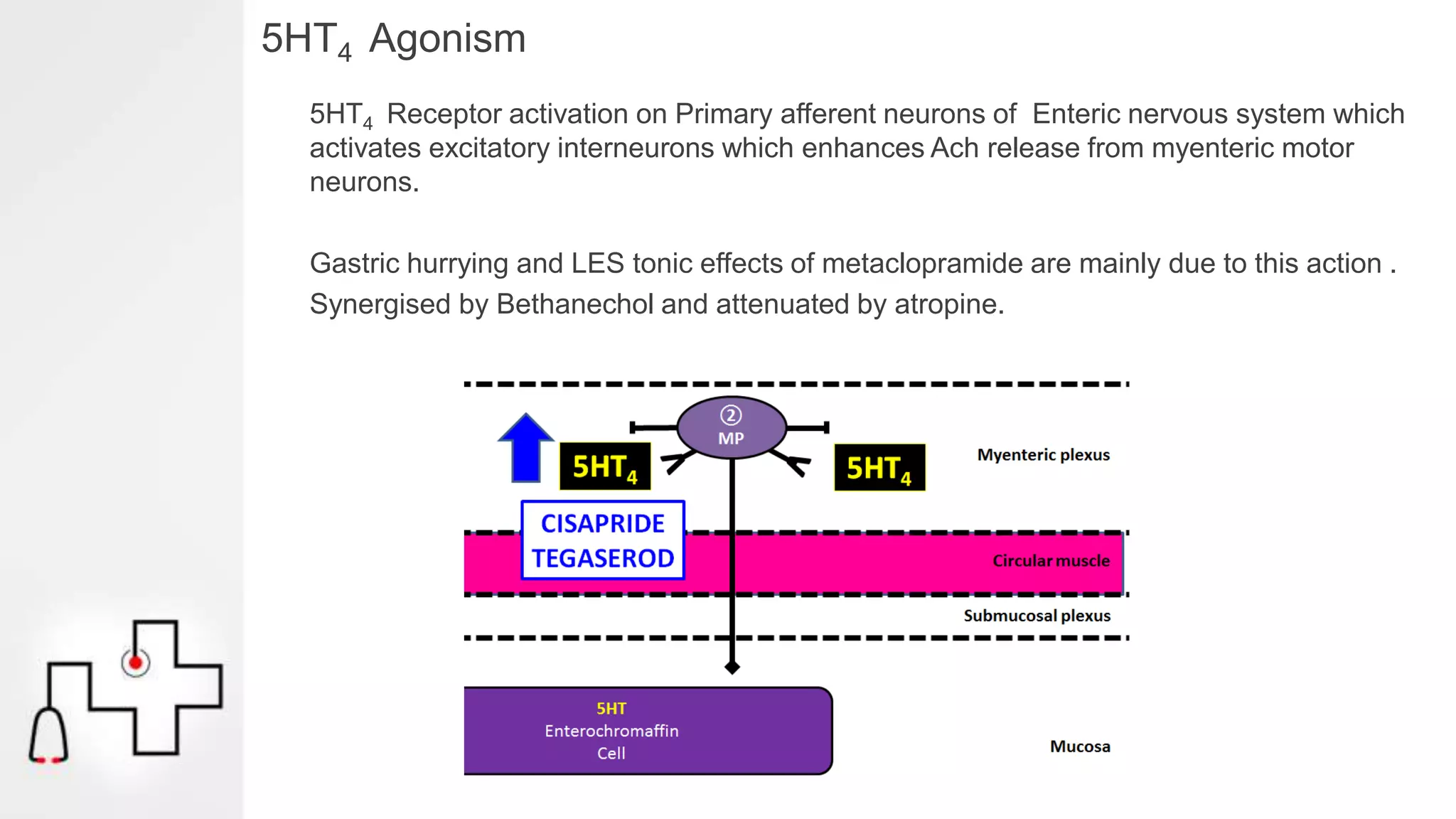
5HT4 Receptor activation on Primary afferent neurons of Enteric nervous system which
activates excitatory interneurons which enhances Ach release from myenteric motor
neurons.
Gastric hurrying and LES tonic effects of metaclopramide are mainly due to this action .
Synergised by Bethanechol and attenuated by atropine.
5HT3 Antagonism.
5HT3 receptors present on inhibitory myenteric interneurons and in NTS and CTZ.
Metaclopramide at high concentrations blocks 5HT3 receptors , This augments Ach
release in the gut which is very minor.
Its central action is significant only when large doses are used to control Chemotherapy
induced nausea and vomiting.
Pharmacokinetics
• Rapidly absorbed orally.
• Enters brain , crosses Placenta and is secreted in milk.
• Partly conjugated in liver, excreted in urine within 24 hours.
• Half life : 3-6 hours, action lasts for 4-6 hours.
• Oral, IM, IV.
Interactions : aspirin, diazepam, digoxin rate of absorption alters due to gastric hurrying
action.
Adverse effects : well tolerated.
Sedation, dizziness, loose stools, muscle dystonias.
Long term : parkinsonism, galactorrhoea and gynacecomastia.
uses
• Antiemetic: postoperative, drug induced, disease associated, radiation sickness and
less effective in motion sickness.
• Prophylaxis and treatment of vomiting induced by emetogenic anticancer drugs
(cisplatin)
• Gastrokinetic: accelerate gastric emptying , in emergency anaesthesia conditions.
Relieve postvagotomy or diabetic gastroparesis associated gastric stasis.
• Dyspepsia and other gi functional disorders .
• Gastro esophageal reflux disease : milder cases.
Domperidone
D2 receptor antagonist.
Chemically haloperidol relative. Pharmacologically Metaclopramide relative.
Less efficacious ( antiemetic and prokinetic action)
Blocks D2 receptors in upper g.i.t : prokinetic action
Antiemetic action : CTZ.
Crosses BBB poorly, side effects are rare.
Absorbed orally, 15% BA ; First pass metabolism.
Completely biotransformed , excreted in urine. Half life is 7.5 hours.
Side effects : Dry mouth, loose stools, head ache, rashes and galactorrhoea. Rapid IV inj :
Cardiac Arrhythmias..
Uses : antiemetic for mild to moderate cases of postopertative, drug and disease induced
nausea and vomiting. Not effective in severe cases, not useful In motion sickness and
morning sickness. Efficacy in CINV is low.
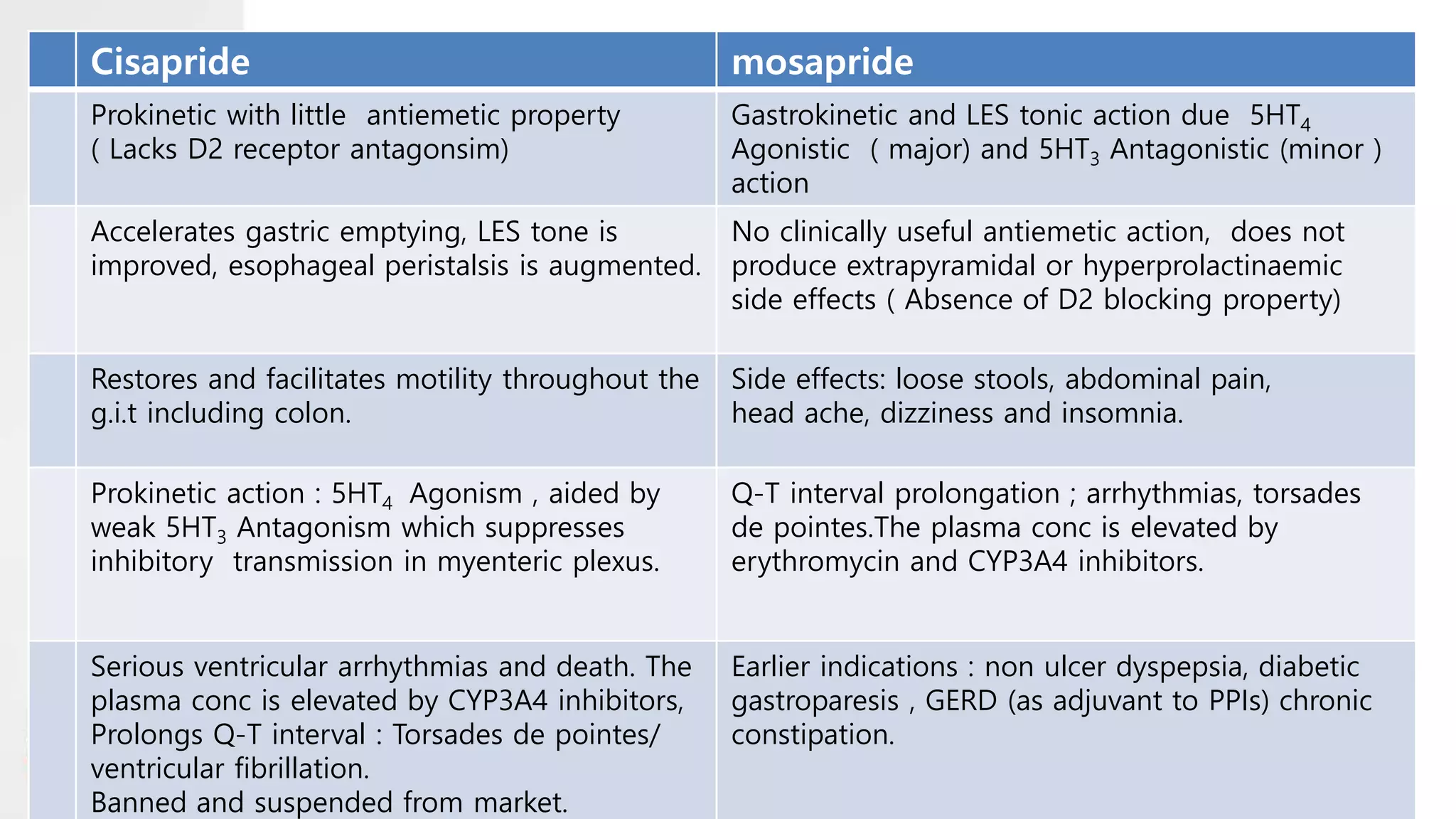
Cisapride mosapride
Prokinetic with little antiemetic property
( Lacks D2 receptor antagonsim)
Gastrokinetic and LES tonic action due 5HT4
Agonistic ( major) and 5HT3 Antagonistic (minor )
action
Accelerates gastric emptying, LES tone is
improved, esophageal peristalsis is augmented.
No clinically useful antiemetic action, does not
produce extrapyramidal or hyperprolactinaemic
side effects ( Absence of D2 blocking property)
Restores and facilitates motility throughout the
g.i.t including colon.
Side effects: loose stools, abdominal pain,
head ache, dizziness and insomnia.
Prokinetic action : 5HT4 Agonism , aided by
weak 5HT3 Antagonism which suppresses
inhibitory transmission in myenteric plexus.
Q-T interval prolongation ; arrhythmias, torsades
de pointes.The plasma conc is elevated by
erythromycin and CYP3A4 inhibitors.
Serious ventricular arrhythmias and death. The
plasma conc is elevated by CYP3A4 inhibitors,
Prolongs Q-T interval : Torsades de pointes/
ventricular fibrillation.
Banned and suspended from market.
Earlier indications : non ulcer dyspepsia, diabetic
gastroparesis , GERD (as adjuvant to PPIs) chronic
constipation.
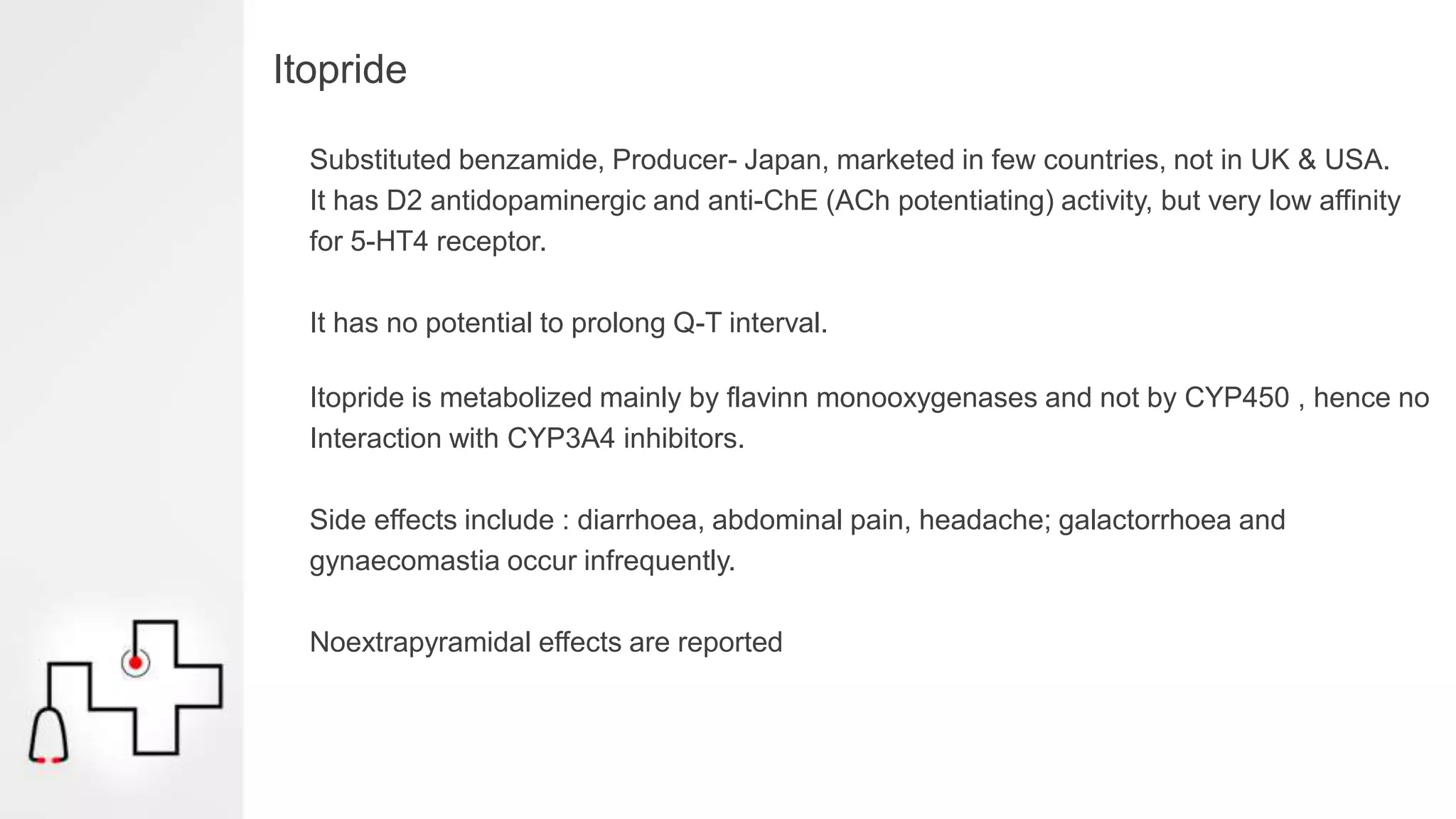
Itopride
Substituted benzamide, Producer- Japan, marketed in few countries, not in UK & USA.
It has D2 antidopaminergic and anti-ChE (ACh potentiating) activity, but very low affinity
for 5-HT4 receptor.
It has no potential to prolong Q-T interval.
Itopride is metabolized mainly by flavinn monooxygenases and not by CYP450 , hence no
Interaction with CYP3A4 inhibitors.
Side effects include : diarrhoea, abdominal pain, headache; galactorrhoea and
gynaecomastia occur infrequently.
Noextrapyramidal effects are reported
Motilides (Macrolides and erythromycin)
Motilin, a 22–amino acid peptide hormone found in the GI M cells and in some
enterochromaffin cells of the upper small bowel .
Erythromycin increases smooth muscle contractility. It has multiple effects on upper GI
motility, increasing lower esophageal pressure and stimulating gastric and small-bowel
contractility.
Erythromycin as a prokinetic agent used in patients with diabetic gastroparesis , where it
can improve gastric emptying in the short term.
A standard dose of erythromycin for gastric stimulation is
: 3 mg/kg intravenously or 200-250 mg orally every 8 hours.
Combination of erythromycin and metoclopramide is more effective than Metaclopramide
alone.
Cholecystokinin Receptor Antagonist
Elevated cholecystokinin levels slow gastric emptying and motility and are associated with
feed intolerance in critically ill patients.
Dexloxiglumide
Selective and highly potent CCK-1 receptor antagonist
Inhibits gall bladder contraction
Improves lower esophageal sphincter function
Hastens colonic transit
References
• https://en.wikipedia.org/wiki/Prokinetic_agent
• Essentials of Medical Pharmacology KD Tripathi.
• Goodman & Gilman’s The Pharmacological Basis of
THERAPEUTICS.
Prokinetics 1

Prokinetics 1

  • 1.
    PROKINETICS Presented by, Pavana KA M.Pharm,Pharmacology COPS,DSU
  • 2.
    What are Prokinetics?? • Prokinetics are the type of drugs which enhances gastrointestinal motility/transit by increasing the frequency or strength of contractions. • They speed up gastric emptying by enhancing coordinated propulsive motility. • Treat Gastrointestinal symptoms : Abdominal discomfort, Bloating, constipation, Heart burn, nausea and vomiting. And few gastrointestinal disorders : irritable bowel Syndrome, gastritis, gastroparesis and functional dyspepsia. • Increases gastric emptying • Relief of gastric stasis • Decreases reflux esophagitis / heart burn • Decreases regurgitation of gastric contents & emesis
  • 3.
    Classification Prokinetic Drugs •Muscarinic agonist : Bethanechol (increases GI motility) • Anticholinesterases : Neostigmine • Dopamine D2 blockers : Metaclopramide , Domperidone , Levosulpiride, Cinitapride. • 5HT4 Agonist : Cisapride, Metaclopramide, Mosapride, Itopride , Cinitapride .
  • 4.
    Metaclopramide • Substituted Benzamide( Procainamide) • Commonly used Antiemetic. • It acts in the GIT as well as in CNS. • Mechanism of action : D2 Antagonism , 5 HT4 Agonism , 5 HT3 Antagonism. GIT : More prominent effect on upper g.i.t , ↑ gastric peristalsis while relaxing the pylorus and first part of the duodenum. This speeds up gastric emptying. Lower esophageal sphincter tone is increased and gastro esophageal reflux is opposed. Increases intestinal peristalsis to some extent . No significant action on colonic motility and on gastric secretion. CNS : acts on CTZ which blocks apomorphine induced vomiting. Gastrokinetic action contribute to antiemetic affect.
  • 6.
    D2 Antagonism :Dopamine (D2 Receptor) an inhibitory transmitter in g.i.t . Delay gastric emptying when food is present in the stomach. It causes gastric dilation and LES relaxation attending nausea and vomiting. Metaclopramide blocks D2 receptor- hastens gastric emptying, enhances LES tone by augmenting Ach release. Secondary action , 5HT4 Being primary mechanism. Central antidopaminergic action on CTZ is responsible for antiemetic property. D2 blockade : Antagonism of Apomorphine induced vomiting, CPZ like extrapyramidal Effects and Hyperprolactinaemia.
  • 7.
    5HT4 Agonism 5HT4 Receptoractivation on Primary afferent neurons of Enteric nervous system which activates excitatory interneurons which enhances Ach release from myenteric motor neurons. Gastric hurrying and LES tonic effects of metaclopramide are mainly due to this action . Synergised by Bethanechol and attenuated by atropine.
  • 8.
    5HT3 Antagonism. 5HT3 receptorspresent on inhibitory myenteric interneurons and in NTS and CTZ. Metaclopramide at high concentrations blocks 5HT3 receptors , This augments Ach release in the gut which is very minor. Its central action is significant only when large doses are used to control Chemotherapy induced nausea and vomiting.
  • 9.
    Pharmacokinetics • Rapidly absorbedorally. • Enters brain , crosses Placenta and is secreted in milk. • Partly conjugated in liver, excreted in urine within 24 hours. • Half life : 3-6 hours, action lasts for 4-6 hours. • Oral, IM, IV. Interactions : aspirin, diazepam, digoxin rate of absorption alters due to gastric hurrying action. Adverse effects : well tolerated. Sedation, dizziness, loose stools, muscle dystonias. Long term : parkinsonism, galactorrhoea and gynacecomastia.
  • 10.
    uses • Antiemetic: postoperative,drug induced, disease associated, radiation sickness and less effective in motion sickness. • Prophylaxis and treatment of vomiting induced by emetogenic anticancer drugs (cisplatin) • Gastrokinetic: accelerate gastric emptying , in emergency anaesthesia conditions. Relieve postvagotomy or diabetic gastroparesis associated gastric stasis. • Dyspepsia and other gi functional disorders . • Gastro esophageal reflux disease : milder cases.
  • 11.
    Domperidone D2 receptor antagonist. Chemicallyhaloperidol relative. Pharmacologically Metaclopramide relative. Less efficacious ( antiemetic and prokinetic action) Blocks D2 receptors in upper g.i.t : prokinetic action Antiemetic action : CTZ. Crosses BBB poorly, side effects are rare. Absorbed orally, 15% BA ; First pass metabolism. Completely biotransformed , excreted in urine. Half life is 7.5 hours. Side effects : Dry mouth, loose stools, head ache, rashes and galactorrhoea. Rapid IV inj : Cardiac Arrhythmias.. Uses : antiemetic for mild to moderate cases of postopertative, drug and disease induced nausea and vomiting. Not effective in severe cases, not useful In motion sickness and morning sickness. Efficacy in CINV is low.
  • 12.
    Cisapride mosapride Prokinetic withlittle antiemetic property ( Lacks D2 receptor antagonsim) Gastrokinetic and LES tonic action due 5HT4 Agonistic ( major) and 5HT3 Antagonistic (minor ) action Accelerates gastric emptying, LES tone is improved, esophageal peristalsis is augmented. No clinically useful antiemetic action, does not produce extrapyramidal or hyperprolactinaemic side effects ( Absence of D2 blocking property) Restores and facilitates motility throughout the g.i.t including colon. Side effects: loose stools, abdominal pain, head ache, dizziness and insomnia. Prokinetic action : 5HT4 Agonism , aided by weak 5HT3 Antagonism which suppresses inhibitory transmission in myenteric plexus. Q-T interval prolongation ; arrhythmias, torsades de pointes.The plasma conc is elevated by erythromycin and CYP3A4 inhibitors. Serious ventricular arrhythmias and death. The plasma conc is elevated by CYP3A4 inhibitors, Prolongs Q-T interval : Torsades de pointes/ ventricular fibrillation. Banned and suspended from market. Earlier indications : non ulcer dyspepsia, diabetic gastroparesis , GERD (as adjuvant to PPIs) chronic constipation.
  • 13.
    Itopride Substituted benzamide, Producer-Japan, marketed in few countries, not in UK & USA. It has D2 antidopaminergic and anti-ChE (ACh potentiating) activity, but very low affinity for 5-HT4 receptor. It has no potential to prolong Q-T interval. Itopride is metabolized mainly by flavinn monooxygenases and not by CYP450 , hence no Interaction with CYP3A4 inhibitors. Side effects include : diarrhoea, abdominal pain, headache; galactorrhoea and gynaecomastia occur infrequently. Noextrapyramidal effects are reported
  • 14.
    Motilides (Macrolides anderythromycin) Motilin, a 22–amino acid peptide hormone found in the GI M cells and in some enterochromaffin cells of the upper small bowel . Erythromycin increases smooth muscle contractility. It has multiple effects on upper GI motility, increasing lower esophageal pressure and stimulating gastric and small-bowel contractility. Erythromycin as a prokinetic agent used in patients with diabetic gastroparesis , where it can improve gastric emptying in the short term. A standard dose of erythromycin for gastric stimulation is : 3 mg/kg intravenously or 200-250 mg orally every 8 hours. Combination of erythromycin and metoclopramide is more effective than Metaclopramide alone.
  • 15.
    Cholecystokinin Receptor Antagonist Elevatedcholecystokinin levels slow gastric emptying and motility and are associated with feed intolerance in critically ill patients. Dexloxiglumide Selective and highly potent CCK-1 receptor antagonist Inhibits gall bladder contraction Improves lower esophageal sphincter function Hastens colonic transit
  • 16.
    References • https://en.wikipedia.org/wiki/Prokinetic_agent • Essentialsof Medical Pharmacology KD Tripathi. • Goodman & Gilman’s The Pharmacological Basis of THERAPEUTICS.