Osteoporotic Drugs
Dr. Sairamakrishnan S
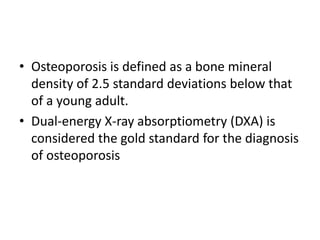
• Osteoporosis is defined as a bone mineral
density of 2.5 standard deviations below that
of a young adult.
• Dual-energy X-ray absorptiometry (DXA) is
considered the gold standard for the diagnosis
of osteoporosis
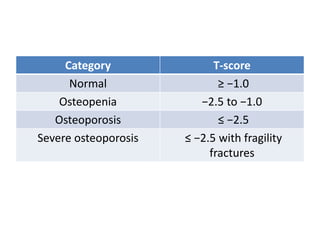
Category T-score
Normal ≥ −1.0
Osteopenia −2.5 to −1.0
Osteoporosis ≤ −2.5
Severe osteoporosis ≤ −2.5 with fragility
fractures
• Osteoporosis is a silent thief which robs us of
our bone strength
• Osteoporosis is age dependant
• Around 15% of people aged 50 years and 70%
of people aged over 80 years suffer from
osteoporosis.
• It affects women more than men.
• 1 out of 3 # in women and 1 out of 5 # in men
aged 50 years is attributable to osteoporosis.
Risk factors of Osteoporosis
• Non modifiable
– Female sex
– Oestrogen deficiency following early menopause
or hysterectomy
– European or Asian ancestry
– Family history of fractures attributable to
osteoporosis (~30 genes have been identified)
– Small stature
• Modifiable risk factors
– Vitamin D deficiency
– Calcium deficiency
– Malnutrition
– Tobacco use
– Excessive Alcoholism (small quantities of alcohol
has been proven to be beneficial)
– Soft drinks (phosphoric acid)
– Prolonged exposure to heavy metals (eg.:lead,
cadmium)
– Prolonged immobilization
• Medical conditions
– Hypogonadism (eg.:Turners, Klinefelters)
– Endocrine disorders
• Cushing's syndrome
• Hyperparathyroidism
• Hyperthyroidism
• Hypothyroidism
• Diabetes mellitus
• Acromegaly
• Adrenal insufficiency
– Malabsorption states
• Crohn’s disease
• Ulcerative colitis
• Cystic fibrosis
• Post GI surgeries
• Liver diseases
– Connective tissue diseases (eg.:Marfans)
– Renal disorders
– Autoimmune connective tissue disorders (eg.:SLE)
– Hematologic disorders and malignancies
– Parkinson's disease
• Drugs
– Steroids
– Antiepileptics
– Thyroxine
– Anticoagulants (both heparin and warfarin)
– Proton pump inhibitors
– Thiozolidindiones
– Lithium therapy
• These risk factors predispose for osteoporosis
by altering one of the following
– Calcium metabolism
– Bone formation and resorption
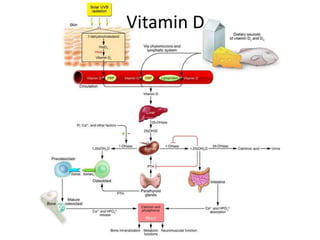
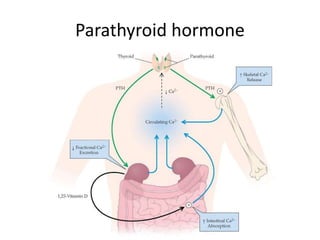
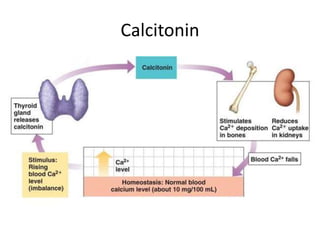
Calcium metabolism
• Calcium metabolism is mediated by
– Vitamin D
– Parathyroid hormone
– Calcitonin
• These control the absorption of calcium from
the gut, deposition or resorption of calcium
from the bone and calcium excretion through
the kidneys.
Vitamin D
Parathyroid hormone
Calcitonin
Bone formation and resorption
• In normal bone, matrix remodeling of bone is
constant; up to 10% of all bone mass may be
undergoing remodeling at any point in time.
• The three main mechanisms by which
osteoporosis develops are an inadequate peak
bone mass, excessive bone resorption, and
inadequate formation of new bone during
remodeling.
• Oestrogen through its alpha receptor
stimulates osteoblasts and inhibits osteoclasts
and its deficiency increases bone resorption
leading to osteoporosis in postmenopausal
women
• Osteoclasts are activated through many
molecular pathways of which RANK - RANKL –
Osteoprotegerin(OPG) pathway is well
established
• RANKL is produced by osteoblasts (and
inflammatory cells) which bind to RANK on
osteoclasts and activates them.
• OPG acts as a decoy receptor and binds to
RANKL before it binds to RANK and prevents it
from activating the osteoclasts
• Expression of OPG by mesenchymal cells is
increased by oestrogen.
• This pathway is the target of newer
osteoporotic drugs
• Vitamin K2 is a cofactor in gamma
carboxylation which is needed for osteocalcin
secretion. It also inhibits the expression of
RANK by the osteoclasts and thus prevents
their activation.
• Thus vitamin K2 not only increases bone
formation it also decreases bone resorption
thus helps in the prevention of osteoporosis.
• Osteoporotic fractures commonly involve
around the cancellous bone regions as they
are associated with high rate of bone turnover
compared to the cortical bone.
• # NOF and IT # > Vertebral # > Distal radius # >
Rib #
Prevention
• Taking diet rich in Calcium and vitamin D
• Regular physical activities
• Avoiding Tobacco use
• Avoiding excessive alcohol consumption
• Avoiding prolonged immobilization
Pharmacotherapy
• Vitamin D
• Calcium suplimentation
• Vitamin K2
• Hormone replacement therapy
• Bisphosphonates
• Teriparatide
• Calcitonin
• Newer drugs
– Strontium ranelate
– Raloxifene (selective oestrogen receptor agonists)
– Denosumab
Vitamin D
• Vitamin D is the antirachitic substances
synthesized in the body and found in foods
activated by uv radiation
• D3-cholecalciferol-synthesized in the skin
under the influence of uv rays
• D2-calciferol-present in irradiated food-
yeasts,fungi,bread.milk
• D1-mixture of antirachitic substances found in
food
ACTIONS
• CALCITRIOL-enhances absorption of calcium
and phosphate from intestine,brought about
by increasing synthesis of calcium channels
and a carrier protien for ca2+ called calcium
binding protein or calbindin
• Calcitriol enhances resorption of calcium and
phosphate from bone
• Calcitriol enhances tubular resorption of
calcium and phosphate in kidney
PHARMACOKINETICS
• Vitamin D is well absorbed from the intestine
in the presence of bile salts,mainly through
lymphatics
• In the circulation it is bound to a specific alpha
globulin and is stored in the adipose tissue
• Metabolites of vit D are excreted mainly in bile
PREPARATIONS
• DOSE :PROPHYLAXIS:400IU/DAY,TREATMENT
3000-4000IU/DAY.Alternatively 300000-
600000IU can be given orally or im once in 2-
6months
• CALCIFEROL(ergocalciferol,D2) available in
gelatin capsules 25000 and 50000 IU caps
• CHOLECALCIFEROL:arachitol-300000IU(7.5mg)
and 600000IU(15mg)perml inj . CALCIROL-
60000IU in 1g granules
• CALCITRIOL-0.25-1 orally daily or alternate
days ,0.5-1 iv on alternate days
• ALFACALCIDOL-it is a 1 alpha-OHD3 prodrug
that is rapidly hydroxylated in the liver to
calcitriol.dose-1-2 /day,children 0.5 /day
• DIHYDROTACHYSTEROL-a synthetic analogue
of vit D2 . Dose 0.25-0.5mg/day
INTERACTIONS
• Cholestyramine and chronic use of liquid
paraffin can reduce vit D absorption
• Phenytoin and phenobarbitone reduce the
responsiveness of target tissues to calcitriol
CALCIUM
• Plasma calcium level is regulated by 3 hormones
PTH,calcitonin,calcitriol.Normal level 9-11mg/dl
• Physiological roles:ca2 controls excitabiliy of
nerves and muscles and regulates permiability of
cellmembrane.it maintains integrity of cell
membrane and regulates cell adhesion
• Ca2+ ions are essential for excitation and
contraction coupling in all muscles and excitation-
secretion coupling in exocrine and endocrine
glands
• Intracellular messenger for
hormones,autocoids and transmitters
• Impulse generation in heart and A-V
conduction
• Coagulation of blood
• Structural function in bone and teeth
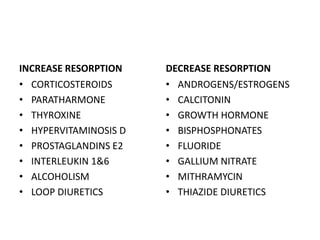
INCREASE RESORPTION
• CORTICOSTEROIDS
• PARATHARMONE
• THYROXINE
• HYPERVITAMINOSIS D
• PROSTAGLANDINS E2
• INTERLEUKIN 1&6
• ALCOHOLISM
• LOOP DIURETICS
DECREASE RESORPTION
• ANDROGENS/ESTROGENS
• CALCITONIN
• GROWTH HORMONE
• BISPHOSPHONATES
• FLUORIDE
• GALLIUM NITRATE
• MITHRAMYCIN
• THIAZIDE DIURETICS
ABSORPTION AND EXCRETION
• Ca2+ is absorbed by facilitated diffusion from
the entire small intestine by a carrier
mediated active transport under the influence
of vit D
• VIT D increases and calcitonin decreases prox
tubular resorption,while PTH increases distal
tubular resorption of ca2+
• Normally 1/3rd of ingested ca2+ is
absorbed,dietary allowance 0.8-1.5g /day
PREPARATIONS
• Ca chloride(27%ca)-highly irritating,available
as im,iv and oral forms
• Ca gluconate(9%ca)-availble as 0.5-1g tab
and10% inj,it is the preferred inj salt
• Ca lactate(13%ca)-oral,non irritant and well
tolerated
• Ca diphasic phosohate(23%ca)-is insoluble
reacts with HCL to form soluble chloride,used
orally as an antacid and ca supplementation
• Ca carbonate(40%ca)-insoluble,tasteless and
nonreacting
• SIDE EFFECTS:constipation,bloating and excess
gas
• DOSAGE:1-1.5g /day
CALCITONIN
• Calcitonin is a hypocalcaemic hormone produced
by parafollicular C cells of thyroid
• PREPARATION-synthetic salmon calcitonin is used
clinically,because it is more potent,human
calcitonin also available
• MIACAlCIN NASAL SPRAY-2200 IU in 2ml,a nasal
formulation delivering 200IU per actuation
• DOSAGE- for osteoporosis 100IU s.c or i.m daily
along with ca and vitD supplementation
BISPHOSPHONATES
• FISRT GENERATION BPN-
ETIDRONATE,TILUDRONATE
• 2ND GENERATION-
PAMIDRONATE,ALENDRONATE,IBANDRONATE
• 3RD GENERATION-RISEDRONATE,ZOLEDRONATE
• BISPHOSPHONATES ARE ANALOGUE OF
PYROPHOSPHATE
• CARBON ATOM REPLACING OXYGEN IN P-O-P
SKELETON
MECHANISM OF ACTION
• ACCELERATED APOPTOSIS IF OSTEOCLASTS
REDUCING THEIR NUMBER
• DISRUPTION OF CYTOSKELETON AND RUFFLED
BORDER OF OSTEOCLASTS
• 2ND AND 3RD GENERATION HAVE IMP EFFECTS
ON MEVALONATE PATHWAY .THEY INHIBIT
CERTAIN GTP BINDING PROTEINS INVOLVED IN
CYTOSKETAL ORGANISATION,MEMBRANE
RUFFLING
• Net effect is inactivation of
osteoclasts,impaired vesicle fusion and
enhanced apoptosis.interference with
mevalonate pathway may also impart
antitumour action on bony metastasis
• SIDE EFFECTS:gi intolerance,esophagitis.
CONTRAINDICATION: in GERD,peptic
ulcer,renal impairment
• ETIDRONATE-first BPN to be used clinically
• Route of admistration-oral and iv
• Dosage-5-7.5mg/kg/day
• SF-gastric
irritation,bonepain,headache,metallic
taste,pyrexia,hypersensitivity,prolonged use
wil lead to osteomalacia
PAMIDRONATE
• 2ND generation BPN only by iv infusion
• Dosage-60-90mg over 2-4hrs weekly or
monthly
• SF-thrombophlebitis of inj vein,bony
pain,fever,leukopenia,flu like reaction initially
due to cytokine release
ALENDRONATE
• Orally effective 2nd generation BPN should be
taken on empty stomach in the morning with
full glass of water and not to lie down or take
food for 30min to prevent contact with
oesophageal mucosa which results in
esophagitis
• Dosage-5-10mg od or 35-70mg/weekly
• Ca,iron,mineral water,tea,coffee,fruit juice
interfere with alendronate absorption
• Bioavailability-1%,upto 50% sequestrated in
bone,rest is excreted unchanged mainly in
urine
• Terminal elimination of t1/2 of alendronate is
10.5yrs
RISEDRONATE
• Oral 3rd generation BPN more potent than
alendronate
• BIOAVAILABILITY-1% and other features
similar to alendronate
• DOSAGE-35mg/week
ZOLEDRONATE
• Parenteral highly potent 3rd generation BPN
• Dosage-4mg diluted in 100ml saline or glucose
solution infused iv over 15min,may be
repeated after 7days and then at 3-4weeks
intervals
• SF-renal toxicity,flu like symptoms
• For hypercalcaemia more effective than
pamidronate and DOC
TERIPARATIDE
• It is a recombinant preparation of 1-34 residues of
amino terminal of human PTH
• It duplicates all the actions of human PTH
• DOSE: 20 mcg s/c daily
• Plasma t1/2 is 1hr
• Intermittent exposure to PTH activate osteoblasts more
than osteoclasts
• It is found to be equally or more effective than
oestrogen and BPN in reducing risk of vertebral as well
as non vertebral fractures
• AE-highcost,osteosarcoma
Vitamin K2 (menaquinone)
• Vitamin K2 is a cofactor of gamma-
carboxylase, which activates osteocalcin.
• Osteocalcin promotes normal bone
mineralization
• Vitamin K2 also inhibits the expression of the
osteoclast differentiation factor (ODF) and
RANKL
• DOSAGE: 50mcg daily
Strontium Ranelate
• Strontium ranelate stimulates calcium sensing
receptors and leads to the differentiation of
pre-osteoblast to osteoblast
• Strontium ranelate also stimulates osteoblasts
to secrete osteoprotegerin in inhibiting
osteoclasts
• DOSAGE: 2g daily
• Side Effects: CVS symptoms, DRESS Syndrome.
DENOSUMAB
• DENOSUMAB is a human monoclonal antibody
• MOA-Denosumab is a RANKL inhibitor,which
works by preventing the development of
osteoclasts
• Uses-osteoporosis,treatment induced
boneloss,bony metastasis,GCT
• AE-joint and muscle
pain,cellulitis,hypocalcemia,osteonecrosis of jaw
• Dosage-60mcg sc once every six months
RALOXIFENE
• It is a selective estrogen receptor modulator
• It is an estrogen partial agonist in bone and
cvs,but an antagonist in endometrium and
breast.it has affinity for both estrogen alpha
and beta receptors
• Dose-60mg/day orally
• T1/2-28hrs ,major route of excretion is faeces
• It is a first line drug in treatment and
prevention of osteoporosis in postmenopausal
women,ca and vitD supplements enhance the
benefit
• It has no use in men

Osteoporotic drugs

  • 1.
  • 2.
    • Osteoporosis isdefined as a bone mineral density of 2.5 standard deviations below that of a young adult. • Dual-energy X-ray absorptiometry (DXA) is considered the gold standard for the diagnosis of osteoporosis
  • 3.
    Category T-score Normal ≥−1.0 Osteopenia −2.5 to −1.0 Osteoporosis ≤ −2.5 Severe osteoporosis ≤ −2.5 with fragility fractures
  • 4.
    • Osteoporosis isa silent thief which robs us of our bone strength • Osteoporosis is age dependant • Around 15% of people aged 50 years and 70% of people aged over 80 years suffer from osteoporosis. • It affects women more than men. • 1 out of 3 # in women and 1 out of 5 # in men aged 50 years is attributable to osteoporosis.
  • 5.
    Risk factors ofOsteoporosis • Non modifiable – Female sex – Oestrogen deficiency following early menopause or hysterectomy – European or Asian ancestry – Family history of fractures attributable to osteoporosis (~30 genes have been identified) – Small stature
  • 6.
    • Modifiable riskfactors – Vitamin D deficiency – Calcium deficiency – Malnutrition – Tobacco use – Excessive Alcoholism (small quantities of alcohol has been proven to be beneficial) – Soft drinks (phosphoric acid) – Prolonged exposure to heavy metals (eg.:lead, cadmium) – Prolonged immobilization
  • 7.
    • Medical conditions –Hypogonadism (eg.:Turners, Klinefelters) – Endocrine disorders • Cushing's syndrome • Hyperparathyroidism • Hyperthyroidism • Hypothyroidism • Diabetes mellitus • Acromegaly • Adrenal insufficiency
  • 8.
    – Malabsorption states •Crohn’s disease • Ulcerative colitis • Cystic fibrosis • Post GI surgeries • Liver diseases – Connective tissue diseases (eg.:Marfans) – Renal disorders – Autoimmune connective tissue disorders (eg.:SLE) – Hematologic disorders and malignancies – Parkinson's disease
  • 9.
    • Drugs – Steroids –Antiepileptics – Thyroxine – Anticoagulants (both heparin and warfarin) – Proton pump inhibitors – Thiozolidindiones – Lithium therapy
  • 10.
    • These riskfactors predispose for osteoporosis by altering one of the following – Calcium metabolism – Bone formation and resorption
  • 11.
    Calcium metabolism • Calciummetabolism is mediated by – Vitamin D – Parathyroid hormone – Calcitonin • These control the absorption of calcium from the gut, deposition or resorption of calcium from the bone and calcium excretion through the kidneys.
  • 12.
  • 13.
  • 14.
  • 15.
    Bone formation andresorption • In normal bone, matrix remodeling of bone is constant; up to 10% of all bone mass may be undergoing remodeling at any point in time. • The three main mechanisms by which osteoporosis develops are an inadequate peak bone mass, excessive bone resorption, and inadequate formation of new bone during remodeling.
  • 16.
    • Oestrogen throughits alpha receptor stimulates osteoblasts and inhibits osteoclasts and its deficiency increases bone resorption leading to osteoporosis in postmenopausal women • Osteoclasts are activated through many molecular pathways of which RANK - RANKL – Osteoprotegerin(OPG) pathway is well established
  • 17.
    • RANKL isproduced by osteoblasts (and inflammatory cells) which bind to RANK on osteoclasts and activates them. • OPG acts as a decoy receptor and binds to RANKL before it binds to RANK and prevents it from activating the osteoclasts • Expression of OPG by mesenchymal cells is increased by oestrogen. • This pathway is the target of newer osteoporotic drugs
  • 18.
    • Vitamin K2is a cofactor in gamma carboxylation which is needed for osteocalcin secretion. It also inhibits the expression of RANK by the osteoclasts and thus prevents their activation. • Thus vitamin K2 not only increases bone formation it also decreases bone resorption thus helps in the prevention of osteoporosis.
  • 19.
    • Osteoporotic fracturescommonly involve around the cancellous bone regions as they are associated with high rate of bone turnover compared to the cortical bone. • # NOF and IT # > Vertebral # > Distal radius # > Rib #
  • 20.
    Prevention • Taking dietrich in Calcium and vitamin D • Regular physical activities • Avoiding Tobacco use • Avoiding excessive alcohol consumption • Avoiding prolonged immobilization
  • 21.
    Pharmacotherapy • Vitamin D •Calcium suplimentation • Vitamin K2 • Hormone replacement therapy • Bisphosphonates • Teriparatide • Calcitonin
  • 22.
    • Newer drugs –Strontium ranelate – Raloxifene (selective oestrogen receptor agonists) – Denosumab
  • 23.
    Vitamin D • VitaminD is the antirachitic substances synthesized in the body and found in foods activated by uv radiation • D3-cholecalciferol-synthesized in the skin under the influence of uv rays • D2-calciferol-present in irradiated food- yeasts,fungi,bread.milk • D1-mixture of antirachitic substances found in food
  • 24.
    ACTIONS • CALCITRIOL-enhances absorptionof calcium and phosphate from intestine,brought about by increasing synthesis of calcium channels and a carrier protien for ca2+ called calcium binding protein or calbindin • Calcitriol enhances resorption of calcium and phosphate from bone • Calcitriol enhances tubular resorption of calcium and phosphate in kidney
  • 25.
    PHARMACOKINETICS • Vitamin Dis well absorbed from the intestine in the presence of bile salts,mainly through lymphatics • In the circulation it is bound to a specific alpha globulin and is stored in the adipose tissue • Metabolites of vit D are excreted mainly in bile
  • 26.
    PREPARATIONS • DOSE :PROPHYLAXIS:400IU/DAY,TREATMENT 3000-4000IU/DAY.Alternatively300000- 600000IU can be given orally or im once in 2- 6months • CALCIFEROL(ergocalciferol,D2) available in gelatin capsules 25000 and 50000 IU caps • CHOLECALCIFEROL:arachitol-300000IU(7.5mg) and 600000IU(15mg)perml inj . CALCIROL- 60000IU in 1g granules
  • 27.
    • CALCITRIOL-0.25-1 orallydaily or alternate days ,0.5-1 iv on alternate days • ALFACALCIDOL-it is a 1 alpha-OHD3 prodrug that is rapidly hydroxylated in the liver to calcitriol.dose-1-2 /day,children 0.5 /day • DIHYDROTACHYSTEROL-a synthetic analogue of vit D2 . Dose 0.25-0.5mg/day
  • 28.
    INTERACTIONS • Cholestyramine andchronic use of liquid paraffin can reduce vit D absorption • Phenytoin and phenobarbitone reduce the responsiveness of target tissues to calcitriol
  • 29.
    CALCIUM • Plasma calciumlevel is regulated by 3 hormones PTH,calcitonin,calcitriol.Normal level 9-11mg/dl • Physiological roles:ca2 controls excitabiliy of nerves and muscles and regulates permiability of cellmembrane.it maintains integrity of cell membrane and regulates cell adhesion • Ca2+ ions are essential for excitation and contraction coupling in all muscles and excitation- secretion coupling in exocrine and endocrine glands
  • 30.
    • Intracellular messengerfor hormones,autocoids and transmitters • Impulse generation in heart and A-V conduction • Coagulation of blood • Structural function in bone and teeth
  • 31.
    INCREASE RESORPTION • CORTICOSTEROIDS •PARATHARMONE • THYROXINE • HYPERVITAMINOSIS D • PROSTAGLANDINS E2 • INTERLEUKIN 1&6 • ALCOHOLISM • LOOP DIURETICS DECREASE RESORPTION • ANDROGENS/ESTROGENS • CALCITONIN • GROWTH HORMONE • BISPHOSPHONATES • FLUORIDE • GALLIUM NITRATE • MITHRAMYCIN • THIAZIDE DIURETICS
  • 32.
    ABSORPTION AND EXCRETION •Ca2+ is absorbed by facilitated diffusion from the entire small intestine by a carrier mediated active transport under the influence of vit D • VIT D increases and calcitonin decreases prox tubular resorption,while PTH increases distal tubular resorption of ca2+ • Normally 1/3rd of ingested ca2+ is absorbed,dietary allowance 0.8-1.5g /day
  • 33.
    PREPARATIONS • Ca chloride(27%ca)-highlyirritating,available as im,iv and oral forms • Ca gluconate(9%ca)-availble as 0.5-1g tab and10% inj,it is the preferred inj salt • Ca lactate(13%ca)-oral,non irritant and well tolerated • Ca diphasic phosohate(23%ca)-is insoluble reacts with HCL to form soluble chloride,used orally as an antacid and ca supplementation
  • 34.
    • Ca carbonate(40%ca)-insoluble,tastelessand nonreacting • SIDE EFFECTS:constipation,bloating and excess gas • DOSAGE:1-1.5g /day
  • 35.
    CALCITONIN • Calcitonin isa hypocalcaemic hormone produced by parafollicular C cells of thyroid • PREPARATION-synthetic salmon calcitonin is used clinically,because it is more potent,human calcitonin also available • MIACAlCIN NASAL SPRAY-2200 IU in 2ml,a nasal formulation delivering 200IU per actuation • DOSAGE- for osteoporosis 100IU s.c or i.m daily along with ca and vitD supplementation
  • 36.
    BISPHOSPHONATES • FISRT GENERATIONBPN- ETIDRONATE,TILUDRONATE • 2ND GENERATION- PAMIDRONATE,ALENDRONATE,IBANDRONATE • 3RD GENERATION-RISEDRONATE,ZOLEDRONATE • BISPHOSPHONATES ARE ANALOGUE OF PYROPHOSPHATE • CARBON ATOM REPLACING OXYGEN IN P-O-P SKELETON
  • 37.
    MECHANISM OF ACTION •ACCELERATED APOPTOSIS IF OSTEOCLASTS REDUCING THEIR NUMBER • DISRUPTION OF CYTOSKELETON AND RUFFLED BORDER OF OSTEOCLASTS • 2ND AND 3RD GENERATION HAVE IMP EFFECTS ON MEVALONATE PATHWAY .THEY INHIBIT CERTAIN GTP BINDING PROTEINS INVOLVED IN CYTOSKETAL ORGANISATION,MEMBRANE RUFFLING
  • 38.
    • Net effectis inactivation of osteoclasts,impaired vesicle fusion and enhanced apoptosis.interference with mevalonate pathway may also impart antitumour action on bony metastasis • SIDE EFFECTS:gi intolerance,esophagitis. CONTRAINDICATION: in GERD,peptic ulcer,renal impairment
  • 39.
    • ETIDRONATE-first BPNto be used clinically • Route of admistration-oral and iv • Dosage-5-7.5mg/kg/day • SF-gastric irritation,bonepain,headache,metallic taste,pyrexia,hypersensitivity,prolonged use wil lead to osteomalacia
  • 40.
    PAMIDRONATE • 2ND generationBPN only by iv infusion • Dosage-60-90mg over 2-4hrs weekly or monthly • SF-thrombophlebitis of inj vein,bony pain,fever,leukopenia,flu like reaction initially due to cytokine release
  • 41.
    ALENDRONATE • Orally effective2nd generation BPN should be taken on empty stomach in the morning with full glass of water and not to lie down or take food for 30min to prevent contact with oesophageal mucosa which results in esophagitis • Dosage-5-10mg od or 35-70mg/weekly • Ca,iron,mineral water,tea,coffee,fruit juice interfere with alendronate absorption
  • 42.
    • Bioavailability-1%,upto 50%sequestrated in bone,rest is excreted unchanged mainly in urine • Terminal elimination of t1/2 of alendronate is 10.5yrs
  • 43.
    RISEDRONATE • Oral 3rdgeneration BPN more potent than alendronate • BIOAVAILABILITY-1% and other features similar to alendronate • DOSAGE-35mg/week
  • 44.
    ZOLEDRONATE • Parenteral highlypotent 3rd generation BPN • Dosage-4mg diluted in 100ml saline or glucose solution infused iv over 15min,may be repeated after 7days and then at 3-4weeks intervals • SF-renal toxicity,flu like symptoms • For hypercalcaemia more effective than pamidronate and DOC
  • 45.
    TERIPARATIDE • It isa recombinant preparation of 1-34 residues of amino terminal of human PTH • It duplicates all the actions of human PTH • DOSE: 20 mcg s/c daily • Plasma t1/2 is 1hr • Intermittent exposure to PTH activate osteoblasts more than osteoclasts • It is found to be equally or more effective than oestrogen and BPN in reducing risk of vertebral as well as non vertebral fractures • AE-highcost,osteosarcoma
  • 46.
    Vitamin K2 (menaquinone) •Vitamin K2 is a cofactor of gamma- carboxylase, which activates osteocalcin. • Osteocalcin promotes normal bone mineralization • Vitamin K2 also inhibits the expression of the osteoclast differentiation factor (ODF) and RANKL • DOSAGE: 50mcg daily
  • 47.
    Strontium Ranelate • Strontiumranelate stimulates calcium sensing receptors and leads to the differentiation of pre-osteoblast to osteoblast • Strontium ranelate also stimulates osteoblasts to secrete osteoprotegerin in inhibiting osteoclasts • DOSAGE: 2g daily • Side Effects: CVS symptoms, DRESS Syndrome.
  • 48.
    DENOSUMAB • DENOSUMAB isa human monoclonal antibody • MOA-Denosumab is a RANKL inhibitor,which works by preventing the development of osteoclasts • Uses-osteoporosis,treatment induced boneloss,bony metastasis,GCT • AE-joint and muscle pain,cellulitis,hypocalcemia,osteonecrosis of jaw • Dosage-60mcg sc once every six months
  • 49.
    RALOXIFENE • It isa selective estrogen receptor modulator • It is an estrogen partial agonist in bone and cvs,but an antagonist in endometrium and breast.it has affinity for both estrogen alpha and beta receptors • Dose-60mg/day orally • T1/2-28hrs ,major route of excretion is faeces
  • 50.
    • It isa first line drug in treatment and prevention of osteoporosis in postmenopausal women,ca and vitD supplements enhance the benefit • It has no use in men