JAI GANESH, SHREE KRISHAN SHARNAM MAMAH
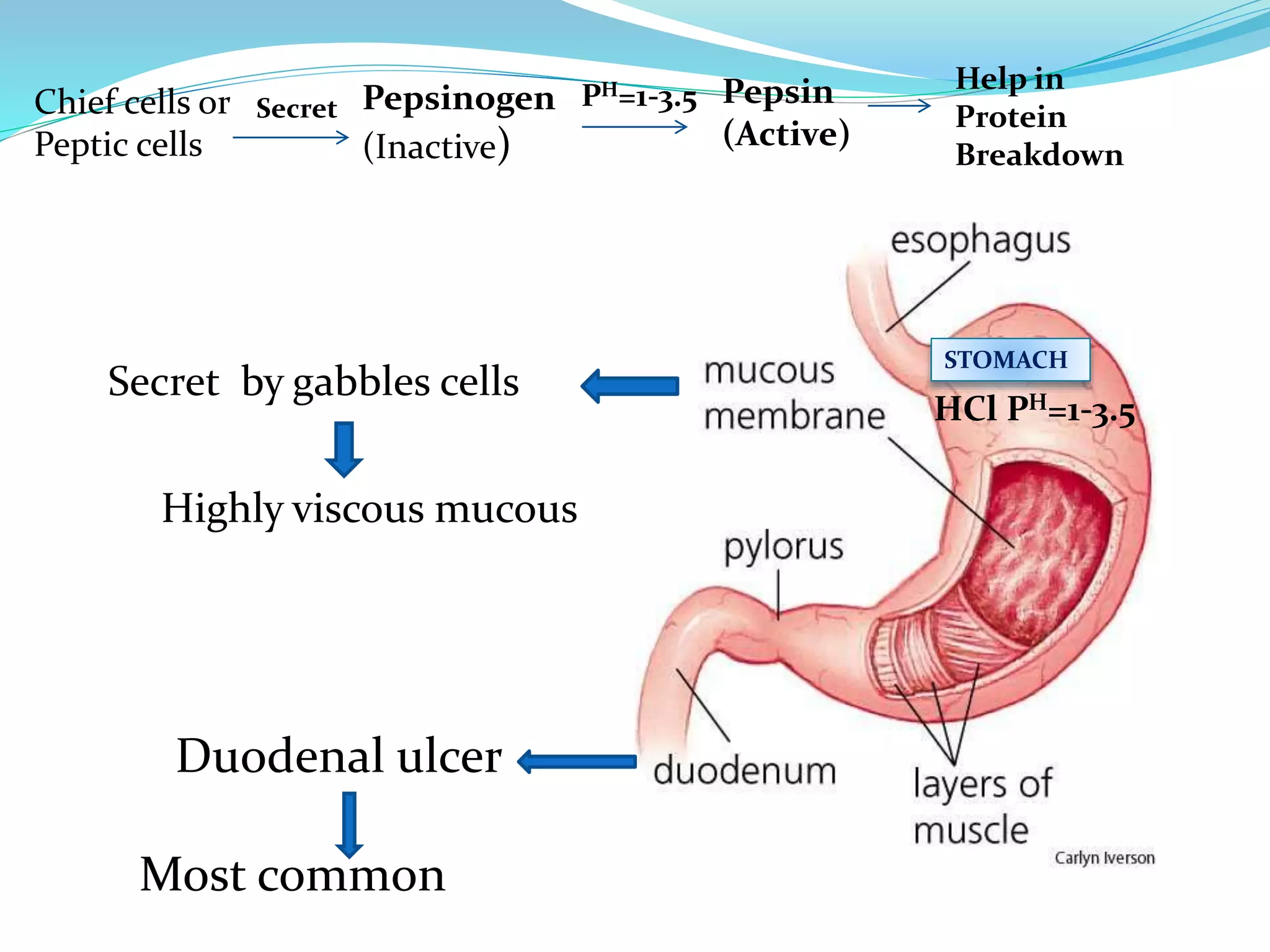
Duodenal ulcer
Most common
Highly viscous mucous
Chief cells or
Peptic cells
HCl PH=1-3.5
Secret PH=1-3.5 Pepsin
(Active)
Help in
Protein
Breakdown
Pepsinogen
(Inactive)
STOMACH
Secret by gabbles cells
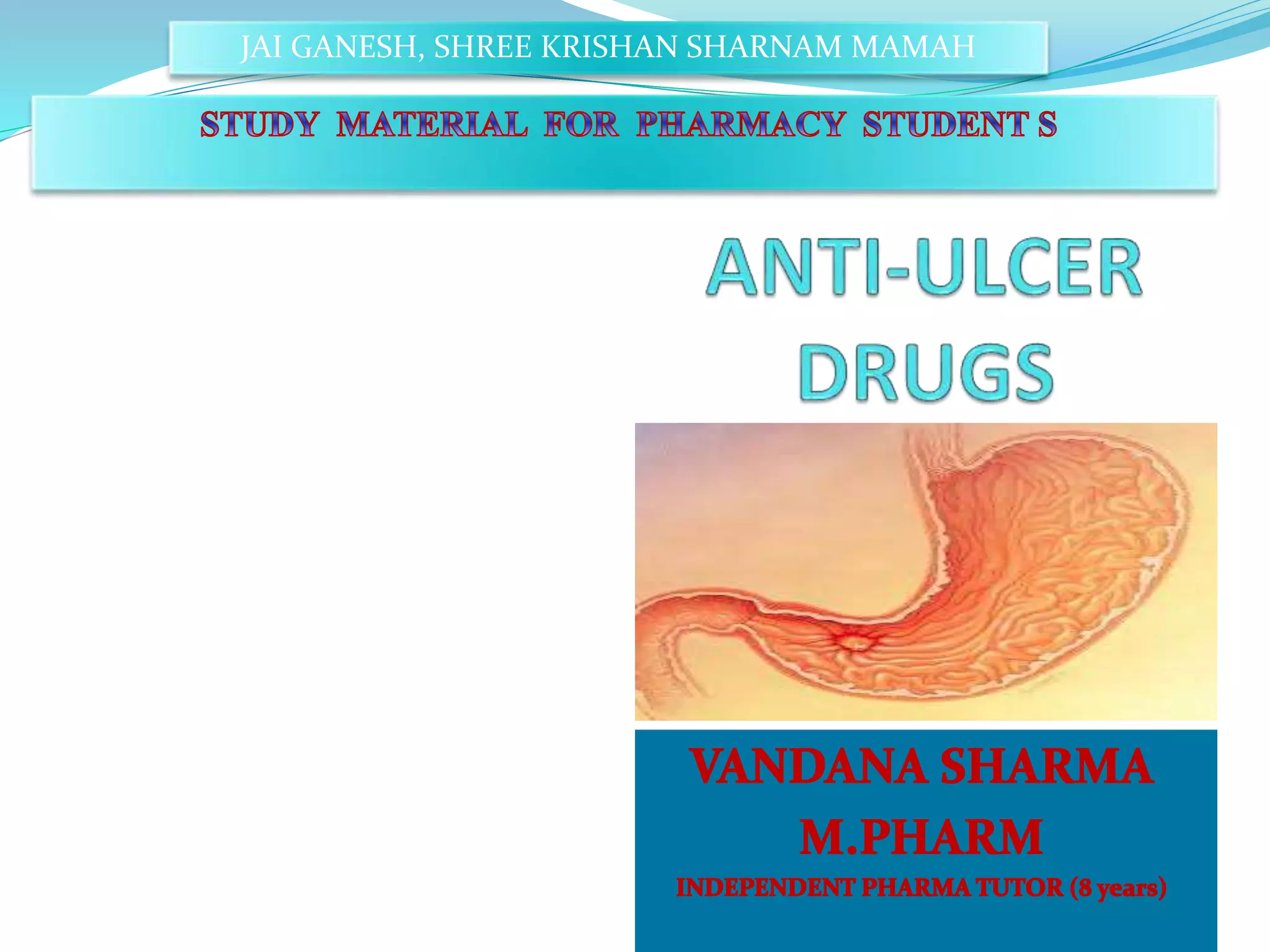
Peptic ulcer
 A peptic ulcer is an open sore in the upper digestive tract. There are two
types of peptic ulcers, a gastric ulcer, which forms in the lining of the
stomach, and a duodenal ulcer, which forms in the upper part of the
small intestine.
 Reason of ulcer Imbalance between Protective factors/defensive
factors (Mucus and bicarbonate secretion) and aggregative factors
(HCl and pepsin)
 Note-
Oxantic gland (made of Parital cell) Secrete HCl/H+
Acidic enviorment produce by gastric HCl Responsible for
Antimicrobial activity
Causes of peptic ulcer
 the bacterium named Helicobacter pylori (H pylori,), camphylobacter
pyloric (C. pylori)
 Decrease mucous secretion and bicarbonate secretion
 Increase protein diet
 Over intake of aspirin and non steroidal anti-inflammatory drugs
(NSAIDs),
 Steroids (Preferably taken with antacid and with food to reduce the
chances of ulcer)
 Skipping of diet
 Over intake of coffee, tea
 alcohol,
 physical or emotional stress,
 smoking, or
 radiation therapy
Sign and Symptoms
 Some people may have no symptoms of an ulcer, but Main
symptoms include
 Heart burn
 Stomach Ulcer Blood in vomiting
 Lower part bleeding- Black tarry stool Indication of
ulcer
Other symptom
 abdominal pain,
 nausea,
 loss of appetite,
 weight loss,
Anti ulcer drugs
Anti pyloric drugs/ Antibiotics
Antacids
Drugs decrease HCl secretion
Ulcer Protective
Ulcer healing drugs
Anti Pyloric drugs
Used when cause of ulcer are C.pylori and H. pylori
 Macrolide Antibiotic( Clarithromycin)-
MOA- Inhibit Protein synthesis
 Beta lactum antibiotic (Amoxacillin)-
MOA- Inhibit cell wall formation
 Nitroimidazole dvt. (Tinidazole, Ornidazole)
MOA- cidal in nature ( reduction of their Nitro group and
formation of metabolite that bind with DNA and interferes
its functions.
Antacid
 MOA- Neutralize gastric HCl.
 Ideal antacid should not increase gastric PH NMT 5 (otherwise chances of rebound
hyperacidity occurs)
 Antacids should not be given with enteric coated tablet. Otherwise enteric coating will
dissolve in stomach. Becouse antacid increase the stomach PH
 During acid neutralization foam formation occur
it will cause esophagus burn
so it is must to add antifoaming agent or dispersing agent (HLB value= 1-3)
 these are the essensial component of antacid. Eg Polysiloxane (Simethicon ,
Dimethicon).
 Formuation available in market-
Suspension
Chewable tablet
Note- NSAIDs should be taken with antacid It decrease the chances of ulcer.
ACID NUTRALIZATION CAPACITY IS USED TO DETERMINE THE STRENGTH OR
ACTIVITY OF ANTACID
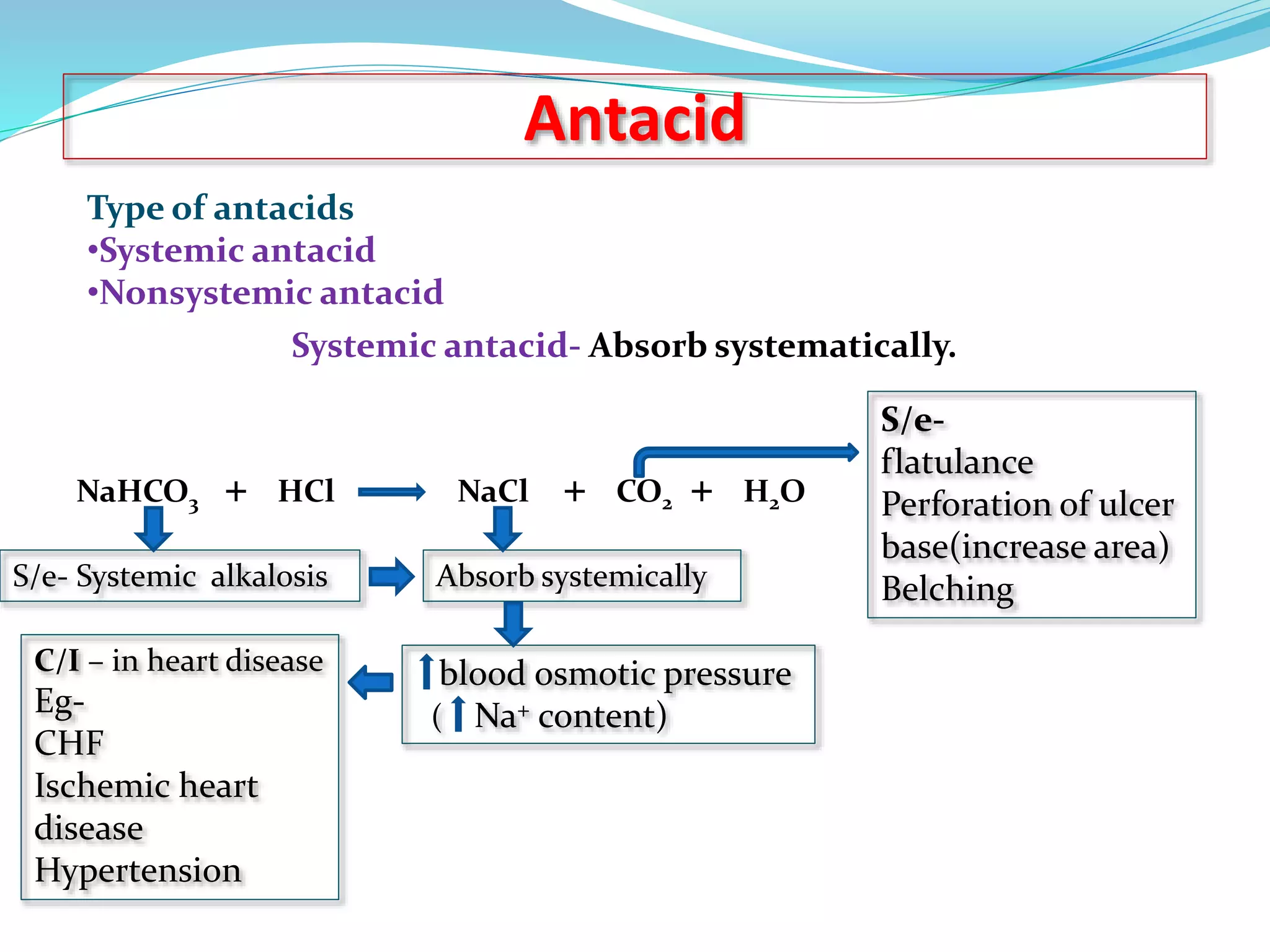
Antacid
NaHCO3 + HCl NaCl ++ H2OCO2
S/e- Systemic alkalosis Absorb systemically
blood osmotic pressure
( Na+ content)
C/I – in heart disease
Eg-
CHF
Ischemic heart
disease
Hypertension
S/e-
flatulance
Perforation of ulcer
base(increase area)
Belching
Type of antacids
•Systemic antacid
•Nonsystemic antacid
Systemic antacid- Absorb systematically.
Antacid
 Non systemic antacid- Poorly absorbable
 Al(HO)3 gel- Slowly acting
S/e- GIT motility- cause constipation
 Mg(HO) 3 – solution strength7.5%w/v so called as MILK OF MAGNISIA (due
to its milky appearance.
S/e- Diarrhoea (laxative action, increase GIT motility)
 CaCO3-
 Most potent antacid
 Fast acting antacid
S/e- Rebound acid secretion (Reflux acid secretion occur due to fast
neutralization HCl )
 Note- Milk alkali syndrome occurs because previously Dr. prescribe
CaCO3 with milk- It increase blood ca++ level condition called as
Hypercalcimia (Symptoms- anxiety, decrease appetite etc)
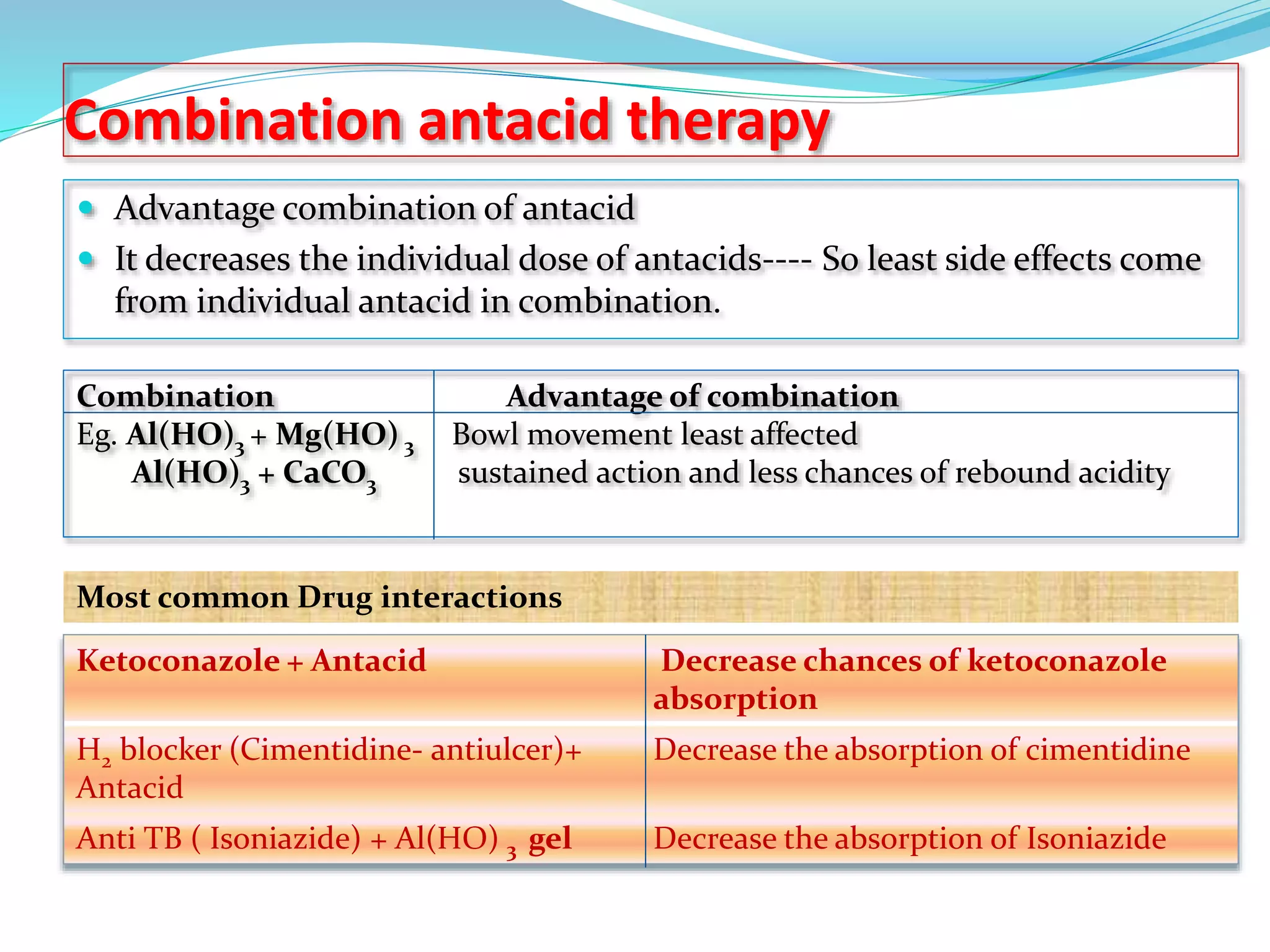
Combination antacid therapy
 Advantage combination of antacid
 It decreases the individual dose of antacids---- So least side effects come
from individual antacid in combination.
Combination Advantage of combination
Eg. Al(HO)3 + Mg(HO) 3 Bowl movement least affected
Al(HO)3 + CaCO3 sustained action and less chances of rebound acidity
Ketoconazole + Antacid Decrease chances of ketoconazole
absorption
H2 blocker (Cimentidine- antiulcer)+
Antacid
Decrease the absorption of cimentidine
Anti TB ( Isoniazide) + Al(HO) 3 gel Decrease the absorption of Isoniazide
Most common Drug interactions
Drugs decrease HCl secretion
Anticholinergic
drugs-
•Piperazine etc…
H2 receptor blocker/
H2 Antihistaminic
•Cimentidine
•Renitidine
•Femotidine
•Nizatidine etc…
Proton pump
inhibitors
•Omeprazole
•Pantoprazole
•Rabeprazole
•Esomeprazole etc…
Prostaglandine
analogue
•Misoprostel
•Rioprostile
•Enoprostil etc…
HCl secretion and control
Mechanism of action of drugs decrease HCl secretion
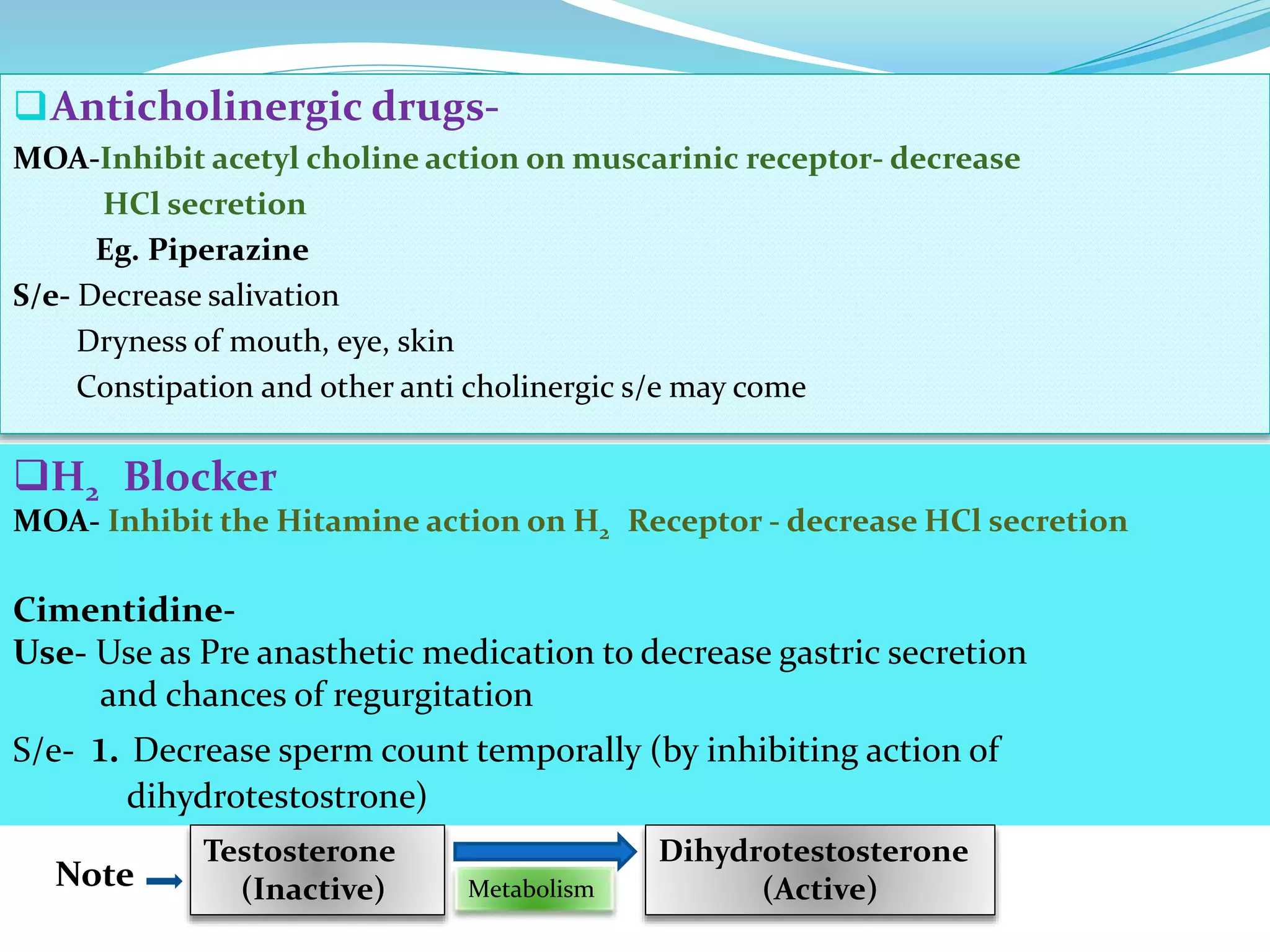
Anticholinergic drugs-
MOA-Inhibit acetyl choline action on muscarinic receptor- decrease
HCl secretion
Eg. Piperazine
S/e- Decrease salivation
Dryness of mouth, eye, skin
Constipation and other anti cholinergic s/e may come
H2 Blocker
MOA- Inhibit the Hitamine action on H2 Receptor - decrease HCl secretion
Cimentidine-
Use- Use as Pre anasthetic medication to decrease gastric secretion
and chances of regurgitation
S/e- 1. Decrease sperm count temporally (by inhibiting action of
dihydrotestostrone)
Metabolism
Testosterone
(Inactive)Note
Dihydrotestosterone
(Active)
It displace dihydrotestosterone from their binding site and
show Anti androgenic Activity (Decrease sperm counts)
2. Gynecomestiea (Increase prolectine secretion- increase milk secretion)
3. Loss of libidio
It inhibits cytochrom (Cyto P-450) group of enzyme in liver
inhibit metabolism of few drugs
D/I-
Increse the duration of action some co administered drugseg. Warfarin,
theophyline
Prostaglandins Analogue/ PGs derivatives-
PGE1 Analogue- Misoprostel, Rioprostil
PGE2 Analogue- Enprostil
MOA-1. Increase mucous and bicarbonate secretion
2. Show cyto protective action by Increasing mucosal blood supply
3 Increase healing by Increase blood supply
4. decrease HCl secretion
S/e-
Contraction in Intestinal smooth muscles- Abdominal cramps- Diarrohea
Contraction in Uterus & Uterine tube smooth muscles- Backache in females (C/I
in pregnancy) etc
Proton pump inhibitors-
MOA Inactive at neutral PH
Rearrangement into cationic
form(Sulphenic acid & Sulphenamide)
Covalently bind with –SH group of
proton pump
Inactive Proton pump
permanently
Decrease HCl secretion
D/I
PH <5
Inhibit the oxidation of some drugs eg. Warfarin, Diazepam
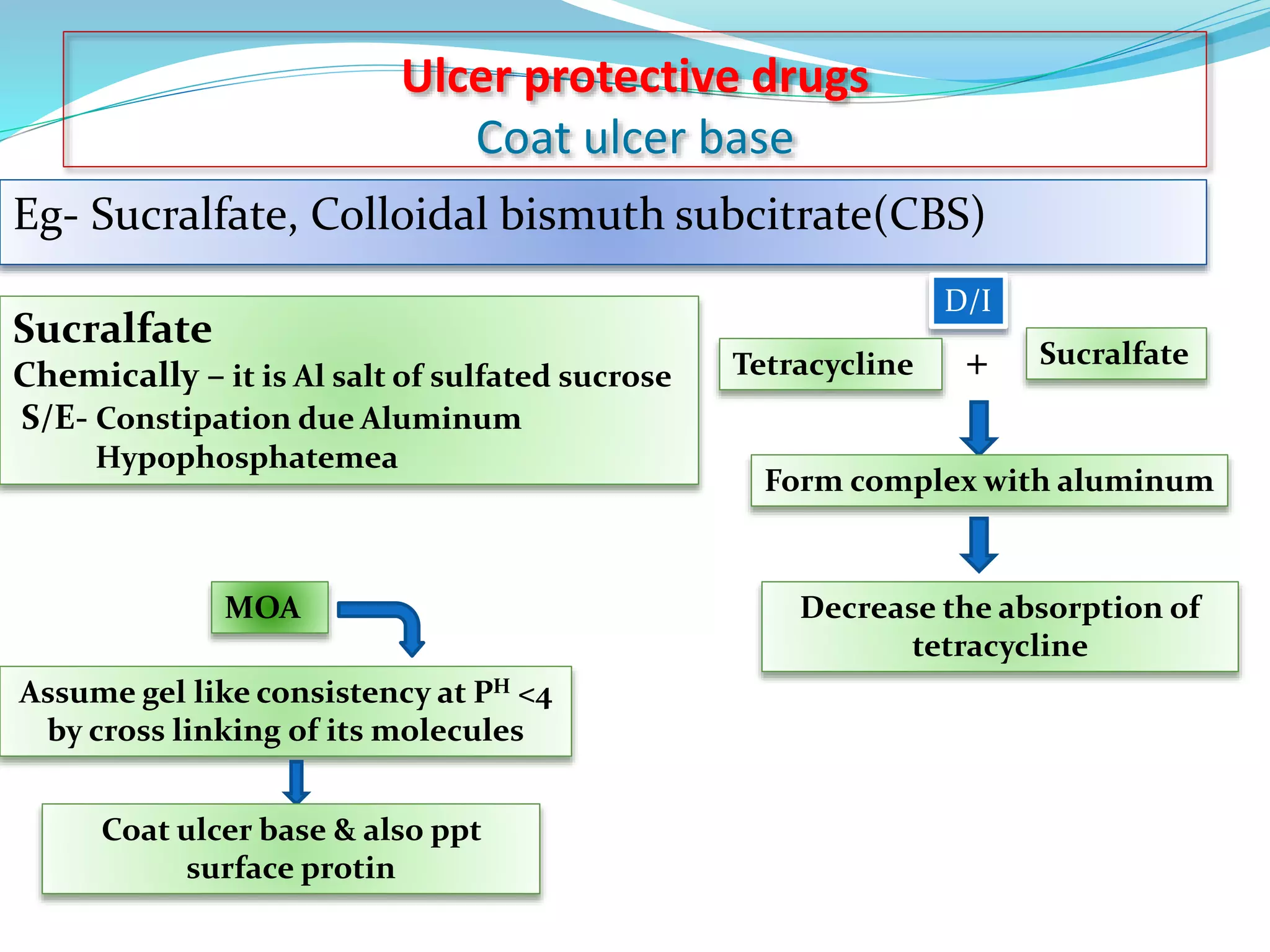
Ulcer protective drugs
Coat ulcer base
Eg- Sucralfate, Colloidal bismuth subcitrate(CBS)
Sucralfate
Chemically – it is Al salt of sulfated sucrose
S/E- Constipation due Aluminum
Hypophosphatemea
MOA
Assume gel like consistency at PH <4
by cross linking of its molecules
Coat ulcer base & also ppt
surface protin
D/I
Tetracycline + Sucralfate
Form complex with aluminum
Decrease the absorption of
tetracycline
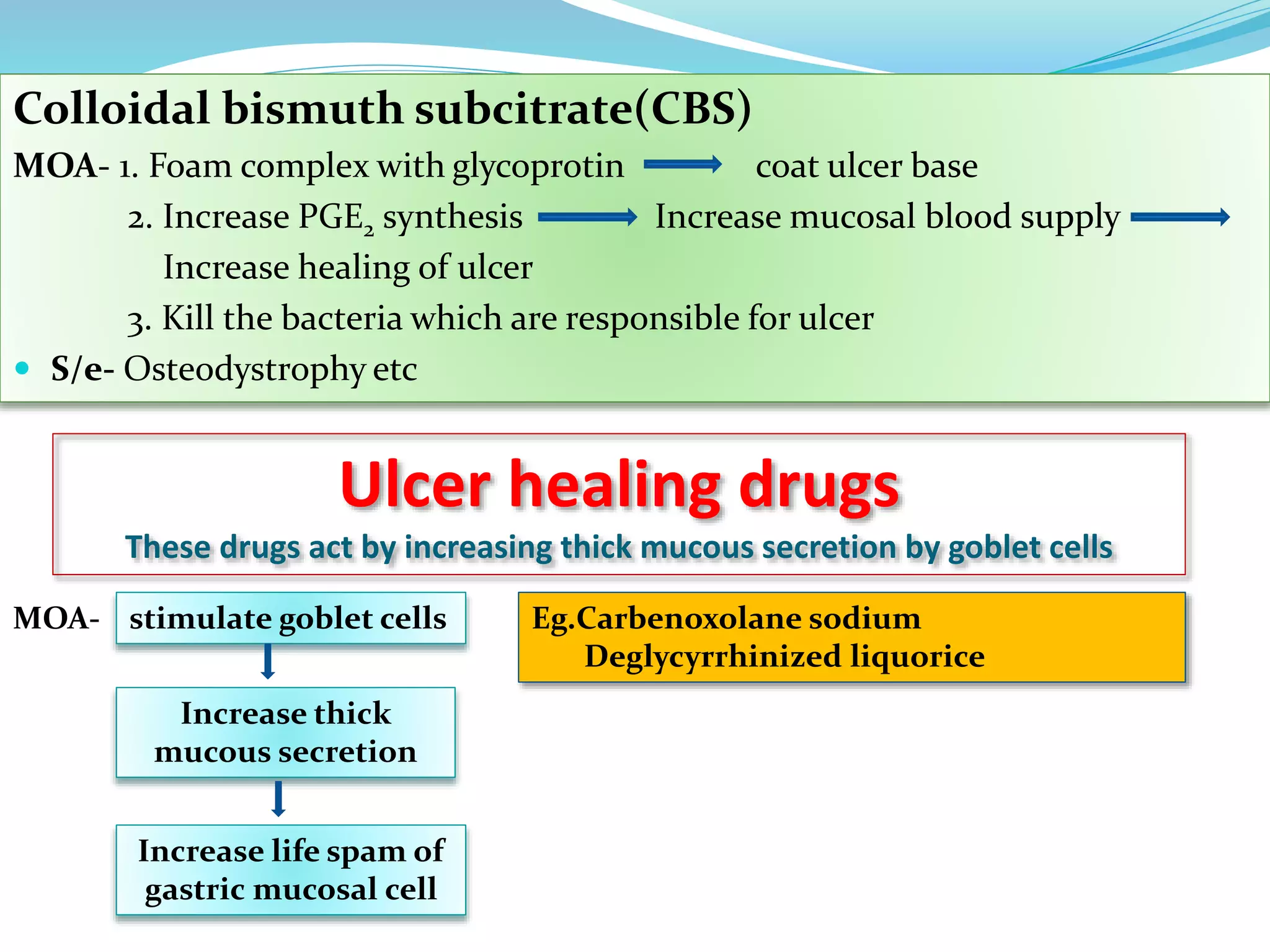
Colloidal bismuth subcitrate(CBS)
MOA- 1. Foam complex with glycoprotin coat ulcer base
2. Increase PGE2 synthesis Increase mucosal blood supply
Increase healing of ulcer
3. Kill the bacteria which are responsible for ulcer
 S/e- Osteodystrophy etc
Ulcer healing drugs
These drugs act by increasing thick mucous secretion by goblet cells
stimulate goblet cellsMOA-
Increase thick
mucous secretion
Increase life spam of
gastric mucosal cell
Eg.Carbenoxolane sodium
Deglycyrrhinized liquorice
Antiulcer drugs

Antiulcer drugs

  • 1.
    JAI GANESH, SHREEKRISHAN SHARNAM MAMAH
  • 3.
    Duodenal ulcer Most common Highlyviscous mucous Chief cells or Peptic cells HCl PH=1-3.5 Secret PH=1-3.5 Pepsin (Active) Help in Protein Breakdown Pepsinogen (Inactive) STOMACH Secret by gabbles cells
  • 5.
    Peptic ulcer  Apeptic ulcer is an open sore in the upper digestive tract. There are two types of peptic ulcers, a gastric ulcer, which forms in the lining of the stomach, and a duodenal ulcer, which forms in the upper part of the small intestine.  Reason of ulcer Imbalance between Protective factors/defensive factors (Mucus and bicarbonate secretion) and aggregative factors (HCl and pepsin)  Note- Oxantic gland (made of Parital cell) Secrete HCl/H+ Acidic enviorment produce by gastric HCl Responsible for Antimicrobial activity
  • 6.
    Causes of pepticulcer  the bacterium named Helicobacter pylori (H pylori,), camphylobacter pyloric (C. pylori)  Decrease mucous secretion and bicarbonate secretion  Increase protein diet  Over intake of aspirin and non steroidal anti-inflammatory drugs (NSAIDs),  Steroids (Preferably taken with antacid and with food to reduce the chances of ulcer)  Skipping of diet  Over intake of coffee, tea  alcohol,  physical or emotional stress,  smoking, or  radiation therapy
  • 8.
    Sign and Symptoms Some people may have no symptoms of an ulcer, but Main symptoms include  Heart burn  Stomach Ulcer Blood in vomiting  Lower part bleeding- Black tarry stool Indication of ulcer Other symptom  abdominal pain,  nausea,  loss of appetite,  weight loss,
  • 9.
    Anti ulcer drugs Antipyloric drugs/ Antibiotics Antacids Drugs decrease HCl secretion Ulcer Protective Ulcer healing drugs
  • 10.
    Anti Pyloric drugs Usedwhen cause of ulcer are C.pylori and H. pylori  Macrolide Antibiotic( Clarithromycin)- MOA- Inhibit Protein synthesis  Beta lactum antibiotic (Amoxacillin)- MOA- Inhibit cell wall formation  Nitroimidazole dvt. (Tinidazole, Ornidazole) MOA- cidal in nature ( reduction of their Nitro group and formation of metabolite that bind with DNA and interferes its functions.
  • 11.
    Antacid  MOA- Neutralizegastric HCl.  Ideal antacid should not increase gastric PH NMT 5 (otherwise chances of rebound hyperacidity occurs)  Antacids should not be given with enteric coated tablet. Otherwise enteric coating will dissolve in stomach. Becouse antacid increase the stomach PH  During acid neutralization foam formation occur it will cause esophagus burn so it is must to add antifoaming agent or dispersing agent (HLB value= 1-3)  these are the essensial component of antacid. Eg Polysiloxane (Simethicon , Dimethicon).  Formuation available in market- Suspension Chewable tablet Note- NSAIDs should be taken with antacid It decrease the chances of ulcer. ACID NUTRALIZATION CAPACITY IS USED TO DETERMINE THE STRENGTH OR ACTIVITY OF ANTACID
  • 12.
    Antacid NaHCO3 + HClNaCl ++ H2OCO2 S/e- Systemic alkalosis Absorb systemically blood osmotic pressure ( Na+ content) C/I – in heart disease Eg- CHF Ischemic heart disease Hypertension S/e- flatulance Perforation of ulcer base(increase area) Belching Type of antacids •Systemic antacid •Nonsystemic antacid Systemic antacid- Absorb systematically.
  • 13.
    Antacid  Non systemicantacid- Poorly absorbable  Al(HO)3 gel- Slowly acting S/e- GIT motility- cause constipation  Mg(HO) 3 – solution strength7.5%w/v so called as MILK OF MAGNISIA (due to its milky appearance. S/e- Diarrhoea (laxative action, increase GIT motility)  CaCO3-  Most potent antacid  Fast acting antacid S/e- Rebound acid secretion (Reflux acid secretion occur due to fast neutralization HCl )  Note- Milk alkali syndrome occurs because previously Dr. prescribe CaCO3 with milk- It increase blood ca++ level condition called as Hypercalcimia (Symptoms- anxiety, decrease appetite etc)
  • 14.
    Combination antacid therapy Advantage combination of antacid  It decreases the individual dose of antacids---- So least side effects come from individual antacid in combination. Combination Advantage of combination Eg. Al(HO)3 + Mg(HO) 3 Bowl movement least affected Al(HO)3 + CaCO3 sustained action and less chances of rebound acidity Ketoconazole + Antacid Decrease chances of ketoconazole absorption H2 blocker (Cimentidine- antiulcer)+ Antacid Decrease the absorption of cimentidine Anti TB ( Isoniazide) + Al(HO) 3 gel Decrease the absorption of Isoniazide Most common Drug interactions
  • 15.
    Drugs decrease HClsecretion Anticholinergic drugs- •Piperazine etc… H2 receptor blocker/ H2 Antihistaminic •Cimentidine •Renitidine •Femotidine •Nizatidine etc… Proton pump inhibitors •Omeprazole •Pantoprazole •Rabeprazole •Esomeprazole etc… Prostaglandine analogue •Misoprostel •Rioprostile •Enoprostil etc…
  • 16.
  • 17.
    Mechanism of actionof drugs decrease HCl secretion
  • 18.
    Anticholinergic drugs- MOA-Inhibit acetylcholine action on muscarinic receptor- decrease HCl secretion Eg. Piperazine S/e- Decrease salivation Dryness of mouth, eye, skin Constipation and other anti cholinergic s/e may come H2 Blocker MOA- Inhibit the Hitamine action on H2 Receptor - decrease HCl secretion Cimentidine- Use- Use as Pre anasthetic medication to decrease gastric secretion and chances of regurgitation S/e- 1. Decrease sperm count temporally (by inhibiting action of dihydrotestostrone) Metabolism Testosterone (Inactive)Note Dihydrotestosterone (Active)
  • 19.
    It displace dihydrotestosteronefrom their binding site and show Anti androgenic Activity (Decrease sperm counts) 2. Gynecomestiea (Increase prolectine secretion- increase milk secretion) 3. Loss of libidio It inhibits cytochrom (Cyto P-450) group of enzyme in liver inhibit metabolism of few drugs D/I- Increse the duration of action some co administered drugseg. Warfarin, theophyline Prostaglandins Analogue/ PGs derivatives- PGE1 Analogue- Misoprostel, Rioprostil PGE2 Analogue- Enprostil MOA-1. Increase mucous and bicarbonate secretion 2. Show cyto protective action by Increasing mucosal blood supply 3 Increase healing by Increase blood supply 4. decrease HCl secretion
  • 20.
    S/e- Contraction in Intestinalsmooth muscles- Abdominal cramps- Diarrohea Contraction in Uterus & Uterine tube smooth muscles- Backache in females (C/I in pregnancy) etc Proton pump inhibitors- MOA Inactive at neutral PH Rearrangement into cationic form(Sulphenic acid & Sulphenamide) Covalently bind with –SH group of proton pump Inactive Proton pump permanently Decrease HCl secretion D/I PH <5 Inhibit the oxidation of some drugs eg. Warfarin, Diazepam
  • 21.
    Ulcer protective drugs Coatulcer base Eg- Sucralfate, Colloidal bismuth subcitrate(CBS) Sucralfate Chemically – it is Al salt of sulfated sucrose S/E- Constipation due Aluminum Hypophosphatemea MOA Assume gel like consistency at PH <4 by cross linking of its molecules Coat ulcer base & also ppt surface protin D/I Tetracycline + Sucralfate Form complex with aluminum Decrease the absorption of tetracycline
  • 22.
    Colloidal bismuth subcitrate(CBS) MOA-1. Foam complex with glycoprotin coat ulcer base 2. Increase PGE2 synthesis Increase mucosal blood supply Increase healing of ulcer 3. Kill the bacteria which are responsible for ulcer  S/e- Osteodystrophy etc Ulcer healing drugs These drugs act by increasing thick mucous secretion by goblet cells stimulate goblet cellsMOA- Increase thick mucous secretion Increase life spam of gastric mucosal cell Eg.Carbenoxolane sodium Deglycyrrhinized liquorice