Driving HR Initiatives Gautam Ghosh Mehjabeen Shalam Vibha Rai 31 st  July , 2006
“support function” / “cost center” / “bureaucratic drag” or  …
Are you “Rock Stars of the  Age of Talent”   - Tom Peters
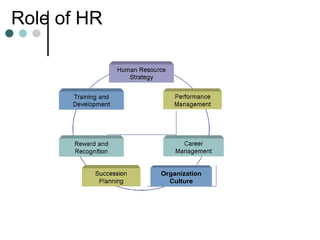
Role of HR
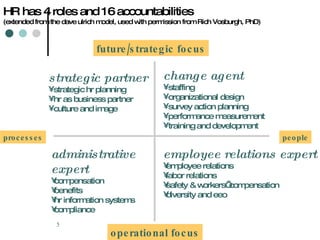
HR has 4 roles and 16 accountabilities (extended from the dave ulrich model, used with permission from Rich Vosburgh, PhD) people processes future/strategic focus operational focus strategic partner strategic hr planning hr as business partner culture and image change agent staffing organizational design survey action planning performance measurement training and development employee relations expert employee relations labor relations safety & workers’ compensation diversity and eeo administrative expert compensation benefits hr information systems compliance
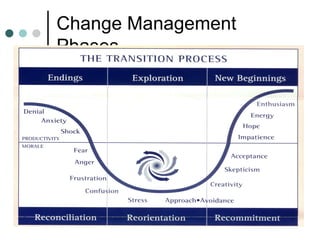
Change Management Phases
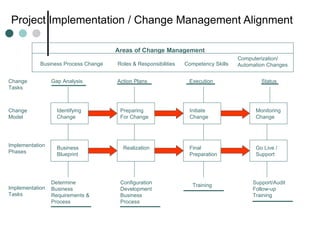
Project Implementation / Change Management Alignment Identifying Change Business Blueprint Gap Analysis Determine Business Requirements & Process Monitoring Change Go Live / Support Status Support/Audit Follow-up Training Initiate Change Final Preparation Execution Training Realization Preparing For Change Action Plans Configuration Development Business  Process Areas of Change Management Business Process Change Roles & Responsibilities Competency Skills Computerization/ Automation Changes Change Tasks Change Model Implementation Phases Implementation Tasks
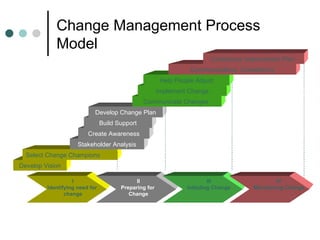
Change Management Process Model Develop Vision Select Change Champions I Identifying need for  change Stakeholder Analysis Create Awareness Build Support Develop Change Plan II Preparing for  Change Communicate Changes  Implement Change Help People Adjust III Initiating Change Communications, Consistency Continuous Improvement Plan  IV Maintaining Change
Cautions Imposing your own values/judgments Beware of  negative  responses Compliance v/s informed choice
The process of change Behaviors Knowledge Attitudes Values and Beliefs
Theorists of Change Kurt Lewin   force field analysis E.H. Schein  general change model R. Havelock  theory of change J Prochaska  model of change C. DiClementi
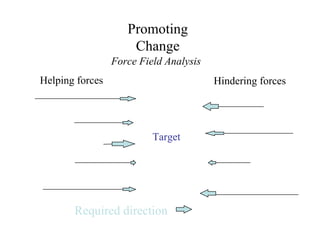
Target Promoting Change Helping forces Hindering forces Force Field Analysis Required direction
General Change Model E.H. Schein
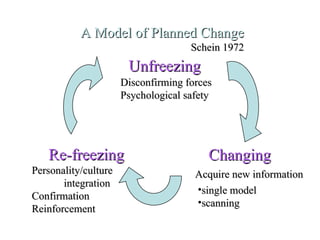
Unfreezing Changing Re-freezing Disconfirming forces Psychological safety Acquire new information single model scanning Personality/culture  integration Confirmation Reinforcement A Model of Planned Change Schein 1972
Theory of Change R. Havelock
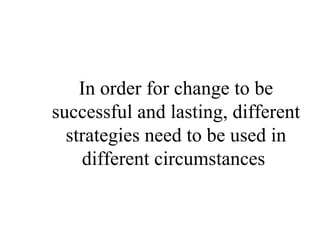
In order for change to be successful and lasting, different strategies need to be used in different circumstances
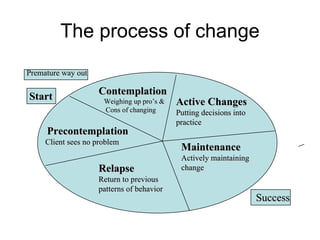
The process of change Precontemplation Client sees no problem Premature way out Contemplation Weighing up pro’s & Cons of changing  Success Active Changes Putting decisions into practice Maintenance Actively maintaining change Relapse Return to previous patterns of behavior Start
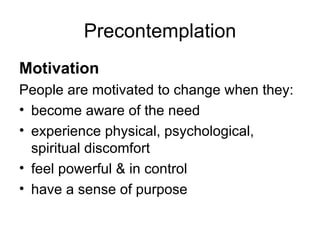
Precontemplation Motivation People are motivated to change when they: become aware of the need experience physical, psychological, spiritual discomfort feel powerful & in control have a sense of purpose
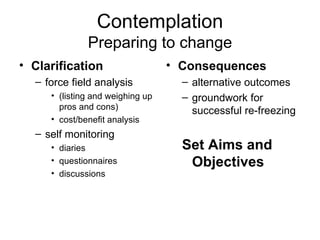
Contemplation Preparing to change Clarification force field analysis (listing and weighing up pros and cons) cost/benefit analysis self monitoring diaries questionnaires discussions Consequences alternative outcomes groundwork for successful re-freezing Set Aims and Objectives
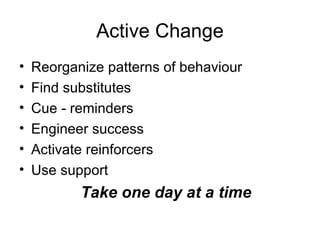
Active Change Reorganize patterns of behaviour Find substitutes Cue - reminders Engineer success Activate reinforcers Use support Take one day at a time
Maintenance All of the above and then some!
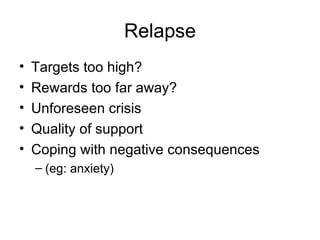
Relapse Targets too high? Rewards too far away? Unforeseen crisis Quality of support Coping with negative consequences  (eg: anxiety)
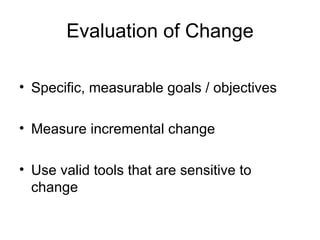
Evaluation of Change Specific, measurable goals / objectives Measure incremental change Use valid tools that are sensitive to change


Thank You!

Driving HR initiatives

  • 1.
    Driving HR InitiativesGautam Ghosh Mehjabeen Shalam Vibha Rai 31 st July , 2006
  • 2.
    “support function” /“cost center” / “bureaucratic drag” or …
  • 3.
    Are you “RockStars of the Age of Talent” - Tom Peters
  • 4.
  • 5.
    HR has 4roles and 16 accountabilities (extended from the dave ulrich model, used with permission from Rich Vosburgh, PhD) people processes future/strategic focus operational focus strategic partner strategic hr planning hr as business partner culture and image change agent staffing organizational design survey action planning performance measurement training and development employee relations expert employee relations labor relations safety & workers’ compensation diversity and eeo administrative expert compensation benefits hr information systems compliance
  • 6.
  • 7.
    Project Implementation /Change Management Alignment Identifying Change Business Blueprint Gap Analysis Determine Business Requirements & Process Monitoring Change Go Live / Support Status Support/Audit Follow-up Training Initiate Change Final Preparation Execution Training Realization Preparing For Change Action Plans Configuration Development Business Process Areas of Change Management Business Process Change Roles & Responsibilities Competency Skills Computerization/ Automation Changes Change Tasks Change Model Implementation Phases Implementation Tasks
  • 8.
    Change Management ProcessModel Develop Vision Select Change Champions I Identifying need for change Stakeholder Analysis Create Awareness Build Support Develop Change Plan II Preparing for Change Communicate Changes Implement Change Help People Adjust III Initiating Change Communications, Consistency Continuous Improvement Plan IV Maintaining Change
  • 9.
    Cautions Imposing yourown values/judgments Beware of negative responses Compliance v/s informed choice
  • 10.
    The process ofchange Behaviors Knowledge Attitudes Values and Beliefs
  • 11.
    Theorists of ChangeKurt Lewin force field analysis E.H. Schein general change model R. Havelock theory of change J Prochaska model of change C. DiClementi
  • 12.
    Target Promoting ChangeHelping forces Hindering forces Force Field Analysis Required direction
  • 13.
  • 14.
    Unfreezing Changing Re-freezingDisconfirming forces Psychological safety Acquire new information single model scanning Personality/culture integration Confirmation Reinforcement A Model of Planned Change Schein 1972
  • 15.
    Theory of ChangeR. Havelock
  • 16.
    In order forchange to be successful and lasting, different strategies need to be used in different circumstances
  • 17.
    The process ofchange Precontemplation Client sees no problem Premature way out Contemplation Weighing up pro’s & Cons of changing Success Active Changes Putting decisions into practice Maintenance Actively maintaining change Relapse Return to previous patterns of behavior Start
  • 18.
    Precontemplation Motivation Peopleare motivated to change when they: become aware of the need experience physical, psychological, spiritual discomfort feel powerful & in control have a sense of purpose
  • 19.
    Contemplation Preparing tochange Clarification force field analysis (listing and weighing up pros and cons) cost/benefit analysis self monitoring diaries questionnaires discussions Consequences alternative outcomes groundwork for successful re-freezing Set Aims and Objectives
  • 20.
    Active Change Reorganizepatterns of behaviour Find substitutes Cue - reminders Engineer success Activate reinforcers Use support Take one day at a time
  • 21.
    Maintenance All ofthe above and then some!
  • 22.
    Relapse Targets toohigh? Rewards too far away? Unforeseen crisis Quality of support Coping with negative consequences (eg: anxiety)
  • 23.
    Evaluation of ChangeSpecific, measurable goals / objectives Measure incremental change Use valid tools that are sensitive to change
  • 24.
  • 25.
  • 26.
  • 27.
  • 28.
  • 29.