
Organizational Behavior and its role in Change
Course Rationale  Why people behave the way they do  in organizations both as individuals and in groups,  Able to  apply your understanding in  the practical, complex dynamics of the workplace.
Course Objectives  To develop an awareness of  how critical the management of OB  is to the success or failure of organizations.   To develop an understanding of  how and why people behave in organizations both as individuals and in groups.   To  emphasize the manager's role in  nurturing and maintaining positive and successful organization behaviour in his/her group, department, division, or organization.
Behaviour   is an individual’s physical action or verbal statement.  Behavior is  not  what a person would like to do or thinks he/she should or would have done.  Behavior is  directly observable   in that the action can be  seen   or the verbal statement can be  heard .  What is behaviour
Session Overview  This session is  situation based  and will focus on Behaviors in change initiatives.  At the end of the session you  should have become acquainted with  How to  assess ones Organizations readiness for change  How to  assess ones own personal readiness for spearheading change  How to create a critical mass that will support and sustain the change
 
Situation  Please take  5 -10 minutes to visualize a situation that you are currently a part of and which involves change  Ideally something that you are playing a lead role in  The size and scale including the number of people likely to be impacted is immaterial  Write down all the salient points about that situation that come to your mind  For eg: your Role , role of other mangers /leaders ,pain points , facilitators, inhibitors etc
Roles in Change initiatives Executive Sponsor(s) have power to initiate and legitimize the change for everyone Change Leaders maintain power and proximity to the stakeholders Change Agents are responsibility to implement actions and form critical links between Change Leaders and Stakeholders Stakeholders are directly affected by, must contribute to, will benefit from, and will be accountable for sustaining future state performance Ambassadors want to achieve change but do not have sufficient authority; use their influence with others to support the initiatives
Success of Change initiatives  50 % of systemic change efforts fail * By failure one doesn’t mean outright failure but the fact that  A lot of objectives remain unmet  The inability to sustain change  over time  There are innumerable studies ,  and theories on change . Lets look at 2  Beer, M, & Nohria, N. (Eds.). (2000).  Breaking the code of change.  Harvard Business School.
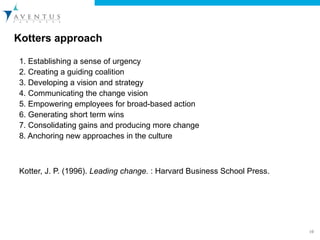
Kotters approach  1. Establishing a sense of urgency 2. Creating a guiding coalition 3. Developing a vision and strategy 4. Communicating the change vision 5. Empowering employees for broad-based action 6. Generating short term wins 7. Consolidating gains and producing more change 8. Anchoring new approaches in the culture Kotter, J. P. (1996).  Leading change.  : Harvard Business School Press.
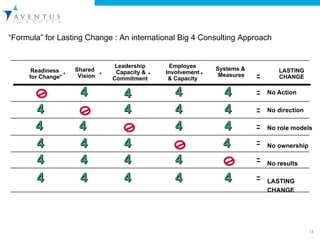
No Action No direction No role models No ownership No results LASTING CHANGE LASTING CHANGE Readiness for Change* Shared  Vision Leadership Capacity & Commitment Employee Involvement & Capacity Systems &  Measures 4 4 4 4 4 4 4 4 4 4 4 4 4 4 4 4 4 4 4 4 4 4 4 4 4 + + + + “ Formula” for Lasting Change : An international Big 4 Consulting Approach
Why do they fail  Insufficient buy in at the early stages  Understanding and acceptance of the need for change: Belief that the change is both desirable and possible: Lack of understanding of the facilitators and inhibitors No clear plan ,definition of roles in the change effort, accountability and sufficient passionate commitment key change leaders  not demonstrating their commitment to the success of the change in an unambiguous manner Inability of leaders to handle the pressure exerted by the gap between reality ( current state )and aspiration ( desired state)  Lack of critical mass that believes in the change  Not rewarding the new behavior & withdrawal of rewards for the old behavior
What are the messages for us  Know what you are up against ? ( even if one has been in the same organization for years ) Facilitate definition of roles  Build the case for change  and engage the executive team  Build coalitions across the organization and engage the employees Create implementation road maps but be flexible and responsive  Mobilize resources  Identify and Prepare for Pilots .  Sustain And Build Momentum
How does one assess Organizations readiness for change  Three broad areas  Management Style and Leadership  Individual Employee Behaviors and characteristics Communication levels  Note : Refer handout  and take 10 minutes to fill it out
Guidelines for self assessment  If you are leading the change effort or are part of the leadership team please be non evaluative /non self critical  when filling the inventory  Use the words employees and your team members interchangeably when need be.
How does one assess ones own readiness for spearheading change  Critical competencies to spearhead change  Articulate the future : In terms of what it will look like ,implications and future opportunities the change may bring about  Manage Complexity and stability  Impact and Influence without Authority Create and manage  alliances  Self knowledge  Note : Refer handout  and take 10 minutes to fill it out
How does one create a critical mass All organisations and systems develop  a Status quo inertia  These are governed by belief, values , expectations , which have become individual and organization habits  These become self fulfilling prophesies  In order to help change them one needs to constantly provide  Information that will help people adjust to the change  Skills needed to adjust to the change  Help develop attitudes that will support the change Reward people for adopting the change Note : Source : Article by John D Adams in OD practitioner
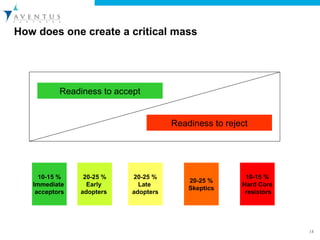
How does one create a critical mass Readiness to accept Readiness to reject 10-15 % Immediate  acceptors 20-25 % Early  adopters  20-25 % Late  adopters 20-25 % Skeptics 10-15 % Hard Core resistors
How does one create a critical mass Focus on the  immediate adopters ( strong )supporters irrespective of their role and bring them together  Their shared interest in bring about the change will spark interest and ideas that will help convert the early adopters  This becomes your core group . Frequent interactions among this group and giving them roles in the change effort  will build further momentum  Ensure no confrontation happened with the hardcore resisters . This will make the skeptics at times tilt towards the perceived underdogs There is no clear number that is indicative of a critical mass
If we are change agents we need to  Understand change dynamics Communicate business case at many levels Coordinate key players “ Light a fire” under sponsors Manage expectations proactively Understand how to influence (often without authority)
Thank you

Aventus Partners on Organisation Behavior and Change

  • 1.
    Organizational Behavior andits role in Change
  • 2.
    Course Rationale Why people behave the way they do in organizations both as individuals and in groups, Able to apply your understanding in the practical, complex dynamics of the workplace.
  • 3.
    Course Objectives To develop an awareness of how critical the management of OB is to the success or failure of organizations. To develop an understanding of how and why people behave in organizations both as individuals and in groups. To emphasize the manager's role in nurturing and maintaining positive and successful organization behaviour in his/her group, department, division, or organization.
  • 4.
    Behaviour is an individual’s physical action or verbal statement. Behavior is not what a person would like to do or thinks he/she should or would have done. Behavior is directly observable in that the action can be seen or the verbal statement can be heard . What is behaviour
  • 5.
    Session Overview This session is situation based and will focus on Behaviors in change initiatives. At the end of the session you should have become acquainted with How to assess ones Organizations readiness for change How to assess ones own personal readiness for spearheading change How to create a critical mass that will support and sustain the change
  • 6.
  • 7.
    Situation Pleasetake 5 -10 minutes to visualize a situation that you are currently a part of and which involves change Ideally something that you are playing a lead role in The size and scale including the number of people likely to be impacted is immaterial Write down all the salient points about that situation that come to your mind For eg: your Role , role of other mangers /leaders ,pain points , facilitators, inhibitors etc
  • 8.
    Roles in Changeinitiatives Executive Sponsor(s) have power to initiate and legitimize the change for everyone Change Leaders maintain power and proximity to the stakeholders Change Agents are responsibility to implement actions and form critical links between Change Leaders and Stakeholders Stakeholders are directly affected by, must contribute to, will benefit from, and will be accountable for sustaining future state performance Ambassadors want to achieve change but do not have sufficient authority; use their influence with others to support the initiatives
  • 9.
    Success of Changeinitiatives 50 % of systemic change efforts fail * By failure one doesn’t mean outright failure but the fact that A lot of objectives remain unmet The inability to sustain change over time There are innumerable studies , and theories on change . Lets look at 2 Beer, M, & Nohria, N. (Eds.). (2000). Breaking the code of change. Harvard Business School.
  • 10.
    Kotters approach 1. Establishing a sense of urgency 2. Creating a guiding coalition 3. Developing a vision and strategy 4. Communicating the change vision 5. Empowering employees for broad-based action 6. Generating short term wins 7. Consolidating gains and producing more change 8. Anchoring new approaches in the culture Kotter, J. P. (1996). Leading change. : Harvard Business School Press.
  • 11.
    No Action Nodirection No role models No ownership No results LASTING CHANGE LASTING CHANGE Readiness for Change* Shared Vision Leadership Capacity & Commitment Employee Involvement & Capacity Systems & Measures 4 4 4 4 4 4 4 4 4 4 4 4 4 4 4 4 4 4 4 4 4 4 4 4 4 + + + + “ Formula” for Lasting Change : An international Big 4 Consulting Approach
  • 12.
    Why do theyfail Insufficient buy in at the early stages Understanding and acceptance of the need for change: Belief that the change is both desirable and possible: Lack of understanding of the facilitators and inhibitors No clear plan ,definition of roles in the change effort, accountability and sufficient passionate commitment key change leaders not demonstrating their commitment to the success of the change in an unambiguous manner Inability of leaders to handle the pressure exerted by the gap between reality ( current state )and aspiration ( desired state) Lack of critical mass that believes in the change Not rewarding the new behavior & withdrawal of rewards for the old behavior
  • 13.
    What are themessages for us Know what you are up against ? ( even if one has been in the same organization for years ) Facilitate definition of roles Build the case for change and engage the executive team Build coalitions across the organization and engage the employees Create implementation road maps but be flexible and responsive Mobilize resources Identify and Prepare for Pilots . Sustain And Build Momentum
  • 14.
    How does oneassess Organizations readiness for change Three broad areas Management Style and Leadership Individual Employee Behaviors and characteristics Communication levels Note : Refer handout and take 10 minutes to fill it out
  • 15.
    Guidelines for selfassessment If you are leading the change effort or are part of the leadership team please be non evaluative /non self critical when filling the inventory Use the words employees and your team members interchangeably when need be.
  • 16.
    How does oneassess ones own readiness for spearheading change Critical competencies to spearhead change Articulate the future : In terms of what it will look like ,implications and future opportunities the change may bring about Manage Complexity and stability Impact and Influence without Authority Create and manage alliances Self knowledge Note : Refer handout and take 10 minutes to fill it out
  • 17.
    How does onecreate a critical mass All organisations and systems develop a Status quo inertia These are governed by belief, values , expectations , which have become individual and organization habits These become self fulfilling prophesies In order to help change them one needs to constantly provide Information that will help people adjust to the change Skills needed to adjust to the change Help develop attitudes that will support the change Reward people for adopting the change Note : Source : Article by John D Adams in OD practitioner
  • 18.
    How does onecreate a critical mass Readiness to accept Readiness to reject 10-15 % Immediate acceptors 20-25 % Early adopters 20-25 % Late adopters 20-25 % Skeptics 10-15 % Hard Core resistors
  • 19.
    How does onecreate a critical mass Focus on the immediate adopters ( strong )supporters irrespective of their role and bring them together Their shared interest in bring about the change will spark interest and ideas that will help convert the early adopters This becomes your core group . Frequent interactions among this group and giving them roles in the change effort will build further momentum Ensure no confrontation happened with the hardcore resisters . This will make the skeptics at times tilt towards the perceived underdogs There is no clear number that is indicative of a critical mass
  • 20.
    If we arechange agents we need to Understand change dynamics Communicate business case at many levels Coordinate key players “ Light a fire” under sponsors Manage expectations proactively Understand how to influence (often without authority)
  • 21.