HR Policies
   Recruitment Policies
   New Regular Staff Employee Orientation
   Staff Retention
   Attendance and Leave Policies
   Grievance Handling
   Drug/Alcohol Abuse
   Employee Relations
   Personal Debts
   Performance Evaluation
   Feedback and Coaching
   Insurance Policy
   Termination Policy
Recruitment Policies

   Recruitment is done in-house.
   Detailed Recruitment Process to guide
   Advertising the Position: To ensure that the
    applicant pool is diverse and qualified.
   Screening/Interviewing Candidates
   Offering the Position
   Concluding the Search
New/Regular Staff Employee
Orientation
   90 Days orientation period is
    important to:
   Assess the employee’s job
    performance
   Evaluate the employee’s overall
    compatibility
   Orient the employee to the job.
New Regular Staff Employee
Orientation
   HR file of each staff employee is
    maintained.
   File includes the following Documents:
   ID Proof
   Permanent Account Number
   Address Proof
   Copy Of Employment Agreement
   Educational Certificates
   Professional Certificates
Staff Retention
   Employees as Assets
   Our environment places attention on
    systems that inform us of what the
    talent needs are.
   Attention is given to attracting and
    selecting the right people.
Staff Retention
   Culture of Interdependence
   We focus on building relationships
    and do not take on this challenge
    alone
   Create and maintain systems that
    allow people to grow professionally
Attendance and Leave Policies
   Being absent from or reporting to work after the
    scheduled beginning time requires the employee to
    properly notify the supervisor in advance.
   The department head is responsible for maintaining
    work schedules.
   Employees are allowed to take three leaves in each
    quarter.
   6 medical leaves per year are also allowed.
   They can also avail 6 casual leaves.
   No leaves are allowed in Probation period of 90 days.
Grievance Handling
   The proceedings are informal in nature.
   If the grievant choose to take legal action,
    the internal grievance process will cease.
   All employees, including the grievant, shall
    cooperate at all stages in the investigation
    of a grievance.
    Detailed Grievance procedure is required
Grievance Handling
   These grievance procedures may not be
    used for the following:
   To address an employee’s dissatisfaction
    with the Company
   To appeal performance evaluations
   To address actions from individuals outside
    of the Company
   To address situations over which the HR
    lacks authority to remedy
   To address dissatisfaction with the
    grievance policy
Grievance Handling: Process
   Stage 1
   The grievant shall state the nature of
    the grievance in writing.
   The decision of the departmental
    official shall be given in writing to the
    grievant.
   Copies of the appeal and decision
    shall be forwarded to HR
Grievance Handling: Process
   Stage 2:
   If the grievant is not satisfied with
    the decision at Stage I
   the grievant may appeal in writing to
    the Human Resources.
   HR shall investigate the appeal
   The Senior Officer shall render a
    decision in writing.
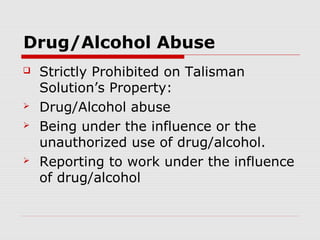
Drug/Alcohol Abuse
   Strictly Prohibited on Talisman
    Solution’s Property:
   Drug/Alcohol abuse
   Being under the influence or the
    unauthorized use of drug/alcohol.
   Reporting to work under the influence
    of drug/alcohol
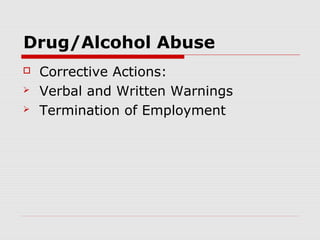
Drug/Alcohol Abuse
   Corrective Actions:
   Verbal and Written Warnings
   Termination of Employment
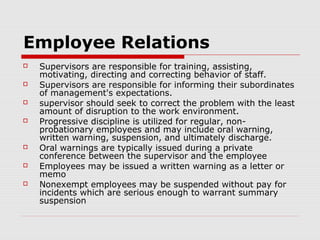
Employee Relations
   Supervisors are responsible for training, assisting,
    motivating, directing and correcting behavior of staff.
   Supervisors are responsible for informing their subordinates
    of management's expectations.
   supervisor should seek to correct the problem with the least
    amount of disruption to the work environment.
   Progressive discipline is utilized for regular, non-
    probationary employees and may include oral warning,
    written warning, suspension, and ultimately discharge.
   Oral warnings are typically issued during a private
    conference between the supervisor and the employee
   Employees may be issued a written warning as a letter or
    memo
   Nonexempt employees may be suspended without pay for
    incidents which are serious enough to warrant summary
    suspension
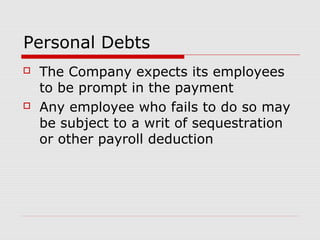
Personal Debts
   The Company expects its employees
    to be prompt in the payment
   Any employee who fails to do so may
    be subject to a writ of sequestration
    or other payroll deduction
Performance Evaluation
   The Company’s performance evaluation
    system is called Performance Evaluation
    (PE)
   The PE system is designed to:
   Promote and document performance
    assessments based on essential job
    functions and clear, realistic job standards
   Promote a high level of employee
    performance through consistent feedback
    from supervisors
Feedback and Coaching

   Occur on an ongoing basis and at the
    optional mid-year review.
   The purpose of feedback and coaching is to
    recognize effective performance and
    provide coaching for improvement.
   Opportunity for supervisors and employees
    to discuss and update job standards set at
    the beginning of the year
Insurance Policy
   The Company makes available group
    accidental & death insurance
    coverage for employees.
   This is only for Regular/Confirmed
    Employees
Termination Policy
   If the employee terminates the
    employment relationship:
   The employee shall fulfill the notice
    associated with the position he
    occupies
Termination Policy
   If the employee is terminated for reasons
    which are considered misconduct:
   The termination shall generally be
    immediate
   If the employee is terminated for reasons
    which are not considered misconduct :
   The termination shall generally occur after
    at least one documented discussion with
    the employee.
The code of conduct includes the
following:
   Ethical Principles
   Honesty
   Integrity
   Promise keeping
   Loyalty
   Fairness
   Respect for others
   Law abiding
   Commitment to excellence
   Reputation and morale
   Leadership
   Accountability
The code of conduct includes the
following:
   Values
   People working here should be honest, unbiased,
    and have unprejudiced work environment.
   Accountability
   Taking responsibility for your own action
   To ensure appropriate use of information
   exercising diligence, and duty of care, obligations
   avoiding conflict of interest.
The code of conduct includes the
following:
   Standard of Practice
   Maintaining active personal and professional
    development programs
   Creating and supporting an environment that fosters
    teamwork, emphasizes on quality, recognizes the
    customer, and promotes learning.
   Maintaining a commitment to the improvement of the
    professional
   Addresses concerns
   Provides for performance and quality management
    training
   Establishes specific quality related goals for
    management
The code of conduct includes the
following:
   Disciplinary Actions at work can be
    performed due to any of the following
    reasons:
   Abusive Behavior at work place.
   Uninformed Absence at work place.
   Lack of work Standard.
   Sorting Out Problems
   Sorting out informally.
   Disciplinary and dismissal procedures.
All policies are subject to
review and periodic
revision.
Thank You

Hr policies

  • 1.
    HR Policies  Recruitment Policies  New Regular Staff Employee Orientation  Staff Retention  Attendance and Leave Policies  Grievance Handling  Drug/Alcohol Abuse  Employee Relations  Personal Debts  Performance Evaluation  Feedback and Coaching  Insurance Policy  Termination Policy
  • 2.
    Recruitment Policies  Recruitment is done in-house.  Detailed Recruitment Process to guide  Advertising the Position: To ensure that the applicant pool is diverse and qualified.  Screening/Interviewing Candidates  Offering the Position  Concluding the Search
  • 3.
    New/Regular Staff Employee Orientation  90 Days orientation period is important to:  Assess the employee’s job performance  Evaluate the employee’s overall compatibility  Orient the employee to the job.
  • 4.
    New Regular StaffEmployee Orientation  HR file of each staff employee is maintained.  File includes the following Documents:  ID Proof  Permanent Account Number  Address Proof  Copy Of Employment Agreement  Educational Certificates  Professional Certificates
  • 5.
    Staff Retention  Employees as Assets  Our environment places attention on systems that inform us of what the talent needs are.  Attention is given to attracting and selecting the right people.
  • 6.
    Staff Retention  Culture of Interdependence  We focus on building relationships and do not take on this challenge alone  Create and maintain systems that allow people to grow professionally
  • 7.
    Attendance and LeavePolicies  Being absent from or reporting to work after the scheduled beginning time requires the employee to properly notify the supervisor in advance.  The department head is responsible for maintaining work schedules.  Employees are allowed to take three leaves in each quarter.  6 medical leaves per year are also allowed.  They can also avail 6 casual leaves.  No leaves are allowed in Probation period of 90 days.
  • 8.
    Grievance Handling  The proceedings are informal in nature.  If the grievant choose to take legal action, the internal grievance process will cease.  All employees, including the grievant, shall cooperate at all stages in the investigation of a grievance.  Detailed Grievance procedure is required
  • 9.
    Grievance Handling  These grievance procedures may not be used for the following:  To address an employee’s dissatisfaction with the Company  To appeal performance evaluations  To address actions from individuals outside of the Company  To address situations over which the HR lacks authority to remedy  To address dissatisfaction with the grievance policy
  • 10.
    Grievance Handling: Process  Stage 1  The grievant shall state the nature of the grievance in writing.  The decision of the departmental official shall be given in writing to the grievant.  Copies of the appeal and decision shall be forwarded to HR
  • 11.
    Grievance Handling: Process  Stage 2:  If the grievant is not satisfied with the decision at Stage I  the grievant may appeal in writing to the Human Resources.  HR shall investigate the appeal  The Senior Officer shall render a decision in writing.
  • 12.
    Drug/Alcohol Abuse  Strictly Prohibited on Talisman Solution’s Property:  Drug/Alcohol abuse  Being under the influence or the unauthorized use of drug/alcohol.  Reporting to work under the influence of drug/alcohol
  • 13.
    Drug/Alcohol Abuse  Corrective Actions:  Verbal and Written Warnings  Termination of Employment
  • 14.
    Employee Relations  Supervisors are responsible for training, assisting, motivating, directing and correcting behavior of staff.  Supervisors are responsible for informing their subordinates of management's expectations.  supervisor should seek to correct the problem with the least amount of disruption to the work environment.  Progressive discipline is utilized for regular, non- probationary employees and may include oral warning, written warning, suspension, and ultimately discharge.  Oral warnings are typically issued during a private conference between the supervisor and the employee  Employees may be issued a written warning as a letter or memo  Nonexempt employees may be suspended without pay for incidents which are serious enough to warrant summary suspension
  • 15.
    Personal Debts  The Company expects its employees to be prompt in the payment  Any employee who fails to do so may be subject to a writ of sequestration or other payroll deduction
  • 16.
    Performance Evaluation  The Company’s performance evaluation system is called Performance Evaluation (PE)  The PE system is designed to:  Promote and document performance assessments based on essential job functions and clear, realistic job standards  Promote a high level of employee performance through consistent feedback from supervisors
  • 17.
    Feedback and Coaching  Occur on an ongoing basis and at the optional mid-year review.  The purpose of feedback and coaching is to recognize effective performance and provide coaching for improvement.  Opportunity for supervisors and employees to discuss and update job standards set at the beginning of the year
  • 18.
    Insurance Policy  The Company makes available group accidental & death insurance coverage for employees.  This is only for Regular/Confirmed Employees
  • 19.
    Termination Policy  If the employee terminates the employment relationship:  The employee shall fulfill the notice associated with the position he occupies
  • 20.
    Termination Policy  If the employee is terminated for reasons which are considered misconduct:  The termination shall generally be immediate  If the employee is terminated for reasons which are not considered misconduct :  The termination shall generally occur after at least one documented discussion with the employee.
  • 21.
    The code ofconduct includes the following:  Ethical Principles  Honesty  Integrity  Promise keeping  Loyalty  Fairness  Respect for others  Law abiding  Commitment to excellence  Reputation and morale  Leadership  Accountability
  • 22.
    The code ofconduct includes the following:  Values  People working here should be honest, unbiased, and have unprejudiced work environment.  Accountability  Taking responsibility for your own action  To ensure appropriate use of information  exercising diligence, and duty of care, obligations  avoiding conflict of interest.
  • 23.
    The code ofconduct includes the following:  Standard of Practice  Maintaining active personal and professional development programs  Creating and supporting an environment that fosters teamwork, emphasizes on quality, recognizes the customer, and promotes learning.  Maintaining a commitment to the improvement of the professional  Addresses concerns  Provides for performance and quality management training  Establishes specific quality related goals for management
  • 24.
    The code ofconduct includes the following:  Disciplinary Actions at work can be performed due to any of the following reasons:  Abusive Behavior at work place.  Uninformed Absence at work place.  Lack of work Standard.  Sorting Out Problems  Sorting out informally.  Disciplinary and dismissal procedures.
  • 25.
    All policies aresubject to review and periodic revision.
  • 26.