HUMAN RESOURCE INFORMATION SYSTEM
Tannenbaum defines HRIS as a technology-based system used to
acquire, store, manipulate, analyze, retrieve, and distribute
pertinent information regarding an organization’s human resources.
Kovach defined HRIS as a systematic procedure for
collecting, storing, maintaining, retrieving, and validating data needed by
organization about its human resources, personnel activities, and
organization unit characteristics. Furthermore, HRIS shape an
integration between human resource management (HRM) and
Information Technology. It merges HRM as a discipline and in particular
basic HR activities and processes with the information technology field. As
is the case with any complex organizational information system, an HRIS is
not limited to the computer hardware and software applications that
comprise the technical part of the system it also includes the
people, policies, procedures, and data required to manage the HR function
(Hendrickson, 2003).
The function of Human Resources departments is generally administrative and common
to all organizations. Organizations may have formalized selection, evaluation, and
payroll processes. Efficient and effective management of "Human Capital"
progressed to an increasingly imperative and complex process. The HR function
consists of tracking existing employee data which traditionally includes personal
histories, skills, capabilities, accomplishments and salary. To reduce the manual
workload of these administrative activities, organizations began to electronically
automate many of these processes by introducing specialized Human Resource
Management Systems. HR executives rely on internal or external IT professionals to
develop and maintain an integrated HRMS. Before the client–server architecture evolved
in the late 1980s, many HR automation processes were relegated to mainframe computers
that could handle large amounts of data transactions. In consequence of the high capital
investment necessary to buy or program proprietary software, these internally-developed
HRMS were limited to organizations that possessed a large amount of capital. The advent
of client–server, Application Service Provider, and Software as a Service SaaS or Human
Resource Management Systems enabled increasingly higher administrative control of
such systems. Currently
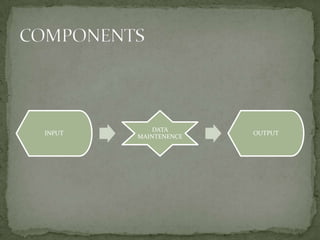
DATA
INPUT                 OUTPUT
        MAINTENENCE
DATA
     INPUT                                  OUTPUT
                    MAINTENENCE
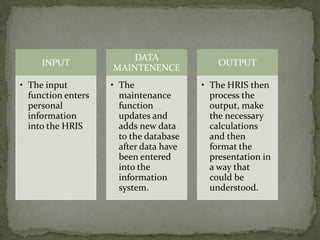
• The input         • The               • The HRIS then
  function enters     maintenance         process the
  personal            function            output, make
  information         updates and         the necessary
  into the HRIS       adds new data       calculations
                      to the database     and then
                      after data have     format the
                      been entered        presentation in
                      into the            a way that
                      information         could be
                      system.             understood.
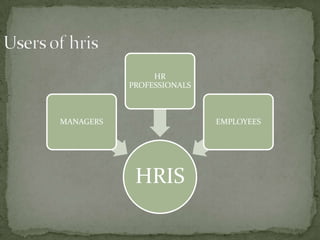
HR
           PROFESSIONALS


MANAGERS                   EMPLOYEES


            HRIS
Thus, for the HR professional there is an increasing reliance on the HRIS
to fulfil even the most elementary job tasks. As human capital plays a
larger role in competitive advantage, functional managers expect the
HRIS to provide functionality to meet the unit’s goals and objectives.
Moreover, managers rely on the HRIS’s capabilities to provide superior
data collection and analysis, especially for performance appraisal and
performance management. Additionally, it also includes skill
testing, assessment and development, résumé processing, recruitment
and retention, team and project management, and management
development. Finally, the individual employees become end users of
many HRIS applications. The increased complexity of employee benefit
options and the corresponding need to monitor and modify category
selections more frequently has increased the awareness of HRIS
functionality among employees. Web-based access and self-service
options have simplified the modification process and enhanced the
usability of many benefit options and administration alternative for most
employees.
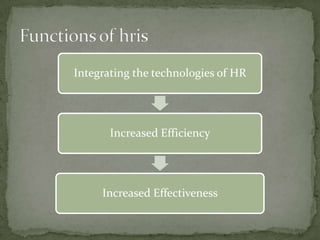
Integrating the technologies of HR


       Increased Efficiency


     Increased Effectiveness
The developments in Information Technology have
dramatically affected traditional HR functions
with nearly every HR function
(example, compensation, staffing, and training)
experiencing some sort of reengineering of its
processes. However, this process of change has
created significant challenges for HR professionals
resulting in the transformation of traditional
processes into on-line processes.
Rapid computing technology has allowed more
transactions to occur with fewer fixed resources.
Typical examples are payroll, flexible benefits
administration, and health benefits processing.
Though technologies of early mainframes
provided significant efficiencies in these areas, the
difference is that the record processing efficiencies
that were once only available to large firms are now
readily available to any organization size
Most often, as with processes, computer technology is designed to
improve effectiveness either by in terms of the accuracy of information
or by using the technology to simplify the process. This is especially the
case where large data sets require reconciliation. However, onerous
manual reconciliation processes may be executed faster, but also with
near perfect accuracy using automated systems. For instance, pension
and profit sharing applications, benefits administration, and employee
activities are just to mention but a few. Using computer technology in
these processes ensures accurate results and offer substantial
simplification and timeliness over manual processing.
Consequently, the vast majority of HR functions have had some degree
of automation applied in order to gain both efficiency and
effectiveness.
HRIS is an effective and efficient catalyst for
integrating human resource management and
Information Technology. This was common with all
the various definitions of HRIS. HRIS as a system
support HR functional applications such as employee
selection and placement, payroll, pension and benefits
management, intake and training projections just to
mention but a few.
THANKING YOU

Hris ppt

  • 1.
  • 2.
    Tannenbaum defines HRISas a technology-based system used to acquire, store, manipulate, analyze, retrieve, and distribute pertinent information regarding an organization’s human resources. Kovach defined HRIS as a systematic procedure for collecting, storing, maintaining, retrieving, and validating data needed by organization about its human resources, personnel activities, and organization unit characteristics. Furthermore, HRIS shape an integration between human resource management (HRM) and Information Technology. It merges HRM as a discipline and in particular basic HR activities and processes with the information technology field. As is the case with any complex organizational information system, an HRIS is not limited to the computer hardware and software applications that comprise the technical part of the system it also includes the people, policies, procedures, and data required to manage the HR function (Hendrickson, 2003).
  • 3.
    The function ofHuman Resources departments is generally administrative and common to all organizations. Organizations may have formalized selection, evaluation, and payroll processes. Efficient and effective management of "Human Capital" progressed to an increasingly imperative and complex process. The HR function consists of tracking existing employee data which traditionally includes personal histories, skills, capabilities, accomplishments and salary. To reduce the manual workload of these administrative activities, organizations began to electronically automate many of these processes by introducing specialized Human Resource Management Systems. HR executives rely on internal or external IT professionals to develop and maintain an integrated HRMS. Before the client–server architecture evolved in the late 1980s, many HR automation processes were relegated to mainframe computers that could handle large amounts of data transactions. In consequence of the high capital investment necessary to buy or program proprietary software, these internally-developed HRMS were limited to organizations that possessed a large amount of capital. The advent of client–server, Application Service Provider, and Software as a Service SaaS or Human Resource Management Systems enabled increasingly higher administrative control of such systems. Currently
  • 4.
    DATA INPUT OUTPUT MAINTENENCE
  • 5.
    DATA INPUT OUTPUT MAINTENENCE • The input • The • The HRIS then function enters maintenance process the personal function output, make information updates and the necessary into the HRIS adds new data calculations to the database and then after data have format the been entered presentation in into the a way that information could be system. understood.
  • 6.
    HR PROFESSIONALS MANAGERS EMPLOYEES HRIS
  • 7.
    Thus, for theHR professional there is an increasing reliance on the HRIS to fulfil even the most elementary job tasks. As human capital plays a larger role in competitive advantage, functional managers expect the HRIS to provide functionality to meet the unit’s goals and objectives. Moreover, managers rely on the HRIS’s capabilities to provide superior data collection and analysis, especially for performance appraisal and performance management. Additionally, it also includes skill testing, assessment and development, résumé processing, recruitment and retention, team and project management, and management development. Finally, the individual employees become end users of many HRIS applications. The increased complexity of employee benefit options and the corresponding need to monitor and modify category selections more frequently has increased the awareness of HRIS functionality among employees. Web-based access and self-service options have simplified the modification process and enhanced the usability of many benefit options and administration alternative for most employees.
  • 8.
    Integrating the technologiesof HR Increased Efficiency Increased Effectiveness
  • 9.
    The developments inInformation Technology have dramatically affected traditional HR functions with nearly every HR function (example, compensation, staffing, and training) experiencing some sort of reengineering of its processes. However, this process of change has created significant challenges for HR professionals resulting in the transformation of traditional processes into on-line processes.
  • 10.
    Rapid computing technologyhas allowed more transactions to occur with fewer fixed resources. Typical examples are payroll, flexible benefits administration, and health benefits processing. Though technologies of early mainframes provided significant efficiencies in these areas, the difference is that the record processing efficiencies that were once only available to large firms are now readily available to any organization size
  • 11.
    Most often, aswith processes, computer technology is designed to improve effectiveness either by in terms of the accuracy of information or by using the technology to simplify the process. This is especially the case where large data sets require reconciliation. However, onerous manual reconciliation processes may be executed faster, but also with near perfect accuracy using automated systems. For instance, pension and profit sharing applications, benefits administration, and employee activities are just to mention but a few. Using computer technology in these processes ensures accurate results and offer substantial simplification and timeliness over manual processing. Consequently, the vast majority of HR functions have had some degree of automation applied in order to gain both efficiency and effectiveness.
  • 12.
    HRIS is aneffective and efficient catalyst for integrating human resource management and Information Technology. This was common with all the various definitions of HRIS. HRIS as a system support HR functional applications such as employee selection and placement, payroll, pension and benefits management, intake and training projections just to mention but a few.
  • 13.