Strategic Human Resource Management:
Value Deliverables and Function
Dr. Elijah Ezendu
FIMC, FCCM, FIIAN, FBDI, FAAFM, FSSM, MIMIS, MIAP, MITD, ACIArb, ACIPM,
PhD, DocM, MBA, CWM, CBDA, CMA, MPM, PME, CSOL, CCIP, CMC, CMgr
HR operates within a business environment that
impinges on the organisation, acceptability of
output, performance, and expectation of
stakeholders, that’s why a static response to
business is inadmissible.
There’s need for proper identification of
business implications in every environmental
upturn, so as to provide the right human
resource input required for driving corporate
strategy and attainment of stated objectives.
The Strategic Role of HR
External Factors Impacting HR
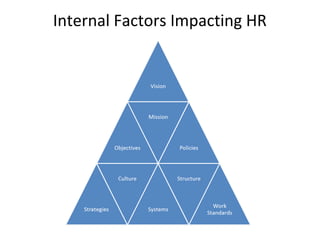
Internal Factors Impacting HR
Business Indicators Demanding HR Responsiveness
• Globalisation
• Innovation
• Operational Mobility
• Competitive Advantage
• Technology
• Competition
• Brand Evolution
• Customer Satisfaction
• Productivity
• Financial Performance
• Cost Reduction
• Regulation
Best Fit Versus Best Practice
In alignment of HR business processes for
optimal performance, best fit surpasses best
practice and emerge as the right choice, due to
characteristic variation of the business
environments of organisations.
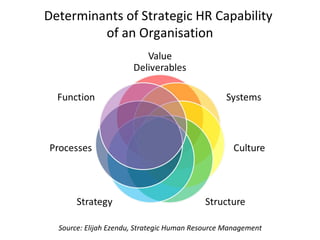
The key focus in strategic human resource
management is identification of appropriate HR
function/ culture/ structure/ systems within the
context of creation of value required for
organisational excellence.
Business Value
Business value refers to a collective set of
results generated in sync with goals of an
organisation. Organisational activities usually
yield some outputs that may be acceptable by
certain groups of workers as equitable value due
to justification by perception. On the contrary,
competitive activity value analysis demonstrates
existence and extent of connectivity between
activity output and an organisation’s goals.
Business Alignment
Business Alignment is occasioned by placement
of key activities with content and direction that
are geared for achievement of organisational
goals.
Effective Business Alignment of HR Function
shall occur when every activity output from
each section of HR contributes fittingly to
organisational pool of output earmarked for
generating product or service.
HR Value vs. Business Goal
Contemporary HR Value had been self-centred
and somewhat disconnected from business goal
orientated perspective. That’s why such output
is not identified as ‘value adding result’ in
corporate strategic outlay.
HR Thrust
Effective Business Alignment of HR Function
implies every component of HR system,
structure, policy, procedures, initiatives,
objectives and strategy must be focused on
provisioning of excellent enablement for
achievement of organisational goals. This should
be the HR Thrust.
Best Practices – How to Bridge the Business Divide
•Evaluate current opportunity with the business
# Bringing insight to investment decisions
# Building future value through today’s forums
# Bridging the people visibility gap
# Removing barriers and optimize performance
•Develop platforms for strategic conversation
•Transform HR Business Partners into strategic advisors
•Report Links
Source: Amy Wilson, Wilson Insight
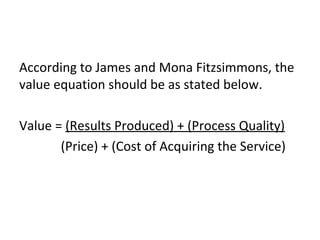
According to James and Mona Fitzsimmons, the
value equation should be as stated below.
Value = (Results Produced) + (Process Quality)
(Price) + (Cost of Acquiring the Service)
Prodding Factuality of Value Equation
If value as a function is relevant
Then ‘results produced’ and ‘manned processes
for producing results’ are both relevant.
Therefore, the strategic stance of outstandingly
competitive organisations focus on results and
what produces results, for the purpose of
achieving effective value mapping from Chicken
to Egg.
Identity of Results Produced
Results Produced should be within the context
of the receiver’s stance and not the perception
of producer. HR must identify its service value in
terms of relative worth to the receiver.
The right sets of results that are unique,
influential and conspicuous constitute
competitive advantage.
HR Strategic Resolution
Total Value Deliverables of HR must be planned
and implemented to fulfil requirements of all
designated customers, with crowning focus on
achieving effective alignment to Corporate
Mission and Strategy.
Determinants of Strategic HR Capability
of an Organisation
Source: Elijah Ezendu, Strategic Human Resource Management
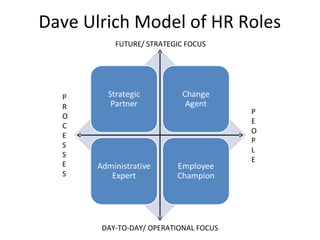
Dave Ulrich Model of HR Roles
P
R
O
C
E
S
S
E
S
P
E
O
P
L
E
FUTURE/ STRATEGIC FOCUS
DAY-TO-DAY/ OPERATIONAL FOCUS
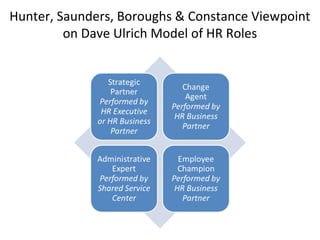
Hunter, Saunders, Boroughs & Constance Viewpoint
on Dave Ulrich Model of HR Roles
HR Business Partner
As a strategic partner, the HR Business Partner (HRBP) aligns business
objectives with employees and management in designated business units.
The HRBP serves as a consultant to management on Human Resource related
issues. Successful HRBP will act as employee champion and change agent.
HRBP assesses and anticipates HR-related needs. Communicating needs
proactively with HR department and business management, the HRBP seeks
to develop integrated solutions. The HRBP formulates partnerships across the
HR function to deliver value added service to management and employees
that reflect the business objectives of the organization. The HRBP may
include international Human Resource responsibilities. The HRBP maintains
an effective level of business literacy about the business units financial
position, its mid range plans, its culture and its competition.
Source: Society for Human Resource Management
Exploratory Engagement
Discuss the man specification for HR Business
Partner?
…………………………………………………………………………
…………………………………………………………………….......
..............................................................................
..............................................................................
..............................................................................
.........................................................................
HR Shared Service Center
This provides HR Shared Service, which is an
assortment of various services selectively
bundled, thus heralding a shift from multiple
isolated service provisioning to centralised
system.
Advantages of HR Shared Service Center
• Economies of Scale
• Cost Reduction
• Standardisation
• Elimination of Waste
• Boosts Customer Service Levels
• Enhances Intradepartmental Synergy
• Greater Accountability
• Greater Autonomy
• Greater Focus
• Improves Communication
• Enhances Customer-Centricity
• Boosts Quality
• Job Enrichment
Disadvantages of HR Shared Service Center
• Problem of Over-Standardization
• Loss of Regular Face to Face Interaction
• Tendency to lose Top Talents to Competitors
• High Initial Cost
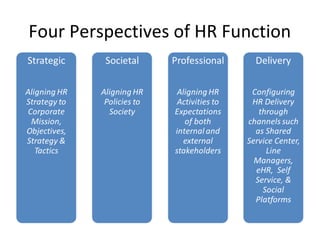
Four Perspectives of HR Function
Elements for Improving &
Sustaining Productivity
• Time Management
• Developing High Performance Teams
• Using Realistic Performance Targets
• Promote Effective Communication
• Flexible Work System
• Technology Driven Excellence
• Work Environment
• Productivity Friendly Culture
• Connecting Output to Reward & Recognition
• Appropriate Empowerment
• Promoting Collaboration and Networking
• Using Feasible Work Standards
• Promoting Leadership Capability
• Using Acceptable Productivity Measurements
HR as Employee Advocate
In this case, HR manages the aggregate
contributions of employees through workable
engagement, motivation, guidance and capacity
development.
Responsibility of Employee Advocate
• Develop and Implement Viable Employee Engagement
Framework
• Create Favourable Work Environment
• Promote Performance Friendly Culture
• Act as Voice of Employees
• Provide Fitting Employee Development Programmes
• Facilitate Goal Convergence between Employer and Employee
• Promote Employer Brand that Elicits Employee Loyalty
• Promote a Corporate Family Framework that Ensures Job
Security, Inclusiveness and Diversity.
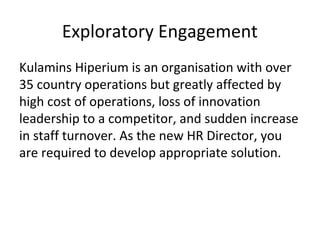
Exploratory Engagement
Kulamins Hiperium is an organisation with over
35 country operations but greatly affected by
high cost of operations, loss of innovation
leadership to a competitor, and sudden increase
in staff turnover. As the new HR Director, you
are required to develop appropriate solution.
Dr Elijah Ezendu is Award-Winning Business Expert & Certified Management Consultant with expertise
in Interim Management, Strategy, Competitive Intelligence, Transformation, Restructuring, Turnaround
Management, Business Development, Marketing, Project & Cost Management, Leadership, HR, CSR, e-
Business & Software Architecture. He had functioned as Founder, Initiative for Sustainable Business
Equity; Chairman of Board, Charisma Broadcast Film Academy; Group Chief Operating Officer, Idova
Group; CEO, Rubiini (UAE); Special Advisor, RTEAN; Director, MMNA Investments; Chair, Int’l Board of
GCC Business Council (UAE); Senior Partner, Shevach Consulting; Chairman (Certification & Training),
Coordinator (Board of Fellows), Lead Assessor & Governing Council Member, Institute of Management
Consultants, Nigeria; Lead Resource, Centre for Competitive Intelligence Development; Lead
Consultant/ Partner, JK Michaels; Turnaround Project Director, Consolidated Business Holdings Limited;
Technical Director, Gestalt; Chief Operating Officer, Rohan Group; Executive Director (Various Roles),
Fortuna, Gambia & Malta; Chief Advisor/ Partner, D & E; Vice Chairman of Board, Refined Shipping;
Director of Programmes & Governing Council Member, Institute of Business Development, Nigeria;
Member of TDD Committee, International Association of Software Architects, USA; Member of Strategic
Planning and Implementation Committee, Chartered Institute of Personnel Management of Nigeria;
Country Manager (Nigeria) & Adjunct Faculty (MBA Programme), Regent Business School, South Africa;
Adjunct Faculty (MBA Programme), Ladoke Akintola University of Technology; Editor-in-Chief, Cost
Management Journal; Council Member, Institute of Internal Auditors of Nigeria; Member, Board of
Directors (Several Organizations). He holds Doctoral Degree in Management, Master of Business
Administration and Fellow of Professional Institutes in North America, UK & Nigeria. He is Innovator of
Corporate Investment Structure Based on Financials and Intangibles, for valuation highlighting
intangible contributions of host communities and ecological environment: A model celebrated globally
as remedy for unmitigated depreciation of ecological capital and developmental deprivation of host
communities. He had served as Examiner to Professional Institutes and Universities. He had been a
member of Guild of Soundtrack Producers of Nigeria. He's an author and extensively featured speaker.
Thank You

Strategic Human Resource Management

  • 1.
    Strategic Human ResourceManagement: Value Deliverables and Function Dr. Elijah Ezendu FIMC, FCCM, FIIAN, FBDI, FAAFM, FSSM, MIMIS, MIAP, MITD, ACIArb, ACIPM, PhD, DocM, MBA, CWM, CBDA, CMA, MPM, PME, CSOL, CCIP, CMC, CMgr
  • 2.
    HR operates withina business environment that impinges on the organisation, acceptability of output, performance, and expectation of stakeholders, that’s why a static response to business is inadmissible. There’s need for proper identification of business implications in every environmental upturn, so as to provide the right human resource input required for driving corporate strategy and attainment of stated objectives. The Strategic Role of HR
  • 3.
  • 4.
  • 5.
    Business Indicators DemandingHR Responsiveness • Globalisation • Innovation • Operational Mobility • Competitive Advantage • Technology • Competition • Brand Evolution • Customer Satisfaction • Productivity • Financial Performance • Cost Reduction • Regulation
  • 6.
    Best Fit VersusBest Practice In alignment of HR business processes for optimal performance, best fit surpasses best practice and emerge as the right choice, due to characteristic variation of the business environments of organisations.
  • 7.
    The key focusin strategic human resource management is identification of appropriate HR function/ culture/ structure/ systems within the context of creation of value required for organisational excellence.
  • 8.
    Business Value Business valuerefers to a collective set of results generated in sync with goals of an organisation. Organisational activities usually yield some outputs that may be acceptable by certain groups of workers as equitable value due to justification by perception. On the contrary, competitive activity value analysis demonstrates existence and extent of connectivity between activity output and an organisation’s goals.
  • 9.
    Business Alignment Business Alignmentis occasioned by placement of key activities with content and direction that are geared for achievement of organisational goals. Effective Business Alignment of HR Function shall occur when every activity output from each section of HR contributes fittingly to organisational pool of output earmarked for generating product or service.
  • 10.
    HR Value vs.Business Goal Contemporary HR Value had been self-centred and somewhat disconnected from business goal orientated perspective. That’s why such output is not identified as ‘value adding result’ in corporate strategic outlay.
  • 11.
    HR Thrust Effective BusinessAlignment of HR Function implies every component of HR system, structure, policy, procedures, initiatives, objectives and strategy must be focused on provisioning of excellent enablement for achievement of organisational goals. This should be the HR Thrust.
  • 12.
    Best Practices –How to Bridge the Business Divide •Evaluate current opportunity with the business # Bringing insight to investment decisions # Building future value through today’s forums # Bridging the people visibility gap # Removing barriers and optimize performance •Develop platforms for strategic conversation •Transform HR Business Partners into strategic advisors •Report Links Source: Amy Wilson, Wilson Insight
  • 13.
    According to Jamesand Mona Fitzsimmons, the value equation should be as stated below. Value = (Results Produced) + (Process Quality) (Price) + (Cost of Acquiring the Service)
  • 14.
    Prodding Factuality ofValue Equation If value as a function is relevant Then ‘results produced’ and ‘manned processes for producing results’ are both relevant. Therefore, the strategic stance of outstandingly competitive organisations focus on results and what produces results, for the purpose of achieving effective value mapping from Chicken to Egg.
  • 15.
    Identity of ResultsProduced Results Produced should be within the context of the receiver’s stance and not the perception of producer. HR must identify its service value in terms of relative worth to the receiver. The right sets of results that are unique, influential and conspicuous constitute competitive advantage.
  • 16.
    HR Strategic Resolution TotalValue Deliverables of HR must be planned and implemented to fulfil requirements of all designated customers, with crowning focus on achieving effective alignment to Corporate Mission and Strategy.
  • 17.
    Determinants of StrategicHR Capability of an Organisation Source: Elijah Ezendu, Strategic Human Resource Management
  • 18.
    Dave Ulrich Modelof HR Roles P R O C E S S E S P E O P L E FUTURE/ STRATEGIC FOCUS DAY-TO-DAY/ OPERATIONAL FOCUS
  • 19.
    Hunter, Saunders, Boroughs& Constance Viewpoint on Dave Ulrich Model of HR Roles
  • 20.
    HR Business Partner Asa strategic partner, the HR Business Partner (HRBP) aligns business objectives with employees and management in designated business units. The HRBP serves as a consultant to management on Human Resource related issues. Successful HRBP will act as employee champion and change agent. HRBP assesses and anticipates HR-related needs. Communicating needs proactively with HR department and business management, the HRBP seeks to develop integrated solutions. The HRBP formulates partnerships across the HR function to deliver value added service to management and employees that reflect the business objectives of the organization. The HRBP may include international Human Resource responsibilities. The HRBP maintains an effective level of business literacy about the business units financial position, its mid range plans, its culture and its competition. Source: Society for Human Resource Management
  • 21.
    Exploratory Engagement Discuss theman specification for HR Business Partner? ………………………………………………………………………… ……………………………………………………………………....... .............................................................................. .............................................................................. .............................................................................. .........................................................................
  • 22.
    HR Shared ServiceCenter This provides HR Shared Service, which is an assortment of various services selectively bundled, thus heralding a shift from multiple isolated service provisioning to centralised system.
  • 23.
    Advantages of HRShared Service Center • Economies of Scale • Cost Reduction • Standardisation • Elimination of Waste • Boosts Customer Service Levels • Enhances Intradepartmental Synergy • Greater Accountability • Greater Autonomy • Greater Focus • Improves Communication • Enhances Customer-Centricity • Boosts Quality • Job Enrichment
  • 24.
    Disadvantages of HRShared Service Center • Problem of Over-Standardization • Loss of Regular Face to Face Interaction • Tendency to lose Top Talents to Competitors • High Initial Cost
  • 25.
  • 26.
    Elements for Improving& Sustaining Productivity • Time Management • Developing High Performance Teams • Using Realistic Performance Targets • Promote Effective Communication • Flexible Work System • Technology Driven Excellence • Work Environment • Productivity Friendly Culture • Connecting Output to Reward & Recognition • Appropriate Empowerment • Promoting Collaboration and Networking • Using Feasible Work Standards • Promoting Leadership Capability • Using Acceptable Productivity Measurements
  • 27.
    HR as EmployeeAdvocate In this case, HR manages the aggregate contributions of employees through workable engagement, motivation, guidance and capacity development.
  • 28.
    Responsibility of EmployeeAdvocate • Develop and Implement Viable Employee Engagement Framework • Create Favourable Work Environment • Promote Performance Friendly Culture • Act as Voice of Employees • Provide Fitting Employee Development Programmes • Facilitate Goal Convergence between Employer and Employee • Promote Employer Brand that Elicits Employee Loyalty • Promote a Corporate Family Framework that Ensures Job Security, Inclusiveness and Diversity.
  • 29.
    Exploratory Engagement Kulamins Hiperiumis an organisation with over 35 country operations but greatly affected by high cost of operations, loss of innovation leadership to a competitor, and sudden increase in staff turnover. As the new HR Director, you are required to develop appropriate solution.
  • 30.
    Dr Elijah Ezenduis Award-Winning Business Expert & Certified Management Consultant with expertise in Interim Management, Strategy, Competitive Intelligence, Transformation, Restructuring, Turnaround Management, Business Development, Marketing, Project & Cost Management, Leadership, HR, CSR, e- Business & Software Architecture. He had functioned as Founder, Initiative for Sustainable Business Equity; Chairman of Board, Charisma Broadcast Film Academy; Group Chief Operating Officer, Idova Group; CEO, Rubiini (UAE); Special Advisor, RTEAN; Director, MMNA Investments; Chair, Int’l Board of GCC Business Council (UAE); Senior Partner, Shevach Consulting; Chairman (Certification & Training), Coordinator (Board of Fellows), Lead Assessor & Governing Council Member, Institute of Management Consultants, Nigeria; Lead Resource, Centre for Competitive Intelligence Development; Lead Consultant/ Partner, JK Michaels; Turnaround Project Director, Consolidated Business Holdings Limited; Technical Director, Gestalt; Chief Operating Officer, Rohan Group; Executive Director (Various Roles), Fortuna, Gambia & Malta; Chief Advisor/ Partner, D & E; Vice Chairman of Board, Refined Shipping; Director of Programmes & Governing Council Member, Institute of Business Development, Nigeria; Member of TDD Committee, International Association of Software Architects, USA; Member of Strategic Planning and Implementation Committee, Chartered Institute of Personnel Management of Nigeria; Country Manager (Nigeria) & Adjunct Faculty (MBA Programme), Regent Business School, South Africa; Adjunct Faculty (MBA Programme), Ladoke Akintola University of Technology; Editor-in-Chief, Cost Management Journal; Council Member, Institute of Internal Auditors of Nigeria; Member, Board of Directors (Several Organizations). He holds Doctoral Degree in Management, Master of Business Administration and Fellow of Professional Institutes in North America, UK & Nigeria. He is Innovator of Corporate Investment Structure Based on Financials and Intangibles, for valuation highlighting intangible contributions of host communities and ecological environment: A model celebrated globally as remedy for unmitigated depreciation of ecological capital and developmental deprivation of host communities. He had served as Examiner to Professional Institutes and Universities. He had been a member of Guild of Soundtrack Producers of Nigeria. He's an author and extensively featured speaker.
  • 31.