Employee Retention
Retention
Retention
   We can't stop employee from leaving
    unless we have a plan to make them stay.
    Employee retention refers to the ability
    of an organization to retain its employees.
Retention
   However, many employee consider,
    retention as relating to the efforts by
    which employers attempt to retain
    employees in their workforce. In this
    sense, retention becomes the strategies
    rather than the outcome. In a Business
     setting, the goal of employers is usually
    to decrease employee turnover, thereby
    decreasing training costs, recruitment
    costs and loss of talent and organizational
    knowledge.
Retention
   By implementing lessons learned from key
    organizational behavior concepts employers
    can improve retention rates and decrease the
    associated costs of high turnover. Employee
    retention is a process in which the employees
    are encourage to remain with the
    organization for the maximum period of time
    or until the completion of the project.
    Employee retention is beneficial for the
    organization as well as for the employee.
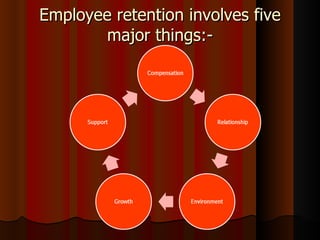
Employee retention involves five
        major things:-
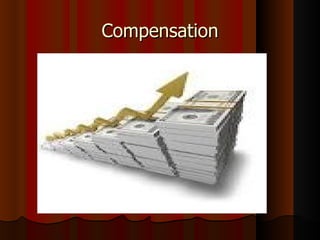
Compensation
Relationship
Environment
Growth
Support
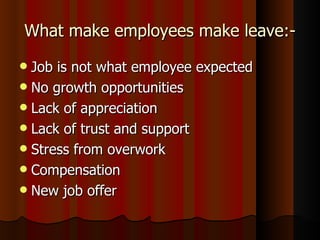
What make employees make leave:-
 Job is not what employee expected
 No growth opportunities
 Lack of appreciation
 Lack of trust and support
 Stress from overwork
 Compensation
 New job offer
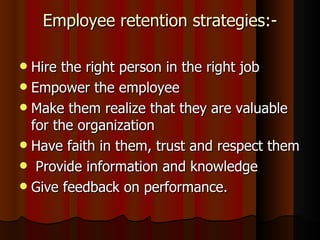
Employee retention strategies:-

 Hire the right person in the right job
 Empower the employee
 Make them realize that they are valuable
  for the organization
 Have faith in them, trust and respect them
 Provide information and knowledge
 Give feedback on performance.
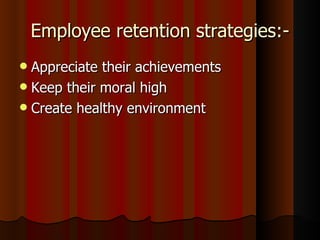
Employee retention strategies:-
 Appreciate their achievements
 Keep their moral high
 Create healthy environment
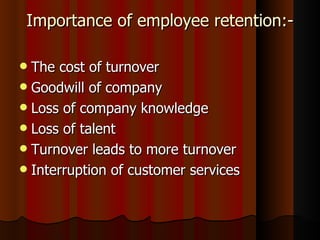
Importance of employee retention:-

 The cost of turnover
 Goodwill of company
 Loss of company knowledge
 Loss of talent
 Turnover leads to more turnover
 Interruption of customer services

Retention

  • 1.
  • 2.
  • 3.
    Retention  We can't stop employee from leaving unless we have a plan to make them stay. Employee retention refers to the ability of an organization to retain its employees.
  • 4.
    Retention  However, many employee consider, retention as relating to the efforts by which employers attempt to retain employees in their workforce. In this sense, retention becomes the strategies rather than the outcome. In a Business setting, the goal of employers is usually to decrease employee turnover, thereby decreasing training costs, recruitment costs and loss of talent and organizational knowledge.
  • 5.
    Retention  By implementing lessons learned from key organizational behavior concepts employers can improve retention rates and decrease the associated costs of high turnover. Employee retention is a process in which the employees are encourage to remain with the organization for the maximum period of time or until the completion of the project. Employee retention is beneficial for the organization as well as for the employee.
  • 6.
    Employee retention involvesfive major things:-
  • 7.
  • 8.
  • 9.
  • 10.
  • 11.
  • 12.
    What make employeesmake leave:-  Job is not what employee expected  No growth opportunities  Lack of appreciation  Lack of trust and support  Stress from overwork  Compensation  New job offer
  • 13.
    Employee retention strategies:- Hire the right person in the right job  Empower the employee  Make them realize that they are valuable for the organization  Have faith in them, trust and respect them  Provide information and knowledge  Give feedback on performance.
  • 14.
    Employee retention strategies:- Appreciate their achievements  Keep their moral high  Create healthy environment
  • 15.
    Importance of employeeretention:-  The cost of turnover  Goodwill of company  Loss of company knowledge  Loss of talent  Turnover leads to more turnover  Interruption of customer services