ANTONY JOSEPH.T.
18TH FEBRUVARY 2014
Presented by,
DEFINITION
Human Resource Information System (HRIS)
is the composite of databases, computer
applications, hardware and software that are
used to collect, record, store, manage,
deliver, present and manipulate data of
human resource.
Broderick and Boudreau (1992)
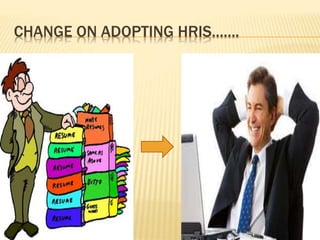
CHANGE ON ADOPTING HRIS…….
HISTORY OF HRIS…..
 1950`s - Virtually non-existent
 1960`s - Only a few vendors.
 1970`s - greater need in organizations.
 1980`s – HRIS - reality in many
organizations.
 1990`s - Numerous vendors, specialties….
FUNCTIONS OF HRIS
 Create and maintain employee records.
 Ensure legal compliance.
 Forecast and plan future HR requirements.
 Reduces the manual work.
 Assist managers by providing the relevant data.
HRIS- ‘STAGES OF DEVELOPMENT’
 Primary level (EDP Stage)
• Focus on data storage, processing and
information flows.
• Restricted to payroll and storing basic details
of employees.
 Secondary level (MIS Stage)
• Increased report generation flexibility.
• Intended in control of operations and
budgetting.
STAGES OF DEVPT- CONTD….
 Tertiary level (DSS Stage)
• More interactive and capable of developing
decisions on many strategic issues.
• Intended in competency mapping of existing
manpower, their future utilization, training
and development initiatives, suitable
compensation packages etc.
AREAS OF HRIS
 Personal employee information.
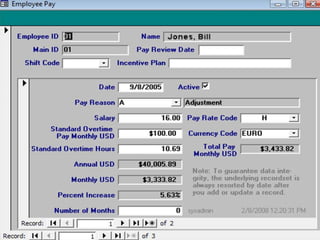
 Wages and salaries.
 Succession planning.
 Calculation of Benefits.
 Education & training.
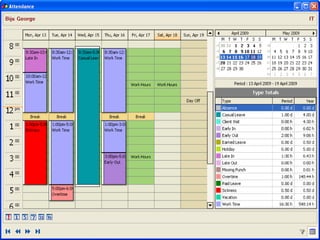
 Attendance.
 Performance appraisal.
 Strategic planning.
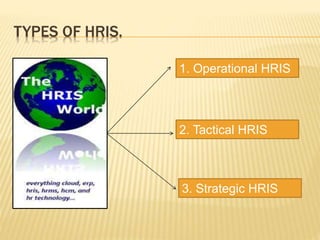
TYPES OF HRIS.
1. Operational HRIS
2. Tactical HRIS
3. Strategic HRIS
OPERATIONAL HRIS
Operational HRIS provides data to support
routine and repetitive human resource
decisions.
Information is detailed, structured, accurate
and internal.
STRATEGIC HRIS
Strategic HRIS helps top level managers to
set goals and directions for organisation.
Gather and manage information from within
and outside organisation.
TACTICAL HRIS
 Supports management decisions emphasizing
allocation of human resources.
 The decisions include recruitment decisions,
job analysis and design decisions, training and
development decisions, and employee
compensation plan decisions.
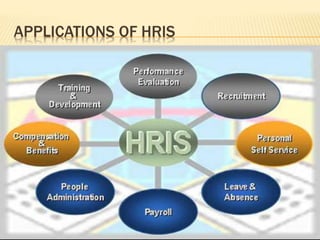
APPLICATIONS OF HRIS
BENEFITS OF HRIS
Saving time
 Saving costs
Work re-allocation
SAVING TIME
 Saving time leads to efficiency.
 Easy data maintenance.
 Administrative processes automated.
 Employee “self-service”.
 Adequate information base that leads to
timely decision making.
 Responding faster to employee inquiries to
enhance efficiency and productivity.
SAVING COSTS
 Less time spent on tasks = less money.
 Minimum paperwork.
 Timely and accurate decision making
includes less cost.
WORK RE-ALLOCATION
 Helping the employees perform better
through effective career planning and
performance management.
 Integrating the human resource function with
other business functions in the enterprise, to
serve personnel better.
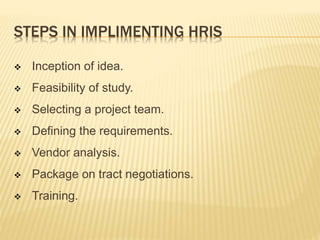
STEPS IN IMPLIMENTING HRIS
 Inception of idea.
 Feasibility of study.
 Selecting a project team.
 Defining the requirements.
 Vendor analysis.
 Package on tract negotiations.
 Training.
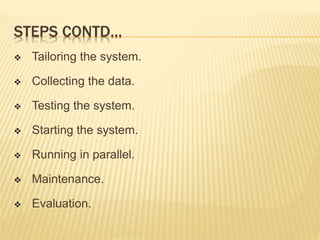
STEPS CONTD…
 Tailoring the system.
 Collecting the data.
 Testing the system.
 Starting the system.
 Running in parallel.
 Maintenance.
 Evaluation.
HRIS PRODUCTS
 css horizon
 elabour.com
 Genesys
 Lawson
 Oracle
 People soft
 Proact
 Goodwood hr.com
LIMITATIONS OF HRIS
 It can be expensive in terms of finance and
manpower.
 Thorough understanding of the system is
necessary for its functioning.
 Lack of communication.
 HRIS implemented may be on poorly done
needs analysis.
HRIS IN HOSPITALS
 Low-resource countries face difficulties in
meeting the health care needs of their
people. For e.g.:- Countries in sub-Saharan
Africa suffer from 24% of the global disease
burden, but have only three percent of the
global health workforce to provide necessary
services.
 Routine and accurate HRIS data helps to
deploy the right health workers in the right
places to meet the health care needs.
CONTD…..
 HRIS can be used to standardize and
support ongoing management and support of
the health workforce.
 Capacity Plus Inc, IntraHealth International
are some of the HRIS softwares used in
healthcare industry.
CONCLUSION
 “By automating
Human Resource
practices, HRIS saves
time, money and
effectively reallocates
work processes thus
providing competitive
advantage and adds
strategic value to the
organization.”
REFERENCES
 Dipak kumar bhattacharyya, Human
Resource Management, Second edition,
Excel books publications, New delhi.
 www.slideshare.net
 en.wikipedia.org
 Googlesearch
…………….
Human Resource Information System - HRIS

Human Resource Information System - HRIS

  • 1.
  • 2.
    DEFINITION Human Resource InformationSystem (HRIS) is the composite of databases, computer applications, hardware and software that are used to collect, record, store, manage, deliver, present and manipulate data of human resource. Broderick and Boudreau (1992)
  • 3.
    CHANGE ON ADOPTINGHRIS…….
  • 4.
    HISTORY OF HRIS….. 1950`s - Virtually non-existent  1960`s - Only a few vendors.  1970`s - greater need in organizations.  1980`s – HRIS - reality in many organizations.  1990`s - Numerous vendors, specialties….
  • 5.
    FUNCTIONS OF HRIS Create and maintain employee records.  Ensure legal compliance.  Forecast and plan future HR requirements.  Reduces the manual work.  Assist managers by providing the relevant data.
  • 6.
    HRIS- ‘STAGES OFDEVELOPMENT’  Primary level (EDP Stage) • Focus on data storage, processing and information flows. • Restricted to payroll and storing basic details of employees.  Secondary level (MIS Stage) • Increased report generation flexibility. • Intended in control of operations and budgetting.
  • 7.
    STAGES OF DEVPT-CONTD….  Tertiary level (DSS Stage) • More interactive and capable of developing decisions on many strategic issues. • Intended in competency mapping of existing manpower, their future utilization, training and development initiatives, suitable compensation packages etc.
  • 8.
    AREAS OF HRIS Personal employee information.  Wages and salaries.  Succession planning.  Calculation of Benefits.  Education & training.  Attendance.  Performance appraisal.  Strategic planning.
  • 9.
    TYPES OF HRIS. 1.Operational HRIS 2. Tactical HRIS 3. Strategic HRIS
  • 10.
    OPERATIONAL HRIS Operational HRISprovides data to support routine and repetitive human resource decisions. Information is detailed, structured, accurate and internal.
  • 11.
    STRATEGIC HRIS Strategic HRIShelps top level managers to set goals and directions for organisation. Gather and manage information from within and outside organisation.
  • 12.
    TACTICAL HRIS  Supportsmanagement decisions emphasizing allocation of human resources.  The decisions include recruitment decisions, job analysis and design decisions, training and development decisions, and employee compensation plan decisions.
  • 13.
  • 14.
    BENEFITS OF HRIS Savingtime  Saving costs Work re-allocation
  • 15.
    SAVING TIME  Savingtime leads to efficiency.  Easy data maintenance.  Administrative processes automated.  Employee “self-service”.  Adequate information base that leads to timely decision making.  Responding faster to employee inquiries to enhance efficiency and productivity.
  • 16.
    SAVING COSTS  Lesstime spent on tasks = less money.  Minimum paperwork.  Timely and accurate decision making includes less cost.
  • 17.
    WORK RE-ALLOCATION  Helpingthe employees perform better through effective career planning and performance management.  Integrating the human resource function with other business functions in the enterprise, to serve personnel better.
  • 18.
    STEPS IN IMPLIMENTINGHRIS  Inception of idea.  Feasibility of study.  Selecting a project team.  Defining the requirements.  Vendor analysis.  Package on tract negotiations.  Training.
  • 19.
    STEPS CONTD…  Tailoringthe system.  Collecting the data.  Testing the system.  Starting the system.  Running in parallel.  Maintenance.  Evaluation.
  • 20.
    HRIS PRODUCTS  csshorizon  elabour.com  Genesys  Lawson  Oracle  People soft  Proact  Goodwood hr.com
  • 21.
    LIMITATIONS OF HRIS It can be expensive in terms of finance and manpower.  Thorough understanding of the system is necessary for its functioning.  Lack of communication.  HRIS implemented may be on poorly done needs analysis.
  • 24.
    HRIS IN HOSPITALS Low-resource countries face difficulties in meeting the health care needs of their people. For e.g.:- Countries in sub-Saharan Africa suffer from 24% of the global disease burden, but have only three percent of the global health workforce to provide necessary services.  Routine and accurate HRIS data helps to deploy the right health workers in the right places to meet the health care needs.
  • 25.
    CONTD…..  HRIS canbe used to standardize and support ongoing management and support of the health workforce.  Capacity Plus Inc, IntraHealth International are some of the HRIS softwares used in healthcare industry.
  • 26.
    CONCLUSION  “By automating HumanResource practices, HRIS saves time, money and effectively reallocates work processes thus providing competitive advantage and adds strategic value to the organization.”
  • 27.
    REFERENCES  Dipak kumarbhattacharyya, Human Resource Management, Second edition, Excel books publications, New delhi.  www.slideshare.net  en.wikipedia.org  Googlesearch …………….