

IPRA Webinar:
Finding the Courage to Change
Tracey Crawford, CTRS, CPRP
Executive Director, NWSRA
tcrawford@nwsra.org
Would you rather…
 Would you rather be really hairy or completely bald?
 Be 4’5 or 7’7?
 Loose your eye site or loose your hearing?
 Take a guaranteed $100,00 or a fifty/fifty chance at $1,000,000.00?
 Never touch another human again or never touch a computer powered device
again?
 Would you rather be homeless or move in with your parents or kids?
 Would you rather not be able to use your hands or not be able to walk?
 Never brush your teeth again or never brush your hair again?
Expectations
We will identify the three levels of change:
 You as an individual
 Your agency
 Your organization
We will identify the obstacles and the opportunities associated
with each level of change
We will help you identify your level of change and help you
create an action plan to address those changes
Level 1 – Personal Change
The Conserver
 They accept structure
 Prefer retaining existing systems and paradigms
 May appear cautious and inflexible
 Does not like the hard detailed questions
The Pragmatist
 They explore structure
 Operate as mediators and catalysts
 Prefer change that best serves the function
 May appear reasonable, practical and flexible
 However, they will not commit
The Originator
 They challenge the existing structure
 Enjoy risky and uncertainty
 Prefer quicker, more expansive and radical change
 May appear disorganized and undisciplined
 They are original thinkers
Why we tend to Avoid Change?
“Thirteen Things Mentally Strong People Don’t Do” by Amy Morin
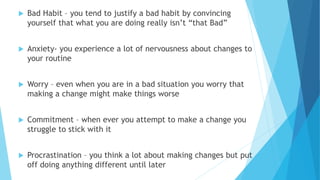
 Bad Habit – you tend to justify a bad habit by convincing
yourself that what you are doing really isn’t “that Bad”
 Anxiety- you experience a lot of nervousness about changes to
your routine
 Worry – even when you are in a bad situation you worry that
making a change might make things worse
 Commitment – when ever you attempt to make a change you
struggle to stick with it
 Procrastination – you think a lot about making changes but put
off doing anything different until later
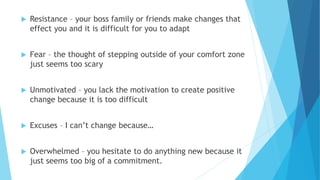
 Resistance – your boss family or friends make changes that
effect you and it is difficult for you to adapt
 Fear – the thought of stepping outside of your comfort zone
just seems too scary
 Unmotivated – you lack the motivation to create positive
change because it is too difficult
 Excuses – I can’t change because…
 Overwhelmed – you hesitate to do anything new because it
just seems too big of a commitment.
Types of Change
“Thirteen Things Mentally Strong People Don’t Do” by Amy Morin
Types of Change
 All or nothing – irrevocable, jump in with both feet
 Habit change – must be done consistently
 Try something new – voluntary
 Behavioral change – requires a commitment
 Emotional change – intangible change (why questions)
 Cognitive change – getting yourself in the right mind set
Worksheet
 What is the change that you need to make?
 Is it a Personal, Health or Career change/goal?
 What type of changes are you facing?
 What is the timeline for the changes?
 What are the action steps needed to make the changes?
Level 2 – Agency Change
Remember…
 Change is the new NORMAL?!@#*
 Sometimes there is a lack of understanding
 To Identify the potential issues and concerns that might become
barriers to change
 To create a sense of urgency to help build momentum
 To create a plan of action to formalize the changes
 To empower your team throughout the process so that they have
a measure of control
 Employees deal with change differently
 Change and how it is handled can strengthen, weaken or stabilize
a team
 How you react directly impacts the dynamics and efficiencies of
your team
Behavioral Reactions to Change
Employees who thrive on
change:
• Results oriented people
• They embrace quick changes and decisions
• They like new products and procedures
• They initiate change within a team
• The challenge the status quo
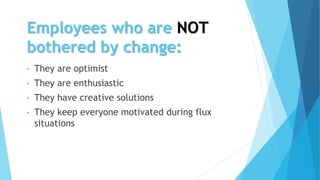
Employees who are NOT
bothered by change:
• They are optimist
• They are enthusiastic
• They have creative solutions
• They keep everyone motivated during flux
situations
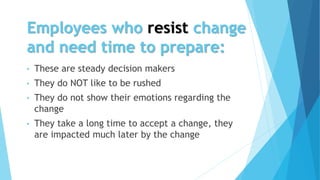
Employees who resist change
and need time to prepare:
• These are steady decision makers
• They do NOT like to be rushed
• They do not show their emotions regarding the
change
• They take a long time to accept a change, they
are impacted much later by the change
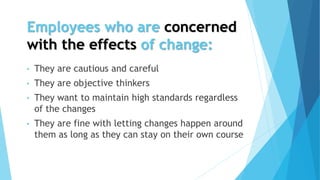
Employees who are concerned
with the effects of change:
• They are cautious and careful
• They are objective thinkers
• They want to maintain high standards regardless
of the changes
• They are fine with letting changes happen around
them as long as they can stay on their own course
Exercise
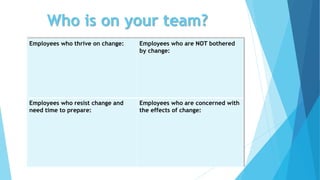
Who is on your team?
Employees who thrive on change: Employees who are NOT bothered
by change:
Employees who resist change and
need time to prepare:
Employees who are concerned with
the effects of change:
Leading Your Team Through
Change
 Host regular team meetings to communicate upcoming changes
 Involve the entire team through the process
 Discuss the positive and negative implications of the change
 Provide a reason to adopt the change to create a shared
understanding with the team
 Allow employees the opportunity to question, challenge and propose
alternatives
Worksheet
 What is the change that your Team/Agency needs to make?
 Is it an Individual, Department/Team, Agency change/goal?
 What type of change are you facing?
 What is the timeline for the change?
 What are the action steps needed to make the change?
Wrap-up: Agency/Team Level
 Understand that change is the new NORMAL.
 Recognize that your team is multigenerational with unique
characteristics.
 Identified your teams behavioral reaction to change.
 Created opportunities through our Action Plan
Level 3 – Organizational Change
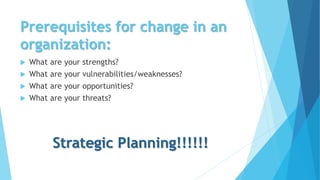
Prerequisites for change in an
organization:
 What are your strengths?
 What are your vulnerabilities/weaknesses?
 What are your opportunities?
 What are your threats?
Strategic Planning!!!!!!
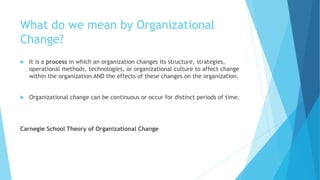
What do we mean by Organizational
Change?
 It is a process in which an organization changes its structure, strategies,
operational methods, technologies, or organizational culture to affect change
within the organization AND the effects of these changes on the organization.
 Organizational change can be continuous or occur for distinct periods of time.
Carnegie School Theory of Organizational Change
Carnegie School
Management Model
 Focused on studying sources of stabilization and change in
an organization
 Three important theories of organizational change:
1. Failure induced change – change that creates a sense of urgency, it
is fear based, and results in immediate action to stabilize your
organization
2. Routinization of organizational activity – change that causes you to
re-evaluate your routines and standard procedures to facilitate and
adapt to change
3. Model of organizational learning – change that is effective when
learning/knowledge influences the change
Questions: Organizational Level
 Are there changes needed?
 Are they major changes?
 Are they minor changes?
 What type of change is occurring in your agency (structure,
strategy, operation, technology, cultural)?
 What is preventing you organization from addressing the
changes that are needed?
Managing Organizational Change
Kotter’s 8 Step Process for Leading Change
Step 1:
Establishing a sense of urgency
 Leaders that know what they are doing will aim for the
heart and connect to the deepest values of their
employees and inspire them to greatness
 Helping others see the need for change so they will be
convinced of the importance of acting immediately;
 Inspires a gut level determination to move and win NOW
Step 2:
Creating the guiding coalition
 Assemble a group with enough power to lead the change effort
 Encourage the group to work as a team;
 Develop the right vision,
 Communicating to the vast number of people,
 Eliminating all of the key obstacles
 Generating short term wins
 Leading and managing dozens of change projects
 Anchoring new approaches deep in an organizations culture
Step 3:
Developing a change vision
 Clarify how the future will be different from the past:
 Imagine - a clear picture of what the future looks like
 Desirable – appeal to the long term interest of those that have a stake in
the enterprise
 Feasible – contain realistic and attainable goals
 Focused – clear enough to provide guidance in decision making
 Flexible – allow individual initiative and alternative responses
 Communicable – easy to communicate and are explained quickly
 Create a clear vision that:
 Simplifies hundreds and thousands of more detailed decisions
 Motivates people to take action in the right direction
 Coordinates the action of different people in a fast and efficient way
Step 4:
Communicating the vision buy in
 Ensuring that as many people as possible understand and
accept the vision
 Simple – no tech, no babble or jargon
 Vivid – a verbal picture is worth a thousand words, use
metaphor, analogy and examples
 Repeatable – Ideas should be able to be spread by
anyone to anyone
 Invitational – two way communication is always more
powerful than one way communication
Step 5:
Empowering broad-based action
 Removing as many barriers as possible and unleashing
people to do their best work
 Structural barriers – these are the most difficult
barriers because of the internal structure of the
organization. Realigning incentives and performance
appraisals
 Troublesome Supervisors – Interrelated habits that
inhibit change, they are not actively undermining the
effort but they simply are not “wired” to go with the
changes required
Step 6:
Generating short term wins
 Creating visible unambiguous success as soon as possible –
Within addressing the long term change you have to
celebrate the short term wins
 The wins must be clearly related to the change effort and
provides evidence that the sacrifices that people are
making are paying off
 Increases optimism for those who are making the effort to
change
 Boosts moral and overall motivation
 The small wins help to fine tune the vision and strategy by
keeping you on course
Step 7:
Never Let Up!
 Consolidating gains and producing more change
 Even if you are successful in the early stages you must
continue to drive your team forward and drive the nay-
sayers underground
Step 8:
Incorporating Change into the culture
 Make it stick
 Anchoring new approaches in the culture to sustain change
 New practices must grow deep roots to remain firmly planted in the
culture
 Culture is composed of norms of behaviors and shared values
 Culture change comes last not first
 You must be able to prove that the new way IS superior to the old way
 The success must be visible and well communicated
 You will loose some people in the process
 You MUST reinforce new norms in values with incentives and rewards
including promotions
 Reinforce the culture with every new employee
Worksheet
 What is the change that your organization needs to make?
 Is it a structural, strategic, operational, technology or cultural
change?
 What type of change are you facing (urgent, structure or
procedural, organizational learning)?
 What is the timeline for the change?
 What are the action steps needed to make the change?
Wrap-up: Organizational Level
 Recognized that organizational change is a process
 Identified the theory(s)/types of organizational change
 Reviewed a process for managing change on an
organizational level
 Created opportunities to address change through our
Action Plan
Wrap Up Questions

Finding the Courage to Change tracy crawford

  • 1.
    IPRA Webinar: Finding theCourage to Change Tracey Crawford, CTRS, CPRP Executive Director, NWSRA tcrawford@nwsra.org
  • 2.
    Would you rather… Would you rather be really hairy or completely bald?  Be 4’5 or 7’7?  Loose your eye site or loose your hearing?  Take a guaranteed $100,00 or a fifty/fifty chance at $1,000,000.00?  Never touch another human again or never touch a computer powered device again?  Would you rather be homeless or move in with your parents or kids?  Would you rather not be able to use your hands or not be able to walk?  Never brush your teeth again or never brush your hair again?
  • 4.
    Expectations We will identifythe three levels of change:  You as an individual  Your agency  Your organization We will identify the obstacles and the opportunities associated with each level of change We will help you identify your level of change and help you create an action plan to address those changes
  • 5.
    Level 1 –Personal Change
  • 6.
    The Conserver  Theyaccept structure  Prefer retaining existing systems and paradigms  May appear cautious and inflexible  Does not like the hard detailed questions
  • 7.
    The Pragmatist  Theyexplore structure  Operate as mediators and catalysts  Prefer change that best serves the function  May appear reasonable, practical and flexible  However, they will not commit
  • 8.
    The Originator  Theychallenge the existing structure  Enjoy risky and uncertainty  Prefer quicker, more expansive and radical change  May appear disorganized and undisciplined  They are original thinkers
  • 9.
    Why we tendto Avoid Change? “Thirteen Things Mentally Strong People Don’t Do” by Amy Morin
  • 10.
     Bad Habit– you tend to justify a bad habit by convincing yourself that what you are doing really isn’t “that Bad”  Anxiety- you experience a lot of nervousness about changes to your routine  Worry – even when you are in a bad situation you worry that making a change might make things worse  Commitment – when ever you attempt to make a change you struggle to stick with it  Procrastination – you think a lot about making changes but put off doing anything different until later
  • 11.
     Resistance –your boss family or friends make changes that effect you and it is difficult for you to adapt  Fear – the thought of stepping outside of your comfort zone just seems too scary  Unmotivated – you lack the motivation to create positive change because it is too difficult  Excuses – I can’t change because…  Overwhelmed – you hesitate to do anything new because it just seems too big of a commitment.
  • 13.
    Types of Change “ThirteenThings Mentally Strong People Don’t Do” by Amy Morin
  • 14.
    Types of Change All or nothing – irrevocable, jump in with both feet  Habit change – must be done consistently  Try something new – voluntary  Behavioral change – requires a commitment  Emotional change – intangible change (why questions)  Cognitive change – getting yourself in the right mind set
  • 15.
    Worksheet  What isthe change that you need to make?  Is it a Personal, Health or Career change/goal?  What type of changes are you facing?  What is the timeline for the changes?  What are the action steps needed to make the changes?
  • 16.
    Level 2 –Agency Change
  • 18.
    Remember…  Change isthe new NORMAL?!@#*  Sometimes there is a lack of understanding  To Identify the potential issues and concerns that might become barriers to change  To create a sense of urgency to help build momentum  To create a plan of action to formalize the changes  To empower your team throughout the process so that they have a measure of control  Employees deal with change differently  Change and how it is handled can strengthen, weaken or stabilize a team  How you react directly impacts the dynamics and efficiencies of your team
  • 19.
  • 20.
    Employees who thriveon change: • Results oriented people • They embrace quick changes and decisions • They like new products and procedures • They initiate change within a team • The challenge the status quo
  • 21.
    Employees who areNOT bothered by change: • They are optimist • They are enthusiastic • They have creative solutions • They keep everyone motivated during flux situations
  • 22.
    Employees who resistchange and need time to prepare: • These are steady decision makers • They do NOT like to be rushed • They do not show their emotions regarding the change • They take a long time to accept a change, they are impacted much later by the change
  • 23.
    Employees who areconcerned with the effects of change: • They are cautious and careful • They are objective thinkers • They want to maintain high standards regardless of the changes • They are fine with letting changes happen around them as long as they can stay on their own course
  • 24.
  • 25.
    Who is onyour team? Employees who thrive on change: Employees who are NOT bothered by change: Employees who resist change and need time to prepare: Employees who are concerned with the effects of change:
  • 26.
    Leading Your TeamThrough Change  Host regular team meetings to communicate upcoming changes  Involve the entire team through the process  Discuss the positive and negative implications of the change  Provide a reason to adopt the change to create a shared understanding with the team  Allow employees the opportunity to question, challenge and propose alternatives
  • 27.
    Worksheet  What isthe change that your Team/Agency needs to make?  Is it an Individual, Department/Team, Agency change/goal?  What type of change are you facing?  What is the timeline for the change?  What are the action steps needed to make the change?
  • 28.
    Wrap-up: Agency/Team Level Understand that change is the new NORMAL.  Recognize that your team is multigenerational with unique characteristics.  Identified your teams behavioral reaction to change.  Created opportunities through our Action Plan
  • 29.
    Level 3 –Organizational Change
  • 30.
    Prerequisites for changein an organization:  What are your strengths?  What are your vulnerabilities/weaknesses?  What are your opportunities?  What are your threats? Strategic Planning!!!!!!
  • 32.
    What do wemean by Organizational Change?  It is a process in which an organization changes its structure, strategies, operational methods, technologies, or organizational culture to affect change within the organization AND the effects of these changes on the organization.  Organizational change can be continuous or occur for distinct periods of time. Carnegie School Theory of Organizational Change
  • 33.
    Carnegie School Management Model Focused on studying sources of stabilization and change in an organization  Three important theories of organizational change: 1. Failure induced change – change that creates a sense of urgency, it is fear based, and results in immediate action to stabilize your organization 2. Routinization of organizational activity – change that causes you to re-evaluate your routines and standard procedures to facilitate and adapt to change 3. Model of organizational learning – change that is effective when learning/knowledge influences the change
  • 34.
    Questions: Organizational Level Are there changes needed?  Are they major changes?  Are they minor changes?  What type of change is occurring in your agency (structure, strategy, operation, technology, cultural)?  What is preventing you organization from addressing the changes that are needed?
  • 35.
    Managing Organizational Change Kotter’s8 Step Process for Leading Change
  • 36.
    Step 1: Establishing asense of urgency  Leaders that know what they are doing will aim for the heart and connect to the deepest values of their employees and inspire them to greatness  Helping others see the need for change so they will be convinced of the importance of acting immediately;  Inspires a gut level determination to move and win NOW
  • 37.
    Step 2: Creating theguiding coalition  Assemble a group with enough power to lead the change effort  Encourage the group to work as a team;  Develop the right vision,  Communicating to the vast number of people,  Eliminating all of the key obstacles  Generating short term wins  Leading and managing dozens of change projects  Anchoring new approaches deep in an organizations culture
  • 38.
    Step 3: Developing achange vision  Clarify how the future will be different from the past:  Imagine - a clear picture of what the future looks like  Desirable – appeal to the long term interest of those that have a stake in the enterprise  Feasible – contain realistic and attainable goals  Focused – clear enough to provide guidance in decision making  Flexible – allow individual initiative and alternative responses  Communicable – easy to communicate and are explained quickly  Create a clear vision that:  Simplifies hundreds and thousands of more detailed decisions  Motivates people to take action in the right direction  Coordinates the action of different people in a fast and efficient way
  • 39.
    Step 4: Communicating thevision buy in  Ensuring that as many people as possible understand and accept the vision  Simple – no tech, no babble or jargon  Vivid – a verbal picture is worth a thousand words, use metaphor, analogy and examples  Repeatable – Ideas should be able to be spread by anyone to anyone  Invitational – two way communication is always more powerful than one way communication
  • 40.
    Step 5: Empowering broad-basedaction  Removing as many barriers as possible and unleashing people to do their best work  Structural barriers – these are the most difficult barriers because of the internal structure of the organization. Realigning incentives and performance appraisals  Troublesome Supervisors – Interrelated habits that inhibit change, they are not actively undermining the effort but they simply are not “wired” to go with the changes required
  • 41.
    Step 6: Generating shortterm wins  Creating visible unambiguous success as soon as possible – Within addressing the long term change you have to celebrate the short term wins  The wins must be clearly related to the change effort and provides evidence that the sacrifices that people are making are paying off  Increases optimism for those who are making the effort to change  Boosts moral and overall motivation  The small wins help to fine tune the vision and strategy by keeping you on course
  • 43.
    Step 7: Never LetUp!  Consolidating gains and producing more change  Even if you are successful in the early stages you must continue to drive your team forward and drive the nay- sayers underground
  • 44.
    Step 8: Incorporating Changeinto the culture  Make it stick  Anchoring new approaches in the culture to sustain change  New practices must grow deep roots to remain firmly planted in the culture  Culture is composed of norms of behaviors and shared values  Culture change comes last not first  You must be able to prove that the new way IS superior to the old way  The success must be visible and well communicated  You will loose some people in the process  You MUST reinforce new norms in values with incentives and rewards including promotions  Reinforce the culture with every new employee
  • 45.
    Worksheet  What isthe change that your organization needs to make?  Is it a structural, strategic, operational, technology or cultural change?  What type of change are you facing (urgent, structure or procedural, organizational learning)?  What is the timeline for the change?  What are the action steps needed to make the change?
  • 46.
    Wrap-up: Organizational Level Recognized that organizational change is a process  Identified the theory(s)/types of organizational change  Reviewed a process for managing change on an organizational level  Created opportunities to address change through our Action Plan
  • 47.

Editor's Notes