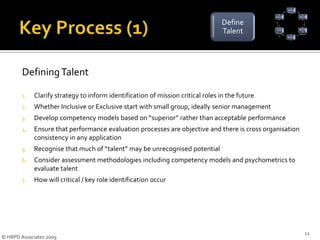
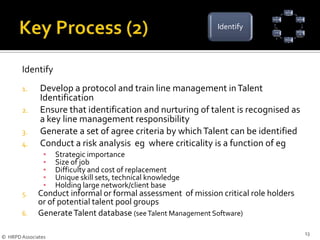
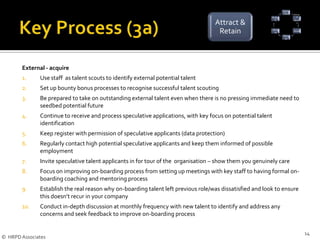
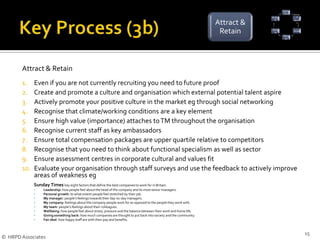
Recognising and releasing valueTalent ManagementDr Douglas Young1© HRPD Associates 2009
DefinitionsTalent consists of those individuals who can make a difference to organisational performance, either through their immediate contribution or in the longer-term by demonstrating the highest levels of potential. Talent management is the systematic attraction, identification, development, engagement/ retention and deployment of those individuals who are of particular value to an organisation, either in view of their ‘high potential’ for the future or because they are fulfilling business/operation-critical roles								CIPD working definitions2© HRPD Associates 2009
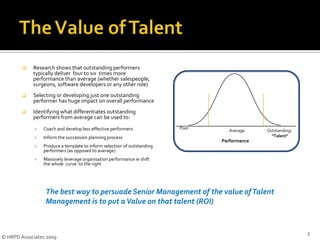
The Value of TalentResearch shows that outstanding performers typically deliver  four to six  times more performance than average (whether salespeople, surgeons, software developers or any other role)
Selecting or developing just one outstanding performer has huge impact on overall performance
Identifying what differentiates outstanding performers from average can be used to:
Coach and develop less effective performers
Inform the succession planning process
Produce a template to inform selection of outstanding performers (as opposed to average)
Massively leverage organisation performance ie shift the whole  curve  to the rightPoorAverageOutstanding/“Talent”PerformanceThe best way to persuade Senior Management of the value of Talent Management is to put a Value on that talent (ROI)3© HRPD Associates 2009
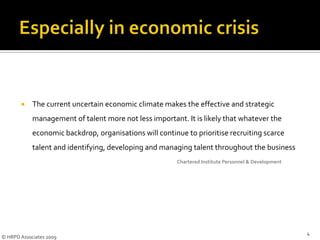
Especially in economic crisisThe current uncertain economic climate makes the effective and strategic management of talent more not less important. It is likely that whatever the economic backdrop, organisations will continue to prioritise recruiting scarce talent and identifying, developing and managing talent throughout the businessChartered Institute Personnel & Development4© HRPD Associates 2009
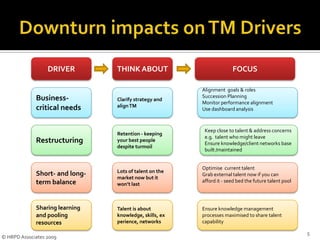
Downturn impacts on TM DriversDRIVERTHINK ABOUTFOCUSBusiness-critical needsClarify strategy and align TMAlignment  goals & rolesSuccession PlanningMonitor performance alignmentUse dashboard analysisRestructuringRetention - keeping your best people despite turmoilKeep close to talent & address concerns e.g.  talent who might leaveEnsure knowledge/client networks base built /maintainedShort- and long-term balanceLots of talent on the market now but it won’t lastOptimise  current talentGrab external talent now if you can afford it - seed bed the future talent poolSharing learning and pooling resourcesTalent is about knowledge, skills, experience, networksEnsure knowledge management  processes maximised to share talent capability5© HRPD Associates 2009
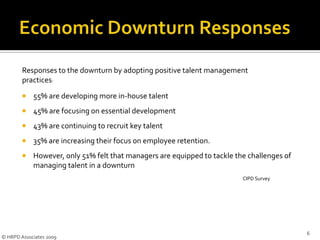
Economic Downturn ResponsesResponses to the downturn by adopting positive talent managementpractices: 55% are developing more in-house talent 45% are focusing on essential development 43% are continuing to recruit key talent 35% are increasing their focus on employee retention.However, only 51% felt that managers are equipped to tackle the challenges of managing talent in a downturn								 CIPD Survey 6© HRPD Associates 2009
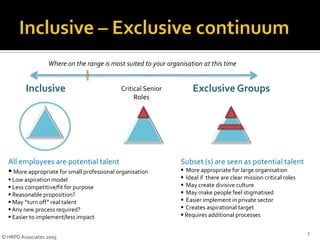
Inclusive – Exclusive continuumWhere on the range is most suited to your organisation at this timeExclusive GroupsInclusiveCritical SeniorRolesAll employees are potential talentMore appropriate for small professional organisation
 Low aspiration model
 Less competitive/fit for purpose
 Reasonable proposition?
 May “turn off” real talent
 Any new process required?
 Easier to implement/less impactSubset (s) are seen as potential talent  More appropriate for large organisation
  Ideal if  there are clear mission critical roles
  May create divisive culture
  May make people feel stigmatised

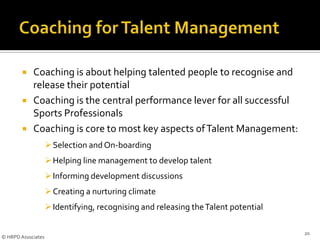
Talent Management

  • 1.
    Recognising and releasingvalueTalent ManagementDr Douglas Young1© HRPD Associates 2009
  • 2.
    DefinitionsTalent consists ofthose individuals who can make a difference to organisational performance, either through their immediate contribution or in the longer-term by demonstrating the highest levels of potential. Talent management is the systematic attraction, identification, development, engagement/ retention and deployment of those individuals who are of particular value to an organisation, either in view of their ‘high potential’ for the future or because they are fulfilling business/operation-critical roles CIPD working definitions2© HRPD Associates 2009
  • 3.
    The Value ofTalentResearch shows that outstanding performers typically deliver four to six times more performance than average (whether salespeople, surgeons, software developers or any other role)
  • 4.
    Selecting or developingjust one outstanding performer has huge impact on overall performance
  • 5.
    Identifying what differentiatesoutstanding performers from average can be used to:
  • 6.
    Coach and developless effective performers
  • 7.
    Inform the successionplanning process
  • 8.
    Produce a templateto inform selection of outstanding performers (as opposed to average)
  • 9.
    Massively leverage organisationperformance ie shift the whole curve to the rightPoorAverageOutstanding/“Talent”PerformanceThe best way to persuade Senior Management of the value of Talent Management is to put a Value on that talent (ROI)3© HRPD Associates 2009
  • 10.
    Especially in economiccrisisThe current uncertain economic climate makes the effective and strategic management of talent more not less important. It is likely that whatever the economic backdrop, organisations will continue to prioritise recruiting scarce talent and identifying, developing and managing talent throughout the businessChartered Institute Personnel & Development4© HRPD Associates 2009
  • 11.
    Downturn impacts onTM DriversDRIVERTHINK ABOUTFOCUSBusiness-critical needsClarify strategy and align TMAlignment goals & rolesSuccession PlanningMonitor performance alignmentUse dashboard analysisRestructuringRetention - keeping your best people despite turmoilKeep close to talent & address concerns e.g. talent who might leaveEnsure knowledge/client networks base built /maintainedShort- and long-term balanceLots of talent on the market now but it won’t lastOptimise current talentGrab external talent now if you can afford it - seed bed the future talent poolSharing learning and pooling resourcesTalent is about knowledge, skills, experience, networksEnsure knowledge management processes maximised to share talent capability5© HRPD Associates 2009
  • 12.
    Economic Downturn ResponsesResponsesto the downturn by adopting positive talent managementpractices: 55% are developing more in-house talent 45% are focusing on essential development 43% are continuing to recruit key talent 35% are increasing their focus on employee retention.However, only 51% felt that managers are equipped to tackle the challenges of managing talent in a downturn CIPD Survey 6© HRPD Associates 2009
  • 13.
    Inclusive – ExclusivecontinuumWhere on the range is most suited to your organisation at this timeExclusive GroupsInclusiveCritical SeniorRolesAll employees are potential talentMore appropriate for small professional organisation
  • 14.
  • 15.
  • 16.
  • 17.
    May “turnoff” real talent
  • 18.
    Any newprocess required?
  • 19.
    Easier toimplement/less impactSubset (s) are seen as potential talent More appropriate for large organisation
  • 20.
    Idealif there are clear mission critical roles
  • 21.
    Maycreate divisive culture
  • 22.
    Maymake people feel stigmatised