Types of Combustion
Chamber for C.I Engine
Prepared by Kaushal Patel
Primary Considerations in the Design of
Combustion Chambers for C.I Engines
1. High thermal efficiency.
2. Ability to use less expensive fuel (multi-fuel).
3. Ease of starting.
4. Ability to handle variations in speed.
5. Smoothness of operation i.e. avoidance of diesel knock and noise.
6. Low exhaust emission.
7. Nozzle design.
8. High volumetric efficiency.
9. High brake Mean effective pressure.
Role of Air Swirl in Diesel Engine
• Most important function of CI engine combustion chamber is to
provide proper mixing of fuel and air in short possible time. For this
purpose an organized air movement called air swirl is to be produced
to produce high relative velocity between the fuel droplets and air.
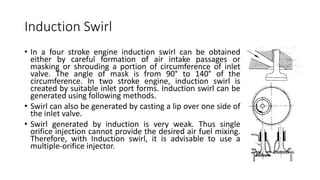
Induction Swirl
• In a four stroke engine induction swirl can be obtained
either by careful formation of air intake passages or
masking or shrouding a portion of circumference of inlet
valve. The angle of mask is from 90° to 140° of the
circumference. In two stroke engine, induction swirl is
created by suitable inlet port forms. Induction swirl can be
generated using following methods.
• Swirl can also be generated by casting a lip over one side of
the inlet valve.
• Swirl generated by induction is very weak. Thus single
orifice injection cannot provide the desired air fuel mixing.
Therefore, with Induction swirl, it is advisable to use a
multiple-orifice injector.
Advantages of Induction Swirl
• Easier starting (due to low intensity of swirl).
• High excess air (low temperature), low turbulence (less heat loss),
therefore indicated thermal efficiency is high.
• Production of swirl requires no additional work.
• Used with low speeds, therefore low quality of fuel can be used.
Disadvantages of Induction Swirl
• Shrouded valves, smaller valves, low volumetric efficiency.
• Weak swirl, low air utilisation (60%), lower M.E.P. and large size
(costly) engine.
• Weak swirl, multi-orifice nozzle, high induction pressure; clogging of
holes, high maintenance.
• Swirl not proportional to speed; efficiency not maintained at variable
speed engine.
• Influence minimum quantity of fuel. Complication at high loads and
idling.
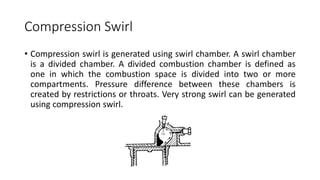
Compression Swirl
• Compression swirl is generated using swirl chamber. A swirl chamber
is a divided chamber. A divided combustion chamber is defined as
one in which the combustion space is divided into two or more
compartments. Pressure difference between these chambers is
created by restrictions or throats. Very strong swirl can be generated
using compression swirl.
Advantage of Compression Swirl
• Large valves, high volumetric efficiency.

• Single injector, pintle type (self cleaning), less maintenance.
• Smooth engine operation.
• Greater air utilization due to strong swirl. Smaller (cheaper) engine.
• Swirl proportional to speed, suitable for variable speed operation.
Disadvantage of Compression Swirl
• Cold starting trouble due to high loss du to strong swirl, mechanical
efficiency.
• Less excess air ; lower indicated efficiency; 5 to 8% more fuel
consumption; decreased exhaust valve life
• Cylinder more expensive in construction.
• Work absorbed in producing swirl, mechanical efficiency lower.
Combustion Induction Swirl
• This is created due to partial combustion, therefore known as
combustion induced swirl. This method is used only in pre-
combustion chamber. In this method, upward movement of piston
during compression forces the air tangentially and fuel is injected in
pre-combustion , when the combustion of the accumulated fuel
during delay periods burns rapidly in pre-combustion chamber as A:F
mixture is rich and forces the gases at a very high velocity in the main
combustion chamber. This creates a good swirl and provides better
combustion.
Types of Combustion Chambers
1.Open Injection (DI) Type : This type of combustion chamber is also called
an Open combustion chamber. In this type the entire volume of combustion
chamber is located in the main cylinder and the fuel is injected into this
volume.
2.Indirect Injection (IDI) Type: in this type of combustion chambers, the
combustion space is divided into two parts, one part in the main cylinder
and the other part in the cylinder head. The fuel –injection is effected usually
into the part of chamber located in the cylinder head. These chambers are
classified further into :
a) Swirl chamber in which compression swirl is generated.
b) Pre combustion chamber in which combustion swirl is induced.
c) Air cell in which both compression and combustion swirl are
induced.
Direct Injection Chambers – Open
Combustion Chambers
• An open combustion chamber is defined as one in which the combustion
space is essentially a single cavity with little restriction from one part of the
chamber to the other and hence with no large difference in pressure
between parts of the chamber during the combustion process. There are
many designs of open chamber some of which are shown below :
• In four-stroke engines with open combustion chambers, induction swirl is obtained.
• Either by careful formation of the air intake passages or by masking a portion of the
circumference of the inlet valve whereas in two-stroke engines it is created by
suitable form for the inlet ports.
• The injection nozzles used for this chamber are generally of multi hole type working
at a relatively high pressure ( about 200 bar).
Main Advantages of DI Type Of Chambers
• Minimum heat loss during compression because of lower surface area
to volume ratio and hence, better efficiency.
• No cold starting problems.
• Fine atomization because of multi hole nozzle.
Drawbacks of DI Combustion Chambers
• High fuel-injection pressure required and hence complex design of
fuel injection pump.
• Necessity of accurate metering of fuel by the injection system,
particularly for small engines.
Various Types of DI Combustion Chamber
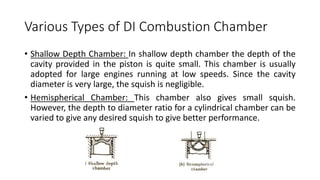
• Shallow Depth Chamber: In shallow depth chamber the depth of the
cavity provided in the piston is quite small. This chamber is usually
adopted for large engines running at low speeds. Since the cavity
diameter is very large, the squish is negligible.
• Hemispherical Chamber: This chamber also gives small squish.
However, the depth to diameter ratio for a cylindrical chamber can be
varied to give any desired squish to give better performance.
Various Types of DI Combustion Chamber
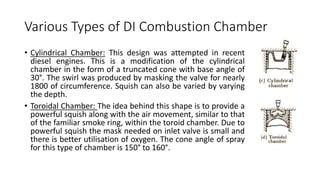
• Cylindrical Chamber: This design was attempted in recent
diesel engines. This is a modification of the cylindrical
chamber in the form of a truncated cone with base angle of
30°. The swirl was produced by masking the valve for nearly
1800 of circumference. Squish can also be varied by varying
the depth.
• Toroidal Chamber: The idea behind this shape is to provide a
powerful squish along with the air movement, similar to that
of the familiar smoke ring, within the toroid chamber. Due to
powerful squish the mask needed on inlet valve is small and
there is better utilisation of oxygen. The cone angle of spray
for this type of chamber is 150° to 160°.
In Direct Injection Chambers
• A divided combustion chamber is defined as one in which the
combustion space is divided into two or more distinct compartments
connected by restricted passages. This creates considerable pressure
differences between them during the combustion process.
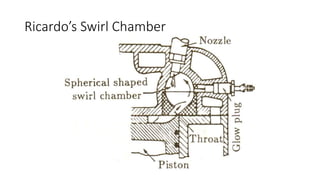
Ricardo’s Swirl Chamber
• Swirl chamber consists of a spherical shaped chamber separated from the
engine cylinder and located in the cylinder head. Into this chamber, about
50% of the air is transferred during the compression stroke.
• A throat connects the chamber to the cylinder which enters the chamber in
a tangential direction so that the air coming into this chamber is given a
strong rotary movement inside the swirl chamber and after combustion,
the products rush back into the cylinder through same throat at much
higher velocity. This causes considerable heat loss to walls of the passage
which can be reduced by employing a heat insulated passage.
• This type of combustion chamber finds its application where fuel quality is
difficult to control, where reliability under adverse conditions is more
important than fuel economy. The use of single hole of larger diameter for
the fuel spray nozzle is often important consideration for the choice of
swirl chamber engine.
Ricardo’s Swirl Chamber
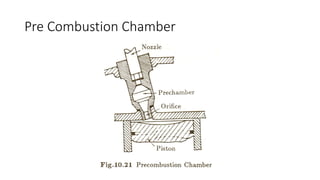
Pre Combustion Chamber
• Typical pre-combustion chamber consists of an anti chamber connected to the main
chamber through a number of small holes (compared to a relatively large passage in the
swirl chamber). The pre-combustion chamber is located in the cylinder head and its
volume accounts for about 40% of the total combustion, space. During the compression
stroke the piston forces the air into the pre-combustion chamber.
• The fuel is injected into the pre-chamber and the combustion is initiated. The resulting
pressure rise forces the flaming droplets together with some air and their combustion
products to rush out into the main cylinder at high velocity through the small holes. Thus
it creates both strong secondary turbulence and distributes the flaming fuel droplets
throughout the air in the main combustion chamber where bulk of combustion takes
place. About 80% of energy is released in main combustion chamber.
• The rate of pressure rise and the maximum pressure is lower compared to those in open
type chamber. The initial shock if combustion is limited to pre-combustion chamber only.
The pre-combustion chamber has multi fuel capability without any modification in the
injection system because the temperature of pre-chamber. The variation in the optimum
injection timing for petrol and diesel operations is only 2 deg. for this chamber compared
to 8 to 10 deg in other chamber design.
Pre Combustion Chamber
Advantages of Pre-combustion comber
• Due to short or practically no delay period for the fuel entering the
main combustion space, tendency to knock is minimum, and as such
running is smooth.
• The combustion in the third stage is rapid.
• The fuel injection system design need not be critical. Because the
mixing of fuel and air takes place in pre-chamber.
Disadvantages of Pre-combustion comber
• The velocity of burning mixture is too high during the passage from
pre-chambers, so the heat loss is very high. This causes reduction in
the thermal efficiency, which can be offset by increasing the
compression ratio.
• Cold starting will be difficult as the air loses heat to chamber walls
during compression.
M Combustion Chamber
• After twenty years of research in 1954, Dr. Meuner of M.A.N., Germany
developed M process engine which ran without typical diesel combustion
noise and hence it was named ‘whisper engine’.
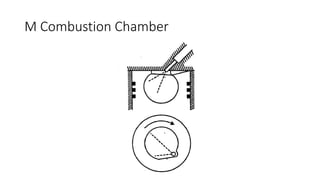
• The ‘M-combustion chamber’ is a special type of open combustion
chamber, having combustion chamber in the piston cavity.
• It differs in principle from other open chamber designs in that the fuel
spray impinges on and spreads over the surface of a spherical cavity in the
piston. Earlier it had usually been assumed that fuel spray impingement
was undesirable, though in most diesel engines some impingement always
takes place at full load. The fuel is injected tangentially from a multi-hole
nozzle on the surface of the chamber in the direction of the air swirl.
M Combustion Chamber
• Injected fuel forms a film, about 0.15 mm thick, on the surface of the
chamber. The combustion is initiated by the auto-ignition of a small
portion of fuel which is air-borne at the very beginning. The amount
of this airborne fuel is controlled by selecting a proper distance
between the nozzle tip and the combustion chamber wall.
• Subsequently the fuel vapours rise from the hot wall and are mixed
with the swirling air in successive layers and combustion takes place
in a near homogeneous air-fuel mixture at the desired rate. The rate
of energy release is thus almost equal to the rate of evaporation of
fuel. Thus, even though the engine works on diesel cycle, once the
ignition takes place, the combustion characteristics are similar to
those of OTTO cycle combustion.
M Combustion Chamber
Advantages of ‘M-chamber
• Low rates of pressure rise, low peak pressure.
• Low smoke level.
• Ability to operate on a wide range of liquid fuels (multi-fuel
capability).
• No combustion noise is reported even for 80-octane petrol.
Disadvantages of M-chamber
• Since fuel vaporization depends upon the surface temperature of the
combustion chamber, cold starting requires certain aids.
• Some white smoke, diesel odour, and high hydrocarbon emission
may occur at starting and idling conditions.
• Volumetric efficiency is low.
Thank you

Combustion Chamber for Compression Ignition Engines

  • 1.
    Types of Combustion Chamberfor C.I Engine Prepared by Kaushal Patel
  • 2.
    Primary Considerations inthe Design of Combustion Chambers for C.I Engines 1. High thermal efficiency. 2. Ability to use less expensive fuel (multi-fuel). 3. Ease of starting. 4. Ability to handle variations in speed. 5. Smoothness of operation i.e. avoidance of diesel knock and noise. 6. Low exhaust emission. 7. Nozzle design. 8. High volumetric efficiency. 9. High brake Mean effective pressure.
  • 3.
    Role of AirSwirl in Diesel Engine • Most important function of CI engine combustion chamber is to provide proper mixing of fuel and air in short possible time. For this purpose an organized air movement called air swirl is to be produced to produce high relative velocity between the fuel droplets and air.
  • 4.
    Induction Swirl • Ina four stroke engine induction swirl can be obtained either by careful formation of air intake passages or masking or shrouding a portion of circumference of inlet valve. The angle of mask is from 90° to 140° of the circumference. In two stroke engine, induction swirl is created by suitable inlet port forms. Induction swirl can be generated using following methods. • Swirl can also be generated by casting a lip over one side of the inlet valve. • Swirl generated by induction is very weak. Thus single orifice injection cannot provide the desired air fuel mixing. Therefore, with Induction swirl, it is advisable to use a multiple-orifice injector.
  • 5.
    Advantages of InductionSwirl • Easier starting (due to low intensity of swirl). • High excess air (low temperature), low turbulence (less heat loss), therefore indicated thermal efficiency is high. • Production of swirl requires no additional work. • Used with low speeds, therefore low quality of fuel can be used.
  • 6.
    Disadvantages of InductionSwirl • Shrouded valves, smaller valves, low volumetric efficiency. • Weak swirl, low air utilisation (60%), lower M.E.P. and large size (costly) engine. • Weak swirl, multi-orifice nozzle, high induction pressure; clogging of holes, high maintenance. • Swirl not proportional to speed; efficiency not maintained at variable speed engine. • Influence minimum quantity of fuel. Complication at high loads and idling.
  • 7.
    Compression Swirl • Compressionswirl is generated using swirl chamber. A swirl chamber is a divided chamber. A divided combustion chamber is defined as one in which the combustion space is divided into two or more compartments. Pressure difference between these chambers is created by restrictions or throats. Very strong swirl can be generated using compression swirl.
  • 8.
    Advantage of CompressionSwirl • Large valves, high volumetric efficiency. • Single injector, pintle type (self cleaning), less maintenance. • Smooth engine operation. • Greater air utilization due to strong swirl. Smaller (cheaper) engine. • Swirl proportional to speed, suitable for variable speed operation.
  • 9.
    Disadvantage of CompressionSwirl • Cold starting trouble due to high loss du to strong swirl, mechanical efficiency. • Less excess air ; lower indicated efficiency; 5 to 8% more fuel consumption; decreased exhaust valve life • Cylinder more expensive in construction. • Work absorbed in producing swirl, mechanical efficiency lower.
  • 10.
    Combustion Induction Swirl •This is created due to partial combustion, therefore known as combustion induced swirl. This method is used only in pre- combustion chamber. In this method, upward movement of piston during compression forces the air tangentially and fuel is injected in pre-combustion , when the combustion of the accumulated fuel during delay periods burns rapidly in pre-combustion chamber as A:F mixture is rich and forces the gases at a very high velocity in the main combustion chamber. This creates a good swirl and provides better combustion.
  • 11.
    Types of CombustionChambers 1.Open Injection (DI) Type : This type of combustion chamber is also called an Open combustion chamber. In this type the entire volume of combustion chamber is located in the main cylinder and the fuel is injected into this volume. 2.Indirect Injection (IDI) Type: in this type of combustion chambers, the combustion space is divided into two parts, one part in the main cylinder and the other part in the cylinder head. The fuel –injection is effected usually into the part of chamber located in the cylinder head. These chambers are classified further into : a) Swirl chamber in which compression swirl is generated. b) Pre combustion chamber in which combustion swirl is induced. c) Air cell in which both compression and combustion swirl are induced.
  • 12.
    Direct Injection Chambers– Open Combustion Chambers • An open combustion chamber is defined as one in which the combustion space is essentially a single cavity with little restriction from one part of the chamber to the other and hence with no large difference in pressure between parts of the chamber during the combustion process. There are many designs of open chamber some of which are shown below : • In four-stroke engines with open combustion chambers, induction swirl is obtained. • Either by careful formation of the air intake passages or by masking a portion of the circumference of the inlet valve whereas in two-stroke engines it is created by suitable form for the inlet ports. • The injection nozzles used for this chamber are generally of multi hole type working at a relatively high pressure ( about 200 bar).
  • 13.
    Main Advantages ofDI Type Of Chambers • Minimum heat loss during compression because of lower surface area to volume ratio and hence, better efficiency. • No cold starting problems. • Fine atomization because of multi hole nozzle.
  • 14.
    Drawbacks of DICombustion Chambers • High fuel-injection pressure required and hence complex design of fuel injection pump. • Necessity of accurate metering of fuel by the injection system, particularly for small engines.
  • 15.
    Various Types ofDI Combustion Chamber • Shallow Depth Chamber: In shallow depth chamber the depth of the cavity provided in the piston is quite small. This chamber is usually adopted for large engines running at low speeds. Since the cavity diameter is very large, the squish is negligible. • Hemispherical Chamber: This chamber also gives small squish. However, the depth to diameter ratio for a cylindrical chamber can be varied to give any desired squish to give better performance.
  • 16.
    Various Types ofDI Combustion Chamber • Cylindrical Chamber: This design was attempted in recent diesel engines. This is a modification of the cylindrical chamber in the form of a truncated cone with base angle of 30°. The swirl was produced by masking the valve for nearly 1800 of circumference. Squish can also be varied by varying the depth. • Toroidal Chamber: The idea behind this shape is to provide a powerful squish along with the air movement, similar to that of the familiar smoke ring, within the toroid chamber. Due to powerful squish the mask needed on inlet valve is small and there is better utilisation of oxygen. The cone angle of spray for this type of chamber is 150° to 160°.
  • 17.
    In Direct InjectionChambers • A divided combustion chamber is defined as one in which the combustion space is divided into two or more distinct compartments connected by restricted passages. This creates considerable pressure differences between them during the combustion process.
  • 18.
    Ricardo’s Swirl Chamber •Swirl chamber consists of a spherical shaped chamber separated from the engine cylinder and located in the cylinder head. Into this chamber, about 50% of the air is transferred during the compression stroke. • A throat connects the chamber to the cylinder which enters the chamber in a tangential direction so that the air coming into this chamber is given a strong rotary movement inside the swirl chamber and after combustion, the products rush back into the cylinder through same throat at much higher velocity. This causes considerable heat loss to walls of the passage which can be reduced by employing a heat insulated passage. • This type of combustion chamber finds its application where fuel quality is difficult to control, where reliability under adverse conditions is more important than fuel economy. The use of single hole of larger diameter for the fuel spray nozzle is often important consideration for the choice of swirl chamber engine.
  • 19.
  • 20.
    Pre Combustion Chamber •Typical pre-combustion chamber consists of an anti chamber connected to the main chamber through a number of small holes (compared to a relatively large passage in the swirl chamber). The pre-combustion chamber is located in the cylinder head and its volume accounts for about 40% of the total combustion, space. During the compression stroke the piston forces the air into the pre-combustion chamber. • The fuel is injected into the pre-chamber and the combustion is initiated. The resulting pressure rise forces the flaming droplets together with some air and their combustion products to rush out into the main cylinder at high velocity through the small holes. Thus it creates both strong secondary turbulence and distributes the flaming fuel droplets throughout the air in the main combustion chamber where bulk of combustion takes place. About 80% of energy is released in main combustion chamber. • The rate of pressure rise and the maximum pressure is lower compared to those in open type chamber. The initial shock if combustion is limited to pre-combustion chamber only. The pre-combustion chamber has multi fuel capability without any modification in the injection system because the temperature of pre-chamber. The variation in the optimum injection timing for petrol and diesel operations is only 2 deg. for this chamber compared to 8 to 10 deg in other chamber design.
  • 21.
  • 22.
    Advantages of Pre-combustioncomber • Due to short or practically no delay period for the fuel entering the main combustion space, tendency to knock is minimum, and as such running is smooth. • The combustion in the third stage is rapid. • The fuel injection system design need not be critical. Because the mixing of fuel and air takes place in pre-chamber.
  • 23.
    Disadvantages of Pre-combustioncomber • The velocity of burning mixture is too high during the passage from pre-chambers, so the heat loss is very high. This causes reduction in the thermal efficiency, which can be offset by increasing the compression ratio. • Cold starting will be difficult as the air loses heat to chamber walls during compression.
  • 24.
    M Combustion Chamber •After twenty years of research in 1954, Dr. Meuner of M.A.N., Germany developed M process engine which ran without typical diesel combustion noise and hence it was named ‘whisper engine’. • The ‘M-combustion chamber’ is a special type of open combustion chamber, having combustion chamber in the piston cavity. • It differs in principle from other open chamber designs in that the fuel spray impinges on and spreads over the surface of a spherical cavity in the piston. Earlier it had usually been assumed that fuel spray impingement was undesirable, though in most diesel engines some impingement always takes place at full load. The fuel is injected tangentially from a multi-hole nozzle on the surface of the chamber in the direction of the air swirl.
  • 25.
    M Combustion Chamber •Injected fuel forms a film, about 0.15 mm thick, on the surface of the chamber. The combustion is initiated by the auto-ignition of a small portion of fuel which is air-borne at the very beginning. The amount of this airborne fuel is controlled by selecting a proper distance between the nozzle tip and the combustion chamber wall. • Subsequently the fuel vapours rise from the hot wall and are mixed with the swirling air in successive layers and combustion takes place in a near homogeneous air-fuel mixture at the desired rate. The rate of energy release is thus almost equal to the rate of evaporation of fuel. Thus, even though the engine works on diesel cycle, once the ignition takes place, the combustion characteristics are similar to those of OTTO cycle combustion.
  • 26.
  • 27.
    Advantages of ‘M-chamber •Low rates of pressure rise, low peak pressure. • Low smoke level. • Ability to operate on a wide range of liquid fuels (multi-fuel capability). • No combustion noise is reported even for 80-octane petrol.
  • 28.
    Disadvantages of M-chamber •Since fuel vaporization depends upon the surface temperature of the combustion chamber, cold starting requires certain aids. • Some white smoke, diesel odour, and high hydrocarbon emission may occur at starting and idling conditions. • Volumetric efficiency is low.
  • 29.