Tool
signature
NAME :- VAIBHAV.V. KADU
REG. NO. :- 2015BPR031
ROLL NO. :-A 27
THIRD YEAR
Objective of ppt
 You will get to know signature of cutting tool.
 Effect of various angle on machining.
 Why there is need to learn signature of cutting tool.
 Different system on which It is base
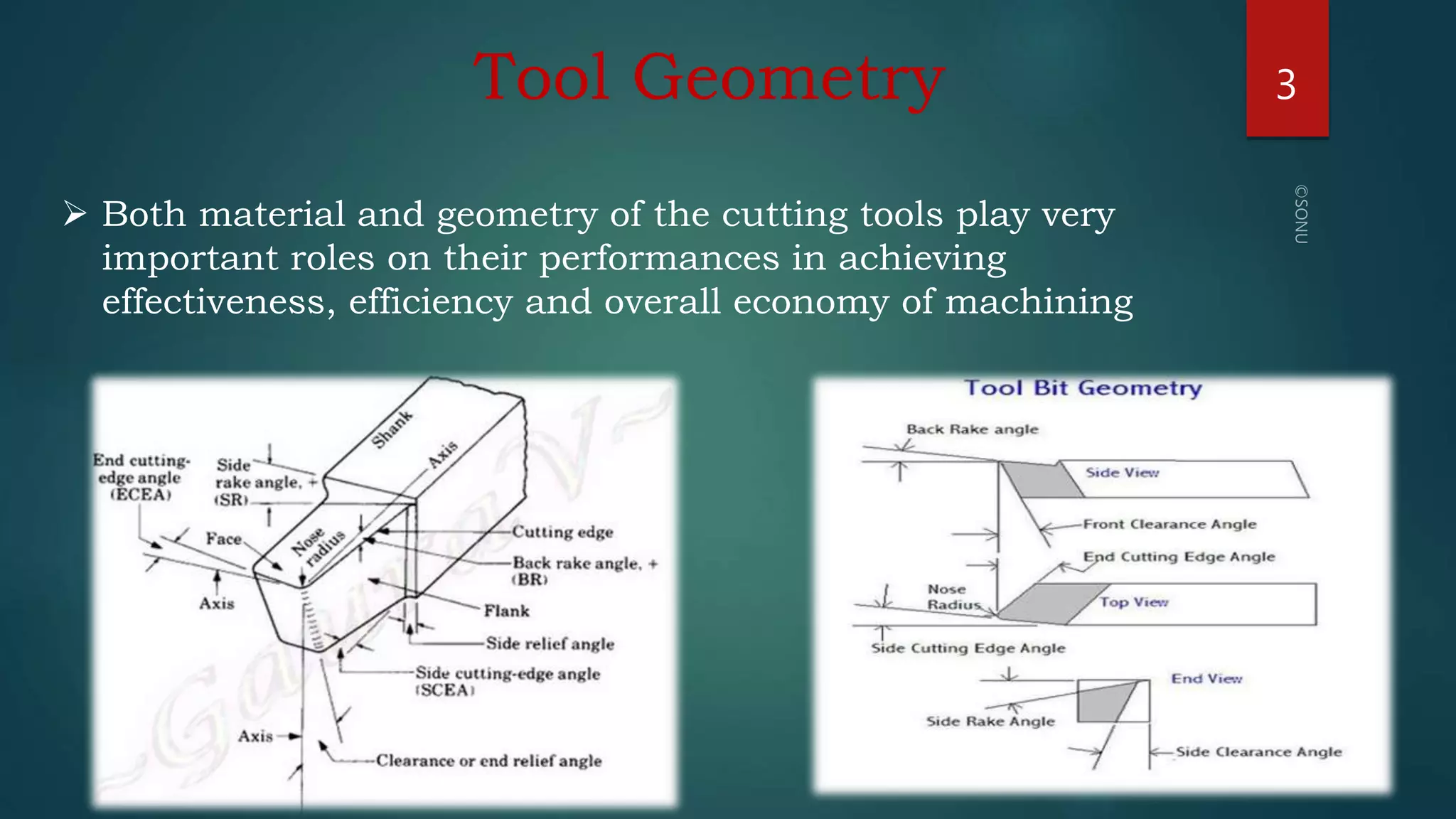
3Tool Geometry
 Both material and geometry of the cutting tools play very
important roles on their performances in achieving
effectiveness, efficiency and overall economy of machining
Why SIGNATURE ???
 The numerical code that describes all the key angles of a given cutting tool . A
tool signature may be used for HSS or carbide inserts
 Convenient way to specify tool angles by use of a standardized abbreviated
system is known as tool signature or tool nomenclature.
 It indicates the angle that a tool utilizes during the cut.
 It specifies the active angles of the tool normal to the cutting edge.
 This will always be true as long as the tool shank is mounted at right angles to
the W/P axis.
5
Tool Designation
1. ASA System (American Standard Association)
2. ORS System (Orthogonal Rake System)
3. NRS System (Normal Rake System)
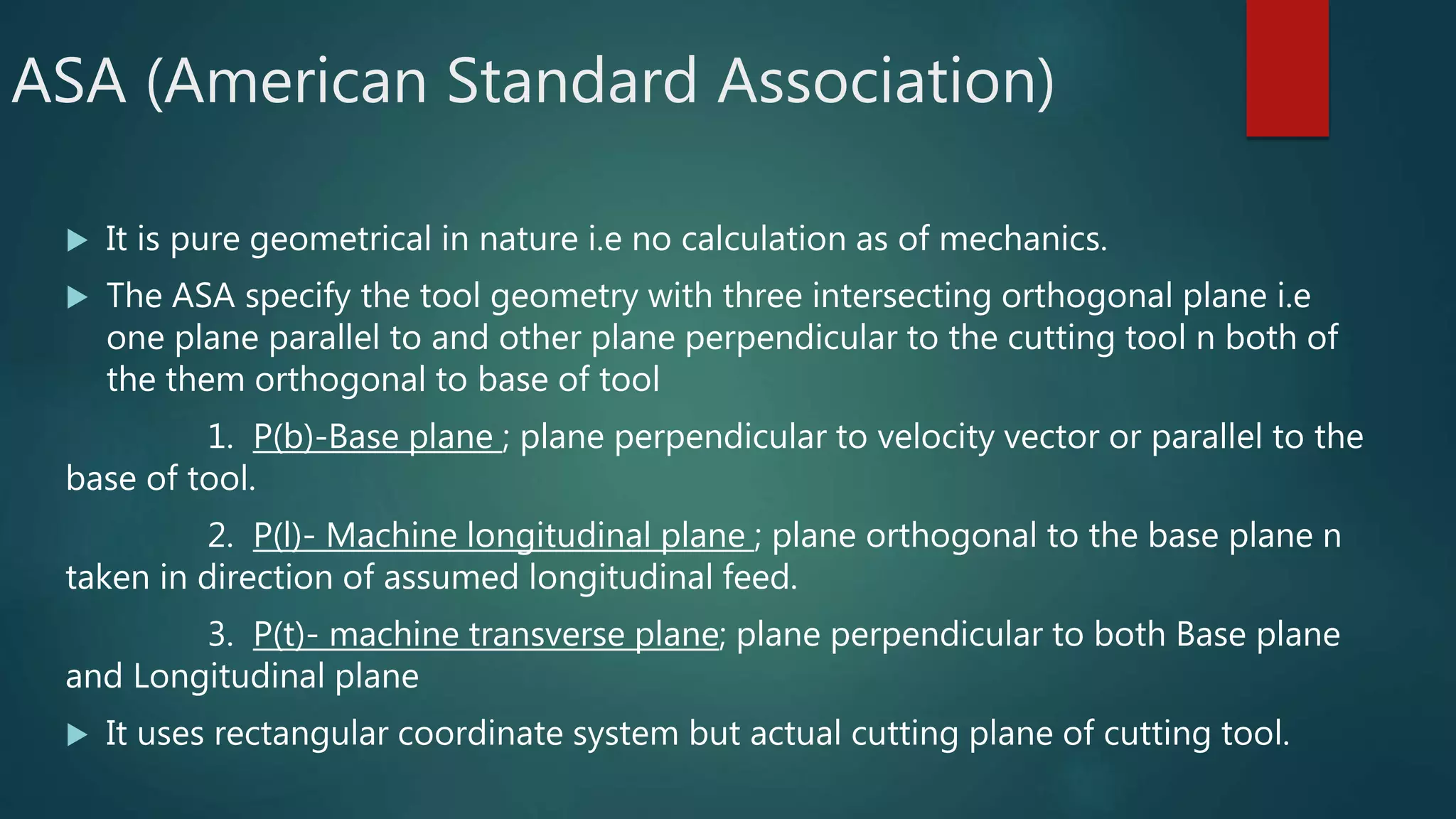
ASA (American Standard Association)
 It is pure geometrical in nature i.e no calculation as of mechanics.
 The ASA specify the tool geometry with three intersecting orthogonal plane i.e
one plane parallel to and other plane perpendicular to the cutting tool n both of
the them orthogonal to base of tool
1. P(b)-Base plane ; plane perpendicular to velocity vector or parallel to the
base of tool.
2. P(l)- Machine longitudinal plane ; plane orthogonal to the base plane n
taken in direction of assumed longitudinal feed.
3. P(t)- machine transverse plane; plane perpendicular to both Base plane
and Longitudinal plane
 It uses rectangular coordinate system but actual cutting plane of cutting tool.
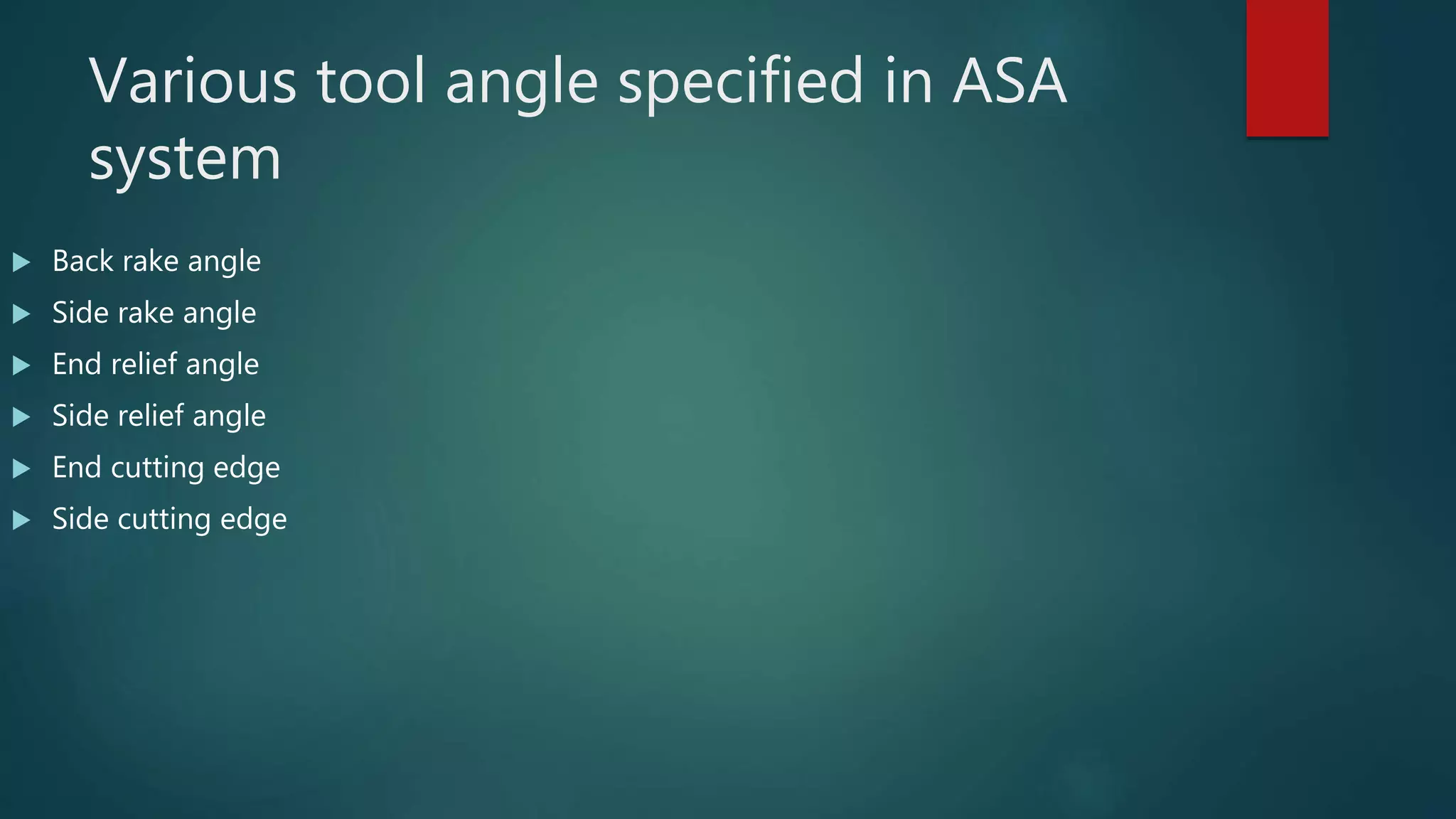
Various tool angle specified in ASA
system
 Back rake angle
 Side rake angle
 End relief angle
 Side relief angle
 End cutting edge
 Side cutting edge
Schematic diagram of ASA system
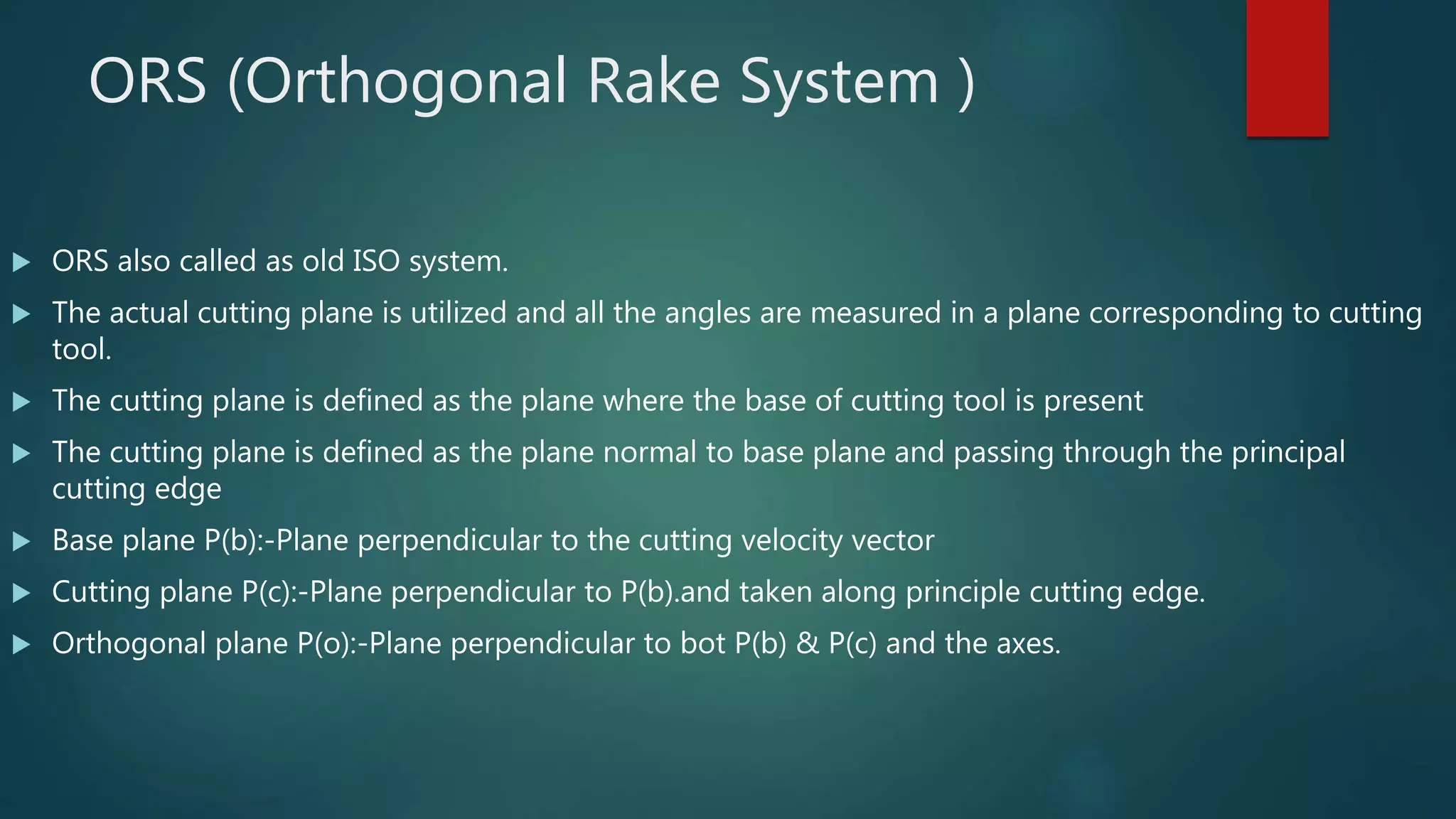
ORS (Orthogonal Rake System )
 ORS also called as old ISO system.
 The actual cutting plane is utilized and all the angles are measured in a plane corresponding to cutting
tool.
 The cutting plane is defined as the plane where the base of cutting tool is present
 The cutting plane is defined as the plane normal to base plane and passing through the principal
cutting edge
 Base plane P(b):-Plane perpendicular to the cutting velocity vector
 Cutting plane P(c):-Plane perpendicular to P(b).and taken along principle cutting edge.
 Orthogonal plane P(o):-Plane perpendicular to bot P(b) & P(c) and the axes.
Various tool angle specifies in ORS
system
 Inclination angle (i)
 Orthogonal rake angle ()
 Orthogonal clearance of principal flank angle
 Auxiliary orthogonal clearance angle
 Principal cutting edge angle
 Auxiliary cutting angle
 Nose radius
Schematic diagram of ORS system
ISO System or NORMAL RAKE system
(NRS)
 The major problem with ORS system are these:
1.The true geometry of the cutting tool is not revealed when the cutting edges are inclined
from the base plane. 2.Also,
tool grinding in ORS required additional calculation for setting of angles in the cutter
grinder .
 To overcome this problem NRS was introduced
 In this system the rake angle is visualized in the normal plane in plce of orthogonal plane in ORS
 In this system the base and cutting plane are same as ORS , but the third plane is perpendicular to
cutting edge of tool it is called the normal plane .
 In this system, the side rake angle is defined as the angle between the base plane of tool and the rake
face of the tool measured in a plane normal to side cutting edge.
Schematic diagram of NRS system
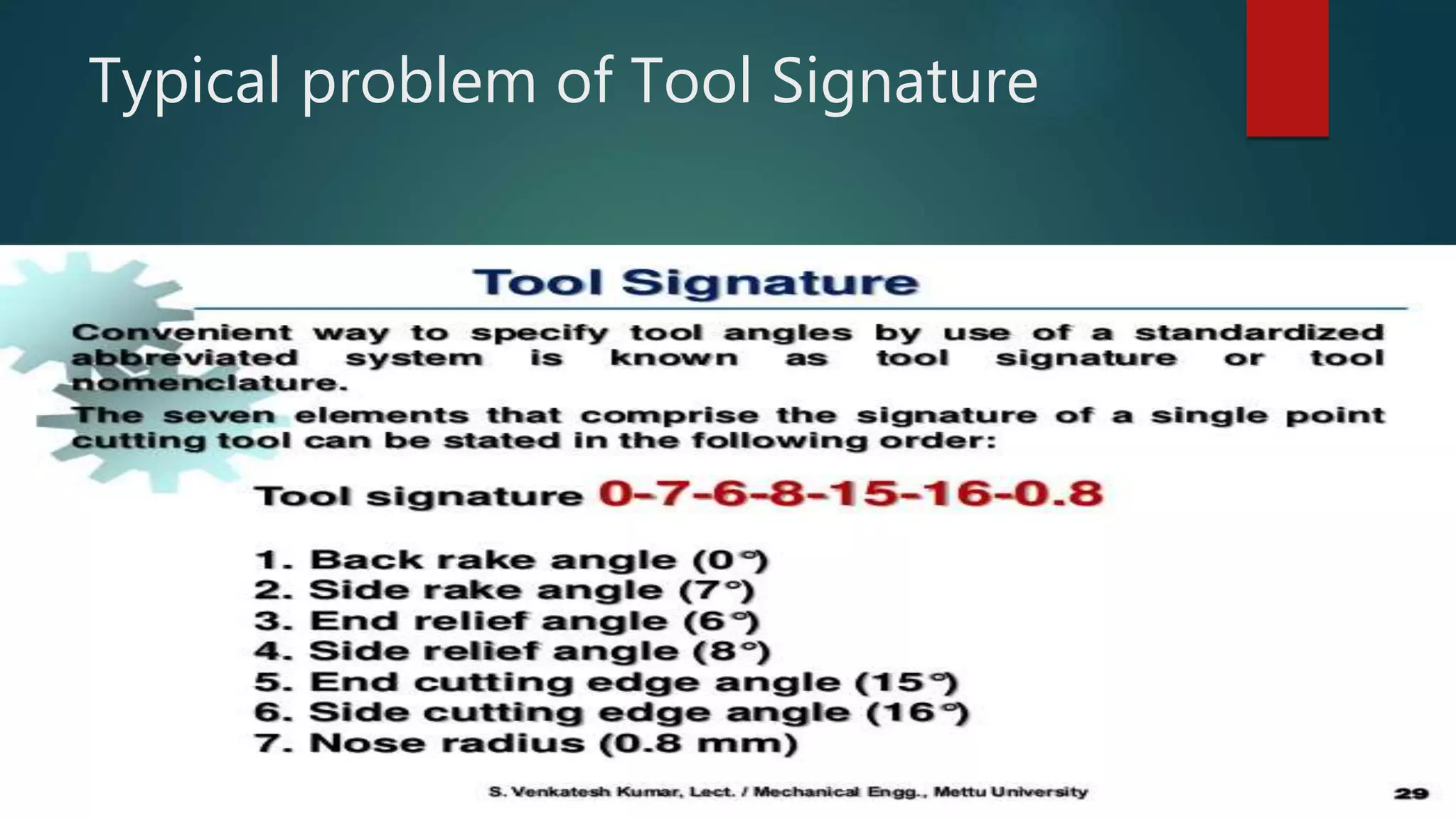
Typical problem of Tool Signature

signature of single point cutting tool

  • 1.
    Tool signature NAME :- VAIBHAV.V.KADU REG. NO. :- 2015BPR031 ROLL NO. :-A 27 THIRD YEAR
  • 2.
    Objective of ppt You will get to know signature of cutting tool.  Effect of various angle on machining.  Why there is need to learn signature of cutting tool.  Different system on which It is base
  • 3.
    3Tool Geometry  Bothmaterial and geometry of the cutting tools play very important roles on their performances in achieving effectiveness, efficiency and overall economy of machining
  • 4.
    Why SIGNATURE ??? The numerical code that describes all the key angles of a given cutting tool . A tool signature may be used for HSS or carbide inserts  Convenient way to specify tool angles by use of a standardized abbreviated system is known as tool signature or tool nomenclature.  It indicates the angle that a tool utilizes during the cut.  It specifies the active angles of the tool normal to the cutting edge.  This will always be true as long as the tool shank is mounted at right angles to the W/P axis.
  • 5.
    5 Tool Designation 1. ASASystem (American Standard Association) 2. ORS System (Orthogonal Rake System) 3. NRS System (Normal Rake System)
  • 6.
    ASA (American StandardAssociation)  It is pure geometrical in nature i.e no calculation as of mechanics.  The ASA specify the tool geometry with three intersecting orthogonal plane i.e one plane parallel to and other plane perpendicular to the cutting tool n both of the them orthogonal to base of tool 1. P(b)-Base plane ; plane perpendicular to velocity vector or parallel to the base of tool. 2. P(l)- Machine longitudinal plane ; plane orthogonal to the base plane n taken in direction of assumed longitudinal feed. 3. P(t)- machine transverse plane; plane perpendicular to both Base plane and Longitudinal plane  It uses rectangular coordinate system but actual cutting plane of cutting tool.
  • 7.
    Various tool anglespecified in ASA system  Back rake angle  Side rake angle  End relief angle  Side relief angle  End cutting edge  Side cutting edge
  • 8.
  • 9.
    ORS (Orthogonal RakeSystem )  ORS also called as old ISO system.  The actual cutting plane is utilized and all the angles are measured in a plane corresponding to cutting tool.  The cutting plane is defined as the plane where the base of cutting tool is present  The cutting plane is defined as the plane normal to base plane and passing through the principal cutting edge  Base plane P(b):-Plane perpendicular to the cutting velocity vector  Cutting plane P(c):-Plane perpendicular to P(b).and taken along principle cutting edge.  Orthogonal plane P(o):-Plane perpendicular to bot P(b) & P(c) and the axes.
  • 10.
    Various tool anglespecifies in ORS system  Inclination angle (i)  Orthogonal rake angle ()  Orthogonal clearance of principal flank angle  Auxiliary orthogonal clearance angle  Principal cutting edge angle  Auxiliary cutting angle  Nose radius
  • 11.
  • 12.
    ISO System orNORMAL RAKE system (NRS)  The major problem with ORS system are these: 1.The true geometry of the cutting tool is not revealed when the cutting edges are inclined from the base plane. 2.Also, tool grinding in ORS required additional calculation for setting of angles in the cutter grinder .  To overcome this problem NRS was introduced  In this system the rake angle is visualized in the normal plane in plce of orthogonal plane in ORS  In this system the base and cutting plane are same as ORS , but the third plane is perpendicular to cutting edge of tool it is called the normal plane .  In this system, the side rake angle is defined as the angle between the base plane of tool and the rake face of the tool measured in a plane normal to side cutting edge.
  • 13.
  • 14.
    Typical problem ofTool Signature

Editor's Notes

  • #4 Generatrix (G) – Cutting motion (CM) – Work (W) Directrix (D) – Feed motion (FM) – Tool (T) 3. Tool-work motions and G & D in form milling 4.In drilling machines, for making holes both the cutting motion and the feed motion are imparted on the cutting tool i.e. drill bit whereas the workpiece remains stationary