SINGLE POINT CUTTING
TOOL
A Presentation On
By
GIRISH YUVRAJ SURVE (13255)
• Types of tools
• Tool geometry
• Tool designation
1. ASA System
2. ORS System
• Effects of back rake angle on machining
• Effect of side rake angle
• Effect of relief angle
• Effect of cutting edge angle
• Effect of nose radius on machining
• Tool material
• Conclusion
• References
Content
Types of tool
1. Single point cutting tool
• One cutting tip is available
• e.g. lathe machine tools, shaping tools, planning tools, etc.
2. Multi-point cutting tool
• More than one tip is available
• e.g. milling cutter, grinding wheel, drill, etc.
MULTIPOINT CUTTING TOOLS
Tool Geometry
Tool Designation
1. ASA System
2. ORS System
3. NRS System
ASA System
• Angles are measured with reference to 3 mutually perpendicular planes.
• Understanding is easy.
• Measurements of angles is also easy.
• Analysis of machining is difficult.
ORS System
• Angles measured with reference to major cutting edge.
• Analysis is easy.
• Understanding is difficult.
• For measurement of angles, we require special fixtures.
Effect of Back rake angle on machining
As back rake angle increases,
• Strength of tool increases.
• Forces on tool decreases.
• Power required for machining is decreases.
• Tool life increases.
Maximum +ve rake angle used is 45 degree.
0 degree rake angle used for brass workpieces.
Also for thread cutting 0 degree rake angle is used.
-ve rake angle is used carbide cutting tool.
-ve rake angle used is 10 degree only.
Effect of side rake angle on machining
As side rake angle increases,
• Strength of tool increases.
• Forces are decreases but in small amount.
• Power is also decreases but in small amount.
• Tool life is increases.
Generally side rake angle is in between 5 to 15 degree.
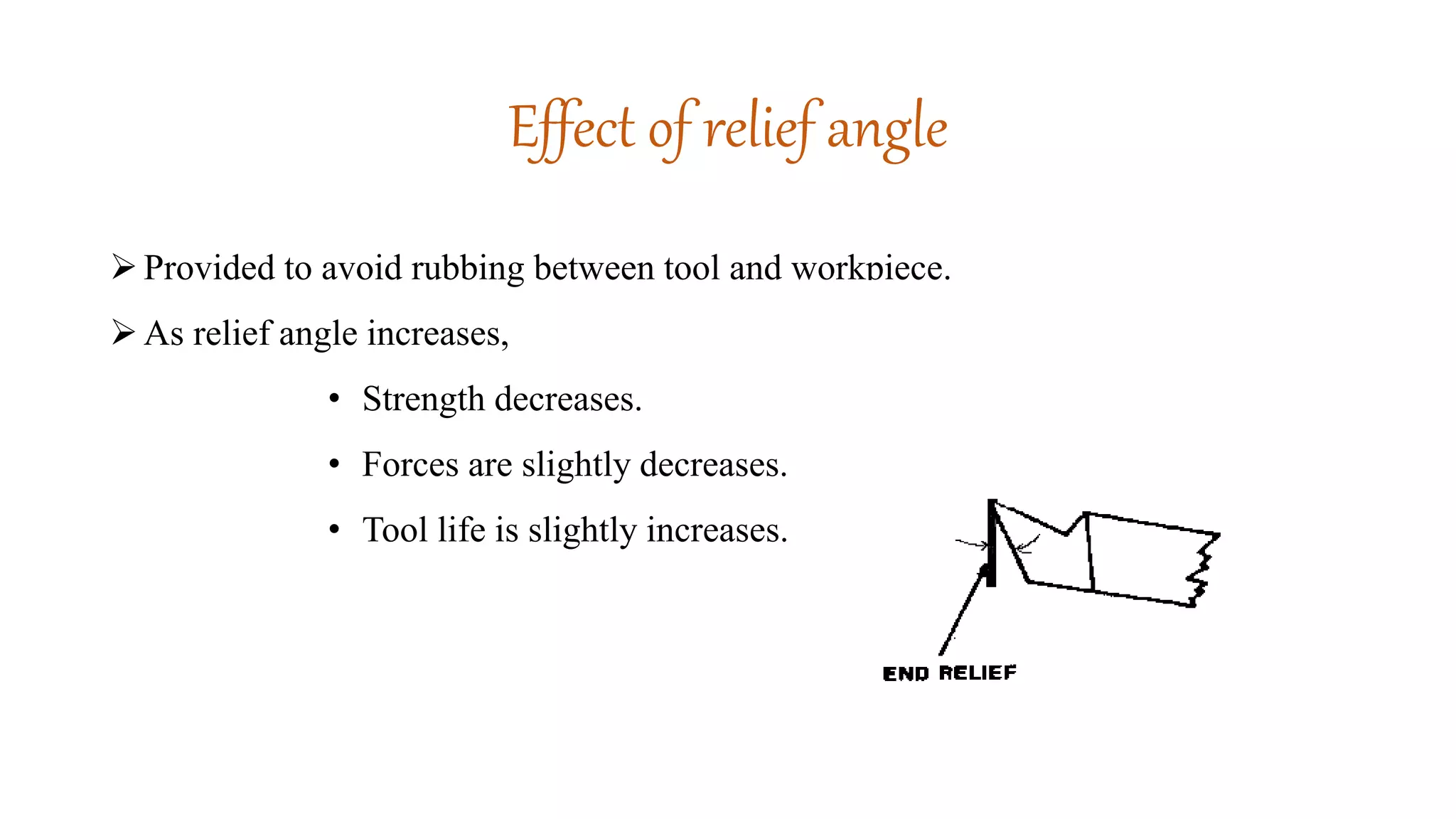
Effect of relief angle
Provided to avoid rubbing between tool and workpiece.
As relief angle increases,
• Strength decreases.
• Forces are slightly decreases.
• Tool life is slightly increases.
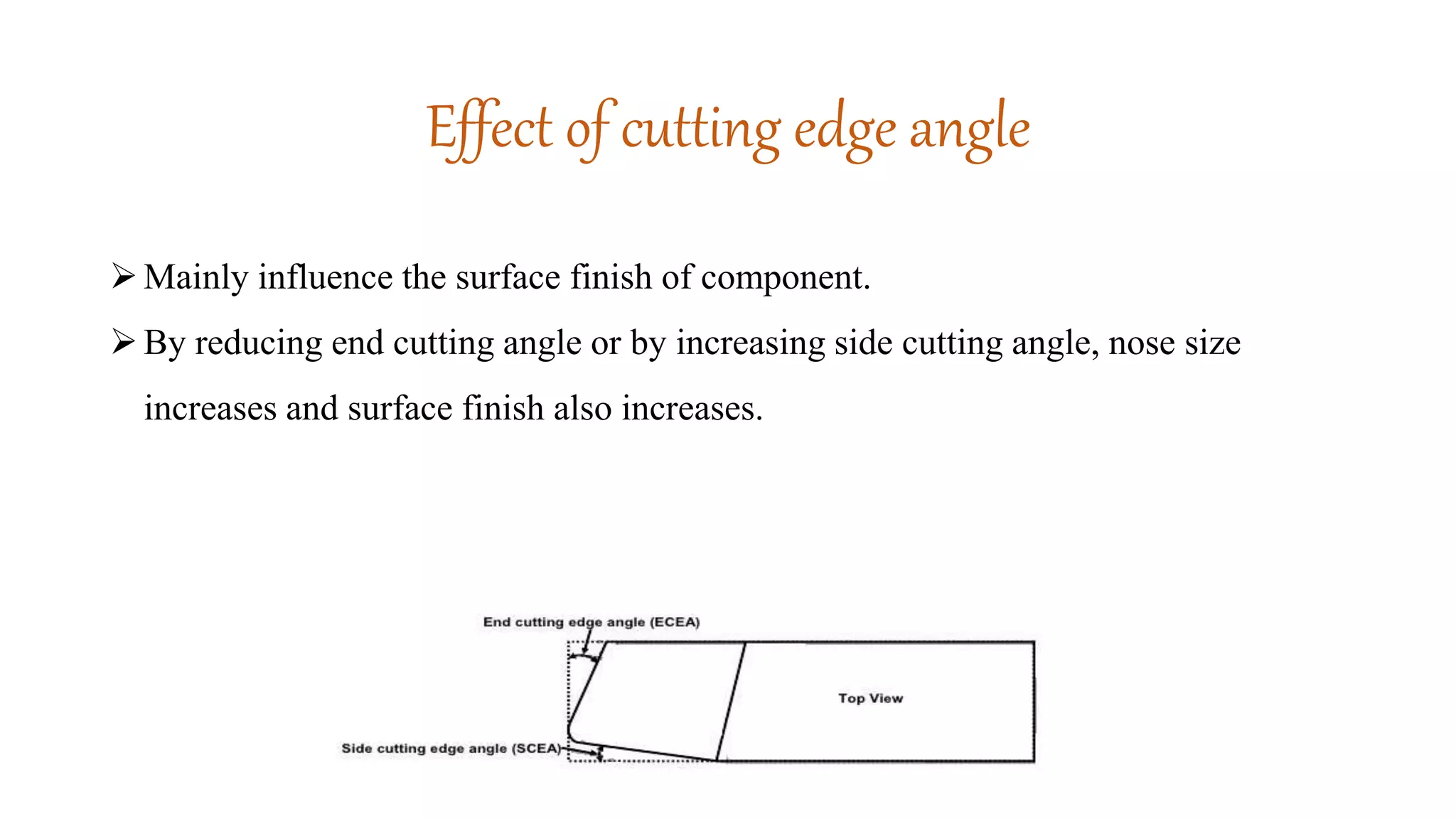
Effect of cutting edge angle
Mainly influence the surface finish of component.
By reducing end cutting angle or by increasing side cutting angle, nose size
increases and surface finish also increases.
Effect of nose radius
Mainly influence the surface finish.
With increase in nose radius, surface finish increases.
Tool material
• High carbon steel
• High speed steel
• Stellite
• Cemented carbide+
• Ceramics
• Cermets
• Diamond
• CBN (Cubic Boron Nitrite) or Borozone
• Ucon
• Sialon
Conclusion
• There are many advantages of single point cutting tool, but there also many
disadvantages.
• Many disadvantages of single point cutting tool are reduced by multi point
cutting tool.
• In this we see geometry of cutting tool, material of cutting tool, etc.
references
• Production technology by P. C. Sharma
• Workshop technology by Hajara Choudhari
• Website – slideshare.net

Single Point Cutting Tools

  • 1.
    SINGLE POINT CUTTING TOOL APresentation On By GIRISH YUVRAJ SURVE (13255)
  • 2.
    • Types oftools • Tool geometry • Tool designation 1. ASA System 2. ORS System • Effects of back rake angle on machining • Effect of side rake angle • Effect of relief angle • Effect of cutting edge angle • Effect of nose radius on machining • Tool material • Conclusion • References Content
  • 3.
    Types of tool 1.Single point cutting tool • One cutting tip is available • e.g. lathe machine tools, shaping tools, planning tools, etc. 2. Multi-point cutting tool • More than one tip is available • e.g. milling cutter, grinding wheel, drill, etc. MULTIPOINT CUTTING TOOLS
  • 4.
  • 6.
    Tool Designation 1. ASASystem 2. ORS System 3. NRS System
  • 7.
    ASA System • Anglesare measured with reference to 3 mutually perpendicular planes. • Understanding is easy. • Measurements of angles is also easy. • Analysis of machining is difficult.
  • 8.
    ORS System • Anglesmeasured with reference to major cutting edge. • Analysis is easy. • Understanding is difficult. • For measurement of angles, we require special fixtures.
  • 9.
    Effect of Backrake angle on machining As back rake angle increases, • Strength of tool increases. • Forces on tool decreases. • Power required for machining is decreases. • Tool life increases. Maximum +ve rake angle used is 45 degree. 0 degree rake angle used for brass workpieces. Also for thread cutting 0 degree rake angle is used. -ve rake angle is used carbide cutting tool. -ve rake angle used is 10 degree only.
  • 10.
    Effect of siderake angle on machining As side rake angle increases, • Strength of tool increases. • Forces are decreases but in small amount. • Power is also decreases but in small amount. • Tool life is increases. Generally side rake angle is in between 5 to 15 degree.
  • 11.
    Effect of reliefangle Provided to avoid rubbing between tool and workpiece. As relief angle increases, • Strength decreases. • Forces are slightly decreases. • Tool life is slightly increases.
  • 12.
    Effect of cuttingedge angle Mainly influence the surface finish of component. By reducing end cutting angle or by increasing side cutting angle, nose size increases and surface finish also increases.
  • 13.
    Effect of noseradius Mainly influence the surface finish. With increase in nose radius, surface finish increases.
  • 14.
    Tool material • Highcarbon steel • High speed steel • Stellite • Cemented carbide+ • Ceramics • Cermets • Diamond • CBN (Cubic Boron Nitrite) or Borozone • Ucon • Sialon
  • 15.
    Conclusion • There aremany advantages of single point cutting tool, but there also many disadvantages. • Many disadvantages of single point cutting tool are reduced by multi point cutting tool. • In this we see geometry of cutting tool, material of cutting tool, etc.
  • 16.
    references • Production technologyby P. C. Sharma • Workshop technology by Hajara Choudhari • Website – slideshare.net