RELEASE OF
INTRACELLULAR PRODUCTS
Dr. M. Sonia Angeline
Department of Life Sciences
DOWNSTREAM PROCESSING
• There are several biotechnological products (vitamins, enzymes)
that are located within the cells.
• Such compounds have to be first released (maximally and in an
active form) for their further processing and final isolation.
• The microorganisms or other cells can be disintegrated or
disrupted by physical, chemical, or enzymatic methods.
INTRODUCTION
• The selection of a particular method depends on the nature of the cells, since there is a wide
variation in the property of cell disruption or breakage.
• For instance, Gram-negative bacteria and filamentous fungi can be more easily broken compared
to Gram-positive bacteria arid yeasts.
https://www.biologydiscussion.com/
Cell Disruption:
1. Physical methods of cell disruption:
• The microorganisms or cells can be disrupted by certain physical methods to release the
intracellular products.
• Ultra sonication:
• Ultrasonic disintegration is widely employed in the laboratory. However, due to high cost, it
is not suitable for large-scale use in industries.
• Osmotic shock:
• This method involves the suspension of cells (free from growth medium) in 20% buffered
sucrose. The cells are then transferred to water at about 4 °C. Osmotic shock is used for the
release of hydrolytic enzymes and binding proteins from Gram -negative bacteria.
• Heat shock (thermolysis):
• Breakage of cells by subjecting them to heat is relatively easy and cheap. But this technique
can be used only for a very few heat-stable intracellular products.
• High pressure homogenization:
• This technique involves forcing of cell suspension at high pressure through a very narrow
orifice to come out to atmospheric pressure. This sudden release of high pressure creates a
liquid shear that can break the cells.
Cell Disruption:
• Impingement:
• In this procedure, a stream of suspended cells at high velocity and pressure are
forced to hit either a stationary surface or a second stream of suspended cells
(impinge literally means to strike or hit).
• The cells are disrupted by the forces created at the point of contact. Micro fluidizer
is a device developed based on the principle of impingement.
• It has been successfully used for breaking E. coli cells.
• The advantage with impingement technique is that it can be effectively used for
disrupting cells even at a low concentration.
Cell Disruption:
• Grinding with glass beads:
• The cells mixed with glass beads are subjected to a very high speed in a reaction
vessel.
• The cells break as they are forced against the wall of the vessel by the beads.
• Several factors influence the cell breakage-size and quantity of the glass beads,
concentration and age of cells, temperature and agitator speed.
• Under optimal conditions, one can expect a maximal breakage of about 80% of the
cells.
Cell Disruption:
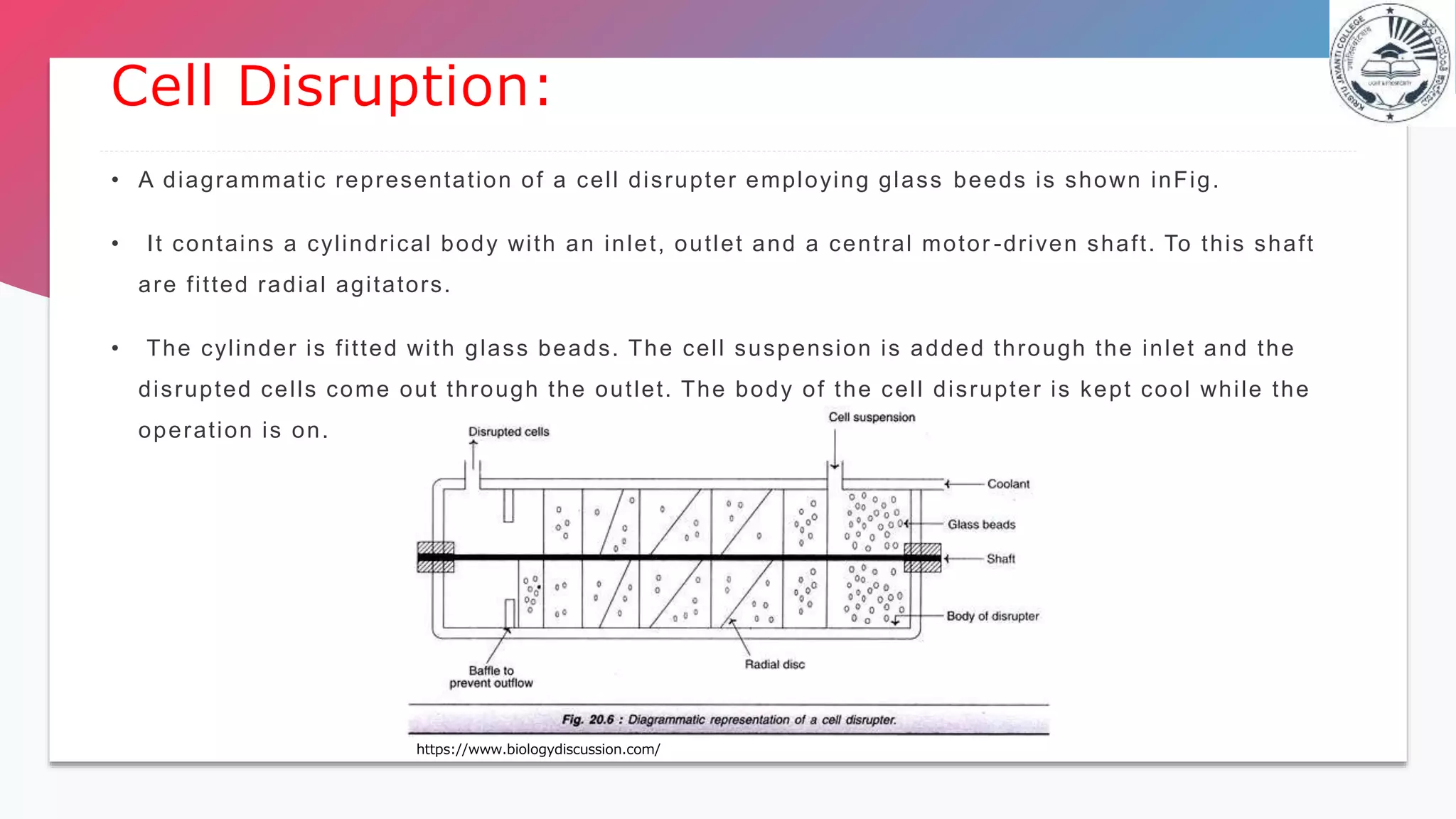
• A diagrammatic representation of a cell disrupter employing glass beeds is shown inFig.
• It contains a cylindrical body with an inlet, outlet and a central motor -driven shaft. To this shaft
are fitted radial agitators.
• The cylinder is fitted with glass beads. The cell suspension is added through the inlet and the
disrupted cells come out through the outlet. The body of the cell disrupter is kept cool while the
operation is on.
Cell Disruption:
https://www.biologydiscussion.com/
2. Mechanical and non-mechanical methods:
• Among the physical methods of cell disruption described above, ultra sonication, high -pressure
homogenization, impingement and grinding with glass beads are mechanical while osmotic shock
and heat shock are non-mechanical.
3. Chemical methods of cell disruption:
• Treatment with alkalies, organic solvents and detergents can lyse the cells to release the
contents.
• Alkalies:
• Alkali treatment has been used for the extraction of some bacterial proteins.
• However, the alkali stability of the desired product is very crucial for the success of this method
e.g., recombinant growth hormone can be efficiently released from E. coli by treatment with
sodium hydroxide at pH 11.
• Organic solvents:
• Several water miscible organic solvents can be used to disrupt the cells e.g., methanol, ethanol,
isopropanol, butanol.
• These compounds are inflammable; hence require specialized equipment for fire safety.
• The organic solvent toluene is frequently used.
• It is believed that toluene dissolves membrane phospholipids and creates membrane pores for release of
intracellular contents.
• Detergents:
• Detergents that are ionic in nature, cationic-cetyl trimethyl ammonium bromide or anionic-sodium lauryl
sulfate can denature membrane proteins and lyse the cells.
• Non-ionic detergents (although less reactive than ionic ones) are also used to some extent e.g., Triton X-
100 or Tween. The problem with the use of detergents is that they affect purification steps, particularly
the salt precipitation. This limitation can be overcome by using ultrafiltration or ion-exchange chromato-
graphy for purification.
4. Enzymatic methods of cell disruption:
• Cell disruption by enzymatic methods has certain advantages i.e., lysis of cells occurs under mild
conditions in a selective manner.
• This is quite advantageous for product recovery. Lysozyme is the most frequently used enzyme
and is commercially available (produced from hen egg white).
• It hydrolyses β-1, 4-glycosidic bonds of the mucopeptide in bacterial cell walls. The Gram -
positive bacteria (with high content of cell wall mucopeptides) are more susceptible for the action
of lysozyme.
• For Gram-negative bacteria, lysozyme in association with EDTA can break the cells.
• As the cell wall gets digested by lysozyme, the osmotic effects break the periplasmic membrane
to release the intracellular contents.
• Certain other enzymes are also used, although less frequently, for cell disruption. For the lysis of
yeast cell walls, glucanase and mannanase in combination with proteases are used.
CONCENTRATION:
• The filtrate that is free from suspended particles (cells, cell debris etc.) usually
contains 80-98% of water.
• The desired product is a very minor constituent. The water has to be removed to
achieve the product concentration.
• The commonly used techniques for concentrating biological products are
evaporation, liquid-liquid extraction, membrane filtration, precipitation and
adsorption.
• The actual procedure adopted depends on the nature of the desired product (quality
and quantity to be retained as far as possible) and the cost factor.
Evaporation:
• Water in the broth filtrate can be removed by a simple evaporation process.
• The evaporators, in general, have a heating device for supply of steam, and unit for the
separation of concentrated product and vapour, a condenser for condensing vapour,
accessories and control equipment.
• The capacity of the equipment is variable that may range from small laboratory scale to
industrial scale. Some of the important types of evaporators in common use are briefly
described.
• Plate evaporators:
• The liquid to be concentrated flows over plates. As the steam is supplied, the liquid gets
concentrated and becomes viscous.
• Falling film evaporators:
• In this case, the liquid flows down long tubes which gets distributed as a thin film over
the heating surface. Falling film evaporators are suitable for removing water from
viscous products of fermentation.
• Forced film evaporators:
• The liquid films are mechanically driven and these devices are suitable for producing
dry product concentrates.
• Centrifugal forced film evaporators:
• These equipment evaporate the liquid very quickly (in seconds), hence suitable for
concentrating even heat-labile substances. In these evaporators, a centrifugal force is
used to pass on the liquid over heated plates or conical surfaces for instantaneous
evaporation.
LIQUID-LIQUID EXTRACTION:
• The concentration of biological products can be achieved by transferring the desired
product (solute) from one liquid phase to another liquid phase, a phenomenon
referred to as liquid-liquid extraction.
• Besides concentration, this technique is also useful for partial purification of a
product.
• The efficiency of extraction is dependent on the partition coefficient i.e. the relative
distribution of a substance between the two liquid phases.
• The process of liquid-liquid extraction may be broadly categorized as extraction of
low molecular weight products and extraction of high molecular weight products.
• Extraction of low molecular weight products:
• By using organic solvents, the lipophilic compounds can be conveniently extracted.
• However, it is quite difficult to extract hydrophilic compounds.
• Extraction of lipophilic products can be done by the following techniques.
• Extraction of high molecular weight compounds:
• Proteins are the most predominant high molecular weight products produced in fermentation
industries.
• Organic solvents cannot be used for protein extraction, as they lose their biological
activities.
• They are extracted by using an aqueous two-phase systems or reverse micelles formation.
PURIFICATION BY CHROMATOGRAPHY:
• The biological products of fermentation (proteins, pharmaceuticals, diagnostic
compounds and research materials) are very effectively purified by chromatography.
• It is basically an analytical technique dealing with the separation of closely related
compounds from a mixture.
• Chromatography usually consists of a stationary phase and mobile phase.
• The stationary phase is the porous solid matrix packed in a column (equilibrated
with a suitable solvent) on to which the mixture of compounds to be separated is
loaded.
• The compounds are eluted by a mobile phase.
• A single mobile phase may be used continuously or it may be changed appropriately to facilitate
the release of desired compounds.
• The eluate from the column can be monitored continuously (e.g. protein elution can be monitored
by ultraviolet adsorption at 280 nm), and collected in fractions of definite volumes.
• A large number of matrices are commercially available for purification of proteins e.g., agarose,
cellulose, polyacrylamide, porous silica, cross- linked dextran, polystyrene.
• Some of the important features of selected chromatographic techniques are briefly described.
https://www.biologydiscussion.com/
Gel-filtration chromatography:
• This is also referred to as size-exclusion chromatography. In this technique, the separation of
molecules is based on the size, shape and molecular weight.
• The sponge-like gel beads with pores serve as molecular sieves for separation of smaller and
bigger molecules.
• A solution mixture containing molecules of different sizes (e.g. different proteins) is applied to the
column and eluted.
• The smaller molecules enter the gel beads through their pores and get trapped. On the other
hand, the larger molecules cannot pass through the pores and therefore come out first with the
mobile liquid (Fig. 20.7).
• At the industrial scale, gel-filtration is particularly useful to remove salts and low molecular
weight compounds from high molecular weight products.
https://www.biologydiscussion.com/
Ion-exchange chromatography:
• It involves the separation of molecules based on their surface charges. Ion -exchangers are of two
types (cation- exchangers which have negatively charged groups like carboxymethyl and sulfonate,
and anion- exchangers with positively charged groups like diethylaminoethyl (DEAE).
• The most commonly used cation-exchangers are Dowex HCR and Amberlite IR, the anion-exchangers
are Dowex SAR and Amberlite IRA.
• In ion-exchange chromatography, the pH of the medium is very crucial, since the net charge varies
with pH. In other words, the pH determines the effective charge on both the target molecule and the
ion-exchanger.
• The ionic bound molecules can be eluted from the matrix by changing the pH of the eluant or by
increasing the concentration of salt solution.
• Ion-exchange chromatography is useful for the purification of antibiotics, besides the purification of
proteins.
Affinity chromatography:
• This is an elegant method for the purification of proteins from a complex mixture.
• Affinity chromatography is based on an interaction of a protein with an immobilized
ligand.
• The ligand can be a specific antibody, substrate, substrate analogue or an inhibitor.
• The immobilized ligand on a solid matrix can be effectively used to fish out
complementary structures.
• The protein bound to the ligand can be eluted by reducing their interaction.
• This can be achieved by changing the pH of the buffer, altering the ionic strength or
by using another free ligand molecule. The fresh ligand used has to be removed in
the subsequent steps.
https://www.biologydiscussion.com/
Hydrophobic interaction chromatography (HIC):
• This is based on the principle of weak hydrophobic interactions between the
hydrophobic ligands (alkyl, aryl side chains on matrix) and hydrophobic amino acids
of proteins.
• The differences in the composition of hydrophobic amino acids in proteins can be
used for their separation.
• The elution of proteins can be done by lowering the salt concentration, decreasing
the polarity of the medium or reducing the temperature.
FORMULATION:
• Formulation broadly refers to the maintenance of activity and stability of a biotechnological
products during storage and distribution.
• The formulation of low molecular weight products (solvents, organic acids) can be achieved by
concentrating them with removal of most of the water.
• For certain small molecules, (antibiotics, citric acid), formulation can be done by crystallization by
adding salts.
• Proteins are highly susceptible for loss of biological activity; hence their formulation requires
special care. Certain stabilizing additives are added to prolong the shelf life of protein.
• The stabilizers of protein formulation include sugars (sucrose, lactose), salts (sodium chloride,
ammonium sulfate), polymers (polyethylene glycol) and polyhydric alcohols (glycerol). Proteins
may be formulated in the form of solutions, suspensions or dry powders.
• Drying:
• Drying is an essential component of product formulation. It basically involves the
transfer of heat to a wet product for removal of moisture. Most of the biological products
of fermentation are sensitive to heat, and therefore require gentle drying methods.
Based on the method of heat transfer, drying devices may be categorized as contact,
convection, radiation dryers. These three types of dryers are commercially available.
• Spray drying:
• Spray drying is used for drying large volumes of liquids. In spray drying, small droplets
of liquid containing the product are passed through a nozzle directing it over a stream
of hot gas. The water evaporates and the solid particles are left behind.
• Freeze-drying:
• Freeze-drying or lyophilization is the most preferred method for drying and formulation of a wide-range of
products—pharmaceuticals, foodstuffs, diagnostics, bacteria, viruses.
• This is mainly because freeze-drying usually does not cause loss of biological activity of the desired product.
• Lyophilization is based on the principle of sublimation of a liquid from a frozen state. In the actual technique,
the liquid containing the product is frozen and then dried in a freeze-dryer under vacuum.
• The vacuum can now be released and the product containing vials can be sealed e.g., penicillin can be
freeze dried directly in ampules.
• Integration of Different Processes:
• It is ideal to integrate the fermentation and downstream processing to finally get the desired product.
However, this has not been practicable for various reasons.
• Integration of certain stages in downstream processing for purification of product has met with some
success. For instance, protein concentration by extraction into two phase systems combined with clarification
and purification can be done together.

Down stream processing Dr.Sonia

  • 1.
    RELEASE OF INTRACELLULAR PRODUCTS Dr.M. Sonia Angeline Department of Life Sciences DOWNSTREAM PROCESSING
  • 2.
    • There areseveral biotechnological products (vitamins, enzymes) that are located within the cells. • Such compounds have to be first released (maximally and in an active form) for their further processing and final isolation. • The microorganisms or other cells can be disintegrated or disrupted by physical, chemical, or enzymatic methods. INTRODUCTION
  • 3.
    • The selectionof a particular method depends on the nature of the cells, since there is a wide variation in the property of cell disruption or breakage. • For instance, Gram-negative bacteria and filamentous fungi can be more easily broken compared to Gram-positive bacteria arid yeasts. https://www.biologydiscussion.com/
  • 4.
    Cell Disruption: 1. Physicalmethods of cell disruption: • The microorganisms or cells can be disrupted by certain physical methods to release the intracellular products. • Ultra sonication: • Ultrasonic disintegration is widely employed in the laboratory. However, due to high cost, it is not suitable for large-scale use in industries. • Osmotic shock: • This method involves the suspension of cells (free from growth medium) in 20% buffered sucrose. The cells are then transferred to water at about 4 °C. Osmotic shock is used for the release of hydrolytic enzymes and binding proteins from Gram -negative bacteria.
  • 5.
    • Heat shock(thermolysis): • Breakage of cells by subjecting them to heat is relatively easy and cheap. But this technique can be used only for a very few heat-stable intracellular products. • High pressure homogenization: • This technique involves forcing of cell suspension at high pressure through a very narrow orifice to come out to atmospheric pressure. This sudden release of high pressure creates a liquid shear that can break the cells. Cell Disruption:
  • 6.
    • Impingement: • Inthis procedure, a stream of suspended cells at high velocity and pressure are forced to hit either a stationary surface or a second stream of suspended cells (impinge literally means to strike or hit). • The cells are disrupted by the forces created at the point of contact. Micro fluidizer is a device developed based on the principle of impingement. • It has been successfully used for breaking E. coli cells. • The advantage with impingement technique is that it can be effectively used for disrupting cells even at a low concentration. Cell Disruption:
  • 7.
    • Grinding withglass beads: • The cells mixed with glass beads are subjected to a very high speed in a reaction vessel. • The cells break as they are forced against the wall of the vessel by the beads. • Several factors influence the cell breakage-size and quantity of the glass beads, concentration and age of cells, temperature and agitator speed. • Under optimal conditions, one can expect a maximal breakage of about 80% of the cells. Cell Disruption:
  • 8.
    • A diagrammaticrepresentation of a cell disrupter employing glass beeds is shown inFig. • It contains a cylindrical body with an inlet, outlet and a central motor -driven shaft. To this shaft are fitted radial agitators. • The cylinder is fitted with glass beads. The cell suspension is added through the inlet and the disrupted cells come out through the outlet. The body of the cell disrupter is kept cool while the operation is on. Cell Disruption: https://www.biologydiscussion.com/
  • 9.
    2. Mechanical andnon-mechanical methods: • Among the physical methods of cell disruption described above, ultra sonication, high -pressure homogenization, impingement and grinding with glass beads are mechanical while osmotic shock and heat shock are non-mechanical. 3. Chemical methods of cell disruption: • Treatment with alkalies, organic solvents and detergents can lyse the cells to release the contents. • Alkalies: • Alkali treatment has been used for the extraction of some bacterial proteins. • However, the alkali stability of the desired product is very crucial for the success of this method e.g., recombinant growth hormone can be efficiently released from E. coli by treatment with sodium hydroxide at pH 11.
  • 10.
    • Organic solvents: •Several water miscible organic solvents can be used to disrupt the cells e.g., methanol, ethanol, isopropanol, butanol. • These compounds are inflammable; hence require specialized equipment for fire safety. • The organic solvent toluene is frequently used. • It is believed that toluene dissolves membrane phospholipids and creates membrane pores for release of intracellular contents. • Detergents: • Detergents that are ionic in nature, cationic-cetyl trimethyl ammonium bromide or anionic-sodium lauryl sulfate can denature membrane proteins and lyse the cells. • Non-ionic detergents (although less reactive than ionic ones) are also used to some extent e.g., Triton X- 100 or Tween. The problem with the use of detergents is that they affect purification steps, particularly the salt precipitation. This limitation can be overcome by using ultrafiltration or ion-exchange chromato- graphy for purification.
  • 11.
    4. Enzymatic methodsof cell disruption: • Cell disruption by enzymatic methods has certain advantages i.e., lysis of cells occurs under mild conditions in a selective manner. • This is quite advantageous for product recovery. Lysozyme is the most frequently used enzyme and is commercially available (produced from hen egg white). • It hydrolyses β-1, 4-glycosidic bonds of the mucopeptide in bacterial cell walls. The Gram - positive bacteria (with high content of cell wall mucopeptides) are more susceptible for the action of lysozyme. • For Gram-negative bacteria, lysozyme in association with EDTA can break the cells. • As the cell wall gets digested by lysozyme, the osmotic effects break the periplasmic membrane to release the intracellular contents. • Certain other enzymes are also used, although less frequently, for cell disruption. For the lysis of yeast cell walls, glucanase and mannanase in combination with proteases are used.
  • 12.
    CONCENTRATION: • The filtratethat is free from suspended particles (cells, cell debris etc.) usually contains 80-98% of water. • The desired product is a very minor constituent. The water has to be removed to achieve the product concentration. • The commonly used techniques for concentrating biological products are evaporation, liquid-liquid extraction, membrane filtration, precipitation and adsorption. • The actual procedure adopted depends on the nature of the desired product (quality and quantity to be retained as far as possible) and the cost factor.
  • 13.
    Evaporation: • Water inthe broth filtrate can be removed by a simple evaporation process. • The evaporators, in general, have a heating device for supply of steam, and unit for the separation of concentrated product and vapour, a condenser for condensing vapour, accessories and control equipment. • The capacity of the equipment is variable that may range from small laboratory scale to industrial scale. Some of the important types of evaporators in common use are briefly described. • Plate evaporators: • The liquid to be concentrated flows over plates. As the steam is supplied, the liquid gets concentrated and becomes viscous.
  • 14.
    • Falling filmevaporators: • In this case, the liquid flows down long tubes which gets distributed as a thin film over the heating surface. Falling film evaporators are suitable for removing water from viscous products of fermentation. • Forced film evaporators: • The liquid films are mechanically driven and these devices are suitable for producing dry product concentrates. • Centrifugal forced film evaporators: • These equipment evaporate the liquid very quickly (in seconds), hence suitable for concentrating even heat-labile substances. In these evaporators, a centrifugal force is used to pass on the liquid over heated plates or conical surfaces for instantaneous evaporation.
  • 15.
    LIQUID-LIQUID EXTRACTION: • Theconcentration of biological products can be achieved by transferring the desired product (solute) from one liquid phase to another liquid phase, a phenomenon referred to as liquid-liquid extraction. • Besides concentration, this technique is also useful for partial purification of a product. • The efficiency of extraction is dependent on the partition coefficient i.e. the relative distribution of a substance between the two liquid phases. • The process of liquid-liquid extraction may be broadly categorized as extraction of low molecular weight products and extraction of high molecular weight products.
  • 16.
    • Extraction oflow molecular weight products: • By using organic solvents, the lipophilic compounds can be conveniently extracted. • However, it is quite difficult to extract hydrophilic compounds. • Extraction of lipophilic products can be done by the following techniques. • Extraction of high molecular weight compounds: • Proteins are the most predominant high molecular weight products produced in fermentation industries. • Organic solvents cannot be used for protein extraction, as they lose their biological activities. • They are extracted by using an aqueous two-phase systems or reverse micelles formation.
  • 17.
    PURIFICATION BY CHROMATOGRAPHY: •The biological products of fermentation (proteins, pharmaceuticals, diagnostic compounds and research materials) are very effectively purified by chromatography. • It is basically an analytical technique dealing with the separation of closely related compounds from a mixture. • Chromatography usually consists of a stationary phase and mobile phase. • The stationary phase is the porous solid matrix packed in a column (equilibrated with a suitable solvent) on to which the mixture of compounds to be separated is loaded. • The compounds are eluted by a mobile phase.
  • 18.
    • A singlemobile phase may be used continuously or it may be changed appropriately to facilitate the release of desired compounds. • The eluate from the column can be monitored continuously (e.g. protein elution can be monitored by ultraviolet adsorption at 280 nm), and collected in fractions of definite volumes. • A large number of matrices are commercially available for purification of proteins e.g., agarose, cellulose, polyacrylamide, porous silica, cross- linked dextran, polystyrene. • Some of the important features of selected chromatographic techniques are briefly described.
  • 19.
  • 20.
    Gel-filtration chromatography: • Thisis also referred to as size-exclusion chromatography. In this technique, the separation of molecules is based on the size, shape and molecular weight. • The sponge-like gel beads with pores serve as molecular sieves for separation of smaller and bigger molecules. • A solution mixture containing molecules of different sizes (e.g. different proteins) is applied to the column and eluted. • The smaller molecules enter the gel beads through their pores and get trapped. On the other hand, the larger molecules cannot pass through the pores and therefore come out first with the mobile liquid (Fig. 20.7). • At the industrial scale, gel-filtration is particularly useful to remove salts and low molecular weight compounds from high molecular weight products.
  • 21.
  • 22.
    Ion-exchange chromatography: • Itinvolves the separation of molecules based on their surface charges. Ion -exchangers are of two types (cation- exchangers which have negatively charged groups like carboxymethyl and sulfonate, and anion- exchangers with positively charged groups like diethylaminoethyl (DEAE). • The most commonly used cation-exchangers are Dowex HCR and Amberlite IR, the anion-exchangers are Dowex SAR and Amberlite IRA. • In ion-exchange chromatography, the pH of the medium is very crucial, since the net charge varies with pH. In other words, the pH determines the effective charge on both the target molecule and the ion-exchanger. • The ionic bound molecules can be eluted from the matrix by changing the pH of the eluant or by increasing the concentration of salt solution. • Ion-exchange chromatography is useful for the purification of antibiotics, besides the purification of proteins.
  • 23.
    Affinity chromatography: • Thisis an elegant method for the purification of proteins from a complex mixture. • Affinity chromatography is based on an interaction of a protein with an immobilized ligand. • The ligand can be a specific antibody, substrate, substrate analogue or an inhibitor. • The immobilized ligand on a solid matrix can be effectively used to fish out complementary structures. • The protein bound to the ligand can be eluted by reducing their interaction. • This can be achieved by changing the pH of the buffer, altering the ionic strength or by using another free ligand molecule. The fresh ligand used has to be removed in the subsequent steps.
  • 24.
  • 25.
    Hydrophobic interaction chromatography(HIC): • This is based on the principle of weak hydrophobic interactions between the hydrophobic ligands (alkyl, aryl side chains on matrix) and hydrophobic amino acids of proteins. • The differences in the composition of hydrophobic amino acids in proteins can be used for their separation. • The elution of proteins can be done by lowering the salt concentration, decreasing the polarity of the medium or reducing the temperature.
  • 26.
    FORMULATION: • Formulation broadlyrefers to the maintenance of activity and stability of a biotechnological products during storage and distribution. • The formulation of low molecular weight products (solvents, organic acids) can be achieved by concentrating them with removal of most of the water. • For certain small molecules, (antibiotics, citric acid), formulation can be done by crystallization by adding salts. • Proteins are highly susceptible for loss of biological activity; hence their formulation requires special care. Certain stabilizing additives are added to prolong the shelf life of protein. • The stabilizers of protein formulation include sugars (sucrose, lactose), salts (sodium chloride, ammonium sulfate), polymers (polyethylene glycol) and polyhydric alcohols (glycerol). Proteins may be formulated in the form of solutions, suspensions or dry powders.
  • 27.
    • Drying: • Dryingis an essential component of product formulation. It basically involves the transfer of heat to a wet product for removal of moisture. Most of the biological products of fermentation are sensitive to heat, and therefore require gentle drying methods. Based on the method of heat transfer, drying devices may be categorized as contact, convection, radiation dryers. These three types of dryers are commercially available. • Spray drying: • Spray drying is used for drying large volumes of liquids. In spray drying, small droplets of liquid containing the product are passed through a nozzle directing it over a stream of hot gas. The water evaporates and the solid particles are left behind.
  • 28.
    • Freeze-drying: • Freeze-dryingor lyophilization is the most preferred method for drying and formulation of a wide-range of products—pharmaceuticals, foodstuffs, diagnostics, bacteria, viruses. • This is mainly because freeze-drying usually does not cause loss of biological activity of the desired product. • Lyophilization is based on the principle of sublimation of a liquid from a frozen state. In the actual technique, the liquid containing the product is frozen and then dried in a freeze-dryer under vacuum. • The vacuum can now be released and the product containing vials can be sealed e.g., penicillin can be freeze dried directly in ampules. • Integration of Different Processes: • It is ideal to integrate the fermentation and downstream processing to finally get the desired product. However, this has not been practicable for various reasons. • Integration of certain stages in downstream processing for purification of product has met with some success. For instance, protein concentration by extraction into two phase systems combined with clarification and purification can be done together.