DOWNSTREAM PROCESS
YOGESH P
23MIM53
• The various procedure involved in the actual recovery of useful
products after fermentation or any other process together constitute
Downstream Processing.
• It is a very important step in the manufacture of different product in
pharmaceutical industry (Such as antibiotics, hormones, antibodies,
vaccine, enzymes), Food industry etc.
• In addition, the product is either present in the cell, in the medium
or both.
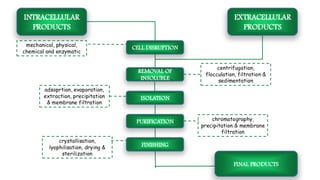
INTRACELLULAR
PRODUCTS
EXTRACELLULAR
PRODUCTS
REMOVAL OF
INSOLUBLE
CELL DISRUPTION
ISOLATION
PURIFICATION
FINISHING
FINAL PRODUCTS
mechanical, physical,
chemical and enzymatic
centrifugation,
flocculation, filtration &
sedimentation
adsoprtion, evaporation,
extraction, precipitation
& membrane filtration
chromatography,
precipitation & membrane
filtration
crystallisation,
lyophilisation, drying &
sterilization
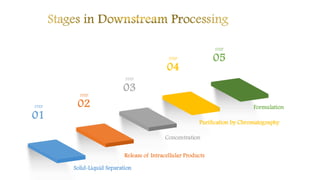
Stages in Downstream Processing
STEP
01
STEP
02
STEP
03
STEP
04
STEP
05
Solid-Liquid Separation
Release of Intracellular Products
Concentration
Purification by Chromatography
Formulation
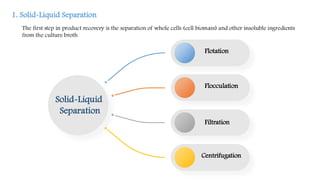
1. Solid-Liquid Separation
The first step in product recovery is the separation of whole cells (cell biomass) and other insoluble ingredients
from the culture broth
Flotation
Flocculation
Centrifugation
Solid-Liquid
Separation
Filtration
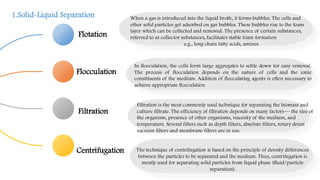
Flotation
Flocculation
Filtration
Centrifugation
When a gas is introduced into the liquid broth, it forms bubbles. The cells and
other solid particles get adsorbed on gas bubbles. These bubbles rise to the foam
layer which can be collected and removed. The presence of certain substances,
referred to as collector substances, facilitates stable foam formation
e.g., long chain fatty acids, amines.
In flocculation, the cells form large aggregates to settle down for easy removal.
The process of flocculation depends on the nature of cells and the ionic
constituents of the medium. Addition of flocculating agents is often necessary to
achieve appropriate flocculation
Filtration is the most commonly used technique for separating the biomass and
culture filtrate. The efficiency of filtration depends on many factors— the size of
the organism, presence of other organisms, viscosity of the medium, and
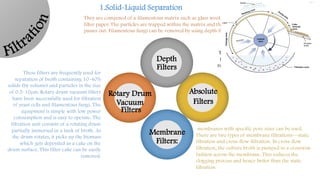
temperature. Several filters such as depth filters, absolute filters, rotary drum
vacuum filters and membrane filters are in use.
The technique of centrifugation is based on the principle of density differences
between the particles to be separated and the medium. Thus, centrifugation is
mostly used for separating solid particles from liquid phase (fluid/particle
separation).
1.Solid-Liquid Separation
Rotary Drum
Vacuum
Filters
Membrane
Filters:
They are composed of a filamentous matrix such as glass wool, asbestos or
filter paper. The particles are trapped within the matrix and the fluid
passes out. Filamentous fungi can be removed by using depth filters.
Depth
Filters
Absolute
Filters
These filters are with specific pore sizes
that are smaller than the particles to be
removed. Bacteria from culture medium
can be removed by absolute filters.
membranes with specific pore sizes can be used.
There are two types of membrane filtrations—static
filtration and cross-flow filtration. In cross-flow
filtration, the culture broth is pumped in a crosswise
fashion across the membrane. This reduces the
clogging process and hence better than the static
filtration
These filters are frequently used for
separation of broth containing 10-40%
solids (by volume) and particles in the size
of 0.5-10µm. Rotary drum vacuum filters
have been successfully used for filtration
of yeast cells and filamentous fungi. The
equipment is simple with low power
consumption and is easy to operate. The
filtration unit consists of a rotating drum
partially immersed in a tank of broth. As
the drum rotates, it picks up the biomass
which gets deposited as a cake on the
drum surface. This filter cake can be easily
removed.
1.Solid-Liquid Separation
C
e
n
t
r
i
f
u
g
a
t
i
o
n
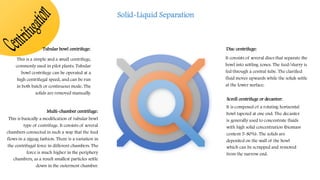
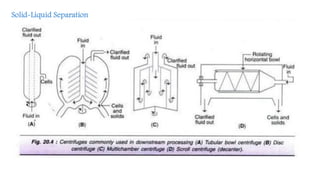
Disc centrifuge:
It consists of several discs that separate the
bowl into settling zones. The feed/slurry is
fed through a central tube. The clarified
fluid moves upwards while the solids settle
at the lower surface.
Tubular bowl centrifuge:
This is a simple and a small centrifuge,
commonly used in pilot plants. Tubular
bowl centrifuge can be operated at a
high centrifugal speed, and can be run
in both batch or continuous mode. The
solids are removed manually.
Multi-chamber centrifuge:
This is basically a modification of tubular bowl
type of centrifuge. It consists of several
chambers connected in such a way that the feed
flows in a zigzag fashion. There is a variation in
the centrifugal force in different chambers. The
force is much higher in the periphery
chambers, as a result smallest particles settle
down in the outermost chamber.
Scroll centrifuge or decanter:
It is composed of a rotating horizontal
bowl tapered at one end. The decanter
is generally used to concentrate fluids
with high solid concentration (biomass
content 5-80%). The solids are
deposited on the wall of the bowl
which can be scrapped and removed
from the narrow end.
Solid-Liquid Separation
2.Release of Intracellular Products
CELL DISRUPTION
ULTRASONICATION
OSMOTIC SHOCK
HEAT SHOCK
HIGH PRESSURE
HOMOGENISATION
IMPINGEMENT
GLIDING WITH GLASS BEADS
ALKALIES
ORGANIC SOLVENTS
DETERGENTS
LYSOZYME
GLUCANASE, MANNASE
& PROTEASE
PHYSICAL ENZYMATIC
CHEMICAL
3.Concentration
The filtrate that is free from suspended particles (cells, cell debris etc.) usually contains 80-
98% of water.
The commonly used techniques for concentrating biological products are evaporation,
liquid-liquid extraction, membrane filtration, precipitation and adsorption.
Evaporation:
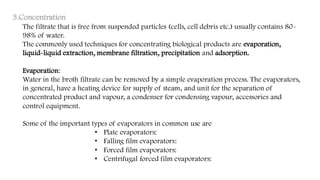
Water in the broth filtrate can be removed by a simple evaporation process. The evaporators,
in general, have a heating device for supply of steam, and unit for the separation of
concentrated product and vapour, a condenser for condensing vapour, accessories and
control equipment.
Some of the important types of evaporators in common use are
• Plate evaporators:
• Falling film evaporators:
• Forced film evaporators:
• Centrifugal forced film evaporators:
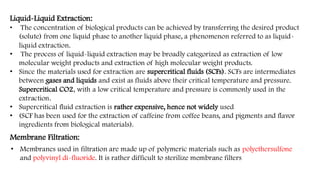
Liquid-Liquid Extraction:
• The concentration of biological products can be achieved by transferring the desired product
(solute) from one liquid phase to another liquid phase, a phenomenon referred to as liquid-
liquid extraction.
• The process of liquid-liquid extraction may be broadly categorized as extraction of low
molecular weight products and extraction of high molecular weight products.
• Since the materials used for extraction are supercritical fluids (SCFs). SCFs are intermediates
between gases and liquids and exist as fluids above their critical temperature and pressure.
Supercritical CO2, with a low critical temperature and pressure is commonly used in the
extraction.
• Supercritical fluid extraction is rather expensive, hence not widely used
• (SCF has been used for the extraction of caffeine from coffee beans, and pigments and flavor
ingredients from biological materials).
Membrane Filtration:
• Membranes used in filtration are made up of polymeric materials such as polyethersulfone
and polyvinyl di-fluoride. It is rather difficult to sterilize membrane filters
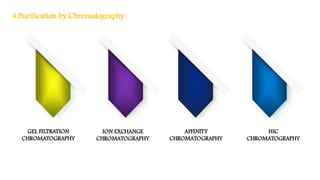
4.Purification by Chromatography
GEL FILTRATION
CHROMATOGRAPHY
ION EXCHANGE
CHROMATOGRAPHY
AFFINITY
CHROMATOGRAPHY
HIC
CHROMATOGRAPHY
Gel-filtration chromatography:
This is also referred to as size-exclusion chromatography. In this technique, the separation of
molecules is based on the size, shape and molecular weight. The sponge-like gel beads with pores
serve as molecular sieves for separation of smaller and bigger molecules. A solution mixture
containing molecules of different sizes (e.g. different proteins) is applied to the column and
eluted. The smaller molecules enter the gel beads through their pores and get trapped. On the
other hand, the larger molecules cannot pass through the pores and therefore come out first
with the mobile liquid. At the industrial scale, gel-filtration is particularly useful to remove salts
and low molecular weight compounds from high molecular weight products.
Ion-exchange chromatography:
It involves the separation of molecules based on their surface charges. Ion-exchangers
are of two types (cation- exchangers which have negatively charged groups like
carboxymethyl and sulfonate, and anion- exchangers with positively charged groups like
diethylaminoethyl (DEAE). The most commonly used cation-exchangers are Dowex HCR
and Amberlite IR, the anion-exchangers are Dowex SAR and Amberlite IRA.
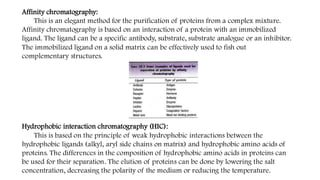
Affinity chromatography:
This is an elegant method for the purification of proteins from a complex mixture.
Affinity chromatography is based on an interaction of a protein with an immobilized
ligand. The ligand can be a specific antibody, substrate, substrate analogue or an inhibitor.
The immobilized ligand on a solid matrix can be effectively used to fish out
complementary structures.
Hydrophobic interaction chromatography (HIC):
This is based on the principle of weak hydrophobic interactions between the
hydrophobic ligands (alkyl, aryl side chains on matrix) and hydrophobic amino acids of
proteins. The differences in the composition of hydrophobic amino acids in proteins can
be used for their separation. The elution of proteins can be done by lowering the salt
concentration, decreasing the polarity of the medium or reducing the temperature.
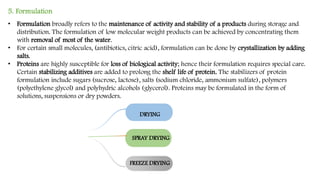
5. Formulation
• Formulation broadly refers to the maintenance of activity and stability of a products during storage and
distribution. The formulation of low molecular weight products can be achieved by concentrating them
with removal of most of the water.
• For certain small molecules, (antibiotics, citric acid), formulation can be done by crystallization by adding
salts.
• Proteins are highly susceptible for loss of biological activity; hence their formulation requires special care.
Certain stabilizing additives are added to prolong the shelf life of protein. The stabilizers of protein
formulation include sugars (sucrose, lactose), salts (sodium chloride, ammonium sulfate), polymers
(polyethylene glycol) and polyhydric alcohols (glycerol). Proteins may be formulated in the form of
solutions, suspensions or dry powders.
DRYING
SPRAY DRYING
FREEZE DRYING
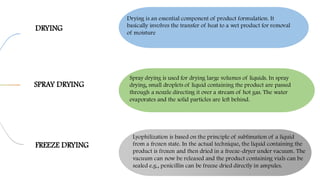
DRYING
SPRAY DRYING
FREEZE DRYING
Drying is an essential component of product formulation. It
basically involves the transfer of heat to a wet product for removal
of moisture
Spray drying is used for drying large volumes of liquids. In spray
drying, small droplets of liquid containing the product are passed
through a nozzle directing it over a stream of hot gas. The water
evaporates and the solid particles are left behind.
Lyophilization is based on the principle of sublimation of a liquid
from a frozen state. In the actual technique, the liquid containing the
product is frozen and then dried in a freeze-dryer under vacuum. The
vacuum can now be released and the product containing vials can be
sealed e.g., penicillin can be freeze dried directly in ampules.
REFERENCE:
• PATEL AH (2012) INDUSTRIAL MICROBIOLOGY 2ND ED. MACMILLAN INDIA LIMITED
• DOYLE MP, BEUCHAT LR AND TJ MONTVILLE(2012) FOOD MICROBIOLOGY FUNDAMENTALS AND
FRONTIERS 4TH ED ASM PRESS, WASHINGTON DC

Downstream process in industrial microbiology

  • 1.
  • 2.
    • The variousprocedure involved in the actual recovery of useful products after fermentation or any other process together constitute Downstream Processing. • It is a very important step in the manufacture of different product in pharmaceutical industry (Such as antibiotics, hormones, antibodies, vaccine, enzymes), Food industry etc. • In addition, the product is either present in the cell, in the medium or both.
  • 3.
    INTRACELLULAR PRODUCTS EXTRACELLULAR PRODUCTS REMOVAL OF INSOLUBLE CELL DISRUPTION ISOLATION PURIFICATION FINISHING FINALPRODUCTS mechanical, physical, chemical and enzymatic centrifugation, flocculation, filtration & sedimentation adsoprtion, evaporation, extraction, precipitation & membrane filtration chromatography, precipitation & membrane filtration crystallisation, lyophilisation, drying & sterilization
  • 4.
    Stages in DownstreamProcessing STEP 01 STEP 02 STEP 03 STEP 04 STEP 05 Solid-Liquid Separation Release of Intracellular Products Concentration Purification by Chromatography Formulation
  • 5.
    1. Solid-Liquid Separation Thefirst step in product recovery is the separation of whole cells (cell biomass) and other insoluble ingredients from the culture broth Flotation Flocculation Centrifugation Solid-Liquid Separation Filtration
  • 6.
    Flotation Flocculation Filtration Centrifugation When a gasis introduced into the liquid broth, it forms bubbles. The cells and other solid particles get adsorbed on gas bubbles. These bubbles rise to the foam layer which can be collected and removed. The presence of certain substances, referred to as collector substances, facilitates stable foam formation e.g., long chain fatty acids, amines. In flocculation, the cells form large aggregates to settle down for easy removal. The process of flocculation depends on the nature of cells and the ionic constituents of the medium. Addition of flocculating agents is often necessary to achieve appropriate flocculation Filtration is the most commonly used technique for separating the biomass and culture filtrate. The efficiency of filtration depends on many factors— the size of the organism, presence of other organisms, viscosity of the medium, and temperature. Several filters such as depth filters, absolute filters, rotary drum vacuum filters and membrane filters are in use. The technique of centrifugation is based on the principle of density differences between the particles to be separated and the medium. Thus, centrifugation is mostly used for separating solid particles from liquid phase (fluid/particle separation). 1.Solid-Liquid Separation
  • 7.
    Rotary Drum Vacuum Filters Membrane Filters: They arecomposed of a filamentous matrix such as glass wool, asbestos or filter paper. The particles are trapped within the matrix and the fluid passes out. Filamentous fungi can be removed by using depth filters. Depth Filters Absolute Filters These filters are with specific pore sizes that are smaller than the particles to be removed. Bacteria from culture medium can be removed by absolute filters. membranes with specific pore sizes can be used. There are two types of membrane filtrations—static filtration and cross-flow filtration. In cross-flow filtration, the culture broth is pumped in a crosswise fashion across the membrane. This reduces the clogging process and hence better than the static filtration These filters are frequently used for separation of broth containing 10-40% solids (by volume) and particles in the size of 0.5-10µm. Rotary drum vacuum filters have been successfully used for filtration of yeast cells and filamentous fungi. The equipment is simple with low power consumption and is easy to operate. The filtration unit consists of a rotating drum partially immersed in a tank of broth. As the drum rotates, it picks up the biomass which gets deposited as a cake on the drum surface. This filter cake can be easily removed. 1.Solid-Liquid Separation
  • 8.
    C e n t r i f u g a t i o n Disc centrifuge: It consistsof several discs that separate the bowl into settling zones. The feed/slurry is fed through a central tube. The clarified fluid moves upwards while the solids settle at the lower surface. Tubular bowl centrifuge: This is a simple and a small centrifuge, commonly used in pilot plants. Tubular bowl centrifuge can be operated at a high centrifugal speed, and can be run in both batch or continuous mode. The solids are removed manually. Multi-chamber centrifuge: This is basically a modification of tubular bowl type of centrifuge. It consists of several chambers connected in such a way that the feed flows in a zigzag fashion. There is a variation in the centrifugal force in different chambers. The force is much higher in the periphery chambers, as a result smallest particles settle down in the outermost chamber. Scroll centrifuge or decanter: It is composed of a rotating horizontal bowl tapered at one end. The decanter is generally used to concentrate fluids with high solid concentration (biomass content 5-80%). The solids are deposited on the wall of the bowl which can be scrapped and removed from the narrow end. Solid-Liquid Separation
  • 9.
  • 10.
    2.Release of IntracellularProducts CELL DISRUPTION ULTRASONICATION OSMOTIC SHOCK HEAT SHOCK HIGH PRESSURE HOMOGENISATION IMPINGEMENT GLIDING WITH GLASS BEADS ALKALIES ORGANIC SOLVENTS DETERGENTS LYSOZYME GLUCANASE, MANNASE & PROTEASE PHYSICAL ENZYMATIC CHEMICAL
  • 11.
    3.Concentration The filtrate thatis free from suspended particles (cells, cell debris etc.) usually contains 80- 98% of water. The commonly used techniques for concentrating biological products are evaporation, liquid-liquid extraction, membrane filtration, precipitation and adsorption. Evaporation: Water in the broth filtrate can be removed by a simple evaporation process. The evaporators, in general, have a heating device for supply of steam, and unit for the separation of concentrated product and vapour, a condenser for condensing vapour, accessories and control equipment. Some of the important types of evaporators in common use are • Plate evaporators: • Falling film evaporators: • Forced film evaporators: • Centrifugal forced film evaporators:
  • 12.
    Liquid-Liquid Extraction: • Theconcentration of biological products can be achieved by transferring the desired product (solute) from one liquid phase to another liquid phase, a phenomenon referred to as liquid- liquid extraction. • The process of liquid-liquid extraction may be broadly categorized as extraction of low molecular weight products and extraction of high molecular weight products. • Since the materials used for extraction are supercritical fluids (SCFs). SCFs are intermediates between gases and liquids and exist as fluids above their critical temperature and pressure. Supercritical CO2, with a low critical temperature and pressure is commonly used in the extraction. • Supercritical fluid extraction is rather expensive, hence not widely used • (SCF has been used for the extraction of caffeine from coffee beans, and pigments and flavor ingredients from biological materials). Membrane Filtration: • Membranes used in filtration are made up of polymeric materials such as polyethersulfone and polyvinyl di-fluoride. It is rather difficult to sterilize membrane filters
  • 13.
    4.Purification by Chromatography GELFILTRATION CHROMATOGRAPHY ION EXCHANGE CHROMATOGRAPHY AFFINITY CHROMATOGRAPHY HIC CHROMATOGRAPHY
  • 14.
    Gel-filtration chromatography: This isalso referred to as size-exclusion chromatography. In this technique, the separation of molecules is based on the size, shape and molecular weight. The sponge-like gel beads with pores serve as molecular sieves for separation of smaller and bigger molecules. A solution mixture containing molecules of different sizes (e.g. different proteins) is applied to the column and eluted. The smaller molecules enter the gel beads through their pores and get trapped. On the other hand, the larger molecules cannot pass through the pores and therefore come out first with the mobile liquid. At the industrial scale, gel-filtration is particularly useful to remove salts and low molecular weight compounds from high molecular weight products. Ion-exchange chromatography: It involves the separation of molecules based on their surface charges. Ion-exchangers are of two types (cation- exchangers which have negatively charged groups like carboxymethyl and sulfonate, and anion- exchangers with positively charged groups like diethylaminoethyl (DEAE). The most commonly used cation-exchangers are Dowex HCR and Amberlite IR, the anion-exchangers are Dowex SAR and Amberlite IRA.
  • 15.
    Affinity chromatography: This isan elegant method for the purification of proteins from a complex mixture. Affinity chromatography is based on an interaction of a protein with an immobilized ligand. The ligand can be a specific antibody, substrate, substrate analogue or an inhibitor. The immobilized ligand on a solid matrix can be effectively used to fish out complementary structures. Hydrophobic interaction chromatography (HIC): This is based on the principle of weak hydrophobic interactions between the hydrophobic ligands (alkyl, aryl side chains on matrix) and hydrophobic amino acids of proteins. The differences in the composition of hydrophobic amino acids in proteins can be used for their separation. The elution of proteins can be done by lowering the salt concentration, decreasing the polarity of the medium or reducing the temperature.
  • 16.
    5. Formulation • Formulationbroadly refers to the maintenance of activity and stability of a products during storage and distribution. The formulation of low molecular weight products can be achieved by concentrating them with removal of most of the water. • For certain small molecules, (antibiotics, citric acid), formulation can be done by crystallization by adding salts. • Proteins are highly susceptible for loss of biological activity; hence their formulation requires special care. Certain stabilizing additives are added to prolong the shelf life of protein. The stabilizers of protein formulation include sugars (sucrose, lactose), salts (sodium chloride, ammonium sulfate), polymers (polyethylene glycol) and polyhydric alcohols (glycerol). Proteins may be formulated in the form of solutions, suspensions or dry powders. DRYING SPRAY DRYING FREEZE DRYING
  • 17.
    DRYING SPRAY DRYING FREEZE DRYING Dryingis an essential component of product formulation. It basically involves the transfer of heat to a wet product for removal of moisture Spray drying is used for drying large volumes of liquids. In spray drying, small droplets of liquid containing the product are passed through a nozzle directing it over a stream of hot gas. The water evaporates and the solid particles are left behind. Lyophilization is based on the principle of sublimation of a liquid from a frozen state. In the actual technique, the liquid containing the product is frozen and then dried in a freeze-dryer under vacuum. The vacuum can now be released and the product containing vials can be sealed e.g., penicillin can be freeze dried directly in ampules.
  • 18.
    REFERENCE: • PATEL AH(2012) INDUSTRIAL MICROBIOLOGY 2ND ED. MACMILLAN INDIA LIMITED • DOYLE MP, BEUCHAT LR AND TJ MONTVILLE(2012) FOOD MICROBIOLOGY FUNDAMENTALS AND FRONTIERS 4TH ED ASM PRESS, WASHINGTON DC