An Introduction to
Fermentation process
Presented By: Rezaul Karim
&
Jabed khan
What is
Fermentation??
The term ‘fermentation’ is
derived from the Latin verb
‘fevere’ means ‘to boil’
 Conversion of Sugar to Alcohol using yeast
 Chemical conversion of carbohydrates into alcohols
or acids.
 Any spoilage of food by microorganisms
 Any process that produces alcoholic beverages or
acidic dairy products
 Any energy-releasing metabolic process that takes
place only under anaerobic conditions
 However, Fermentation has come to have different meanings to
Biochemists and to Industrial Microbiologists.
 Its Biochemical meaning relates to the generation of energy by
the catabolism of organic compounds,
 Where as Its meaning in Industrial Microbiology tends to be
much broader.
 In Microbial sense, Fermentation may be defined as process
of growing of a culture of microorganism in a nutrient
medium and thereby converting feed into a desired
product.
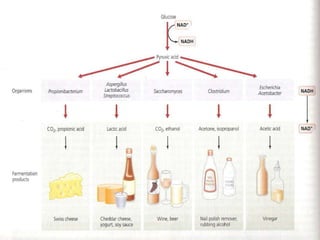
 Some examples of fermentation products are :
Ethanol, lactic acid, beer, wine etc.
Click here to download this powerpoint template : Brown Floral Background Free Powerpoint Template
For more : Templates For Powerpoint
Page 8Free Powerpoint Templates
The Range of
Fermentation
process
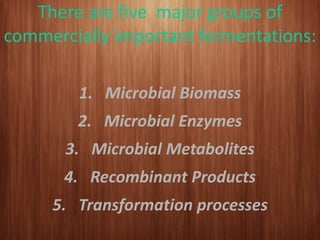
There are five major groups of
commercially important fermentations:
1. Microbial Biomass
2. Microbial Enzymes
3. Microbial Metabolites
4. Recombinant Products
5. Transformation processes
Group 1
Group 2
Group 3
Group 4
Group 5
Microbial Biomass
 Two major processes; The production of yeast to be
used in the baking industry and the production of
microbial cells to be used as human or animal
food(e.g. SCP).
 Baker’s yeast has been produced on large scale since
the early 1900s and yeast was produced as human
food in Germany during the World War.
Microbial Enzymesgroup 1
group 2
group 3
group 4
group 5
 Enzymes has been produced commercially
from plant,animal and microbial sources.
 Commercially produced microbial enzymes
are used in the food and related
industries.such as- Steptokinase from
bacteria used as anti-blood clotting agent in
pharmaceutical.
Microbial Metabolitesgroup 1
group 2
group 3
group 4
group 5
 Primary metabolites:Those product that are produced in
primary metabolism(During Trophophase) e,g, Amino acid,
Vitamims,Ethanol,Polysaccharide.
 Secondary metabolites:Those product that are produced in
secondary metabolism(During the deceleration & Stationary
phase) e.g. Penicillin
Recombinant Productsgroup 1
group 2
group 3
group 4
group 5
 In recombinant DNA technology the
recipients are capable of synthesizing foreign
protein. E.coli,Saccharomyces cerevisiae and
filamentous fungi have been used as host for
such systems. Products produced by such
genetically engineered organism include
IFN,Insulin,Human serum albumin, Factors 8
and 9,Epidermal growth factor.
Transformation processgroup 1
group 2
group 3
group 4
group 5
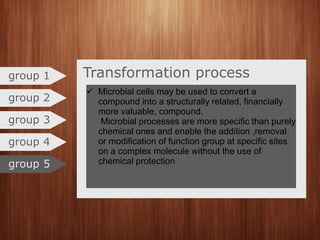
 Microbial cells may be used to convert a
compound into a structurally related, financially
more valuable, compound.
Microbial processes are more specific than purely
chemical ones and enable the addition ,removal
or modification of function group at specific sites
on a complex molecule without the use of
chemical protection
The Chronological
development of the
Fermentation
Industry
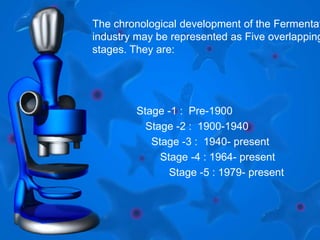
The chronological development of the Fermentat
industry may be represented as Five overlapping
stages. They are:
Stage -1 : Pre-1900
Stage -2 : 1900-1940
Stage -3 : 1940- present
Stage -4 : 1964- present
Stage -5 : 1979- present
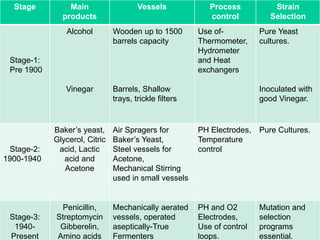
Stage Main
products
Vessels Process
control
Strain
Selection
Stage-1:
Pre 1900
Alcohol
Vinegar
Wooden up to 1500
barrels capacity
Barrels, Shallow
trays, trickle filters
Use of-
Thermometer,
Hydrometer
and Heat
exchangers
Pure Yeast
cultures.
Inoculated with
good Vinegar.
Stage-2:
1900-1940
Baker’s yeast,
Glycerol, Citric
acid, Lactic
acid and
Acetone
Air Spragers for
Baker’s Yeast,
Steel vessels for
Acetone,
Mechanical Stirring
used in small vessels
PH Electrodes,
Temperature
control
Pure Cultures.
Stage-3:
1940-
Present
Penicillin,
Streptomycin
Gibberelin,
Amino acids
Mechanically aerated
vessels, operated
aseptically-True
Fermenters
PH and O2
Electrodes,
Use of control
loops.
Mutation and
selection
programs
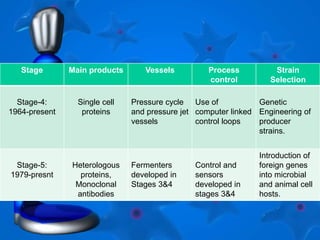
essential.
Stage Main products Vessels Process
control
Strain
Selection
Stage-4:
1964-present
Single cell
proteins
Pressure cycle
and pressure jet
vessels
Use of
computer linked
control loops
Genetic
Engineering of
producer
strains.
Stage-5:
1979-presnt
Heterologous
proteins,
Monoclonal
antibodies
Fermenters
developed in
Stages 3&4
Control and
sensors
developed in
stages 3&4
Introduction of
foreign genes
into microbial
and animal cell
hosts.
19
The Components Parts Of A
fermentation Process
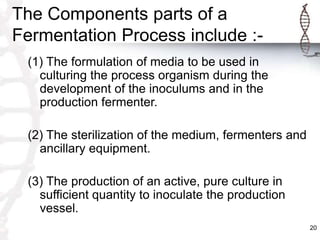
The Components parts of a
Fermentation Process include :-
(1) The formulation of media to be used in
culturing the process organism during the
development of the inoculums and in the
production fermenter.
(2) The sterilization of the medium, fermenters and
ancillary equipment.
(3) The production of an active, pure culture in
sufficient quantity to inoculate the production
vessel.
20
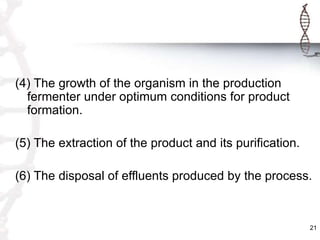
(4) The growth of the organism in the production
fermenter under optimum conditions for product
formation.
(5) The extraction of the product and its purification.
(6) The disposal of effluents produced by the process.
21
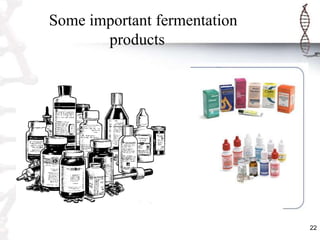
22
Some important fermentation
products
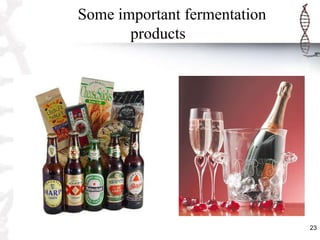
23
Some important fermentation
products
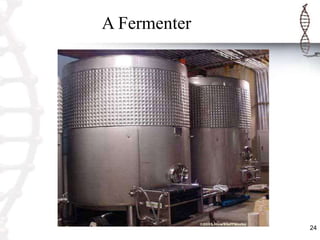
24
A Fermenter
Thank You
For Your
Precious Attention

Introduction to fermentation process

  • 1.
    An Introduction to Fermentationprocess Presented By: Rezaul Karim & Jabed khan
  • 3.
  • 4.
    The term ‘fermentation’is derived from the Latin verb ‘fevere’ means ‘to boil’
  • 5.
     Conversion ofSugar to Alcohol using yeast  Chemical conversion of carbohydrates into alcohols or acids.  Any spoilage of food by microorganisms  Any process that produces alcoholic beverages or acidic dairy products  Any energy-releasing metabolic process that takes place only under anaerobic conditions
  • 6.
     However, Fermentationhas come to have different meanings to Biochemists and to Industrial Microbiologists.  Its Biochemical meaning relates to the generation of energy by the catabolism of organic compounds,  Where as Its meaning in Industrial Microbiology tends to be much broader.  In Microbial sense, Fermentation may be defined as process of growing of a culture of microorganism in a nutrient medium and thereby converting feed into a desired product.  Some examples of fermentation products are : Ethanol, lactic acid, beer, wine etc.
  • 8.
    Click here todownload this powerpoint template : Brown Floral Background Free Powerpoint Template For more : Templates For Powerpoint Page 8Free Powerpoint Templates The Range of Fermentation process
  • 9.
    There are fivemajor groups of commercially important fermentations: 1. Microbial Biomass 2. Microbial Enzymes 3. Microbial Metabolites 4. Recombinant Products 5. Transformation processes
  • 10.
    Group 1 Group 2 Group3 Group 4 Group 5 Microbial Biomass  Two major processes; The production of yeast to be used in the baking industry and the production of microbial cells to be used as human or animal food(e.g. SCP).  Baker’s yeast has been produced on large scale since the early 1900s and yeast was produced as human food in Germany during the World War.
  • 11.
    Microbial Enzymesgroup 1 group2 group 3 group 4 group 5  Enzymes has been produced commercially from plant,animal and microbial sources.  Commercially produced microbial enzymes are used in the food and related industries.such as- Steptokinase from bacteria used as anti-blood clotting agent in pharmaceutical.
  • 12.
    Microbial Metabolitesgroup 1 group2 group 3 group 4 group 5  Primary metabolites:Those product that are produced in primary metabolism(During Trophophase) e,g, Amino acid, Vitamims,Ethanol,Polysaccharide.  Secondary metabolites:Those product that are produced in secondary metabolism(During the deceleration & Stationary phase) e.g. Penicillin
  • 13.
    Recombinant Productsgroup 1 group2 group 3 group 4 group 5  In recombinant DNA technology the recipients are capable of synthesizing foreign protein. E.coli,Saccharomyces cerevisiae and filamentous fungi have been used as host for such systems. Products produced by such genetically engineered organism include IFN,Insulin,Human serum albumin, Factors 8 and 9,Epidermal growth factor.
  • 14.
    Transformation processgroup 1 group2 group 3 group 4 group 5  Microbial cells may be used to convert a compound into a structurally related, financially more valuable, compound. Microbial processes are more specific than purely chemical ones and enable the addition ,removal or modification of function group at specific sites on a complex molecule without the use of chemical protection
  • 15.
    The Chronological development ofthe Fermentation Industry
  • 16.
    The chronological developmentof the Fermentat industry may be represented as Five overlapping stages. They are: Stage -1 : Pre-1900 Stage -2 : 1900-1940 Stage -3 : 1940- present Stage -4 : 1964- present Stage -5 : 1979- present
  • 17.
    Stage Main products Vessels Process control Strain Selection Stage-1: Pre1900 Alcohol Vinegar Wooden up to 1500 barrels capacity Barrels, Shallow trays, trickle filters Use of- Thermometer, Hydrometer and Heat exchangers Pure Yeast cultures. Inoculated with good Vinegar. Stage-2: 1900-1940 Baker’s yeast, Glycerol, Citric acid, Lactic acid and Acetone Air Spragers for Baker’s Yeast, Steel vessels for Acetone, Mechanical Stirring used in small vessels PH Electrodes, Temperature control Pure Cultures. Stage-3: 1940- Present Penicillin, Streptomycin Gibberelin, Amino acids Mechanically aerated vessels, operated aseptically-True Fermenters PH and O2 Electrodes, Use of control loops. Mutation and selection programs essential.
  • 18.
    Stage Main productsVessels Process control Strain Selection Stage-4: 1964-present Single cell proteins Pressure cycle and pressure jet vessels Use of computer linked control loops Genetic Engineering of producer strains. Stage-5: 1979-presnt Heterologous proteins, Monoclonal antibodies Fermenters developed in Stages 3&4 Control and sensors developed in stages 3&4 Introduction of foreign genes into microbial and animal cell hosts.
  • 19.
    19 The Components PartsOf A fermentation Process
  • 20.
    The Components partsof a Fermentation Process include :- (1) The formulation of media to be used in culturing the process organism during the development of the inoculums and in the production fermenter. (2) The sterilization of the medium, fermenters and ancillary equipment. (3) The production of an active, pure culture in sufficient quantity to inoculate the production vessel. 20
  • 21.
    (4) The growthof the organism in the production fermenter under optimum conditions for product formation. (5) The extraction of the product and its purification. (6) The disposal of effluents produced by the process. 21
  • 22.
  • 23.
  • 24.
  • 25.