RECOVERYANDPURIFICATION
RASHIKARAJASUNDAR
The various stages of processing
that occur after the completion
of the fermentation or
bioconversion stage, including
separation, purification, and
packaging of the product
Recovery and Purification of Bio-Products
- Strategies to recovery and purify bio-products
Fermentor
Solid-liquid separation
Recovery
Purification
SupernatantCellsCell products
Cell disruption or
rupture
Cell debris
Crystallization and drying
 Removal of insoluble's
 Product Isolation
 Product Purification
 Product Polishing
• capture of the product as a solute
in a particulate-free liquid
• Example
separation of cells, cell debris or
other particulate matter from
fermentation broth containing an
antibiotic.
Filtration
Centrifugation
Flocculation
 reducing the volume of material to be
handled and concentrating the product.
 the unit operations involved
-Solvent extraction
-ultra filtration
-precipitation
• To separate contaminants that
resemble the product very closely in
physical and chemical properties.
• Expensive and require sensitive and
sophisticated equipment.
• final processing steps which end with
packaging of the product in a form that is
stable, easily transportable and convenient.
• Crystallization, desiccation, lyophilization
and spray drying are typical unit operations
• process of formation of solid crystals
precipitating from a solution, melt or more
rarely deposited directly from a gas.
• chemical solid-liquid separation technique,
in which mass transfer of a solute from the
liquid solution to a pure solid crystalline
phase occurs.
• freezing the material
• reducing the surrounding pressure and
adding enough heat to allow the frozen
water in the material to sublime directly
from the solid phase to gas.
 Intracellular or Extracellular location
 Concentration of product in broth
 Physical and chemical properties
 Use of product
 Minimal acceptable standard of purity
 Bio-hazard of the product
 Impurities in the broth
 Product is present in the fermented broth
 Microbial cells and insoluble particles are
separated from the harvested broth.
 This process mainly includes;
 PRECIPITATION
 FILTRATION
 CENTRIFUGATION
• formation of a solid in a solution during a
chemical reaction.
• solid formed is called the precipitate and
the liquid remaining above the solid is called
the supernatant.
Salt precipitation
Solvent precipitation
 Addition of salts will cause removal of water
molecules from the surface of the
product/protein.
 Hence all the hydrophobic ends of the
product are exposed which causes
aggregation of product together.
 Salting in: at low conc of salt, solubility of
pdt increases.
 Salting out: at high conc of salt, solubility of
pdt decreases.
 With the help of organic solvents that targets
specific product, precipitation of product is
achieved.
 Example:
Dextran can be precipitated out by
addition of methanol.
Chilled ethanol and acetone are
used for precipitation of proteins.
 Acids and bases: Used to change the pH of
the solution till the isoelectric point.
 Salts: Ammonium sulphate, sodium sulphate.
 Non ionic polymers: PEG
 Protein binding dyes: ex) Triazine dyes
 Affinity precipitants that bind and
precipitate only specific proteins.
• A mechanical operation used for the
separation of solids from fluids (liquids or
gases) by interposing a medium to fluid flow
through which the fluid can pass, but the
solids in the fluid are retained.
Size and shape of solid particles.
Solid : liquid ratio
Scale of operation
Aseptic conditions
The basic requirements for filtration
equipment are:
 mechanical support for the filter
medium
 flow accesses to and from the filter
medium
 provision for removing excess filter
cake.
 In some instances, washing of the filter cake
to remove traces of the solution may be
necessary.
 Pressure can be provided on the upstream
side of the filter, or a vacuum can be drawn
downstream, or both can be used to drive
the wash fluid through.
 In the plate and frame filter press, a cloth or
mesh is spread out over plates which support
the cloth along ridges but at the same time
leave a free area, as large as possible, below
the cloth for flow of the filtrate.
 The plates with their filter cloths may be
horizontal, but they are more usually hung
vertically with a number of plates operated in
parallel to give sufficient area.
 In the early stages of the filtration cycle, the
pressure drop across the cloth is small and
filtration proceeds at more or less a constant
rate.
 As the cake increases, the process becomes
more and more a constant-pressure one and
this is the case throughout most of the cycle.
 When the available space between successive
frames is filled with cake, the press has to be
dismantled and the cake scraped off and
cleaned, after which a further cycle can be
initiated.
 The plate and frame filter press is cheap but it is
difficult to mechanize to any great extent.
 Filtration can be done under pressure or vacuum.
 The advantage of vacuum filtration is that the
pressure drop can be maintained whilst the cake is
still under atmospheric pressure and so can be
removed easily.
 The disadvantages are the greater costs of
maintaining a given pressure drop by applying a
vacuum and the limitation on the vacuum to about
80 kPa maximum
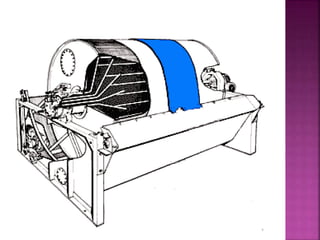
 In rotary filters, the flow passes through
a rotating cylindrical cloth from which
the filter cake can be continuously
scraped.
 Either pressure or vacuum can provide
the driving force, but a particularly
useful form is the rotary vacuum filter.
 Centrifugal force is used to provide the driving
force in some filters.
 These machines are really centrifuges fitted
with a perforated bowl that may also have filter
cloth on it.
 Liquid is fed into the interior of the bowl and
under the centrifugal forces, it passes out
through the filter material.
Filtration equipment:
(a) plate and frame
press
(b) rotary vacuum
filter
(c) centrifugal filter

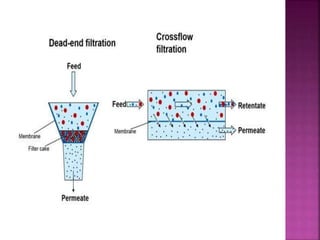
 In this method, the feed flow is driven
within the filter in downward spiralling
direction.
 When flow is parallel to the filter surface,
it is being pressurized against the filter
surface to obtain the filtrate.
 use of the centrifugal force for the
separation of mixtures
 More-dense components migrate away from
the axis of the centrifuge
 less-dense components migrate towards the
axis.
1. Tubular centrifuge
 The bowl is tall and has a narrow diameter
 Such centrifuge, known as super-centrifuges,
develop a force about 13000 times the force
of gravity.
 Some narrow, centrifuges. Having a diameter
of 75 mm and very high speeds or so
rev/min, are known as ultracentrifuges
 These centrifuges are often used to separate
liquid-liquid emulsions
2. Disk bowl centrifuge
 The feed enters the actual compartment at the
bottom and travels upward through vertically
spaced feed holes, filling the spaces between
the disks
 The holes divide the vertical assembly into an
inner section, where mostly light liquid is
present, and an outer section, where mainly
heavy liquid is present. The heavy liquid flows
beneath the underside of a disk to the periphery
of the bowl
 The light liquid flows over the upper side of the
disks and toward the inner outlet
 Any small amount of heavy solids is thrown outer
wall
 Periodic cleaning is required to remove solids
deposited
 Disk bowl centrifuges are used in starch-gluten
separation, concentration of rubber latex, and
cream separation
 3.Decanter centrifuge:
 Only sedimentation centrifuge
designed to handle more solid conc in
feed suspension.
 Also obtains good degree of
clarification of liquid conc.
 It consists of a horizontal,
cylindrical bowl rotating at a high speed
within a helical extraction screw.
• process where a solute comes out of solution
in the form of flocs or flakes.
• Particles finer than 0.1 µm in water remain
continuously in motion due to electrostatic
charge which causes them to repel each
other
• Once their electrostatic charge is
neutralized (use of coagulant) the finer
particles start to collide and combine
together .
• These larger and heavier particles are called
flocs.
PHYSIO-MECHANICAL
METHODS
CHEMICAL METHODS
CELL DISRUPTION
LIQUID SHEAR
SOLID SHEAR
BLENDERS
FREEZE
THAWING
ULTRA
SONICATION
1.HOMOGENIZERS:
 Pumps the slurry through a
restricted orifice valve.
 Uses high pressure up to 1500 bar
followed by instant expansion through a
special exiting nozzle.
 Cell disruption is accomplished by 3
mechanisms;
 Impingement on the valve
 High liquid shear in the orifice
 Sudden pressure drop upon discharge
2.Ball mill/Bead mill:
 Devices used to rapidly grind materials
to colloidal fineness (1 micron or below)
 Grinding is carried out with steel or
ceramic balls within the cylinder.
 Cells are agitated with small abrasive
particles
 Cells break due to shear forces
3.BLENDERS:
Simple method used to disrupt the cells in
case of weak cell wall. High speed mixing is
employed.
4.FREEZE THAWING:
 Freezing and thawing of microbial cell will
cause formation of ice crystals and repeated
freeze thawing will lead to subsequent
disruption of cell.
 Slow process with limited release of cell
contents.
5.Ultrasonication:
 High frequency vibration (20 kHz)
transported through a metallic tip to an
concentrated cellular suspension.
 Leads to creation of cavities, thereby shock
waves disrupt the cells.
 Method is costly and effective in small scale.
 Cells break completely leading to release of
all cellular materials.
 Requirement of more than one release
process.
 Difficult to separate product of interest from
other cellular materials.
 Repeated processing leads to decrease in
quality of the desired product.
DETERGENTS
CHAOTROPIC
AGENTS
OSMOTIC
SHOCK
ALKALI
TREATMENT
ENZYME
TREATMENT
1.Detergents:
 Cause damage to lipoproteins of cell wall of
microorganisms.
 Compounds used are sodium lauryl sulphate,
sodium dodecyl sulphate, triton X-100,phenyl
ethyl alcohol, dimethyl sulphoxide, benzene,
methanol, chloroform etc.
 Triton X-100 with guanidine-HCL is widely
and effectively used for release of cellular
proteins.
2.Chaotrophic agents:
 Agents in water solution capable of
disrupting hydrogen bonds of water
molecule.
 Example, urea and guanidine.
3.Osmotic shock:
 Caused by sudden change in salt
concentration.
 Proved to be a successful tech’ for extraction
of luciferase from Photobacterium fisheri.
 High salt concentration causes cell lysis and
low salt concentration causes over
accumulation of water inside the cell leading
to bursting of cell.
4.Alkali treatment:
 Used for hydrolysis of microbial cell wall.
 Provided that the desired product will
tolerate a pH of 11.5 to 12.5 for 20 to 30
minutes.
5.Enzyme treatment:
 Used to permeabilize cells to release the cell
contents.
 Enzymes used include, glucanase, protease,
mannase, lysozyme etc.
 Expensive method and presence of enzyme
may further complicate purification
processes.
RASHIKA RAJASUNDAR

Downstream processing

  • 1.
  • 2.
    The various stagesof processing that occur after the completion of the fermentation or bioconversion stage, including separation, purification, and packaging of the product
  • 3.
    Recovery and Purificationof Bio-Products - Strategies to recovery and purify bio-products Fermentor Solid-liquid separation Recovery Purification SupernatantCellsCell products Cell disruption or rupture Cell debris Crystallization and drying
  • 4.
     Removal ofinsoluble's  Product Isolation  Product Purification  Product Polishing
  • 5.
    • capture ofthe product as a solute in a particulate-free liquid • Example separation of cells, cell debris or other particulate matter from fermentation broth containing an antibiotic.
  • 6.
  • 7.
     reducing thevolume of material to be handled and concentrating the product.  the unit operations involved -Solvent extraction -ultra filtration -precipitation
  • 8.
    • To separatecontaminants that resemble the product very closely in physical and chemical properties. • Expensive and require sensitive and sophisticated equipment.
  • 9.
    • final processingsteps which end with packaging of the product in a form that is stable, easily transportable and convenient. • Crystallization, desiccation, lyophilization and spray drying are typical unit operations
  • 10.
    • process offormation of solid crystals precipitating from a solution, melt or more rarely deposited directly from a gas. • chemical solid-liquid separation technique, in which mass transfer of a solute from the liquid solution to a pure solid crystalline phase occurs.
  • 11.
    • freezing thematerial • reducing the surrounding pressure and adding enough heat to allow the frozen water in the material to sublime directly from the solid phase to gas.
  • 12.
     Intracellular orExtracellular location  Concentration of product in broth  Physical and chemical properties  Use of product  Minimal acceptable standard of purity  Bio-hazard of the product  Impurities in the broth
  • 13.
     Product ispresent in the fermented broth  Microbial cells and insoluble particles are separated from the harvested broth.  This process mainly includes;  PRECIPITATION  FILTRATION  CENTRIFUGATION
  • 14.
    • formation ofa solid in a solution during a chemical reaction. • solid formed is called the precipitate and the liquid remaining above the solid is called the supernatant.
  • 15.
  • 16.
     Addition ofsalts will cause removal of water molecules from the surface of the product/protein.  Hence all the hydrophobic ends of the product are exposed which causes aggregation of product together.  Salting in: at low conc of salt, solubility of pdt increases.  Salting out: at high conc of salt, solubility of pdt decreases.
  • 17.
     With thehelp of organic solvents that targets specific product, precipitation of product is achieved.  Example: Dextran can be precipitated out by addition of methanol. Chilled ethanol and acetone are used for precipitation of proteins.
  • 18.
     Acids andbases: Used to change the pH of the solution till the isoelectric point.  Salts: Ammonium sulphate, sodium sulphate.  Non ionic polymers: PEG  Protein binding dyes: ex) Triazine dyes  Affinity precipitants that bind and precipitate only specific proteins.
  • 19.
    • A mechanicaloperation used for the separation of solids from fluids (liquids or gases) by interposing a medium to fluid flow through which the fluid can pass, but the solids in the fluid are retained.
  • 20.
    Size and shapeof solid particles. Solid : liquid ratio Scale of operation Aseptic conditions
  • 21.
    The basic requirementsfor filtration equipment are:  mechanical support for the filter medium  flow accesses to and from the filter medium  provision for removing excess filter cake.
  • 22.
     In someinstances, washing of the filter cake to remove traces of the solution may be necessary.  Pressure can be provided on the upstream side of the filter, or a vacuum can be drawn downstream, or both can be used to drive the wash fluid through.
  • 23.
     In theplate and frame filter press, a cloth or mesh is spread out over plates which support the cloth along ridges but at the same time leave a free area, as large as possible, below the cloth for flow of the filtrate.  The plates with their filter cloths may be horizontal, but they are more usually hung vertically with a number of plates operated in parallel to give sufficient area.
  • 24.
     In theearly stages of the filtration cycle, the pressure drop across the cloth is small and filtration proceeds at more or less a constant rate.  As the cake increases, the process becomes more and more a constant-pressure one and this is the case throughout most of the cycle.  When the available space between successive frames is filled with cake, the press has to be dismantled and the cake scraped off and cleaned, after which a further cycle can be initiated.
  • 25.
     The plateand frame filter press is cheap but it is difficult to mechanize to any great extent.  Filtration can be done under pressure or vacuum.  The advantage of vacuum filtration is that the pressure drop can be maintained whilst the cake is still under atmospheric pressure and so can be removed easily.  The disadvantages are the greater costs of maintaining a given pressure drop by applying a vacuum and the limitation on the vacuum to about 80 kPa maximum
  • 27.
     In rotaryfilters, the flow passes through a rotating cylindrical cloth from which the filter cake can be continuously scraped.  Either pressure or vacuum can provide the driving force, but a particularly useful form is the rotary vacuum filter.
  • 29.
     Centrifugal forceis used to provide the driving force in some filters.  These machines are really centrifuges fitted with a perforated bowl that may also have filter cloth on it.  Liquid is fed into the interior of the bowl and under the centrifugal forces, it passes out through the filter material.
  • 30.
    Filtration equipment: (a) plateand frame press (b) rotary vacuum filter (c) centrifugal filter 
  • 31.
     In thismethod, the feed flow is driven within the filter in downward spiralling direction.  When flow is parallel to the filter surface, it is being pressurized against the filter surface to obtain the filtrate.
  • 33.
     use ofthe centrifugal force for the separation of mixtures  More-dense components migrate away from the axis of the centrifuge  less-dense components migrate towards the axis.
  • 35.
    1. Tubular centrifuge The bowl is tall and has a narrow diameter  Such centrifuge, known as super-centrifuges, develop a force about 13000 times the force of gravity.  Some narrow, centrifuges. Having a diameter of 75 mm and very high speeds or so rev/min, are known as ultracentrifuges  These centrifuges are often used to separate liquid-liquid emulsions
  • 37.
    2. Disk bowlcentrifuge  The feed enters the actual compartment at the bottom and travels upward through vertically spaced feed holes, filling the spaces between the disks  The holes divide the vertical assembly into an inner section, where mostly light liquid is present, and an outer section, where mainly heavy liquid is present. The heavy liquid flows beneath the underside of a disk to the periphery of the bowl
  • 38.
     The lightliquid flows over the upper side of the disks and toward the inner outlet  Any small amount of heavy solids is thrown outer wall  Periodic cleaning is required to remove solids deposited  Disk bowl centrifuges are used in starch-gluten separation, concentration of rubber latex, and cream separation
  • 40.
     3.Decanter centrifuge: Only sedimentation centrifuge designed to handle more solid conc in feed suspension.  Also obtains good degree of clarification of liquid conc.  It consists of a horizontal, cylindrical bowl rotating at a high speed within a helical extraction screw.
  • 42.
    • process wherea solute comes out of solution in the form of flocs or flakes. • Particles finer than 0.1 µm in water remain continuously in motion due to electrostatic charge which causes them to repel each other • Once their electrostatic charge is neutralized (use of coagulant) the finer particles start to collide and combine together . • These larger and heavier particles are called flocs.
  • 43.
  • 44.
  • 45.
    1.HOMOGENIZERS:  Pumps theslurry through a restricted orifice valve.  Uses high pressure up to 1500 bar followed by instant expansion through a special exiting nozzle.
  • 46.
     Cell disruptionis accomplished by 3 mechanisms;  Impingement on the valve  High liquid shear in the orifice  Sudden pressure drop upon discharge
  • 48.
    2.Ball mill/Bead mill: Devices used to rapidly grind materials to colloidal fineness (1 micron or below)  Grinding is carried out with steel or ceramic balls within the cylinder.  Cells are agitated with small abrasive particles  Cells break due to shear forces
  • 50.
    3.BLENDERS: Simple method usedto disrupt the cells in case of weak cell wall. High speed mixing is employed.
  • 51.
    4.FREEZE THAWING:  Freezingand thawing of microbial cell will cause formation of ice crystals and repeated freeze thawing will lead to subsequent disruption of cell.  Slow process with limited release of cell contents.
  • 52.
    5.Ultrasonication:  High frequencyvibration (20 kHz) transported through a metallic tip to an concentrated cellular suspension.  Leads to creation of cavities, thereby shock waves disrupt the cells.  Method is costly and effective in small scale.
  • 53.
     Cells breakcompletely leading to release of all cellular materials.  Requirement of more than one release process.  Difficult to separate product of interest from other cellular materials.  Repeated processing leads to decrease in quality of the desired product.
  • 54.
  • 55.
    1.Detergents:  Cause damageto lipoproteins of cell wall of microorganisms.  Compounds used are sodium lauryl sulphate, sodium dodecyl sulphate, triton X-100,phenyl ethyl alcohol, dimethyl sulphoxide, benzene, methanol, chloroform etc.  Triton X-100 with guanidine-HCL is widely and effectively used for release of cellular proteins.
  • 56.
    2.Chaotrophic agents:  Agentsin water solution capable of disrupting hydrogen bonds of water molecule.  Example, urea and guanidine.
  • 57.
    3.Osmotic shock:  Causedby sudden change in salt concentration.  Proved to be a successful tech’ for extraction of luciferase from Photobacterium fisheri.  High salt concentration causes cell lysis and low salt concentration causes over accumulation of water inside the cell leading to bursting of cell.
  • 58.
    4.Alkali treatment:  Usedfor hydrolysis of microbial cell wall.  Provided that the desired product will tolerate a pH of 11.5 to 12.5 for 20 to 30 minutes.
  • 59.
    5.Enzyme treatment:  Usedto permeabilize cells to release the cell contents.  Enzymes used include, glucanase, protease, mannase, lysozyme etc.  Expensive method and presence of enzyme may further complicate purification processes.
  • 60.