DOUBLE FERTILIZATION
IN
ANGIOSPERMS
By
Dr P B Mallikharjuna
GFGC YB
20-4-2020
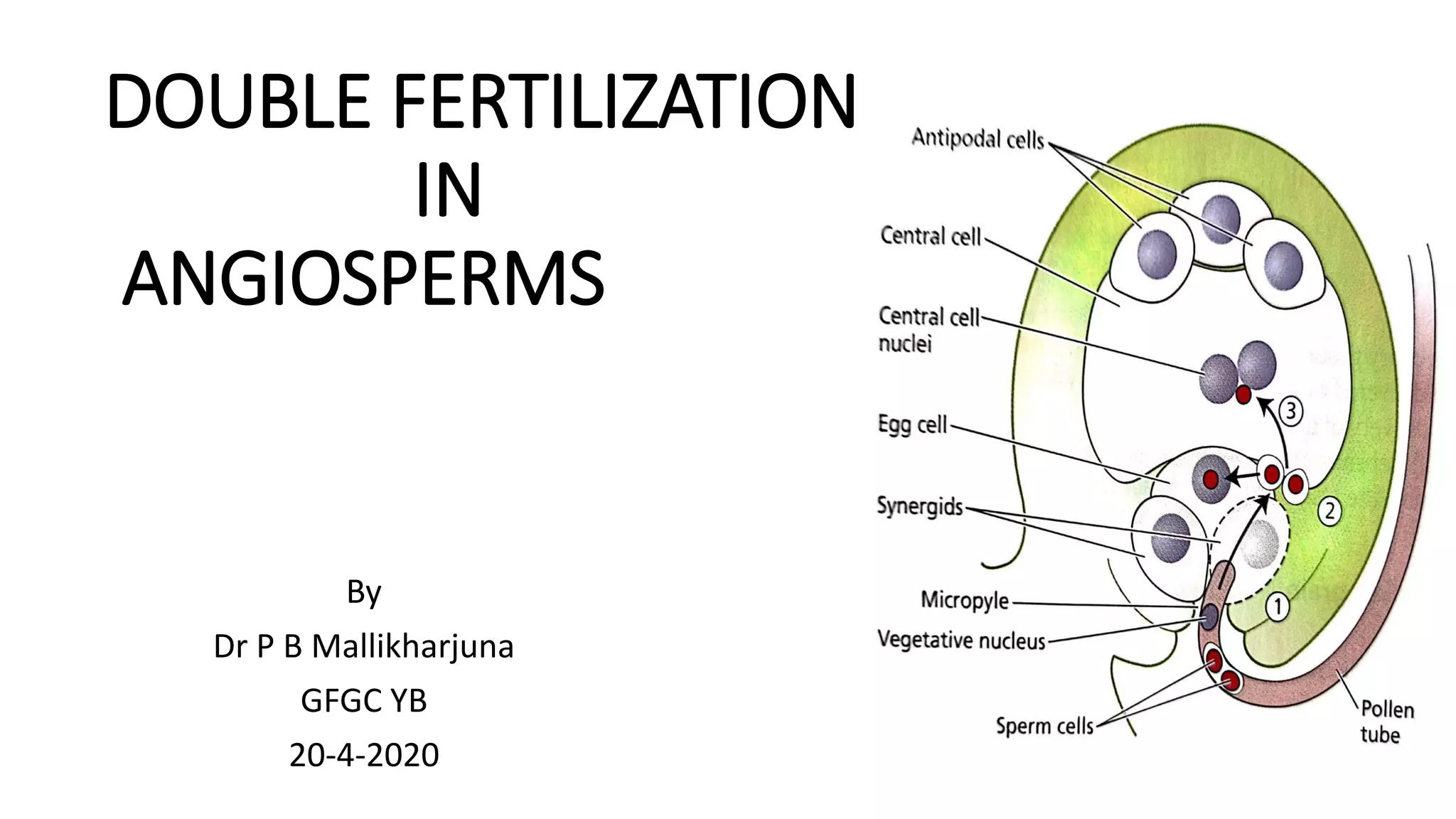
 Double fertilisation is a unique and the universal phenomenon in the life
cycle of angiosperms.
 It involves two separate nuclear fusion events and is therefore called
double fertilisation.
 First is the fusion between the female gamete or egg (found in the ovule)
and one of the male gametes (found in the male gametophyte or pollen
grain) to form a diploid zygote (Syngamy).
 The second fusion is between the other male gamete and the secondary
nucleus, leading to the formation of a Primary Endosperm Nucleus (PEN)
(Triple Fusion).
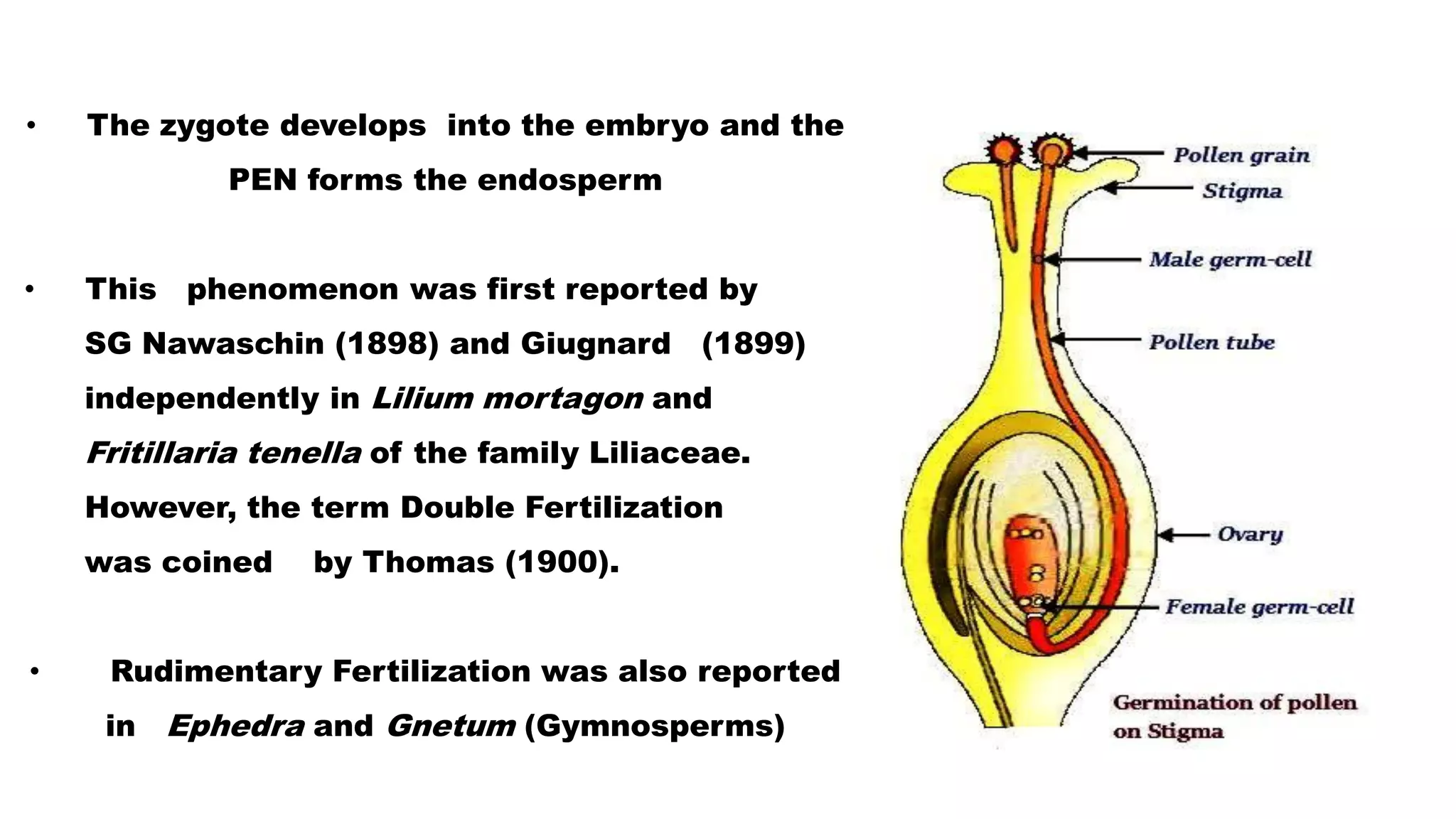
• The zygote develops into the embryo and the
PEN forms the endosperm
• This phenomenon was first reported by
SG Nawaschin (1898) and Giugnard (1899)
independently in Lilium mortagon and
Fritillaria tenella of the family Liliaceae.
However, the term Double Fertilization
was coined by Thomas (1900).
• Rudimentary Fertilization was also reported
in Ephedra and Gnetum (Gymnosperms)
Background:
 The transfer of the pollen onto the stigma of the pistil is a prerequisite
for the fertilization. This is known as Pollination, which is of two types
namely Self-pollination and Cross pollination.
 Double fertilization is a complex process requiring coordinated action
of the component cells of the female gametophyte in concert with the
male gametes.
 Recently, the plant embryologists extensively studied these series
events. With regard to this, there are two concepts are in prelude viz.,
the Male Germ Unit (MGU) and the Female Germ Unit (FGU) proposed
by Dumas et al. (1984)
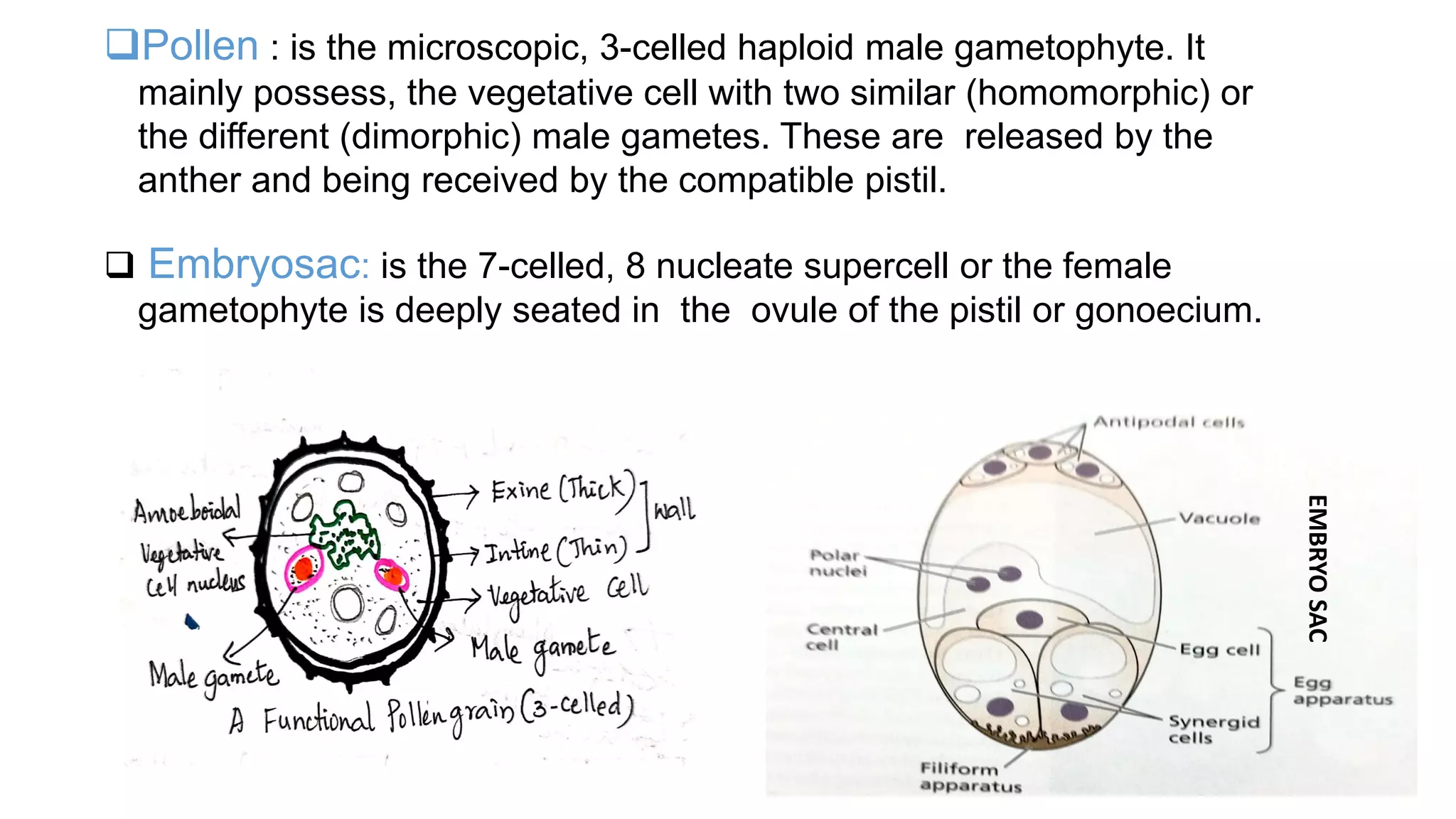
Pollen : is the microscopic, 3-celled haploid male gametophyte. It
mainly possess, the vegetative cell with two similar (homomorphic) or
the different (dimorphic) male gametes. These are released by the
anther and being received by the compatible pistil.
 Embryosac: is the 7-celled, 8 nucleate supercell or the female
gametophyte is deeply seated in the ovule of the pistil or gonoecium.
EMBRYOSAC
The process of fertilisation may be divided
into the following steps:
• Pollen-Pistil Interactions & Germination of Pollen
• Entry of pollen into stigma
• Entry of pollen into style
• Entry of pollen into ovule
• Entry of pollen into embryo sac, and
• Double Fertilisation
Pollen-Pistl Interactions:
Figure 31 Compatible and Non-compatible reactions
Pollen grains are deposited on the stigmatic surface due to pollination. Such pollen grains
interact with the sporophytic tissues of the pistil (stigma & Style) during fertilization.
Important events during such interactions are
 Pollen adhesion: The liquid exudates produced by the stigma and the Papillae present
on the stigmatic surface helps in attachment of the pollen grains to stigma.
 Pollen hydration: Stigma also provides the moisture required for the germination
of pollen grains. Hydration is faster in wet stigmas and slower in dry stigmas,
 Pollen recognition: Before allowing germination of pollens, the stigma recognizes whether
the pollen is compatible (belongs to same species) or incompatible (belong to a different
species). Only compatible pollen is allowed to germinate and incompatible pollen are not
allowed to germinate or they are rejected. The proteins and other chemical factors produce by
both pollen and stigma helps in this process.
 Pollen Germination: if the compatible
pollen starts germinating by absorbing the
nutrition and water produced by the stigma
and develops the pollen tube.
 The pollen tube growth exhibits tip growth.
 The pollen also produces enzymes, which
dissolves the outer pellicle and cuticle layers
of stigmatic papillae through which pollen
tube enters the stigma.
 Whereas, if the pollen is not compatible, it
did not allow germination, and its further
entry is blocked,.
Figure 2 showing the ultrastructure of pollen
tune
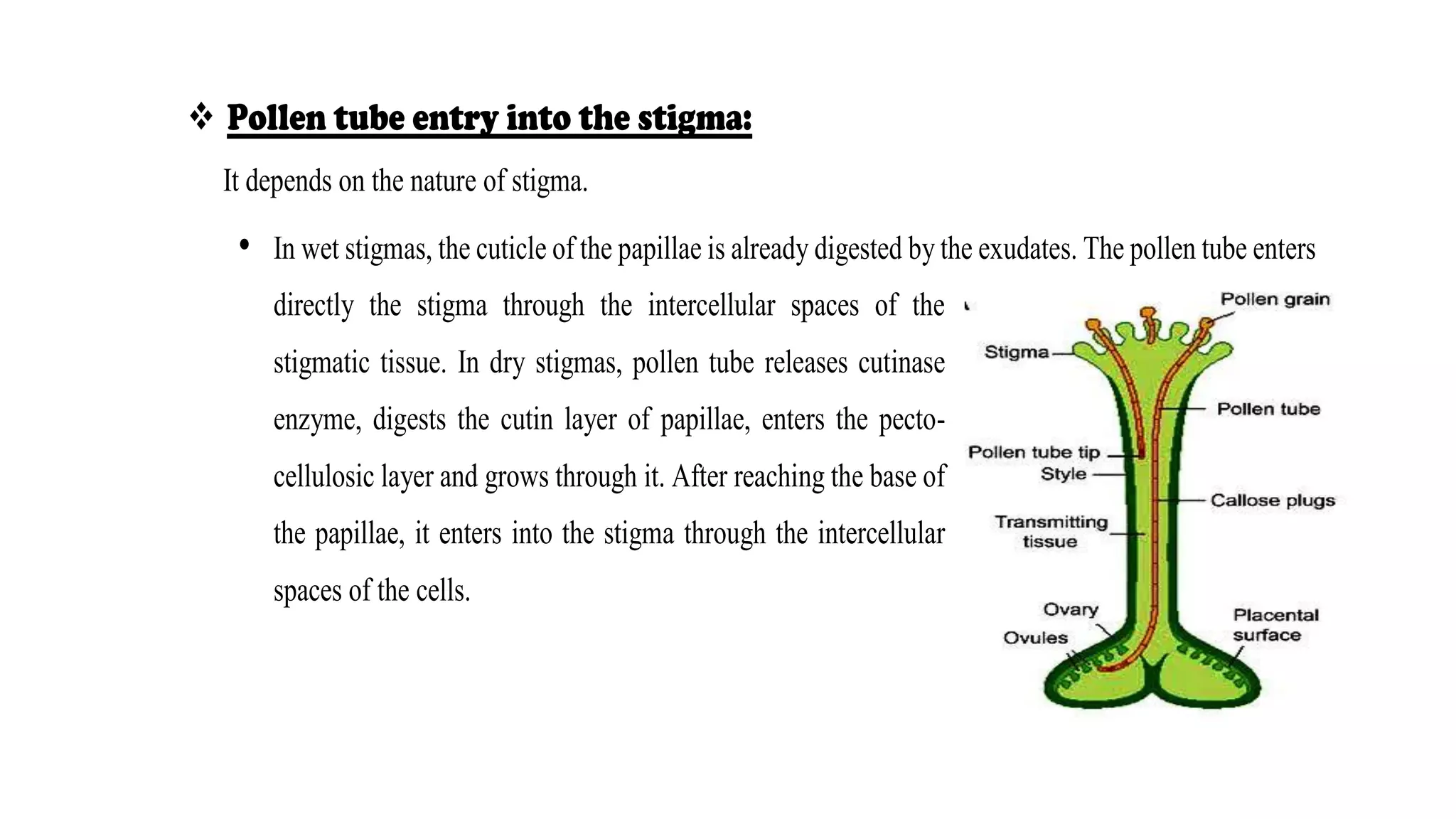
 Pollen tube entry into the stigma:
It depends on the nature of stigma.
• In wet stigmas, the cuticle of the papillae is already digested by the exudates. The pollen tube enters
directly the stigma through the intercellular spaces of the
stigmatic tissue. In dry stigmas, pollen tube releases cutinase
enzyme, digests the cutin layer of papillae, enters the pecto-
cellulosic layer and grows through it. After reaching the base of
the papillae, it enters into the stigma through the intercellular
spaces of the cells.
 Pollentubeentryandgrowthinthestyle:
Itisalsodependent onthenatureofthestyles.
• In solid type of styles, (more common in dicots) the pollen tube grows through the intercellular
spacesofthecentraltransmittingtissue,whichisfilledwithmatrix.
• Inhollowtypeofstyles(morecommonin monocots), thetubegrows downonthesurfaceoflayer
ofcanal cellswhichlinethecentral canal.
• Insemi-solidofstylesoccursonlyafewplants(Cactaceae)where the hallow stles with the
presenceoftransmittingtissueisconfinedtoonesideonly.
Pollen tube entry into ovule: it is of three types
• POROGAMY: pollen tube enters to the ovule through the micropylar
opening. it is common type (Brassica))
• CHALAZOGAMY: pollen tube enters to the integuments of ovule through
the chalazal end (Casuarina)
• MESOGAMY: pollen tube enters to the ovule by piercing the integuments
in the middle of the ovule between the chalaza and
micropyle (Cucurbita) or through the funiculus(Pistacia).
 Pollentubeentrytoembryosac:
 Pollentubeenterstotheembryosacalwaysonlythroughthemicropylarpore.Itentersinto
oneofthesynergidsthroughitsfiliformapparatus(Afingerlikestructureatthebaseofthe
synergids).Thesynergidtowhichpollenhasenteredstartsdegenerating.Thecontentsofthe
pollentube(2Malegametes)andthenucleusandalittleamountofcytoplasmofthe
vegetativecell)isreleasedtothecytoplasmofthissynergidthroughapore.Thisiscalled
Pollendischarge.
 DoubleFertilisation:
Thenuclearfusionsoractualfertilizationoccursafterpollendischarge,
Oneofthereleasedmalegamete(N)movesintotheeggcellanditsnucleusfuseswiththeeggnucleus(N).Thisis
calledSyngamyanditresultsinformationofadiploidnucleuscalledZygote(2N).Thezygotethendevelopsintothe
embryo.Thesecondmalegamete(N)movestothecentralcelloftheembryosac.Itsnucleusfuseswiththesecondary
nucleus(N+N)(formedbythefusionoftwopolarnuclei),formingatriploidnucleuscalledprimaryendospermnucleus
(PEN).ThisiscalledTripleFusion.ThePENdevelopsintotheendosperm.Recentstudieshasrevealedthatthe
movementofthe
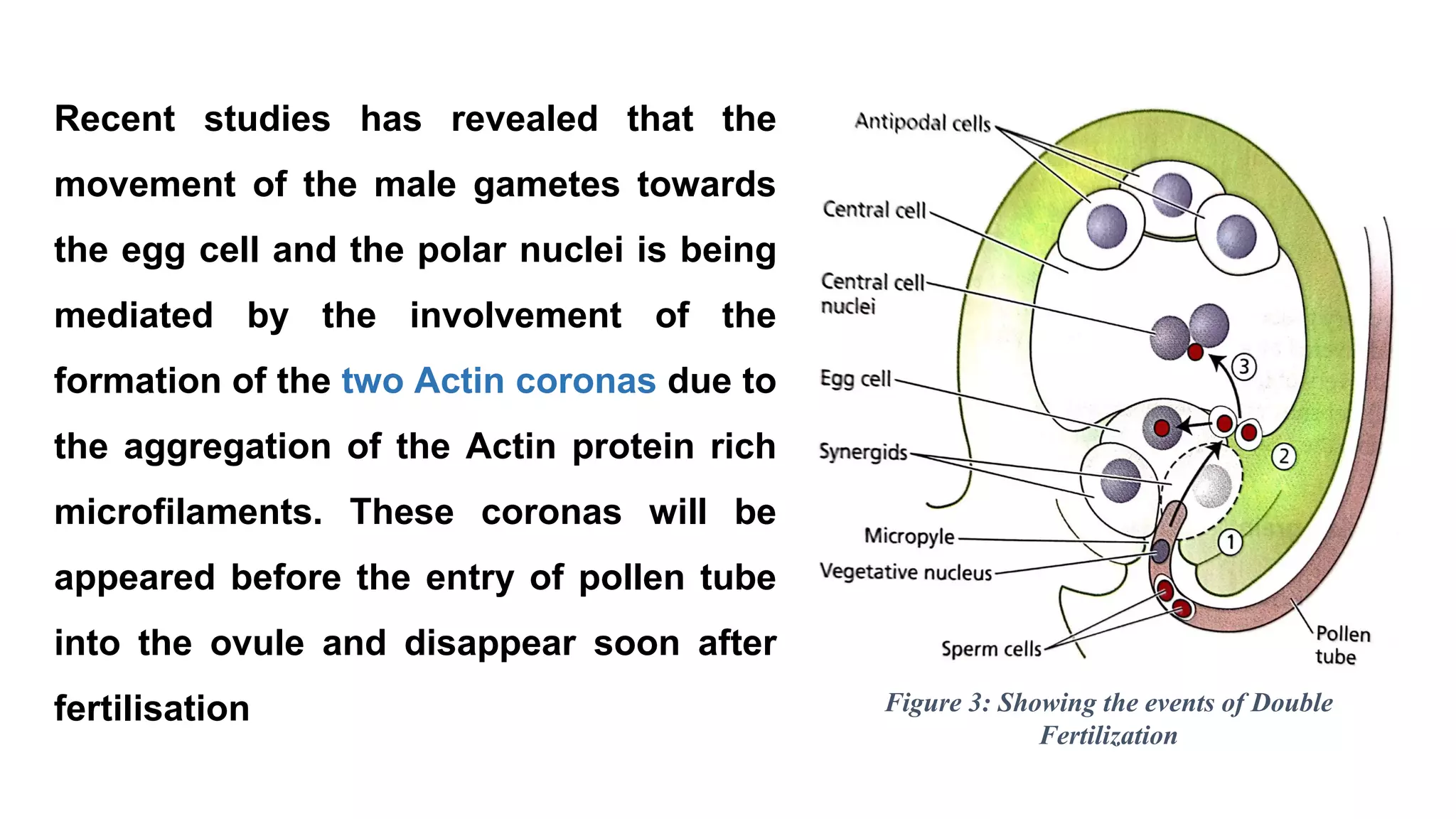
Recent studies has revealed that the
movement of the male gametes towards
the egg cell and the polar nuclei is being
mediated by the involvement of the
formation of the two Actin coronas due to
the aggregation of the Actin protein rich
microfilaments. These coronas will be
appeared before the entry of pollen tube
into the ovule and disappear soon after
fertilisation Figure 3: Showing the events of Double
Fertilization
The pictorial over view of the Double Fertilization
Significance of Double fertilization: Since double fertilization is unique to
Angiosperms, these are the most dominant vegetation on the earth today. Because
they are producing the viable and most adaptive seeds as the propagules. Secondly,
due to endospermic (albumen) the seeds are serving as the food to the human and
his livestock.
References :
1. Mallikharjuna PB : Yellow pages on Embryology (1992)
2. Bhojwani & Bhatnagar: Embryology of Angiosperms, 6th Edn. (2008)
3. Vijayaraghavan V: Double Fertilization (2005)
4. Raven PH et al: Biology of Plants (2010)
5. Bhandari JM : Fertilization in angiosperms (GFGC, Karwar)
Note : This document is prepared by Dr PB Mallikharjuna, Associate Professor & Head, Govt. First
Grade College, Yelahanka , Bangalore -560 064 as a part of the e- learning on 19-4-2020

DOUBLE FERTILIZATION IN ANGIOSPERMS

  • 1.
    DOUBLE FERTILIZATION IN ANGIOSPERMS By Dr PB Mallikharjuna GFGC YB 20-4-2020
  • 2.
     Double fertilisationis a unique and the universal phenomenon in the life cycle of angiosperms.  It involves two separate nuclear fusion events and is therefore called double fertilisation.  First is the fusion between the female gamete or egg (found in the ovule) and one of the male gametes (found in the male gametophyte or pollen grain) to form a diploid zygote (Syngamy).  The second fusion is between the other male gamete and the secondary nucleus, leading to the formation of a Primary Endosperm Nucleus (PEN) (Triple Fusion).
  • 3.
    • The zygotedevelops into the embryo and the PEN forms the endosperm • This phenomenon was first reported by SG Nawaschin (1898) and Giugnard (1899) independently in Lilium mortagon and Fritillaria tenella of the family Liliaceae. However, the term Double Fertilization was coined by Thomas (1900). • Rudimentary Fertilization was also reported in Ephedra and Gnetum (Gymnosperms)
  • 4.
    Background:  The transferof the pollen onto the stigma of the pistil is a prerequisite for the fertilization. This is known as Pollination, which is of two types namely Self-pollination and Cross pollination.  Double fertilization is a complex process requiring coordinated action of the component cells of the female gametophyte in concert with the male gametes.  Recently, the plant embryologists extensively studied these series events. With regard to this, there are two concepts are in prelude viz., the Male Germ Unit (MGU) and the Female Germ Unit (FGU) proposed by Dumas et al. (1984)
  • 5.
    Pollen : isthe microscopic, 3-celled haploid male gametophyte. It mainly possess, the vegetative cell with two similar (homomorphic) or the different (dimorphic) male gametes. These are released by the anther and being received by the compatible pistil.  Embryosac: is the 7-celled, 8 nucleate supercell or the female gametophyte is deeply seated in the ovule of the pistil or gonoecium. EMBRYOSAC
  • 6.
    The process offertilisation may be divided into the following steps: • Pollen-Pistil Interactions & Germination of Pollen • Entry of pollen into stigma • Entry of pollen into style • Entry of pollen into ovule • Entry of pollen into embryo sac, and • Double Fertilisation
  • 7.
    Pollen-Pistl Interactions: Figure 31Compatible and Non-compatible reactions
  • 8.
    Pollen grains aredeposited on the stigmatic surface due to pollination. Such pollen grains interact with the sporophytic tissues of the pistil (stigma & Style) during fertilization. Important events during such interactions are  Pollen adhesion: The liquid exudates produced by the stigma and the Papillae present on the stigmatic surface helps in attachment of the pollen grains to stigma.  Pollen hydration: Stigma also provides the moisture required for the germination of pollen grains. Hydration is faster in wet stigmas and slower in dry stigmas,  Pollen recognition: Before allowing germination of pollens, the stigma recognizes whether the pollen is compatible (belongs to same species) or incompatible (belong to a different species). Only compatible pollen is allowed to germinate and incompatible pollen are not allowed to germinate or they are rejected. The proteins and other chemical factors produce by both pollen and stigma helps in this process.
  • 9.
     Pollen Germination:if the compatible pollen starts germinating by absorbing the nutrition and water produced by the stigma and develops the pollen tube.  The pollen tube growth exhibits tip growth.  The pollen also produces enzymes, which dissolves the outer pellicle and cuticle layers of stigmatic papillae through which pollen tube enters the stigma.  Whereas, if the pollen is not compatible, it did not allow germination, and its further entry is blocked,. Figure 2 showing the ultrastructure of pollen tune
  • 10.
     Pollen tubeentry into the stigma: It depends on the nature of stigma. • In wet stigmas, the cuticle of the papillae is already digested by the exudates. The pollen tube enters directly the stigma through the intercellular spaces of the stigmatic tissue. In dry stigmas, pollen tube releases cutinase enzyme, digests the cutin layer of papillae, enters the pecto- cellulosic layer and grows through it. After reaching the base of the papillae, it enters into the stigma through the intercellular spaces of the cells.
  • 11.
     Pollentubeentryandgrowthinthestyle: Itisalsodependent onthenatureofthestyles. •In solid type of styles, (more common in dicots) the pollen tube grows through the intercellular spacesofthecentraltransmittingtissue,whichisfilledwithmatrix. • Inhollowtypeofstyles(morecommonin monocots), thetubegrows downonthesurfaceoflayer ofcanal cellswhichlinethecentral canal. • Insemi-solidofstylesoccursonlyafewplants(Cactaceae)where the hallow stles with the presenceoftransmittingtissueisconfinedtoonesideonly.
  • 12.
    Pollen tube entryinto ovule: it is of three types • POROGAMY: pollen tube enters to the ovule through the micropylar opening. it is common type (Brassica)) • CHALAZOGAMY: pollen tube enters to the integuments of ovule through the chalazal end (Casuarina) • MESOGAMY: pollen tube enters to the ovule by piercing the integuments in the middle of the ovule between the chalaza and micropyle (Cucurbita) or through the funiculus(Pistacia).
  • 13.
  • 14.
  • 15.
    Recent studies hasrevealed that the movement of the male gametes towards the egg cell and the polar nuclei is being mediated by the involvement of the formation of the two Actin coronas due to the aggregation of the Actin protein rich microfilaments. These coronas will be appeared before the entry of pollen tube into the ovule and disappear soon after fertilisation Figure 3: Showing the events of Double Fertilization
  • 17.
    The pictorial overview of the Double Fertilization
  • 18.
    Significance of Doublefertilization: Since double fertilization is unique to Angiosperms, these are the most dominant vegetation on the earth today. Because they are producing the viable and most adaptive seeds as the propagules. Secondly, due to endospermic (albumen) the seeds are serving as the food to the human and his livestock. References : 1. Mallikharjuna PB : Yellow pages on Embryology (1992) 2. Bhojwani & Bhatnagar: Embryology of Angiosperms, 6th Edn. (2008) 3. Vijayaraghavan V: Double Fertilization (2005) 4. Raven PH et al: Biology of Plants (2010) 5. Bhandari JM : Fertilization in angiosperms (GFGC, Karwar) Note : This document is prepared by Dr PB Mallikharjuna, Associate Professor & Head, Govt. First Grade College, Yelahanka , Bangalore -560 064 as a part of the e- learning on 19-4-2020