Fertilization in an
angiosperm
A.K.JHA
P.G.T(Biology)
D.A.V. CENTENARY PUBLIC SCHOOL
SIWAN(BIHAR)
What is Flower?
 Flower, the reproductive portion of any plant in the division Magnoliophyta
(Angiospermae), a group commonly called flowering plants or angiosperms.
 As popularly used, the term “flower” especially applies when part or all of
the reproductive structure is distinctive in colour and form.
 Regardless of their variety, all flowers have a uniform function,
the reproduction of the species through the production of seed.
 The flower is the characteristic structure of the evolutionarily highest group
of plants, the angiosperms.
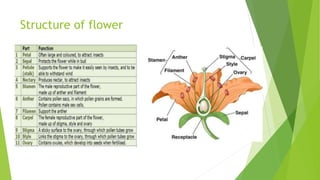
Structure of flower
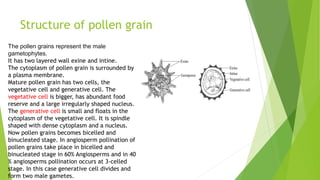
Structure of pollen grain
The pollen grains represent the male
gametophytes.
It has two layered wall exine and intine.
The cytoplasm of pollen grain is surrounded by
a plasma membrane.
Mature pollen grain has two cells, the
vegetative cell and generative cell. The
vegetative cell is bigger, has abundant food
reserve and a large irregularly shaped nucleus.
The generative cell is small and floats in the
cytoplasm of the vegetative cell. It is spindle
shaped with dense cytoplasm and a nucleus.
Now pollen grains becomes bicelled and
binucleated stage. In angiosperm pollination of
pollen grains take place in bicelled and
binucleated stage in 60% Angiosperms and in 40
% angiosperms pollination occurs at 3-celled
stage. In this case generative cell divides and
form two male gametes.
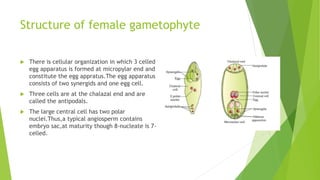
Structure of female gametophyte
 There is cellular organization in which 3 celled
egg apparatus is formed at micropylar end and
constitute the egg appratus.The egg apparatus
consists of two synergids and one egg cell.
 Three cells are at the chalazal end and are
called the antipodals.
 The large central cell has two polar
nuclei.Thus,a typical angiosperm contains
embryo sac,at maturity though 8-nucleate is 7-
celled.
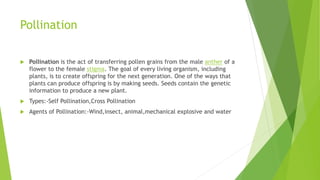
Pollination
 Pollination is the act of transferring pollen grains from the male anther of a
flower to the female stigma. The goal of every living organism, including
plants, is to create offspring for the next generation. One of the ways that
plants can produce offspring is by making seeds. Seeds contain the genetic
information to produce a new plant.
 Types:-Self Pollination,Cross Pollination
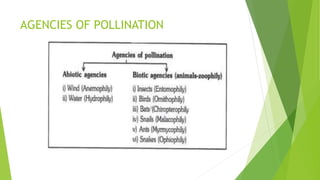
 Agents of Pollination:-Wind,insect, animal,mechanical explosive and water
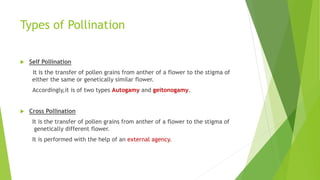
Types of Pollination
 Self Pollination
It is the transfer of pollen grains from anther of a flower to the stigma of
either the same or genetically similar flower.
Accordingly,it is of two types Autogamy and geitonogamy.
 Cross Pollination
It is the transfer of pollen grains from anther of a flower to the stigma of
genetically different flower.
It is performed with the help of an external agency.
AGENCIES OF POLLINATION
Fertilization
 Fertilization is the fusion of the male(n) and
female(n) gametes to produce a zygote(2n).
 The pollen grain produces the male gametes
 Embryo sac produces an egg cell and polar nuclei
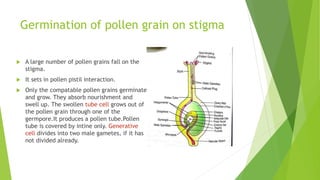
Germination of pollen grain on stigma
 A large number of pollen grains fall on the
stigma.
 It sets in pollen pistil interaction.
 Only the compatable pollen grains germinate
and grow. They absorb nourishment and
swell up. The swollen tube cell grows out of
the pollen grain through one of the
germpore.It produces a pollen tube.Pollen
tube is covered by intine only. Generative
cell divides into two male gametes, if it has
not divided already.
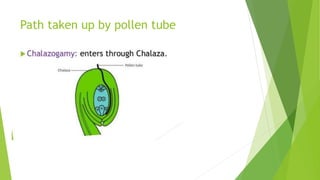
Path taken up by pollen tube
 Entry of pollen tube is 3 types:
 A.Porogamy
 B.Mesogamy
 C.Chalozagamy
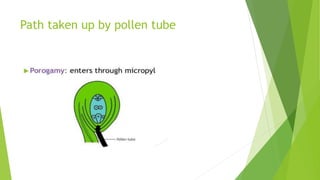
Path taken up by pollen tube
Feritilization process
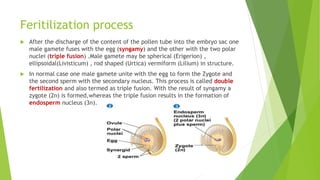
 After the discharge of the content of the pollen tube into the embryo sac one
male gamete fuses with the egg (syngamy) and the other with the two polar
nuclei (triple fusion) .Male gamete may be spherical (Erigerion) ,
ellipsoidal(Livisticum) , rod shaped (Urtica) vermiform (Lilium) in structure.
 In normal case one male gamete unite with the egg to form the Zygote and
the second sperm with the secondary nucleus. This process is called double
fertilization and also termed as triple fusion. With the result of syngamy a
zygote (2n) is formed,whereas the triple fusion results in the formation of
endosperm nucleus (3n).
Significance of Double fertilization in
the embryo sac
 It gives stimulus to the plant due to which ovary develops into fruit and ovules
develop into seeds.
 It restores the diploid condition by fusion of haploid male and female
gametes.
 It results in the formation of diploid zygote, which develops into an embryo
and gives rise to a new plant.
 It results in the formation of triploid primary endosperm nucleus (PEN) which
develops into endosperm in the seed. It provides nourishment to the
developing embryo.
fertilisation in angiosperms

fertilisation in angiosperms

  • 1.
  • 2.
    What is Flower? Flower, the reproductive portion of any plant in the division Magnoliophyta (Angiospermae), a group commonly called flowering plants or angiosperms.  As popularly used, the term “flower” especially applies when part or all of the reproductive structure is distinctive in colour and form.  Regardless of their variety, all flowers have a uniform function, the reproduction of the species through the production of seed.  The flower is the characteristic structure of the evolutionarily highest group of plants, the angiosperms.
  • 3.
  • 4.
    Structure of pollengrain The pollen grains represent the male gametophytes. It has two layered wall exine and intine. The cytoplasm of pollen grain is surrounded by a plasma membrane. Mature pollen grain has two cells, the vegetative cell and generative cell. The vegetative cell is bigger, has abundant food reserve and a large irregularly shaped nucleus. The generative cell is small and floats in the cytoplasm of the vegetative cell. It is spindle shaped with dense cytoplasm and a nucleus. Now pollen grains becomes bicelled and binucleated stage. In angiosperm pollination of pollen grains take place in bicelled and binucleated stage in 60% Angiosperms and in 40 % angiosperms pollination occurs at 3-celled stage. In this case generative cell divides and form two male gametes.
  • 5.
    Structure of femalegametophyte  There is cellular organization in which 3 celled egg apparatus is formed at micropylar end and constitute the egg appratus.The egg apparatus consists of two synergids and one egg cell.  Three cells are at the chalazal end and are called the antipodals.  The large central cell has two polar nuclei.Thus,a typical angiosperm contains embryo sac,at maturity though 8-nucleate is 7- celled.
  • 6.
    Pollination  Pollination isthe act of transferring pollen grains from the male anther of a flower to the female stigma. The goal of every living organism, including plants, is to create offspring for the next generation. One of the ways that plants can produce offspring is by making seeds. Seeds contain the genetic information to produce a new plant.  Types:-Self Pollination,Cross Pollination  Agents of Pollination:-Wind,insect, animal,mechanical explosive and water
  • 7.
    Types of Pollination Self Pollination It is the transfer of pollen grains from anther of a flower to the stigma of either the same or genetically similar flower. Accordingly,it is of two types Autogamy and geitonogamy.  Cross Pollination It is the transfer of pollen grains from anther of a flower to the stigma of genetically different flower. It is performed with the help of an external agency.
  • 8.
  • 9.
    Fertilization  Fertilization isthe fusion of the male(n) and female(n) gametes to produce a zygote(2n).  The pollen grain produces the male gametes  Embryo sac produces an egg cell and polar nuclei
  • 10.
    Germination of pollengrain on stigma  A large number of pollen grains fall on the stigma.  It sets in pollen pistil interaction.  Only the compatable pollen grains germinate and grow. They absorb nourishment and swell up. The swollen tube cell grows out of the pollen grain through one of the germpore.It produces a pollen tube.Pollen tube is covered by intine only. Generative cell divides into two male gametes, if it has not divided already.
  • 11.
    Path taken upby pollen tube  Entry of pollen tube is 3 types:  A.Porogamy  B.Mesogamy  C.Chalozagamy
  • 12.
    Path taken upby pollen tube
  • 13.
    Path taken upby pollen tube
  • 14.
    Path taken upby pollen tube
  • 15.
    Feritilization process  Afterthe discharge of the content of the pollen tube into the embryo sac one male gamete fuses with the egg (syngamy) and the other with the two polar nuclei (triple fusion) .Male gamete may be spherical (Erigerion) , ellipsoidal(Livisticum) , rod shaped (Urtica) vermiform (Lilium) in structure.  In normal case one male gamete unite with the egg to form the Zygote and the second sperm with the secondary nucleus. This process is called double fertilization and also termed as triple fusion. With the result of syngamy a zygote (2n) is formed,whereas the triple fusion results in the formation of endosperm nucleus (3n).
  • 16.
    Significance of Doublefertilization in the embryo sac  It gives stimulus to the plant due to which ovary develops into fruit and ovules develop into seeds.  It restores the diploid condition by fusion of haploid male and female gametes.  It results in the formation of diploid zygote, which develops into an embryo and gives rise to a new plant.  It results in the formation of triploid primary endosperm nucleus (PEN) which develops into endosperm in the seed. It provides nourishment to the developing embryo.