Pollen – pistill interaction and
fertilization
Content:
About pollen grains
Stucture of stigma
Pollen pistill interaction
Self incompatibility
Fertilization
• The wall of a pollen grain is quite complex structurally.
• It has an inner layer called the intine, composed of cellulose, and an
outer layer called the exine that consists of the polymer sporopollenin.
• It has one or several weak spots, germination pores, where the pollen
opens after it has been carried to the stigma of another flower.
Pollen grains
• Sporopollenin is remarkably waterproof and
resistant to almost all chemicals.
• It protects the pollen grain and keeps it from
drying out as it is being carried by wind or
Animals.
• The exine can have ridges, bumps, spines, and numerous other features so
characteristic that each species has its own particular pattern .
• In many cases, it is possible to examine single pollen grain and know exactly
which species of plant production it.
• Because sporopollenin is so resistant, pollen grains and their characteristic
patterns fossilize well.
• By examining samples of old soil, botanists can determine exactly which
plants grew in an area at a particular time in the ancient past.
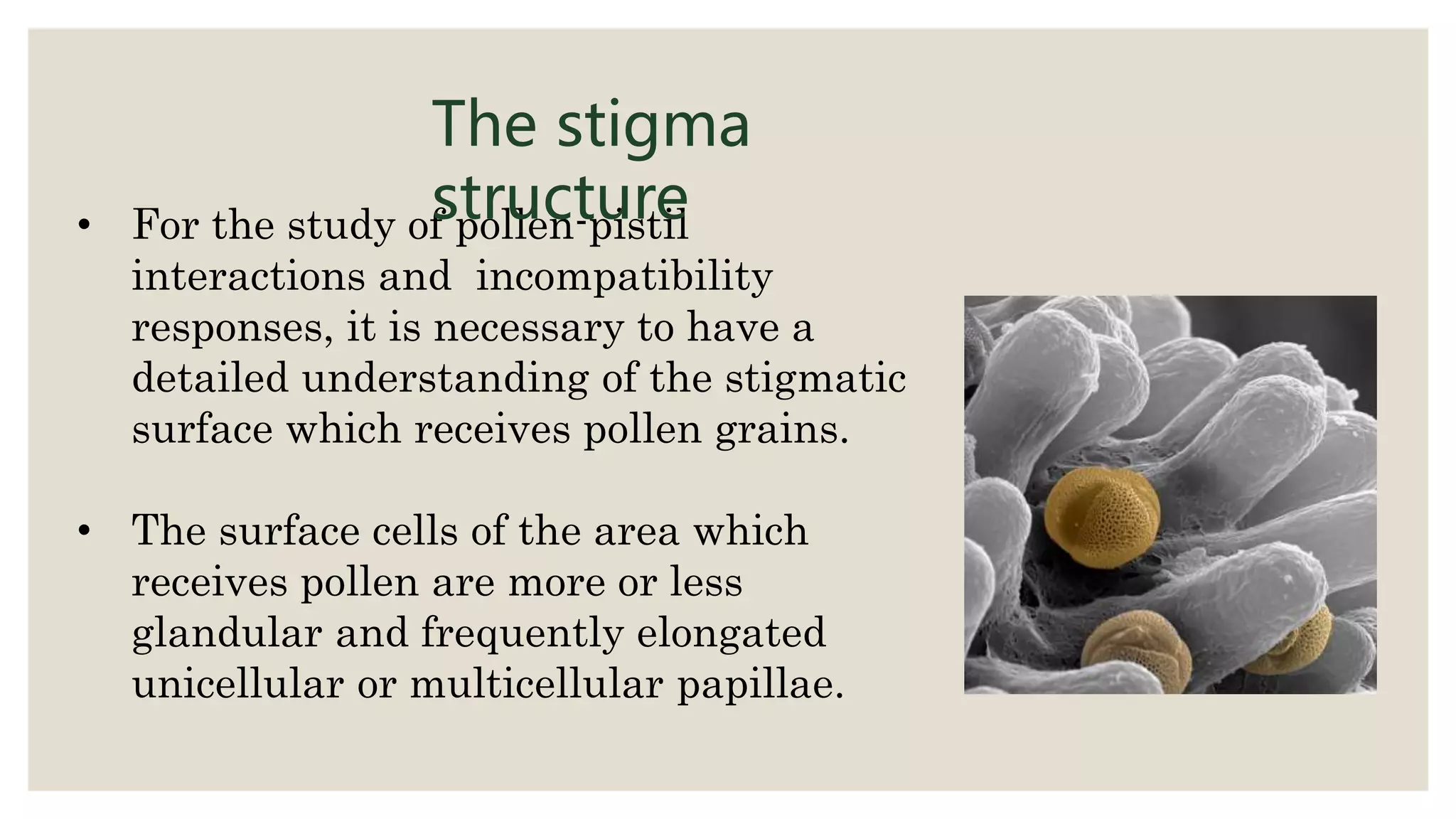
• For the study of pollen-pistil
interactions and incompatibility
responses, it is necessary to have a
detailed understanding of the stigmatic
surface which receives pollen grains.
• The surface cells of the area which
receives pollen are more or less
glandular and frequently elongated
unicellular or multicellular papillae.
The stigma
structure
There are usually two basic types of stigma :
(i) the dry type – where papillae are free from any apparent
exudates .
(ii) the wet type – where the receptive surface is covered
With exudates .
• The dry stigmas are dry only in relative sense, since the papillae
bear a hydrated proteinaceous covering over the cuticle,called
pellicle.
• The families with dry stigmas,such as brassicaceae, and
Asteraceae,pellicle does not show enzymatic properties.
• The cuticle,underlying the pellicle,is made of short radially
directed rodlets with intervening discontinuities.
• In wet stigmas, secretions continue to accumulate throughout the
life of the stigma and these secretions from a medium in which
the captured pollens germinate.
• In some genera there is an overlying lipid layer, forming " liquid
cuticle" The stigmatic exudates contain sugars, phenolic
compounds, many free amino acids and proteins.
• The viscosity of the exudates is due to the presence of
mucopolysaccharides.
• The aqueous phase of the stigmatic exudate shows non specific
esterase activity.
• Wet stigmas occur in many families, such as Solanaceae,
Liliaceae etc.
Pollen–pistil interactions
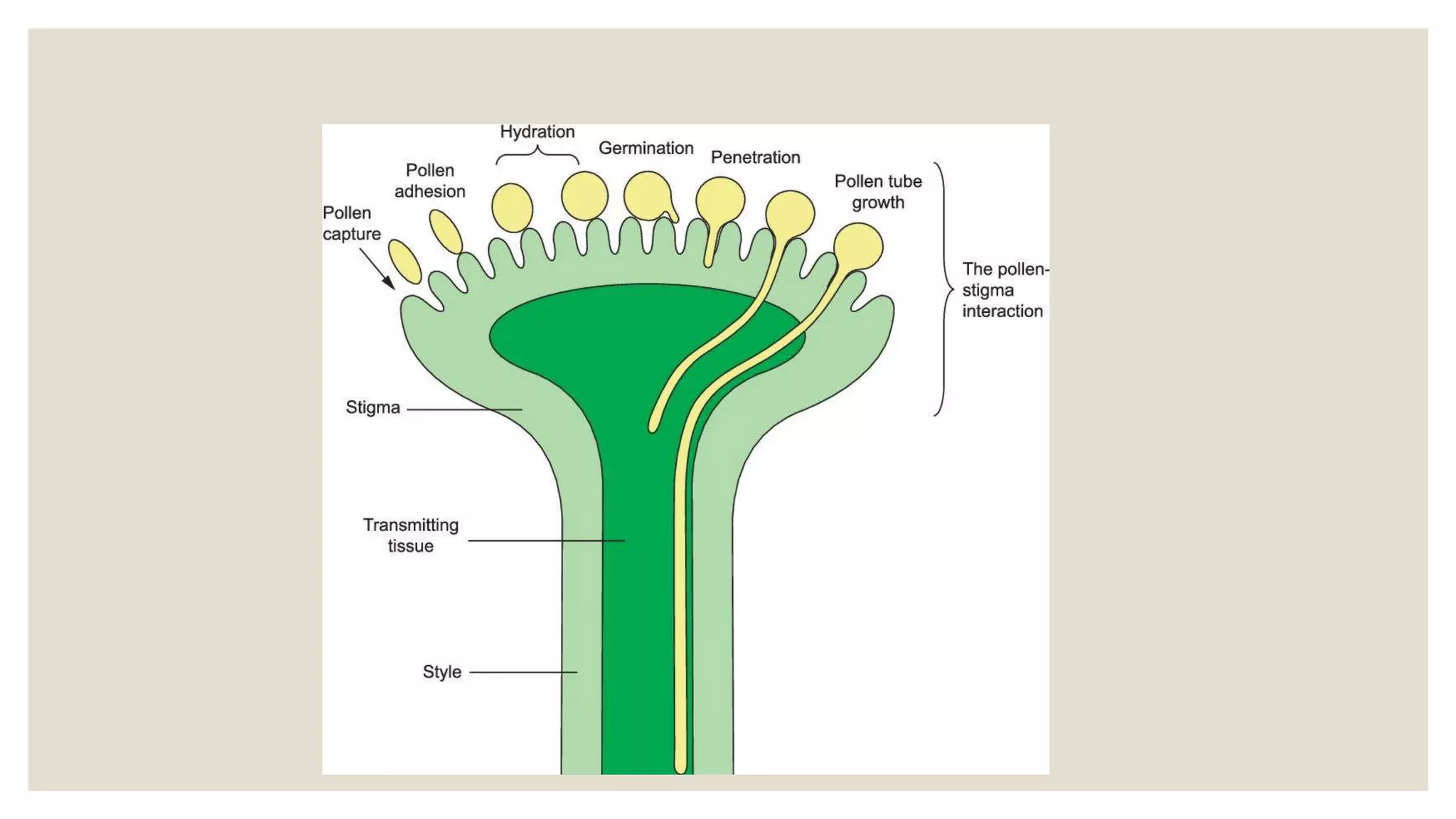
• As soon as a pollen grain lands on the stigma, it is hydrated.
• As a result of hydration, the exine and intine proteins are
released on the stigmatic surface.
• The pollen wall proteins bind to the pellicle within few minutes
of the contact and thereafter cannot be released readily by
leaching.
• The stigma surface pellicle thus forms a receptor site for the
pollen wall proteins.
• When pollen is compatible, erosion of the cuticle of the
stigma papilla begins beneath the emerging pollen tube.
• This is the essential preliminary requirement to the penetration
of the pollen tube.
• In wet stigma, the cuticle generally ruptures during the
deposition of exudates and the pollen tube enters through the
pectocellulose layer.
• In hollow styles, the pollen tube grows through the stylar canal,
whereas in solid style, it traverses the intercellular spaces.
• During its course through the style, the pollen tube utilizes
nutrients from the pistil.
• Pollination initiates many physiological and biochemical
changes in the pistil.
• This included increase in respiration, changes in RNA and
protein synthesis pattern and increase in the activity of
enzymes.
• Signals of compatible or incompatible Pollination are
transferred to the ovule even before the pollen tube is reached
there.
• For instance, in incompatible pollination, degeneration of one of
the synergids begins much before the entry of the pollen tube in
the ovules.
• Following pollination, signals are evidently passed to the style
and overy to initiate response in accordance with the compatible
or incompatible pollination.
when viable pollens of the same or other individuals of same
species prevent fertilization,it is known as intraspecific
incompatibility or self incompatibility.
Self – incompatibility is thus a device to promote cross
pollination. It ensures a certain degree of heterozygosity in a
population, which is a major factor in the evolution of the
species. It is extremely widespread among the flowering
plants.
Self incompatibility
On the basis of morphological features of the flower,self
incompatibility is of the following two types:
(a) Heteromorphic
(b) Homomorphic
Heteromorphic
(a) Distyly : there are two types of style and stamens
● Pin type: long style and short stamens (ss).
● Thrum type : short style and long stamens
(Ss).
● Pin × pin = ss × ss = incompatibility
● Thrum × thrum = Ss × Ss = incompatibility
● Thrum × pin = Ss × ss = compatibility
● Pin× thrum = ss × Ss = compatibility
self-incompatibility is associated with the different
lengths of stamens and style on flowers on the same
plant, this is known as heteromorphic incompatibility.
(b) Tristyly : when style has three different positions
Ex - Lythrum salicaria.
Homomorphic
• Homomorphic incompatibility is characterised by the
occurrence of only one type of flowers in all the
individuals of a species. It is governed by multiple
alleles,called S alleles.
• Mating is not possible if the pollen carriers the same S
allele which is present in the female gamete.
A. Gamatopytic Self incompatibility
B. Sporophytic Self incompatibility
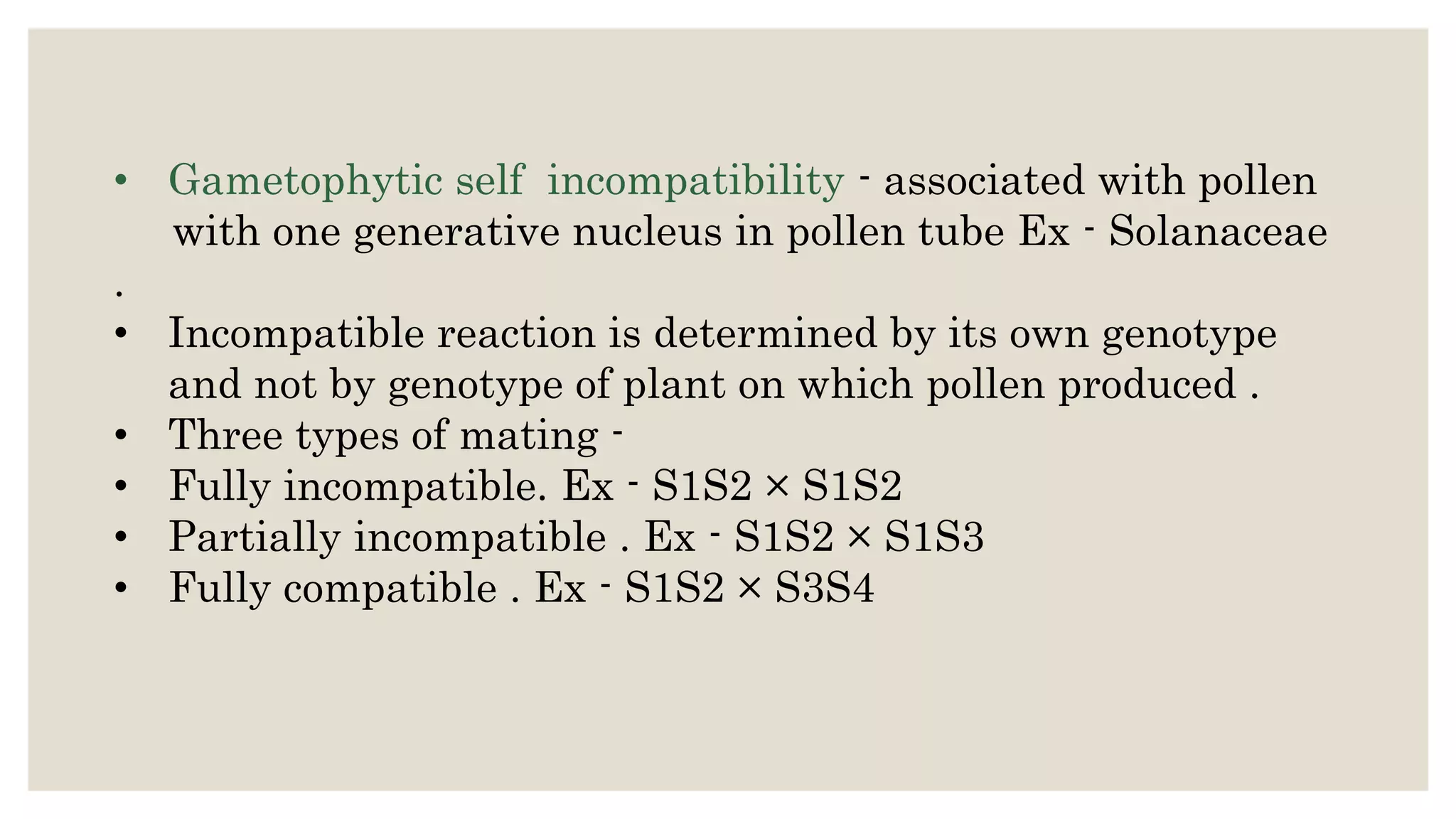
• Gametophytic self incompatibility - associated with pollen
with one generative nucleus in pollen tube Ex - Solanaceae
.
• Incompatible reaction is determined by its own genotype
and not by genotype of plant on which pollen produced .
• Three types of mating -
• Fully incompatible. Ex - S1S2 × S1S2
• Partially incompatible . Ex - S1S2 × S1S3
• Fully compatible . Ex - S1S2 × S3S4
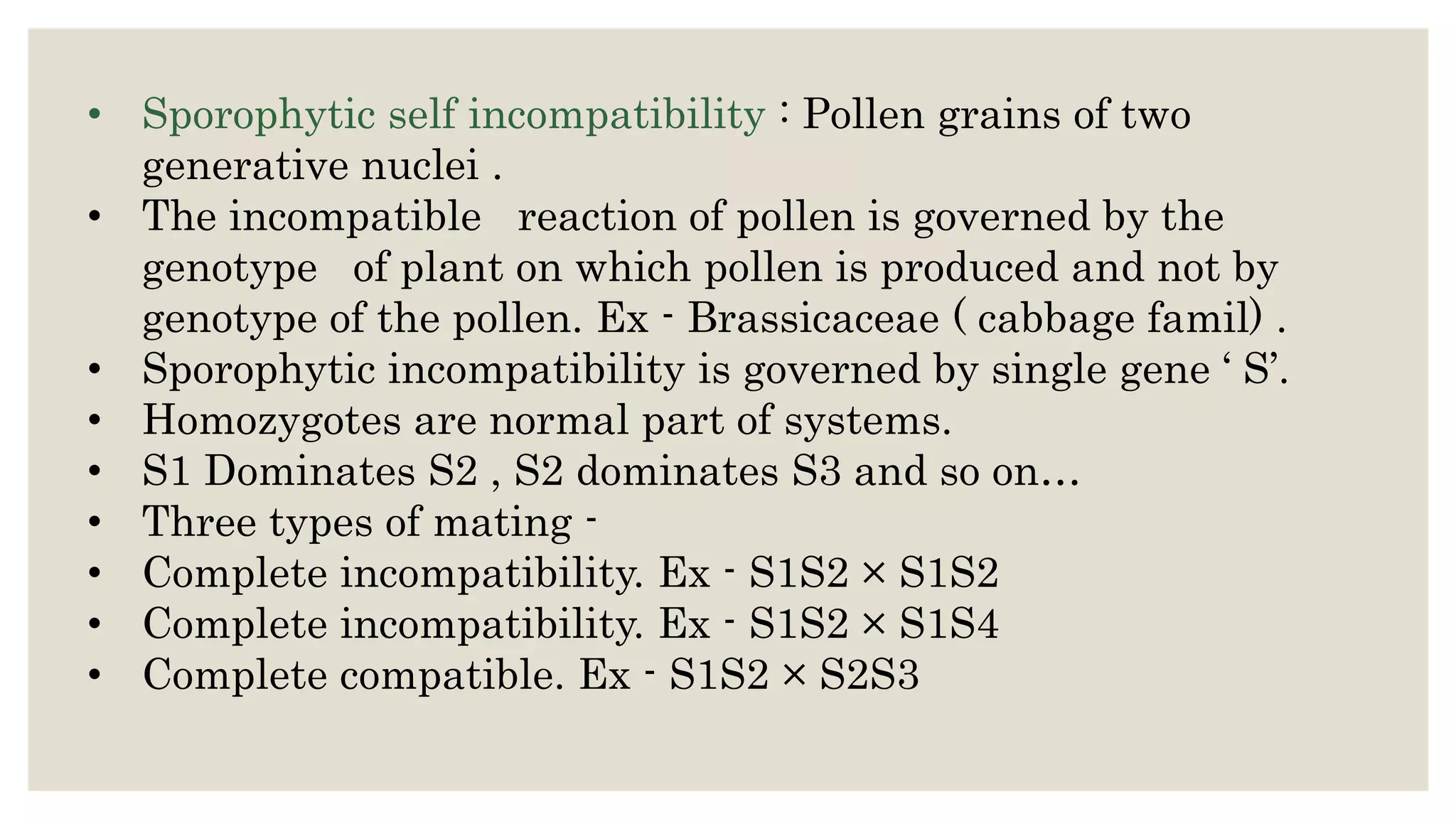
• Sporophytic self incompatibility : Pollen grains of two
generative nuclei .
• The incompatible reaction of pollen is governed by the
genotype of plant on which pollen is produced and not by
genotype of the pollen. Ex - Brassicaceae ( cabbage famil) .
• Sporophytic incompatibility is governed by single gene ‘ S’.
• Homozygotes are normal part of systems.
• S1 Dominates S2 , S2 dominates S3 and so on…
• Three types of mating -
• Complete incompatibility. Ex - S1S2 × S1S2
• Complete incompatibility. Ex - S1S2 × S1S4
• Complete compatible. Ex - S1S2 × S2S3
Fertilization
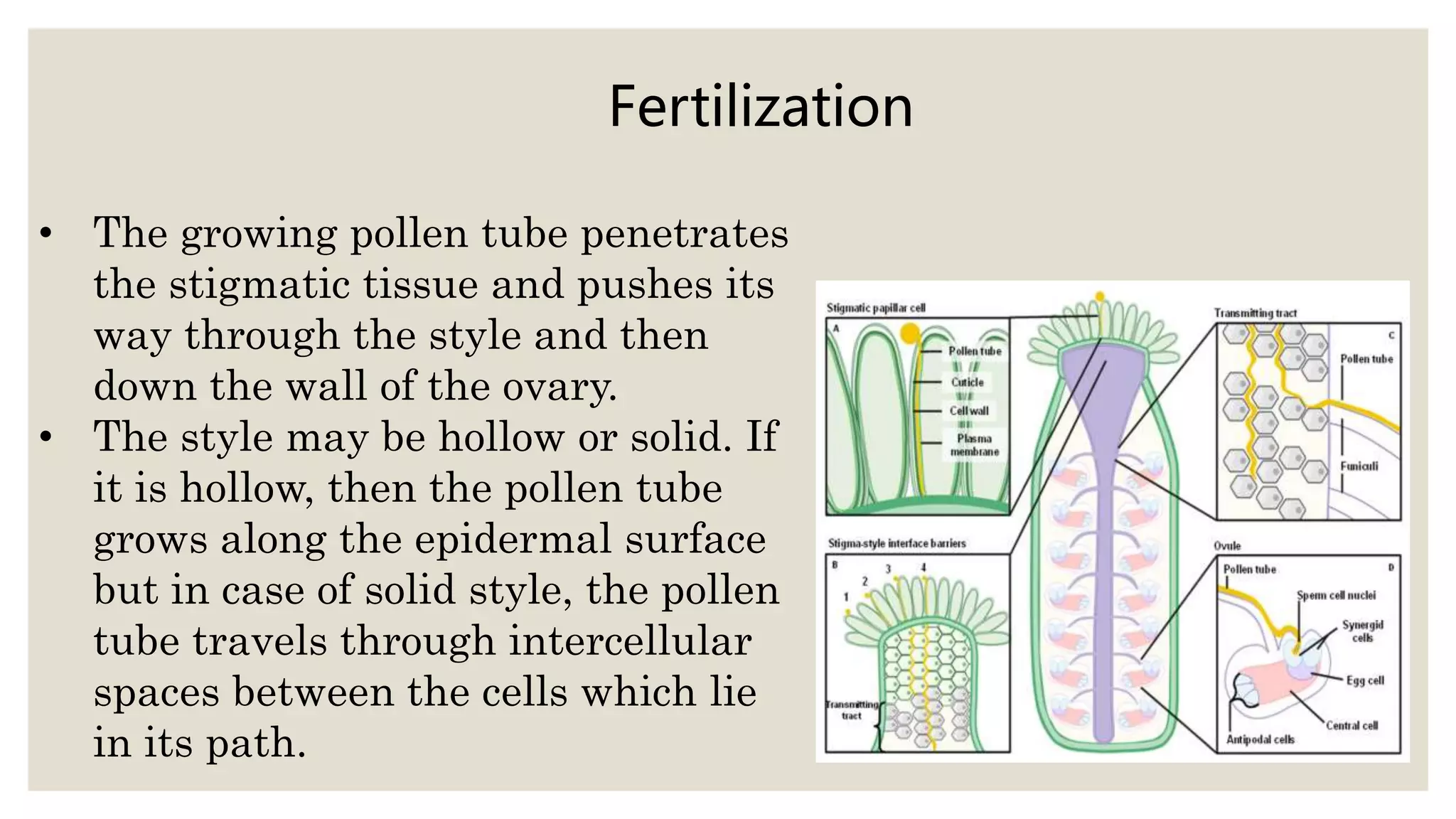
• The growing pollen tube penetrates
the stigmatic tissue and pushes its
way through the style and then
down the wall of the ovary.
• The style may be hollow or solid. If
it is hollow, then the pollen tube
grows along the epidermal surface
but in case of solid style, the pollen
tube travels through intercellular
spaces between the cells which lie
in its path.
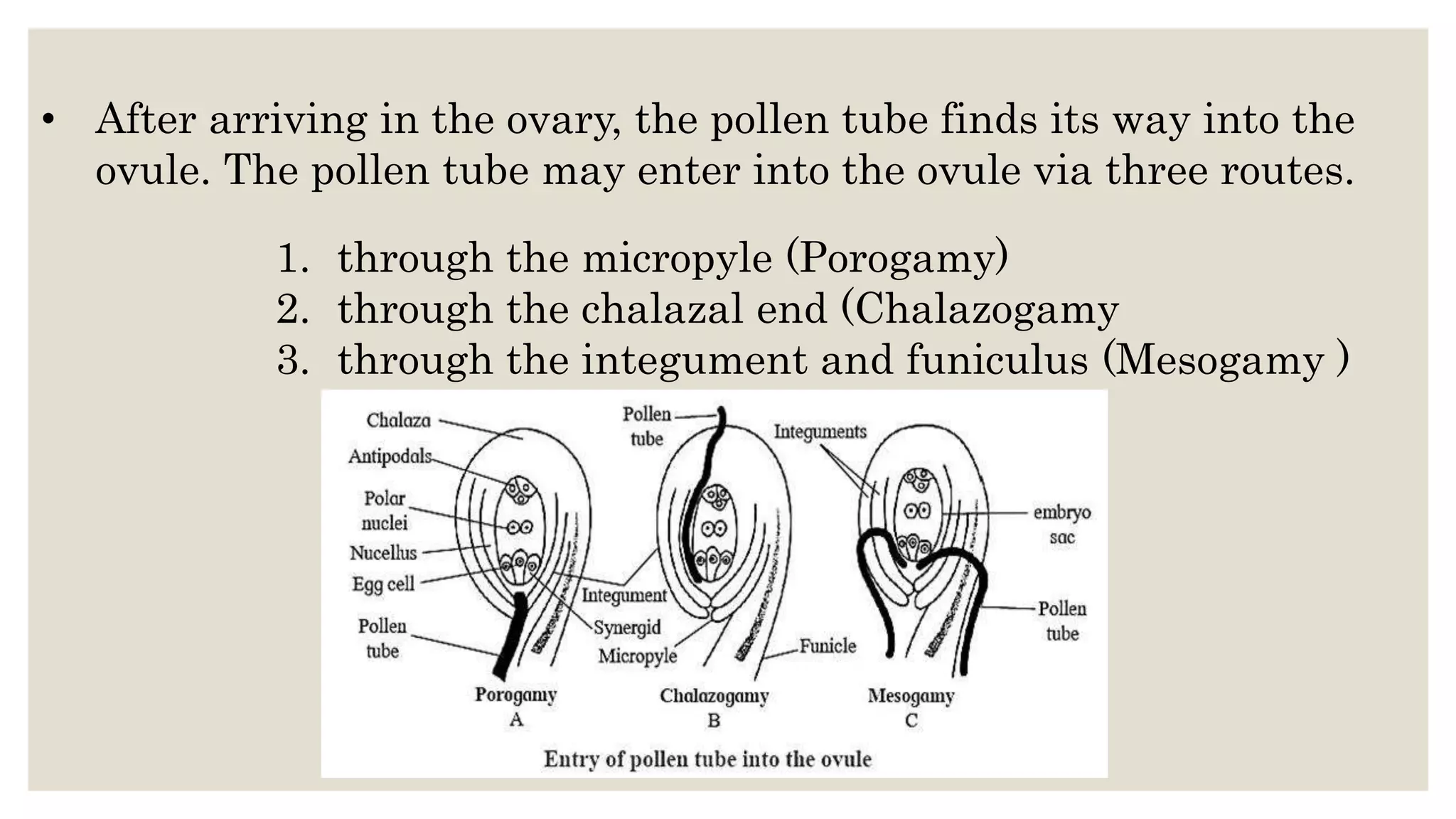
• After arriving in the ovary, the pollen tube finds its way into the
ovule. The pollen tube may enter into the ovule via three routes.
1. through the micropyle (Porogamy)
2. through the chalazal end (Chalazogamy
3. through the integument and funiculus (Mesogamy )
• the two synergids are identical before pollination and do not show
any signs of change. However, one of the synergids shows
structural malformations suggestive of disintegration prior to the
arrival of the pollen tube in the embryo sac.
• In fact, disintegration of the synergid is a consequence of
pollination, and the diversity of changes associated with
disintegration is most often initiated when the pollen tube is in
the style.
• When the pollen tube reaches the embryo sac, the tip of the tube
grows through the filiform apparatus into the degenerating
synergid.
• Immediately after releasing, the
male gametes show amoeboid
movement and one male gamete
moves toward the egg and other one
move to the polar nuclei.
• After passage through the cytoplasm
of the degenerating synergid, pollen
tube growth ceases and then the
tube discharges its contents of
sperm and cytoplasm into this
synergid
• As the one of the male gametes reached the egg, it fuses with it.
As a result of this fusion diploid zygote (2n) forms (because you
know the egg and the male gamete, both are haploid). The
fusion of male and female gametes is known as fertilization.
This is also known as syngamy.
• The other male gamete fuses with the two polar nuclei (or
secondary nucleus, if the two have already fused) and so forms
triple fusion nucleus (3n), called primary endosperm nucleus.
• Thus in an embryo sac two sexual fusions occur; one is syngamy
(i.e. fusion of one male gamete with the egg) and another is triple
fusion (i.e. fusion of other male gamete with the polar nuclei or
secondary nucleus), and therefore, the phenomenon is known as
double fertilization.
Text book of botany structure, development and reproduction
in angiosperms. Authors: V. Singh, P. C. Pande, D. K. Jain.
Botany : an introduction to plant biology / James D. Mauseth.
https://uou.ac.in/sites/default/files/slm/BSCBO-202.pdf
Reference:
pollen pistill interaction.pptx

pollen pistill interaction.pptx

  • 1.
    Pollen – pistillinteraction and fertilization
  • 2.
    Content: About pollen grains Stuctureof stigma Pollen pistill interaction Self incompatibility Fertilization
  • 3.
    • The wallof a pollen grain is quite complex structurally. • It has an inner layer called the intine, composed of cellulose, and an outer layer called the exine that consists of the polymer sporopollenin. • It has one or several weak spots, germination pores, where the pollen opens after it has been carried to the stigma of another flower. Pollen grains
  • 4.
    • Sporopollenin isremarkably waterproof and resistant to almost all chemicals. • It protects the pollen grain and keeps it from drying out as it is being carried by wind or Animals. • The exine can have ridges, bumps, spines, and numerous other features so characteristic that each species has its own particular pattern . • In many cases, it is possible to examine single pollen grain and know exactly which species of plant production it.
  • 5.
    • Because sporopolleninis so resistant, pollen grains and their characteristic patterns fossilize well. • By examining samples of old soil, botanists can determine exactly which plants grew in an area at a particular time in the ancient past.
  • 6.
    • For thestudy of pollen-pistil interactions and incompatibility responses, it is necessary to have a detailed understanding of the stigmatic surface which receives pollen grains. • The surface cells of the area which receives pollen are more or less glandular and frequently elongated unicellular or multicellular papillae. The stigma structure
  • 7.
    There are usuallytwo basic types of stigma : (i) the dry type – where papillae are free from any apparent exudates . (ii) the wet type – where the receptive surface is covered With exudates .
  • 8.
    • The drystigmas are dry only in relative sense, since the papillae bear a hydrated proteinaceous covering over the cuticle,called pellicle. • The families with dry stigmas,such as brassicaceae, and Asteraceae,pellicle does not show enzymatic properties. • The cuticle,underlying the pellicle,is made of short radially directed rodlets with intervening discontinuities.
  • 9.
    • In wetstigmas, secretions continue to accumulate throughout the life of the stigma and these secretions from a medium in which the captured pollens germinate. • In some genera there is an overlying lipid layer, forming " liquid cuticle" The stigmatic exudates contain sugars, phenolic compounds, many free amino acids and proteins. • The viscosity of the exudates is due to the presence of mucopolysaccharides. • The aqueous phase of the stigmatic exudate shows non specific esterase activity. • Wet stigmas occur in many families, such as Solanaceae, Liliaceae etc.
  • 10.
    Pollen–pistil interactions • Assoon as a pollen grain lands on the stigma, it is hydrated. • As a result of hydration, the exine and intine proteins are released on the stigmatic surface. • The pollen wall proteins bind to the pellicle within few minutes of the contact and thereafter cannot be released readily by leaching. • The stigma surface pellicle thus forms a receptor site for the pollen wall proteins. • When pollen is compatible, erosion of the cuticle of the stigma papilla begins beneath the emerging pollen tube.
  • 11.
    • This isthe essential preliminary requirement to the penetration of the pollen tube. • In wet stigma, the cuticle generally ruptures during the deposition of exudates and the pollen tube enters through the pectocellulose layer. • In hollow styles, the pollen tube grows through the stylar canal, whereas in solid style, it traverses the intercellular spaces. • During its course through the style, the pollen tube utilizes nutrients from the pistil.
  • 12.
    • Pollination initiatesmany physiological and biochemical changes in the pistil. • This included increase in respiration, changes in RNA and protein synthesis pattern and increase in the activity of enzymes. • Signals of compatible or incompatible Pollination are transferred to the ovule even before the pollen tube is reached there. • For instance, in incompatible pollination, degeneration of one of the synergids begins much before the entry of the pollen tube in the ovules. • Following pollination, signals are evidently passed to the style and overy to initiate response in accordance with the compatible or incompatible pollination.
  • 14.
    when viable pollensof the same or other individuals of same species prevent fertilization,it is known as intraspecific incompatibility or self incompatibility. Self – incompatibility is thus a device to promote cross pollination. It ensures a certain degree of heterozygosity in a population, which is a major factor in the evolution of the species. It is extremely widespread among the flowering plants. Self incompatibility On the basis of morphological features of the flower,self incompatibility is of the following two types: (a) Heteromorphic (b) Homomorphic
  • 15.
    Heteromorphic (a) Distyly :there are two types of style and stamens ● Pin type: long style and short stamens (ss). ● Thrum type : short style and long stamens (Ss). ● Pin × pin = ss × ss = incompatibility ● Thrum × thrum = Ss × Ss = incompatibility ● Thrum × pin = Ss × ss = compatibility ● Pin× thrum = ss × Ss = compatibility self-incompatibility is associated with the different lengths of stamens and style on flowers on the same plant, this is known as heteromorphic incompatibility.
  • 16.
    (b) Tristyly :when style has three different positions Ex - Lythrum salicaria.
  • 17.
    Homomorphic • Homomorphic incompatibilityis characterised by the occurrence of only one type of flowers in all the individuals of a species. It is governed by multiple alleles,called S alleles. • Mating is not possible if the pollen carriers the same S allele which is present in the female gamete. A. Gamatopytic Self incompatibility B. Sporophytic Self incompatibility
  • 18.
    • Gametophytic selfincompatibility - associated with pollen with one generative nucleus in pollen tube Ex - Solanaceae . • Incompatible reaction is determined by its own genotype and not by genotype of plant on which pollen produced . • Three types of mating - • Fully incompatible. Ex - S1S2 × S1S2 • Partially incompatible . Ex - S1S2 × S1S3 • Fully compatible . Ex - S1S2 × S3S4
  • 20.
    • Sporophytic selfincompatibility : Pollen grains of two generative nuclei . • The incompatible reaction of pollen is governed by the genotype of plant on which pollen is produced and not by genotype of the pollen. Ex - Brassicaceae ( cabbage famil) . • Sporophytic incompatibility is governed by single gene ‘ S’. • Homozygotes are normal part of systems. • S1 Dominates S2 , S2 dominates S3 and so on… • Three types of mating - • Complete incompatibility. Ex - S1S2 × S1S2 • Complete incompatibility. Ex - S1S2 × S1S4 • Complete compatible. Ex - S1S2 × S2S3
  • 22.
    Fertilization • The growingpollen tube penetrates the stigmatic tissue and pushes its way through the style and then down the wall of the ovary. • The style may be hollow or solid. If it is hollow, then the pollen tube grows along the epidermal surface but in case of solid style, the pollen tube travels through intercellular spaces between the cells which lie in its path.
  • 23.
    • After arrivingin the ovary, the pollen tube finds its way into the ovule. The pollen tube may enter into the ovule via three routes. 1. through the micropyle (Porogamy) 2. through the chalazal end (Chalazogamy 3. through the integument and funiculus (Mesogamy )
  • 24.
    • the twosynergids are identical before pollination and do not show any signs of change. However, one of the synergids shows structural malformations suggestive of disintegration prior to the arrival of the pollen tube in the embryo sac. • In fact, disintegration of the synergid is a consequence of pollination, and the diversity of changes associated with disintegration is most often initiated when the pollen tube is in the style. • When the pollen tube reaches the embryo sac, the tip of the tube grows through the filiform apparatus into the degenerating synergid.
  • 25.
    • Immediately afterreleasing, the male gametes show amoeboid movement and one male gamete moves toward the egg and other one move to the polar nuclei. • After passage through the cytoplasm of the degenerating synergid, pollen tube growth ceases and then the tube discharges its contents of sperm and cytoplasm into this synergid
  • 26.
    • As theone of the male gametes reached the egg, it fuses with it. As a result of this fusion diploid zygote (2n) forms (because you know the egg and the male gamete, both are haploid). The fusion of male and female gametes is known as fertilization. This is also known as syngamy. • The other male gamete fuses with the two polar nuclei (or secondary nucleus, if the two have already fused) and so forms triple fusion nucleus (3n), called primary endosperm nucleus. • Thus in an embryo sac two sexual fusions occur; one is syngamy (i.e. fusion of one male gamete with the egg) and another is triple fusion (i.e. fusion of other male gamete with the polar nuclei or secondary nucleus), and therefore, the phenomenon is known as double fertilization.
  • 28.
    Text book ofbotany structure, development and reproduction in angiosperms. Authors: V. Singh, P. C. Pande, D. K. Jain. Botany : an introduction to plant biology / James D. Mauseth. https://uou.ac.in/sites/default/files/slm/BSCBO-202.pdf Reference: