CHAPTER-2
INTRODUCTION
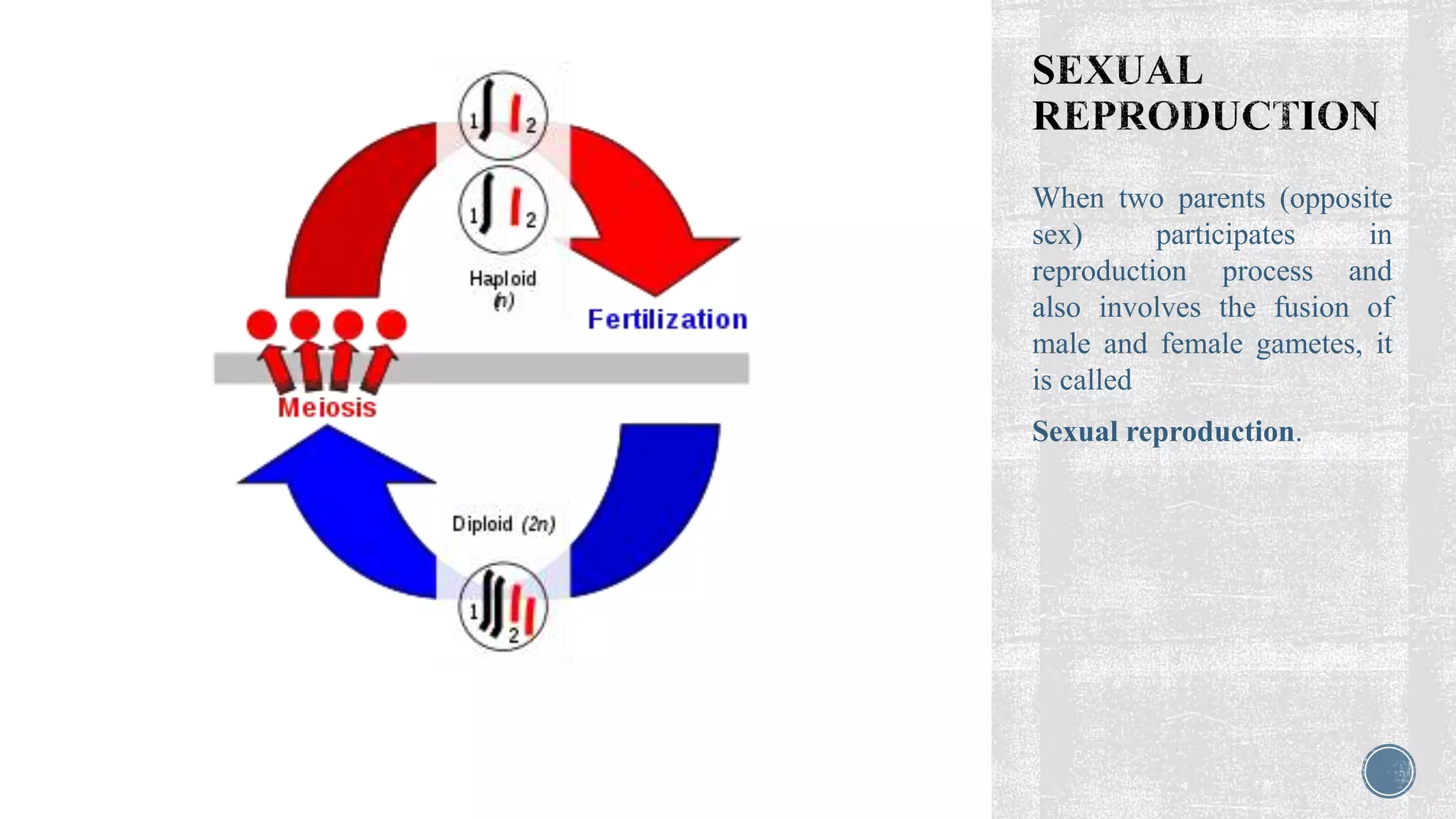
When two parents (opposite
sex) participates in
reproduction process and
also involves the fusion of
male and female gametes, it
is called
Sexual reproduction.
Why is sexual reproduction essential ?
 Reproduction ensures continuity of species
generation after generations as the older individuals
undergo senescence and die.
How is sexual reproduction different in plants ?
• Flowering plants shows sexual mode of
reproduction and bears complex reproductive
units as male and female reproductive units
along with accessary structures.
REPRODUCTIVE STRUCTURES IN
FLOWERING PLANTS
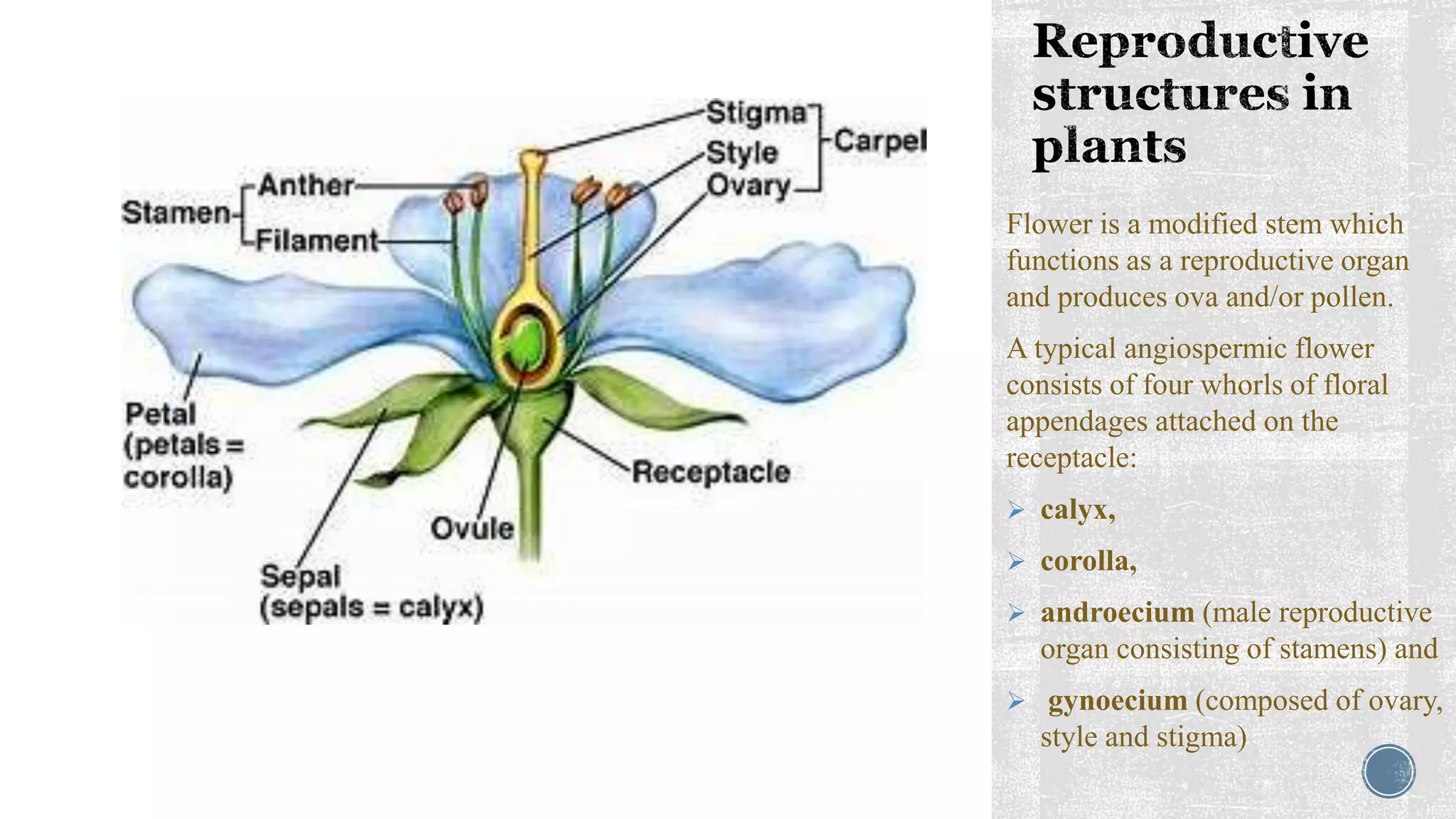
Flower is a modified stem which
functions as a reproductive organ
and produces ova and/or pollen.
A typical angiospermic flower
consists of four whorls of floral
appendages attached on the
receptacle:
 calyx,
 corolla,
 androecium (male reproductive
organ consisting of stamens) and
 gynoecium (composed of ovary,
style and stigma)
MALE REPRODUCTIVE STRUCTURE
Male reproductive unit.
Consists of two parts-
1. Filament : a long thin
structure that supports the
anther
2. Anther : structure in
which pollen grains are
produced
Filament is attached to
thalamus or petal.
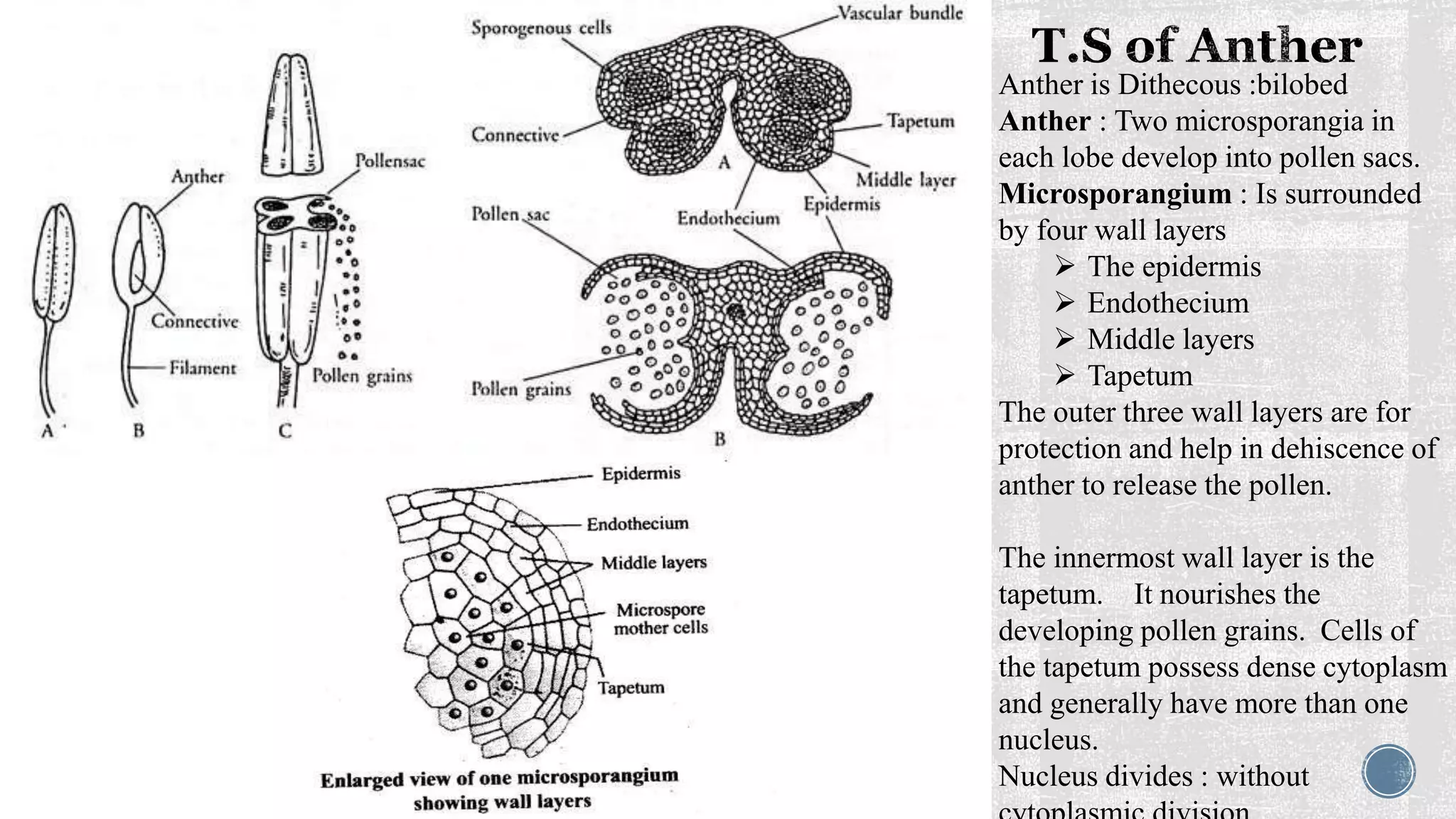
Anther is Dithecous :bilobed
Anther : Two microsporangia in
each lobe develop into pollen sacs.
Microsporangium : Is surrounded
by four wall layers
 The epidermis
 Endothecium
 Middle layers
 Tapetum
The outer three wall layers are for
protection and help in dehiscence of
anther to release the pollen.
The innermost wall layer is the
tapetum. It nourishes the
developing pollen grains. Cells of
the tapetum possess dense cytoplasm
and generally have more than one
nucleus.
Nucleus divides : without
When the anther is
young a group of
compactly arranged
homogenous cells called
sporogenous tissue
occupies the centre of
each microsporangium.
T.S of Young Anther
S
The process of formation of
microspores from a pollen mother
cell through meiosis is called
microsporogenesis.
The cells of sporogenous tissue
undergo meiosis to form
microspore tetrad arranged in a
cluster of 4 cells..
As each cell of sporogenous tissue
has potential to form tetrad, so
each cell is a microspore mother
cell (PMC).
On maturation and dehydration of
anther, the spores dissociate and
develop into pollen grains.
Pollen grains release with the
dehiscence of anther.
Spherical in shape.
Have two layered wall-
 outer hard exine layer and
 inner thin intine.
1. Exine- made up of
sporopolenin. Resistant to
organic matter, withstand
high temperature, acids,
alkalis and enzymes. It has
prominent apertures called
germ pores, where
sporopolenin is absent.
2. Intine- It is thin,
continuous layer, made of
cellulose and pectin.
Pollen grain cytoplasm is
surrounded by plasma membrane.
Mature pollen grain has 2 cells-
(i) vegetative cell
(ii) generative cell.
Vegetative cell- bigger, abundant
food reserve, large irregular nucleus.
Generative cell- small, spindle
shaped with dense cytoplasm and a
nucleus, floats in vegetative cell
cytoplasm.
In 60% species pollen grains are
shed in 2 celled stage where as 40%
species shed in 3 celled stage in
which generative cell divides
mitotically into 2 male gametes.
MATURE POLLEN
FEMALE REPRODUCTIVE STRUCTURE
Pistil- female reproductive
part of flower.
It may be mono or bi or tri
or polycarpellary,
syncarpous or apocarpous.
Each pistil consists of ovary,
style and stigma.
The ovary has one or more
cavities called locules.
Placenta in locules bears
ovules.
Number of ovules may be
one or more.
Arises as primordium on placenta.
The short stalk which attach ovule
with placenta is funicle.
The primordium grows into a mass
of cells forming nucellus, the body
of ovule.
The two protective covering of
nucellus is integuments, except at
the tip leaving a small opening called
Micropyle.
Basal part of ovule is called chalaza
that lie opposite to micropyle.
Cells of nucellus are rich in reserve
food.
A single embryo sac or female
gametophyte located in the nucellus,
which is developed from megaspore.Hilum- junction between ovule and funicle
Cross-section through an ovule
 One of the nucellar cell in the
micropylar region is
differentiated into megaspore
mother cell.
 The cell is larger, contains dense
cytoplasm and a prominent
nucleus.
 It undergoes meiosis forming 4
haploid cells called megaspore
tetrad.
 3 megaspores degenerate and
only one megaspore become
functional.
 Functional megaspore is the first
cell of female gametophyte.
 Its nucleus undergoes mitosis
and form 2 nucleate embryo sac.
 Two successive mitotic division
in each of these 2 nuclei form an
8 nucleate embryo sac.
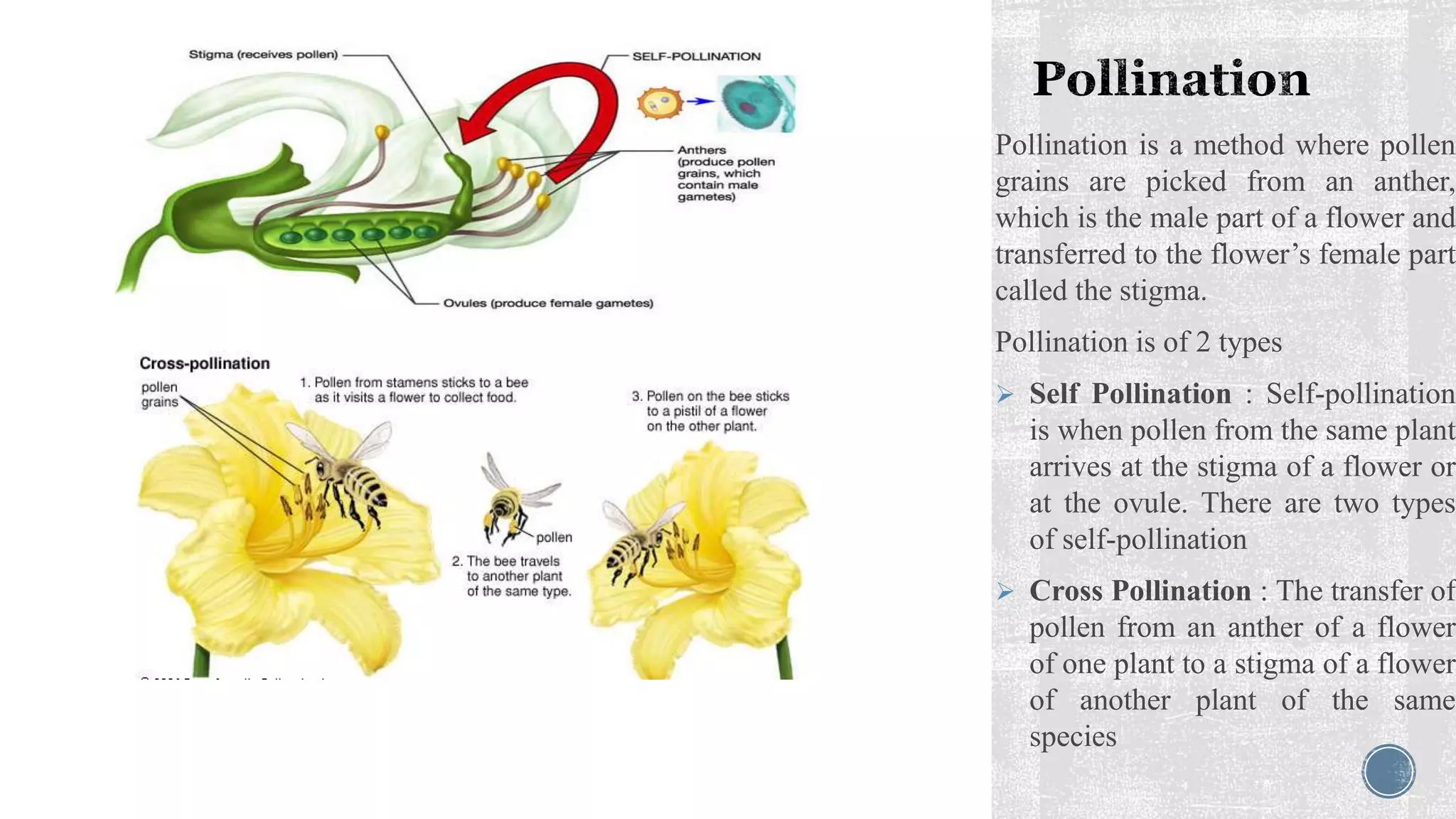
POLLINATION
Pollination is a method where pollen
grains are picked from an anther,
which is the male part of a flower and
transferred to the flower’s female part
called the stigma.
Pollination is of 2 types
 Self Pollination : Self-pollination
is when pollen from the same plant
arrives at the stigma of a flower or
at the ovule. There are two types
of self-pollination
 Cross Pollination : The transfer of
pollen from an anther of a flower
of one plant to a stigma of a flower
of another plant of the same
species
Autogamy : It is the transfer of
pollen grains from the anther to
the stigma of the same flower.
Autogamy requires the anther and
the stigma to lie close. It also
requires synchrony in the pollen
release and stigma receptivity.
Plants like Viola, oxalis etc
produce two kinds of flowers
Chasmogamous flowers (With
exposed anther and stigma)
Cleistogamous flowers (which do
not open at all and only autogamy
occurs).
Geitonogamy − It is the transfer of
pollens from the anther of one
flower to the stigma of another
flower in the same plant.
Genetically, it is similar to
autogamy, but it requires pollinating
agents.
○ Xenogamy − It is the transfer of
pollen grains from the anther to the
stigma of a different plant.
Pollination causes genetically
different types of pollens to be
brought to a plant.
Xenogamy
Pollen grains are light,
nonsticky/ dry, sometimes
winged.
Well exposed anther.
Large feathery stigma.
Flowers arranged as
inflorescence.
Single ovules.
Seen in submerged flowers like
Vallisneria, Hydrilla & Zostera.
In Vallisneria male flowers are
released on water surface and
female flowers reaches the
surface for pollination.
In sea grasses, pollen grains are
long ribbon like and carried
passively to submerged female
flowers
Mucilage coated pollen grains.
 Large
 Brightly coloured and showy.
 If flowers are small, grouped
into inflorescence.
 Highly fragrant
 Produce nectar
 Sticky pollen and stigmatic
surface
 Provide rewards to animal
pollinator such as nectar, food
(pollen) or provide safe place
for laying eggs.
 Repeated self pollination leads to inbreeding depression.
● Plants have developed methods to prevent self
pollination.
Autogamy is prevented by following ways:
○ Pollen release and stigma receptivity not coordinated
○ Different positioning of the anther and the stigma
○ Production of unisexual flowers
● Ways to prevent both autogamy and geitonogamy:
○ Presence of male and female flowers on different plants,
such that each plant is either male or female (dioecy).
○ This mechanism is present in several species of papaya
Recognition of compatible pollen
: It is the interaction between
chemical components of pollen
and those of stigma.
Germination of pollen and
development of Male
gametophyte :
a). Compatible pollen starts its
germination, stimulated by
certain secretion of stigma
b). Intine grows out through one
of germ pore.
c). Content of pollen moves into
the tube i.e.vegetative and
generative/ 2 male gametes.
d). Pollen tube grows
through the tissues of
stigma and style by
secreting enzymes to digest
them and enters ovule
through micropyle.
e). It enters the embryo sac
through filiform apparatus
of one synergids to liberate
male gametes.
POLLEN TUBE
GERMINATION
● It is a method to improve crop yield.
● In this method, it is essential to ensure that the right
kinds of pollen grains are used, and the stigma is
protected from unwanted pollen grains.
It is achieved by:
-Emasculation − The anther is removed from the bud if
the female parent bears bisexual flowers.
-Bagging − The emasculated flower is covered by a bag
so as not to allow contamination of the stigma by
unwanted pollen grains.
● When the stigma of the bagged flower becomes
receptive, the collected pollen grains are dusted onto the
stigma, and then the flower is rebagged.
● If the female parent is unisexual, emasculation is not
necessary. In this case, the female bud is directly bagged,
and when the stigma turns receptive, suitable pollen
grains are dusted onto it so as to allow germination.
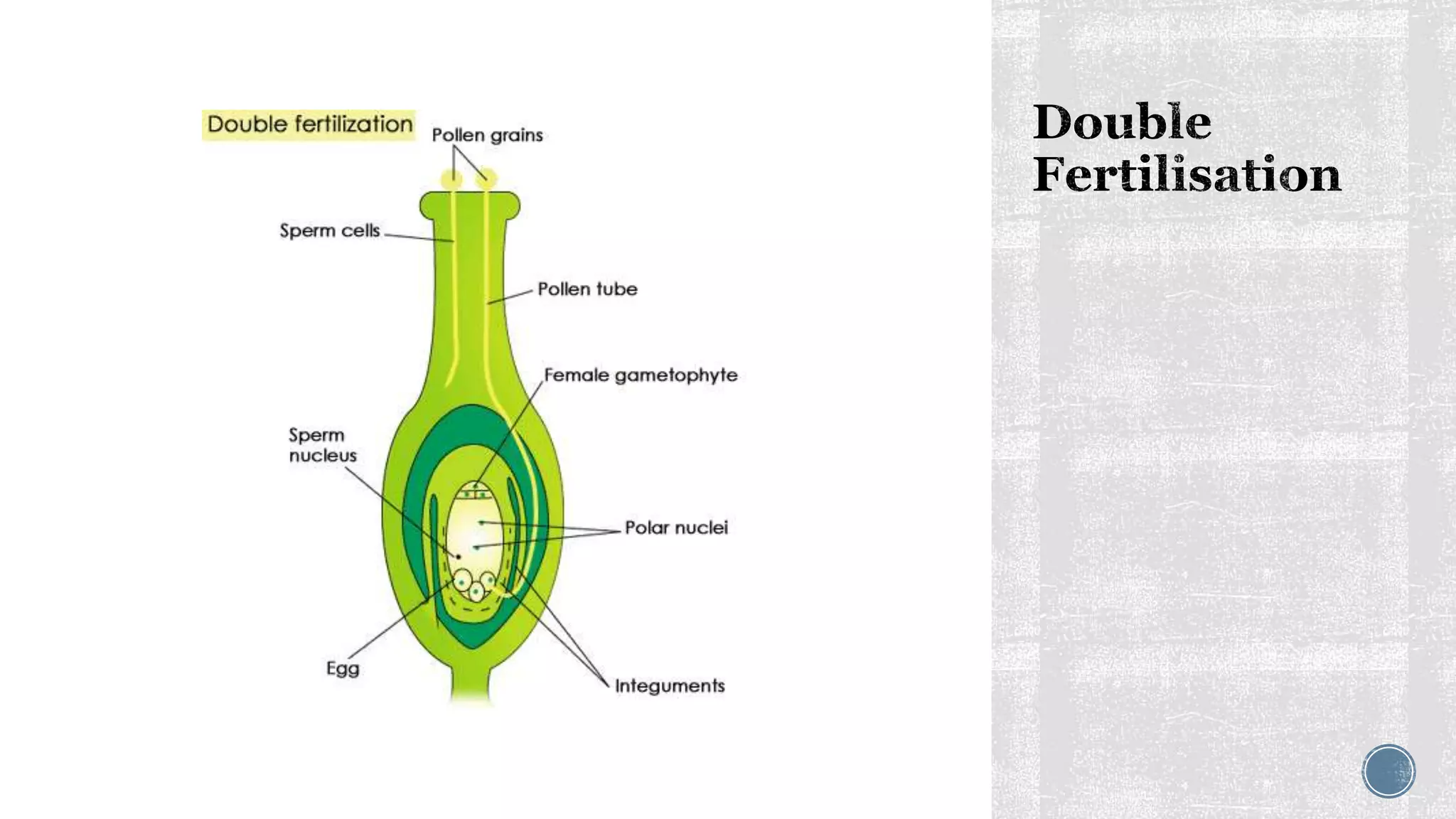
DOUBLE FERTILISATION & TRIPLE FUSION
Release of 2 male gametes from
pollen tube into cytoplasm of
synergids.
Fusion of one male gamete with
egg cell called Syngamy and
form zygote(2n) which develops
into embryo.
Fusion of 2nd male gamete with
polar nuclei of central cell to form
PEN(3n) called as Triple Fusion.
As syngamy and triple fusion
occur in an embryo sac, the
phenomenon is known as double
fertilisation.
Central cell with PEN is called
PEC which develops into
endosperm.
POST FERTILISATION EVENTS
Development of endosperm
Development of embryo
Maturation of ovule into seed
Maturation of ovary into fruit.
ENDOSPERM FORMATION
Its development preceeds embryo
development.
There are 3 methods of embryo
development
 Nuclear
 Cellular &
 Helobial
In nuclear type PEN divides
mitotically without cytokinesis and
endosperm is free nuclear, then cell
wall formation starts from periphery
and endosperm become nuclear.
It provides food to developing
embryo
If endosperm is completely utilised
by embryo, seed is non-albuminous,
if present, seed is albuminous.
EMBRYO
The embryo develops at the
micropylar end of the embryo
sac where the zygote is
situated.
Zygote divides mitotically
and form pro-embryo.
Then it develops into
globular and heart shaped
embryo and then horse shoe
shaped mature embryo with
one or two cotyledons.
In a monocot embryo, there is
only one cotyledon.
In grass, it is known as the
scutellum, and is situated at one
side of the embryonal axis. At
its lower end, the embryonal
axis has the radicle and the root
cap enclosed in the coleorrhiza.
● The epicotyl lies above the
level of the scutellum, and has
the shoot apex and leaf
primordia enclosed in hollow
structures called coleoptiles
L.S of Embryo of Grass
(Monocot)
A typical dicot embryo
consists of an embryonal axis
and two cotyledons.
● The portion of the embryonal
axis above the level of
cotyledons is called epicotyl.
It contains the plumule (shoot
tip). The portion below the axis
is called hypocotyl.
It contains the radicle (root tip).
The root tip is covered by the
root cap.
DICOT EMBRYO
APOMIXIS/POLYEMBRYONY
The development of an embryo
without the occurrence of
fertilization is called Apomixis.
Parthenogenesis is one form of
apomixis
Seeds are formed without
fertilisation.
It may develop if a diploid egg
cell develops into embryo
without fertilisation.
If cells of nucellus may develop
into embryo and pushed into
the embryo.
In some varieties of citrus and mango,
the nucellus cells divide and protrude
into the embryo sac to develop into
embryos.
In such cases, each ovule may contain
several embryos and this condition is
called Polyembryony.
If more than one egg may form in
embryo sac,
If more than one embryo sac formed
in an ovule.
Other cells like synergids or nucellus
develop into embryo.
Ex:- Orange, Lemon, Mango, Onion,
Groundnut etc.
DEVELOPMENT OF FRUIT & SEED
 The ovary of a flower develops into a fruit.
● The walls of the ovary transform into the walls of the fruit
(pericarp).
● Fruits may be fleshy, as in mango and orange, or can be
dry, as in groundnut and mustard.
● In some plants, floral parts other than the ovary take part in
fruit formation, as in apple and strawberry. In these, the
thalamus contributes to fruit formation. Such fruits are
called false fruits. Fruits that develop from the ovary are
called true fruits.
● Some fruits develop without fertilisation, and are known as
parthenocarpic fruits (example: banana).
 - Fertilized and mature ovule develops into seed.
 Seed consists of:
- cotyledon(s)
- embryonal axis
- Seed coat- double layered- formed by integuments
- Testa (outer coat)
- Tegmen (inner coat)
 Micropyle:- small opening on seed coat, it facilitates entry of
H2O & O2 into seeds (for germination)
 Hilum:- scar on seed coat
 Seed - Albuminous / Non-Albuminous
 - Perisperm : remnants of nucellus that is persistent. Ex:
Black pepper
The wall of ovary develops
into wall of fruit called
pericarp. In true fruits only
ovary contributes in fruit
formation by in false fruit
thalamus also contributes in
fruit formation.
Sexual reproduction in flowering plants

Sexual reproduction in flowering plants

  • 1.
  • 2.
  • 3.
    When two parents(opposite sex) participates in reproduction process and also involves the fusion of male and female gametes, it is called Sexual reproduction.
  • 4.
    Why is sexualreproduction essential ?  Reproduction ensures continuity of species generation after generations as the older individuals undergo senescence and die. How is sexual reproduction different in plants ? • Flowering plants shows sexual mode of reproduction and bears complex reproductive units as male and female reproductive units along with accessary structures.
  • 5.
  • 6.
    Flower is amodified stem which functions as a reproductive organ and produces ova and/or pollen. A typical angiospermic flower consists of four whorls of floral appendages attached on the receptacle:  calyx,  corolla,  androecium (male reproductive organ consisting of stamens) and  gynoecium (composed of ovary, style and stigma)
  • 8.
  • 9.
    Male reproductive unit. Consistsof two parts- 1. Filament : a long thin structure that supports the anther 2. Anther : structure in which pollen grains are produced Filament is attached to thalamus or petal.
  • 10.
    Anther is Dithecous:bilobed Anther : Two microsporangia in each lobe develop into pollen sacs. Microsporangium : Is surrounded by four wall layers  The epidermis  Endothecium  Middle layers  Tapetum The outer three wall layers are for protection and help in dehiscence of anther to release the pollen. The innermost wall layer is the tapetum. It nourishes the developing pollen grains. Cells of the tapetum possess dense cytoplasm and generally have more than one nucleus. Nucleus divides : without
  • 11.
    When the antheris young a group of compactly arranged homogenous cells called sporogenous tissue occupies the centre of each microsporangium. T.S of Young Anther S
  • 12.
    The process offormation of microspores from a pollen mother cell through meiosis is called microsporogenesis. The cells of sporogenous tissue undergo meiosis to form microspore tetrad arranged in a cluster of 4 cells.. As each cell of sporogenous tissue has potential to form tetrad, so each cell is a microspore mother cell (PMC). On maturation and dehydration of anther, the spores dissociate and develop into pollen grains. Pollen grains release with the dehiscence of anther.
  • 13.
    Spherical in shape. Havetwo layered wall-  outer hard exine layer and  inner thin intine. 1. Exine- made up of sporopolenin. Resistant to organic matter, withstand high temperature, acids, alkalis and enzymes. It has prominent apertures called germ pores, where sporopolenin is absent. 2. Intine- It is thin, continuous layer, made of cellulose and pectin.
  • 14.
    Pollen grain cytoplasmis surrounded by plasma membrane. Mature pollen grain has 2 cells- (i) vegetative cell (ii) generative cell. Vegetative cell- bigger, abundant food reserve, large irregular nucleus. Generative cell- small, spindle shaped with dense cytoplasm and a nucleus, floats in vegetative cell cytoplasm. In 60% species pollen grains are shed in 2 celled stage where as 40% species shed in 3 celled stage in which generative cell divides mitotically into 2 male gametes. MATURE POLLEN
  • 15.
  • 16.
    Pistil- female reproductive partof flower. It may be mono or bi or tri or polycarpellary, syncarpous or apocarpous. Each pistil consists of ovary, style and stigma. The ovary has one or more cavities called locules. Placenta in locules bears ovules. Number of ovules may be one or more.
  • 17.
    Arises as primordiumon placenta. The short stalk which attach ovule with placenta is funicle. The primordium grows into a mass of cells forming nucellus, the body of ovule. The two protective covering of nucellus is integuments, except at the tip leaving a small opening called Micropyle. Basal part of ovule is called chalaza that lie opposite to micropyle. Cells of nucellus are rich in reserve food. A single embryo sac or female gametophyte located in the nucellus, which is developed from megaspore.Hilum- junction between ovule and funicle
  • 18.
  • 19.
     One ofthe nucellar cell in the micropylar region is differentiated into megaspore mother cell.  The cell is larger, contains dense cytoplasm and a prominent nucleus.  It undergoes meiosis forming 4 haploid cells called megaspore tetrad.  3 megaspores degenerate and only one megaspore become functional.  Functional megaspore is the first cell of female gametophyte.  Its nucleus undergoes mitosis and form 2 nucleate embryo sac.  Two successive mitotic division in each of these 2 nuclei form an 8 nucleate embryo sac.
  • 20.
  • 21.
    Pollination is amethod where pollen grains are picked from an anther, which is the male part of a flower and transferred to the flower’s female part called the stigma. Pollination is of 2 types  Self Pollination : Self-pollination is when pollen from the same plant arrives at the stigma of a flower or at the ovule. There are two types of self-pollination  Cross Pollination : The transfer of pollen from an anther of a flower of one plant to a stigma of a flower of another plant of the same species
  • 22.
    Autogamy : Itis the transfer of pollen grains from the anther to the stigma of the same flower. Autogamy requires the anther and the stigma to lie close. It also requires synchrony in the pollen release and stigma receptivity. Plants like Viola, oxalis etc produce two kinds of flowers Chasmogamous flowers (With exposed anther and stigma) Cleistogamous flowers (which do not open at all and only autogamy occurs).
  • 23.
    Geitonogamy − Itis the transfer of pollens from the anther of one flower to the stigma of another flower in the same plant. Genetically, it is similar to autogamy, but it requires pollinating agents. ○ Xenogamy − It is the transfer of pollen grains from the anther to the stigma of a different plant. Pollination causes genetically different types of pollens to be brought to a plant. Xenogamy
  • 25.
    Pollen grains arelight, nonsticky/ dry, sometimes winged. Well exposed anther. Large feathery stigma. Flowers arranged as inflorescence. Single ovules.
  • 26.
    Seen in submergedflowers like Vallisneria, Hydrilla & Zostera. In Vallisneria male flowers are released on water surface and female flowers reaches the surface for pollination. In sea grasses, pollen grains are long ribbon like and carried passively to submerged female flowers Mucilage coated pollen grains.
  • 27.
     Large  Brightlycoloured and showy.  If flowers are small, grouped into inflorescence.  Highly fragrant  Produce nectar  Sticky pollen and stigmatic surface  Provide rewards to animal pollinator such as nectar, food (pollen) or provide safe place for laying eggs.
  • 28.
     Repeated selfpollination leads to inbreeding depression. ● Plants have developed methods to prevent self pollination. Autogamy is prevented by following ways: ○ Pollen release and stigma receptivity not coordinated ○ Different positioning of the anther and the stigma ○ Production of unisexual flowers ● Ways to prevent both autogamy and geitonogamy: ○ Presence of male and female flowers on different plants, such that each plant is either male or female (dioecy). ○ This mechanism is present in several species of papaya
  • 29.
    Recognition of compatiblepollen : It is the interaction between chemical components of pollen and those of stigma. Germination of pollen and development of Male gametophyte : a). Compatible pollen starts its germination, stimulated by certain secretion of stigma b). Intine grows out through one of germ pore. c). Content of pollen moves into the tube i.e.vegetative and generative/ 2 male gametes.
  • 30.
    d). Pollen tubegrows through the tissues of stigma and style by secreting enzymes to digest them and enters ovule through micropyle. e). It enters the embryo sac through filiform apparatus of one synergids to liberate male gametes. POLLEN TUBE GERMINATION
  • 31.
    ● It isa method to improve crop yield. ● In this method, it is essential to ensure that the right kinds of pollen grains are used, and the stigma is protected from unwanted pollen grains. It is achieved by: -Emasculation − The anther is removed from the bud if the female parent bears bisexual flowers. -Bagging − The emasculated flower is covered by a bag so as not to allow contamination of the stigma by unwanted pollen grains. ● When the stigma of the bagged flower becomes receptive, the collected pollen grains are dusted onto the stigma, and then the flower is rebagged. ● If the female parent is unisexual, emasculation is not necessary. In this case, the female bud is directly bagged, and when the stigma turns receptive, suitable pollen grains are dusted onto it so as to allow germination.
  • 32.
  • 34.
    Release of 2male gametes from pollen tube into cytoplasm of synergids. Fusion of one male gamete with egg cell called Syngamy and form zygote(2n) which develops into embryo. Fusion of 2nd male gamete with polar nuclei of central cell to form PEN(3n) called as Triple Fusion. As syngamy and triple fusion occur in an embryo sac, the phenomenon is known as double fertilisation. Central cell with PEN is called PEC which develops into endosperm.
  • 35.
  • 36.
    Development of endosperm Developmentof embryo Maturation of ovule into seed Maturation of ovary into fruit.
  • 37.
  • 38.
    Its development preceedsembryo development. There are 3 methods of embryo development  Nuclear  Cellular &  Helobial In nuclear type PEN divides mitotically without cytokinesis and endosperm is free nuclear, then cell wall formation starts from periphery and endosperm become nuclear. It provides food to developing embryo If endosperm is completely utilised by embryo, seed is non-albuminous, if present, seed is albuminous.
  • 39.
  • 41.
    The embryo developsat the micropylar end of the embryo sac where the zygote is situated. Zygote divides mitotically and form pro-embryo. Then it develops into globular and heart shaped embryo and then horse shoe shaped mature embryo with one or two cotyledons.
  • 42.
    In a monocotembryo, there is only one cotyledon. In grass, it is known as the scutellum, and is situated at one side of the embryonal axis. At its lower end, the embryonal axis has the radicle and the root cap enclosed in the coleorrhiza. ● The epicotyl lies above the level of the scutellum, and has the shoot apex and leaf primordia enclosed in hollow structures called coleoptiles L.S of Embryo of Grass (Monocot)
  • 43.
    A typical dicotembryo consists of an embryonal axis and two cotyledons. ● The portion of the embryonal axis above the level of cotyledons is called epicotyl. It contains the plumule (shoot tip). The portion below the axis is called hypocotyl. It contains the radicle (root tip). The root tip is covered by the root cap. DICOT EMBRYO
  • 44.
  • 45.
    The development ofan embryo without the occurrence of fertilization is called Apomixis. Parthenogenesis is one form of apomixis Seeds are formed without fertilisation. It may develop if a diploid egg cell develops into embryo without fertilisation. If cells of nucellus may develop into embryo and pushed into the embryo.
  • 46.
    In some varietiesof citrus and mango, the nucellus cells divide and protrude into the embryo sac to develop into embryos. In such cases, each ovule may contain several embryos and this condition is called Polyembryony. If more than one egg may form in embryo sac, If more than one embryo sac formed in an ovule. Other cells like synergids or nucellus develop into embryo. Ex:- Orange, Lemon, Mango, Onion, Groundnut etc.
  • 47.
  • 48.
     The ovaryof a flower develops into a fruit. ● The walls of the ovary transform into the walls of the fruit (pericarp). ● Fruits may be fleshy, as in mango and orange, or can be dry, as in groundnut and mustard. ● In some plants, floral parts other than the ovary take part in fruit formation, as in apple and strawberry. In these, the thalamus contributes to fruit formation. Such fruits are called false fruits. Fruits that develop from the ovary are called true fruits. ● Some fruits develop without fertilisation, and are known as parthenocarpic fruits (example: banana).
  • 49.
     - Fertilizedand mature ovule develops into seed.  Seed consists of: - cotyledon(s) - embryonal axis - Seed coat- double layered- formed by integuments - Testa (outer coat) - Tegmen (inner coat)  Micropyle:- small opening on seed coat, it facilitates entry of H2O & O2 into seeds (for germination)  Hilum:- scar on seed coat  Seed - Albuminous / Non-Albuminous  - Perisperm : remnants of nucellus that is persistent. Ex: Black pepper The wall of ovary develops into wall of fruit called pericarp. In true fruits only ovary contributes in fruit formation by in false fruit thalamus also contributes in fruit formation.