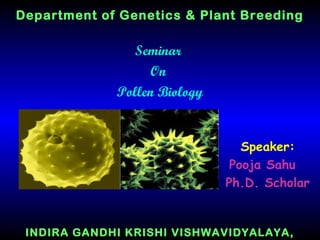
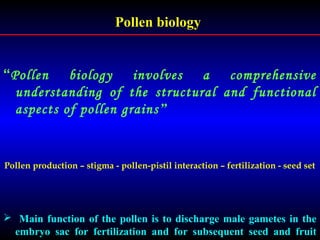
Department of Genetics & Plant Breeding
Seminar
On
Pollen Biology
Speaker:
Pooja Sahu
Ph.D. Scholar
INDIRA GANDHI KRISHI VISHWAVIDYALAYA,
“Pollen biology involves a comprehensive
understanding of the structural and functional
aspects of pollen grains”
Pollen production – stigma - pollen-pistil interaction – fertilization - seed set
 Main function of the pollen is to discharge male gametes in the
embryo sac for fertilization and for subsequent seed and fruit
Pollen biology
 Embody the male partners in sexual
reproduction.
 Shed in a desiccated condition, and
their moisture level is < 20%.
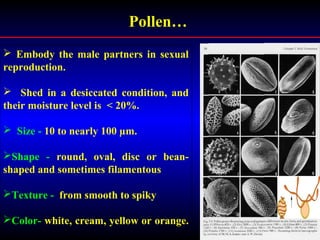
 Size - 10 to nearly 100 µm.
Shape - round, oval, disc or bean-
shaped and sometimes filamentous
Texture - from smooth to spiky
Color- white, cream, yellow or orange.
Pollen…
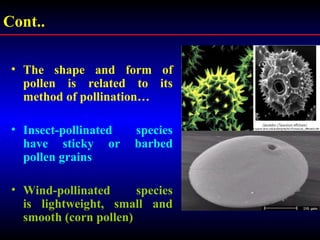
• The shape and form of
pollen is related to its
method of pollination…
• Insect-pollinated species
have sticky or barbed
pollen grains
• Wind-pollinated species
is lightweight, small and
smooth (corn pollen)
Cont..
Structure
Two nuclei occur in
each pollen grain:
 One is the tube nucleus
(or cell)
 One is the generative
nucleus (or cell)
 Heavy, thick cell wall
with sculpturing of the
cell wall
V IP: Pollen G rain
Pollen W all
G enerative
C ell
Tube
Cell
C ytoplasm
Nucleus
Nucleolus
C ytoplasm
N ucleus
NucleolusFate:
Digests Path to Egg
Locates M icropyle
Enters Em bryo Sac
Is Burst to Release SpermFate:
Follows Path of Tube
Divides by M itosis
M akes Tw o Sperm
Both Have Syngam y
Cont..
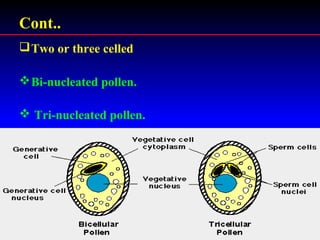
Two or three celled
Bi-nucleated pollen.
 Tri-nucleated pollen.
Cont..
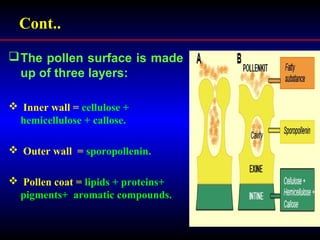
The pollen surface is made
up of three layers:
 Inner wall = cellulose +
hemicellulose + callose.
 Outer wall = sporopollenin.
 Pollen coat = lipids + proteins+
pigments+ aromatic compounds.
Pollen grain
Tube Cell Generative
Cellcytoplasm
nucleus
nucleolus
cytoplasm
nucleus
nucleolus
Pollen Wall
Digests path
through
stigma, style,
and ovary.
Locates
micropyle of
ovule.
Penetrates
into embryo
sac.
Divides by
mitosis to
make two
sperm cells.
Waterproofing prevents desiccation during
pollen transfer.
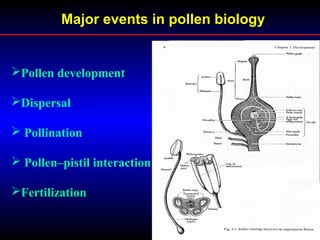
Pollen development
Dispersal
 Pollination
 Pollen–pistil interaction
Fertilization
Major events in pollen biology
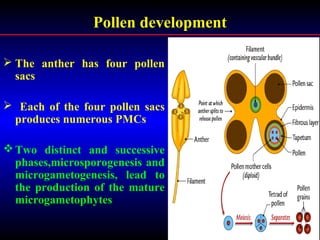
Pollen development
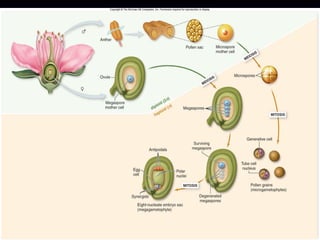
 The anther has four pollen
sacs
 Each of the four pollen sacs
produces numerous PMCs
Two distinct and successive
phases,microsporogenesis and
microgametogenesis, lead to
the production of the mature
microgametophytes
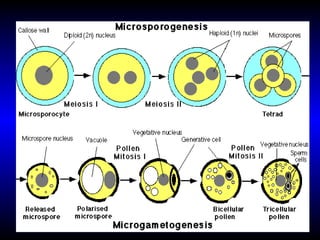
Microsporogenesis
Formation of the haploid unicellular microspores.
 Diploid sporogenous cells differentiate as
microsporocytes which divide by meiosis to form four
haploid microspores.
Each diploid meiocyte gives rise to a tetrad (four
haploid microspores) and microsporogenesis is
complete with the formation of distinct single-celled
haploid microspores.
Microgametogenesis
 Unicellular microspores into mature microgametophytes
containing the gametes.
 Nucleus undergoes mitosis I leads to two unequal cells, a
large vegetative cell and a small generative cell each
containing a haploid nucleus.
 The generative cell subsequently detaches from the pollen
grain wall and is engulfed by the vegetative cell forming a
unique 'cell within a cell' structure.
 The engulfed generative cell divides once more by mitosis
II to form two sperm cells completely enclosed within the
vegetative cell cytoplasm either before it is shed
(tricellular) or within the tube (bicellular).
Genes and Pollen development
 It is estimated that at least 15,000 different genes may be
transcribed during pollen development.
 The precise timing and developmental regulation of these
pollen-specific genes is mediated by defined transcriptional
regulatory DNA elements (Twell et al., 1994).
 A number of pollen-specific genes have been isolated by
molecular cloning and shown to encode diverse proteins
concerned with both basic and specialized cellular
functions.
Pollen dispersalPollen dispersal
Animals (Zoophily )
 Insects – bees, wasps, flies, butterflies, moths
 Birds – hummingbirds, honey creepers
 Mammals – bats, mice, monkeys
 Even some reptiles and amphibians
Wind (Anemophily )
 blown around (dandelion seeds)
Water (Hydrophily)
float (coconuts)
washed down stream
Pollination
• Pollination: The transfer of pollen from the
male anther to the female stigma
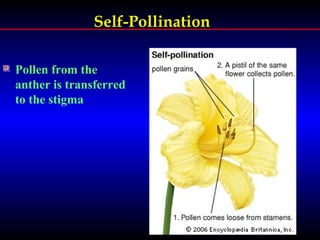
Self-PollinationSelf-Pollination
Pollen from the
anther is transferred
to the stigma
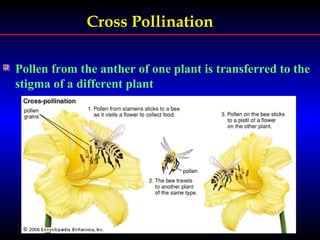
Cross PollinationCross Pollination
Pollen from the anther of one plant is transferred to the
stigma of a different plant
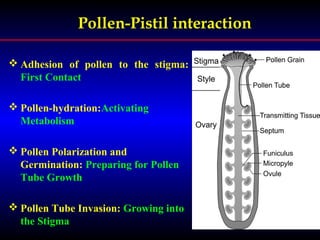
 Adhesion of pollen to the stigma:
First Contact
 Pollen-hydration:Activating
Metabolism
 Pollen Polarization and
Germination: Preparing for Pollen
Tube Growth
 Pollen Tube Invasion: Growing into
the Stigma
Pollen-Pistil interaction
Cont..
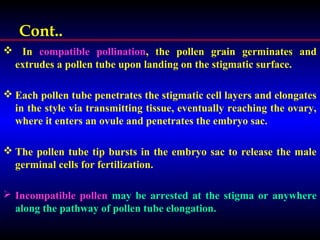
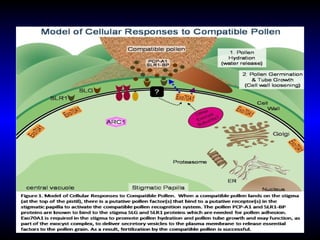
 In compatible pollination, the pollen grain germinates and
extrudes a pollen tube upon landing on the stigmatic surface.
 Each pollen tube penetrates the stigmatic cell layers and elongates
in the style via transmitting tissue, eventually reaching the ovary,
where it enters an ovule and penetrates the embryo sac.
 The pollen tube tip bursts in the embryo sac to release the male
germinal cells for fertilization.
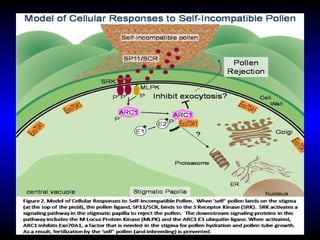
 Incompatible pollen may be arrested at the stigma or anywhere
along the pathway of pollen tube elongation.
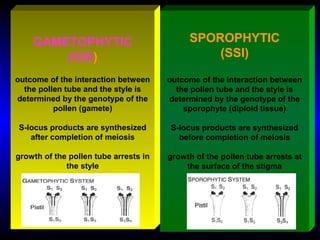
SPOROPHYTIC
(SSI)
outcome of the interaction between
the pollen tube and the style is
determined by the genotype of the
sporophyte (diploid tissue)
S-locus products are synthesized
before completion of meiosis
growth of the pollen tube arrests at
the surface of the stigma
GAMETOPHYTIC
(GSI)
outcome of the interaction between
the pollen tube and the style is
determined by the genotype of the
pollen (gamete)
S-locus products are synthesized
after completion of meiosis
growth of the pollen tube arrests in
the style
Fertilization
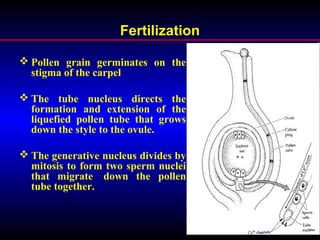
 Pollen grain germinates on the
stigma of the carpel
 The tube nucleus directs the
formation and extension of the
liquefied pollen tube that grows
down the style to the ovule.
 The generative nucleus divides by
mitosis to form two sperm nuclei
that migrate down the pollen
tube together.
Cont..
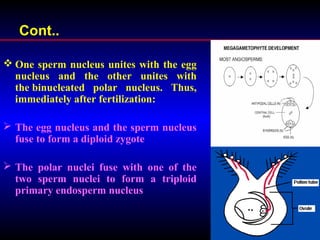
 One sperm nucleus unites with the egg
nucleus and the other unites with
the binucleated polar nucleus. Thus,
immediately after fertilization:
 The egg nucleus and the sperm nucleus
fuse to form a diploid zygote
 The polar nuclei fuse with one of the
two sperm nuclei to form a triploid
primary endosperm nucleus
Palynology: the study of pollen
• Palynology is useful in many fields:
Petroleum geology
Archeology
Anthropology
Criminology
Aerobiology
Role of pollen biology in crop improvement
 Plant resistance to particular stress condition can be identified
by studying the responses of pollen grains to the stress condition
 The frequency of plants having desired genes can be improved
by applying selection pressure to pollen
 The barriers of pre and post fertilization can overcome by many
techniques such as invitro fertilization, mentor pollen, embryo
rescue .
 Genetic transformation
 Monitoring cytotoxic effects of bioactive chemicals and in
studies of differentiation, cytoskeleton and polarity
Conclusion
 Pollen is one of the wonders of nature. Its very existence is
one of the major reasons that flowering plants and trees have
been able to colonize almost every habitat on the planet.
 From forensics to agriculture, it is also a huge benefit to
mankind.
 Pollen biology has been developed into systematic discipline
of its own.
 However, use of pollen grain for basic and applied research is
dependent on expertise in handling them.
Pollen Biology

Pollen Biology

  • 1.
    Department of Genetics& Plant Breeding Seminar On Pollen Biology Speaker: Pooja Sahu Ph.D. Scholar INDIRA GANDHI KRISHI VISHWAVIDYALAYA,
  • 2.
    “Pollen biology involvesa comprehensive understanding of the structural and functional aspects of pollen grains” Pollen production – stigma - pollen-pistil interaction – fertilization - seed set  Main function of the pollen is to discharge male gametes in the embryo sac for fertilization and for subsequent seed and fruit Pollen biology
  • 3.
     Embody themale partners in sexual reproduction.  Shed in a desiccated condition, and their moisture level is < 20%.  Size - 10 to nearly 100 µm. Shape - round, oval, disc or bean- shaped and sometimes filamentous Texture - from smooth to spiky Color- white, cream, yellow or orange. Pollen…
  • 4.
    • The shapeand form of pollen is related to its method of pollination… • Insect-pollinated species have sticky or barbed pollen grains • Wind-pollinated species is lightweight, small and smooth (corn pollen) Cont..
  • 5.
    Structure Two nuclei occurin each pollen grain:  One is the tube nucleus (or cell)  One is the generative nucleus (or cell)  Heavy, thick cell wall with sculpturing of the cell wall V IP: Pollen G rain Pollen W all G enerative C ell Tube Cell C ytoplasm Nucleus Nucleolus C ytoplasm N ucleus NucleolusFate: Digests Path to Egg Locates M icropyle Enters Em bryo Sac Is Burst to Release SpermFate: Follows Path of Tube Divides by M itosis M akes Tw o Sperm Both Have Syngam y
  • 6.
    Cont.. Two or threecelled Bi-nucleated pollen.  Tri-nucleated pollen.
  • 7.
    Cont.. The pollen surfaceis made up of three layers:  Inner wall = cellulose + hemicellulose + callose.  Outer wall = sporopollenin.  Pollen coat = lipids + proteins+ pigments+ aromatic compounds.
  • 8.
    Pollen grain Tube CellGenerative Cellcytoplasm nucleus nucleolus cytoplasm nucleus nucleolus Pollen Wall Digests path through stigma, style, and ovary. Locates micropyle of ovule. Penetrates into embryo sac. Divides by mitosis to make two sperm cells. Waterproofing prevents desiccation during pollen transfer.
  • 9.
    Pollen development Dispersal  Pollination Pollen–pistil interaction Fertilization Major events in pollen biology
  • 10.
    Pollen development  Theanther has four pollen sacs  Each of the four pollen sacs produces numerous PMCs Two distinct and successive phases,microsporogenesis and microgametogenesis, lead to the production of the mature microgametophytes
  • 11.
    Microsporogenesis Formation of thehaploid unicellular microspores.  Diploid sporogenous cells differentiate as microsporocytes which divide by meiosis to form four haploid microspores. Each diploid meiocyte gives rise to a tetrad (four haploid microspores) and microsporogenesis is complete with the formation of distinct single-celled haploid microspores.
  • 12.
    Microgametogenesis  Unicellular microsporesinto mature microgametophytes containing the gametes.  Nucleus undergoes mitosis I leads to two unequal cells, a large vegetative cell and a small generative cell each containing a haploid nucleus.  The generative cell subsequently detaches from the pollen grain wall and is engulfed by the vegetative cell forming a unique 'cell within a cell' structure.  The engulfed generative cell divides once more by mitosis II to form two sperm cells completely enclosed within the vegetative cell cytoplasm either before it is shed (tricellular) or within the tube (bicellular).
  • 14.
    Genes and Pollendevelopment  It is estimated that at least 15,000 different genes may be transcribed during pollen development.  The precise timing and developmental regulation of these pollen-specific genes is mediated by defined transcriptional regulatory DNA elements (Twell et al., 1994).  A number of pollen-specific genes have been isolated by molecular cloning and shown to encode diverse proteins concerned with both basic and specialized cellular functions.
  • 15.
    Pollen dispersalPollen dispersal Animals(Zoophily )  Insects – bees, wasps, flies, butterflies, moths  Birds – hummingbirds, honey creepers  Mammals – bats, mice, monkeys  Even some reptiles and amphibians Wind (Anemophily )  blown around (dandelion seeds) Water (Hydrophily) float (coconuts) washed down stream
  • 16.
    Pollination • Pollination: Thetransfer of pollen from the male anther to the female stigma
  • 17.
  • 18.
    Cross PollinationCross Pollination Pollenfrom the anther of one plant is transferred to the stigma of a different plant
  • 19.
     Adhesion ofpollen to the stigma: First Contact  Pollen-hydration:Activating Metabolism  Pollen Polarization and Germination: Preparing for Pollen Tube Growth  Pollen Tube Invasion: Growing into the Stigma Pollen-Pistil interaction
  • 20.
    Cont..  In compatiblepollination, the pollen grain germinates and extrudes a pollen tube upon landing on the stigmatic surface.  Each pollen tube penetrates the stigmatic cell layers and elongates in the style via transmitting tissue, eventually reaching the ovary, where it enters an ovule and penetrates the embryo sac.  The pollen tube tip bursts in the embryo sac to release the male germinal cells for fertilization.  Incompatible pollen may be arrested at the stigma or anywhere along the pathway of pollen tube elongation.
  • 23.
    SPOROPHYTIC (SSI) outcome of theinteraction between the pollen tube and the style is determined by the genotype of the sporophyte (diploid tissue) S-locus products are synthesized before completion of meiosis growth of the pollen tube arrests at the surface of the stigma GAMETOPHYTIC (GSI) outcome of the interaction between the pollen tube and the style is determined by the genotype of the pollen (gamete) S-locus products are synthesized after completion of meiosis growth of the pollen tube arrests in the style
  • 24.
    Fertilization  Pollen graingerminates on the stigma of the carpel  The tube nucleus directs the formation and extension of the liquefied pollen tube that grows down the style to the ovule.  The generative nucleus divides by mitosis to form two sperm nuclei that migrate down the pollen tube together.
  • 25.
    Cont..  One spermnucleus unites with the egg nucleus and the other unites with the binucleated polar nucleus. Thus, immediately after fertilization:  The egg nucleus and the sperm nucleus fuse to form a diploid zygote  The polar nuclei fuse with one of the two sperm nuclei to form a triploid primary endosperm nucleus
  • 27.
    Palynology: the studyof pollen • Palynology is useful in many fields: Petroleum geology Archeology Anthropology Criminology Aerobiology
  • 28.
    Role of pollenbiology in crop improvement  Plant resistance to particular stress condition can be identified by studying the responses of pollen grains to the stress condition  The frequency of plants having desired genes can be improved by applying selection pressure to pollen  The barriers of pre and post fertilization can overcome by many techniques such as invitro fertilization, mentor pollen, embryo rescue .  Genetic transformation  Monitoring cytotoxic effects of bioactive chemicals and in studies of differentiation, cytoskeleton and polarity
  • 29.
    Conclusion  Pollen isone of the wonders of nature. Its very existence is one of the major reasons that flowering plants and trees have been able to colonize almost every habitat on the planet.  From forensics to agriculture, it is also a huge benefit to mankind.  Pollen biology has been developed into systematic discipline of its own.  However, use of pollen grain for basic and applied research is dependent on expertise in handling them.