Prepared by –ARUN SAINI
Bsc (2nd
) medical
Rollno. -136910054
Submitted to- Dr. Deepika
.
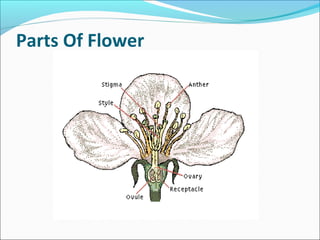
Parts Of Flower
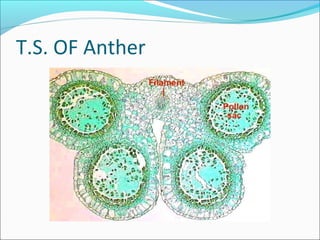
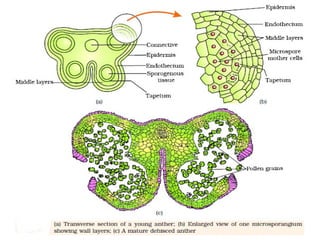
T.S. OF Anther
Structure Of Anther (Microsporangium)
Bilobed and dithecus.
A longitudinal groove separate the theca.
In a cross- section anther is a tetragonal structure,
consisting of 4 microsporangia, two in each lobes.
Later two microsporangia of each lobe fuse as a
pollen sac.
Structure Of Anther
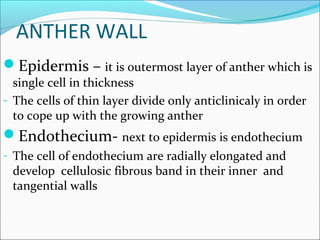
A microsporangium is circular and surrounded by 4
layers.
These layers are -
- Epidermis,
- Endothecium,
- Middle layers
- Tapetum.
Outermost layers protect the pollen and help in
dehiscence of anther to release pollen.
ANTHER WALL
Epidermis – it is outermost layer of anther which is
single cell in thickness
- The cells of thin layer divide only anticlinicaly in order
to cope up with the growing anther
Endothecium- next to epidermis is endothecium
- The cell of endothecium are radially elongated and
develop cellulosic fibrous band in their inner and
tangential walls
Middle layers- next to endothecium are 1-3 middle
layers.
- All of them degenerate at the time of meiosis in microspore
mother cell
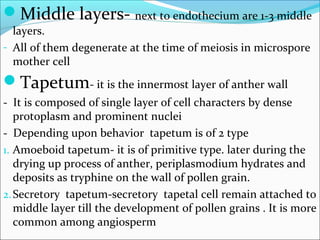
Tapetum- it is the innermost layer of anther wall
- It is composed of single layer of cell characters by dense
protoplasm and prominent nuclei
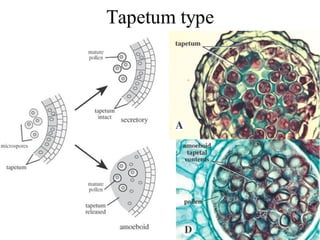
- Depending upon behavior tapetum is of 2 type
1. Amoeboid tapetum- it is of primitive type. later during the
drying up process of anther, periplasmodium hydrates and
deposits as tryphine on the wall of pollen grain.
2.Secretory tapetum-secretory tapetal cell remain attached to
middle layer till the development of pollen grains . It is more
common among angiosperm
Function of tapetum
It provide nourishment to the developing
pollen grain
it help in the formation of exine
It hepls in the transport of food material to
inside of the anther
Tapetum helps in the formation of pollen
wall
Sporogenous tissue
Primary sporogenous tissue give rise to microspore
mother cell
Some of sporogenous cell remain non functional and
serve as the food material for the developing
microspore
MMC under goes meiosis to form microspore tetrad
which seprate out to form microspore or pollen grain
The process of formation of microspore from MMC is
called microsporogensis
Microsporogenesis
The process of formation of microspores from a pollen
mother cell through meiosis is called
microsporogenesis.
The cells of sporogenous tissue undergo meiosis to
form microspore tetrad arranged in a cluster of 4
cells..
As each cell of sporogenous tissue has potential to
form tetrad, so each cell is a microspore mother cell
(PMC).
On maturation and dehydration of anther, the spores
dissociate and develop into pollen grains.
Pollen grains release with the dehiscence of anther.
Pollen Grain (Male Gametophyte)
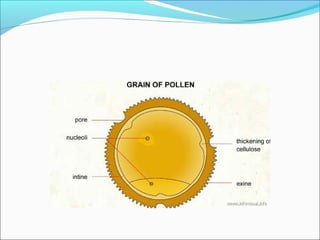
Spherical in shape.
Have two layered wall- outer hard exine layer and
inner thin intine.
Exine- made up of sporopolenin. Resistant to organic
matter, withstand high temperature, acids, alkalis and
enzymes. It has prominent apertures called germ
pores, where sporopolenin is absent.
Intine- It is thin, continuous layer, made of cellulose
and pectin.
Pollen Grain (Male Gametophyte)
Pollen grain cytoplasm is surrounded by plasma
membrane.
Mature pollen grain has 2 cells- (i) vegetative cell (ii)
generative cell.
Vegetative cell- bigger, abundant food reserve, large
irregular nucleus.
Generative cell- small, spindle shaped with dense
cytoplasm and a nucleus, floats in vegetative cell
cytoplasm.
In 60% species pollen grains are shed in 2 celled stage
where as 40% species shed in 3 celled stage in which
generative cell divides mitotically into 2 male gametes.
Microsporogensis
Microsporogensis
Microsporogensis

Microsporogensis

  • 1.
    Prepared by –ARUNSAINI Bsc (2nd ) medical Rollno. -136910054 Submitted to- Dr. Deepika .
  • 2.
  • 3.
  • 4.
    Structure Of Anther(Microsporangium) Bilobed and dithecus. A longitudinal groove separate the theca. In a cross- section anther is a tetragonal structure, consisting of 4 microsporangia, two in each lobes. Later two microsporangia of each lobe fuse as a pollen sac.
  • 5.
    Structure Of Anther Amicrosporangium is circular and surrounded by 4 layers. These layers are - - Epidermis, - Endothecium, - Middle layers - Tapetum. Outermost layers protect the pollen and help in dehiscence of anther to release pollen.
  • 7.
    ANTHER WALL Epidermis –it is outermost layer of anther which is single cell in thickness - The cells of thin layer divide only anticlinicaly in order to cope up with the growing anther Endothecium- next to epidermis is endothecium - The cell of endothecium are radially elongated and develop cellulosic fibrous band in their inner and tangential walls
  • 8.
    Middle layers- nextto endothecium are 1-3 middle layers. - All of them degenerate at the time of meiosis in microspore mother cell Tapetum- it is the innermost layer of anther wall - It is composed of single layer of cell characters by dense protoplasm and prominent nuclei - Depending upon behavior tapetum is of 2 type 1. Amoeboid tapetum- it is of primitive type. later during the drying up process of anther, periplasmodium hydrates and deposits as tryphine on the wall of pollen grain. 2.Secretory tapetum-secretory tapetal cell remain attached to middle layer till the development of pollen grains . It is more common among angiosperm
  • 10.
    Function of tapetum Itprovide nourishment to the developing pollen grain it help in the formation of exine It hepls in the transport of food material to inside of the anther Tapetum helps in the formation of pollen wall
  • 11.
    Sporogenous tissue Primary sporogenoustissue give rise to microspore mother cell Some of sporogenous cell remain non functional and serve as the food material for the developing microspore MMC under goes meiosis to form microspore tetrad which seprate out to form microspore or pollen grain The process of formation of microspore from MMC is called microsporogensis
  • 12.
    Microsporogenesis The process offormation of microspores from a pollen mother cell through meiosis is called microsporogenesis. The cells of sporogenous tissue undergo meiosis to form microspore tetrad arranged in a cluster of 4 cells.. As each cell of sporogenous tissue has potential to form tetrad, so each cell is a microspore mother cell (PMC). On maturation and dehydration of anther, the spores dissociate and develop into pollen grains. Pollen grains release with the dehiscence of anther.
  • 14.
    Pollen Grain (MaleGametophyte) Spherical in shape. Have two layered wall- outer hard exine layer and inner thin intine. Exine- made up of sporopolenin. Resistant to organic matter, withstand high temperature, acids, alkalis and enzymes. It has prominent apertures called germ pores, where sporopolenin is absent. Intine- It is thin, continuous layer, made of cellulose and pectin.
  • 15.
    Pollen Grain (MaleGametophyte) Pollen grain cytoplasm is surrounded by plasma membrane. Mature pollen grain has 2 cells- (i) vegetative cell (ii) generative cell. Vegetative cell- bigger, abundant food reserve, large irregular nucleus. Generative cell- small, spindle shaped with dense cytoplasm and a nucleus, floats in vegetative cell cytoplasm. In 60% species pollen grains are shed in 2 celled stage where as 40% species shed in 3 celled stage in which generative cell divides mitotically into 2 male gametes.