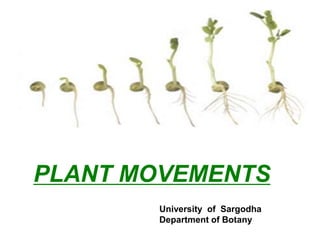
PLANT MOVEMENTS
University of Sargodha
Department of Botany
Plant movement
• "The capacity of plants to change their
position in response to external
(environmental ) or internal stimuli is known
as plant movement".
• Plant movement include movements towards
the light ,opening and closing of flowers ,
growth of developing roots looking for water
and nutrients etc.infact inflourescence ,fruits,
and shoots are all efficient in moving by
picking up modifications in environment,
therefore changing their position , function
and behaviours accordingly.
Important terms:
• Plants show movements in response to a variety of
stimuli.
• srimulus can be defined as a change in external or
internal environment of an organism that elicites
response in the organism.
• The power or ability of a plant to respond to a
stimulus is called sensitivity or reactivity or
irritability.
• The area which percieves a stimulus is called
perception site.
• While the plant part showing the response is
known as responsive region.
• The minimum duration or time required for a
stimulus to be applied continuously on the
perceptive region to produce visible response is
called presentation time.
• The duratio between the application of stimulus
and production of visible response is called latent
time or reaction time.
Continue......
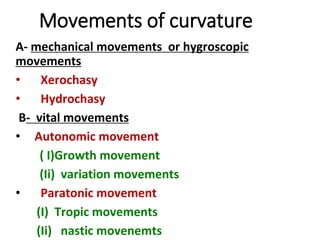
Movements of curvature
A- mechanical movements or hygroscopic
movements
• Xerochasy
• Hydrochasy
B- vital movements
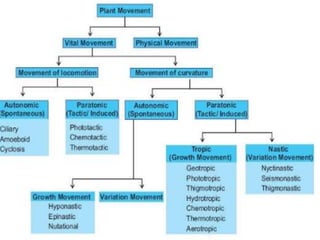
• Autonomic movement
( I)Growth movement
(Ii) variation movements
• Paratonic movement
(I) Tropic movements
(Ii) nastic movenemts
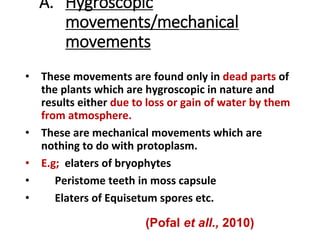
A. Hygroscopic
movements/mechanical
movements
• These movements are found only in dead parts of
the plants which are hygroscopic in nature and
results either due to loss or gain of water by them
from atmosphere.
• These are mechanical movements which are
nothing to do with protoplasm.
• E.g; elaters of bryophytes
• Peristome teeth in moss capsule
• Elaters of Equisetum spores etc.
(Pofal et all., 2010)
Continue.......
Xerochasy
• This movement occurs due to the loss of
water.
• For example : when water is lost from
annulus of sporangia of fern , it burst from
stomium and spores are librated out.
• the explosive movements or catapult actions
of certain fruits Like Lupinus perennis and
Iris versicolor take place when certain fruits
tissue dries up.
(Pofal et all., 2010)
(ll) Hydrochasy:
This movement occurs due to the absorption of
water .
Example: Ruellia fruit ruptures after absorbing
moisture from outside.
Equisetum coil and uncoil in the presence or
absence of Water.
(Pofal et all., 2010)
B- Vital movements.
Irritibility of protoplasm brings these
movements these movements may be of 2
types:
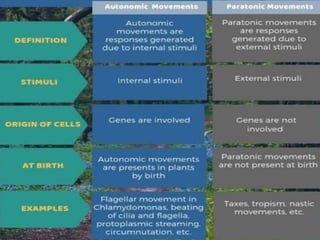
a) Autonomic/spontaneous movements
• Growth movement
• Variation movements
a) Paratonic/induced movements
• Tropic movement
• Nastic movement
a. Autonomic movements
(i) Autonomic growth movements
These movementd are due to unequal growth in
different parts of an organ and are irreversible .
they are independant of surrounding of plants or
external stimuli.
• Nutation
These movements occurs in the growing stem of
twiners (pea or bean) .The stem exhibits a kind if
noding movements in 2 directions .
They are further divided into type
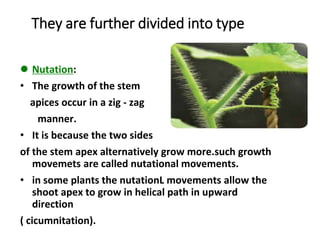
 Nutation:
• The growth of the stem
apices occur in a zig - zag
manner.
• It is because the two sides
of the stem apex alternatively grow more.such growth
movemets are called nutational movements.
• in some plants the nutationL movements allow the
shoot apex to grow in helical path in upward
direction
( cicumnitation).
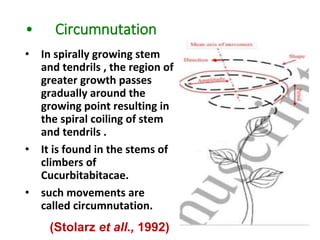
• Circumnutation
• In spirally growing stem
and tendrils , the region of
greater growth passes
gradually around the
growing point resulting in
the spiral coiling of stem
and tendrils .
• It is found in the stems of
climbers of
Cucurbitabitacae.
• such movements are
called circumnutation.
(Stolarz et all., 1992)
• As, the stem apex shows more growth on one side at
one time and a little later there is a greater growth o
opposite side.
• it is called nutation.
• This circular movements of growing stem takes place
always in the same direction for same pla t species.
• Since , the more rapid growth travels around the tip
whuch, as it grows upward must therefore , rotates.
(Stolarz et all., 2014)
Widespread occurance of
circumnutation
• Circumnutations are wide spread in the plant
kingdom.
• Charles Darwin was the 1st scientist who describe
cicumnutation movements extensively.
• In his work, The POWER OF MOVEMNT in plant,
Darwin presented circumnutations in numerous
plant species and claimed that all other movents,
i.e; geotropism or sleep movements are
modification of basic circumnutation movements.
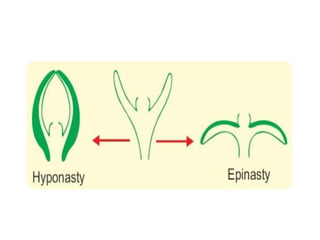
Hyponasty:
When growth is more on lower surface , petals show
curvature on upper side and ultimately the flower
become closed .such type of movement is called
Hyponasty.
Epinasty:
When growth is more on upper surface , petals show
curvature on lower side and ultimately the flower
opens.
The flower usally opens at high temperature and
remains closed at low temperature.
(ll) Movements of variation
• They are autonomous curvature movements and
are independant of external stimuli.
• They are not growth movements hence are
reversible
• These movements are also known as turgor
movements becausr these are brought about by
change in tugor pressure of certain sensitive cells
of the plant organs.such movements are exhibited
by lateral leaflets in Desmodium gyrans ,Mimosa
pidica , Telegraph plant.
Turgor movements
Turgor movements are reversible changes in the
position of plant parts due to changes in internal water
pressure and are often but no always started by contact
with objects.
The movement of Mimosa pudica (touch me not plant)
leaves when touched s an example of turgor
movements .
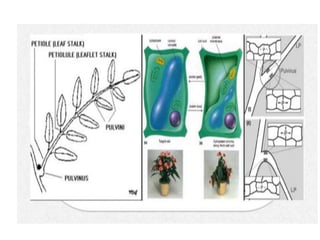
Turgor movement by Mimosa pudica
• The base of petiole is swollen (pulvinus)and similar but
smaller pulvinus are present at the bade of each leaflet.
• lower half thin walled and upper half thick walled.
• If the terminal pinnule is struck a blow or touched , the
stimulus is conducted to its base and then other
pinnules.
• This stimulus causes fall in turgor of lower cells due to
loss of water.
• Upper half retained turgidity.
• Turgid half presses flaccid lower half lower half/leaf
droops.
• when the touch stimulus is removed regains turgity.
MOVEMENTS OF
LOCOMOTION
Definition
"Those movements in which whole of the plant
body or cell or cytoplasm moves from one place
to another are called movements of
locomotion".
These movements are generally very fast.
These movements are very common among lower
plants and mostly by unicellular organismz.
These movents occur either:
a) Spontaneously (autonomic).
b) Response to certain external stimulus
(paratonic or induced)
Autonomic movements of
locomotion
i. Ciliary movements
ii. Amoebeoid movements
iii.Cyclosis
1- ciliary movements
Such type of movement takes place due the
presence of cilia or flagella
e.g; chlamydomonas ,volvox, papramecium
, flagellated or ciliated reproductive cells
etc.
2- Amoeboid movements
Such movements are exhibited by
Myxomycetes where the naked
plasmodium moves by producing
psuedopodia like an Amoeba.
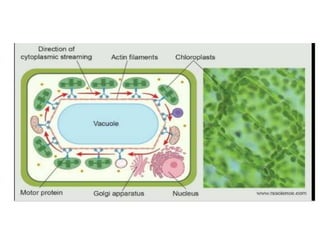
3- Cyclosis
In living cells of many plants the cytoplasm including
various cell organelles moves around the vacuoles. This
movement of the cytoplasm is called cytoplasmic
streaming or cyclosis.
It is of 2 types:
A- Rotation
It is exhibited by plants like hydrilla, Vallisneria , Elodea
etc. The cytoplasm moves either clockwise or anti clock
wise around a cetral large vacuole.
B- circulation
The cytoplasm moves in both clockwise and anticlockwise
direction around many smaller vacuoles
(Stolarz et all., 2010)
Paratonic or induced movements of
locomotion
(Tactic movements)
1. Phototactic movements ( phototaxis)
2. Chemotatic movements (chemotaxis)
3. Thermotactic movements (
thermotactic)
1 - photactic movement or
phototaxis
 These movements occur in response to an
external stimuli the light and are exhibited by
zoospore and gametes of certain algae e.g;
Cladophora ,volvox, chlamydomonas,
Ulothrix etc.
 They show +ive phototactic movement under
diffused light .
 They show -ive phototactic movements under
intense light.
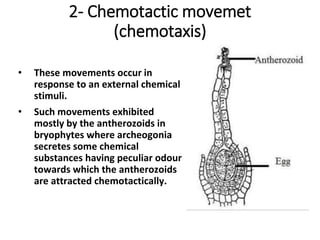
2- Chemotactic movemet
(chemotaxis)
• These movements occur in
response to an external chemical
stimuli.
• Such movements exhibited
mostly by the antherozoids in
bryophytes where archeogonia
secretes some chemical
substances having peculiar odour
towards which the antherozoids
are attracted chemotactically.
Paratonic (induces) movements
of curvature
The movements arising from external stimulus is
callec Paratonic movements .
They are of 2 types:
Tropic movements
Nastic movements.
TROPIC MOVEMENTS (Tropism)
 The word tropism comes from Greek word "Trope"
which means a "turning".
 When growth movements occur in response to an
external stimulus which is unidirectional they are
called as tropical movements called as tropism.
 These are the curvature movements brought about
by more growth on one side and less growth on
opposire side.
 Dictionary defined as tropism is an orientation of an
organism to an external stimuli.
Continue.......
• They are directional movements and direction
of influences the orientarion of responding
plant organs.stimulus is therefore directional
and not diffuse.
• They are slow movements unlike nastic
movements.
• Tropism is typically shown in plant organs
having radial symmetry like shoot, root.
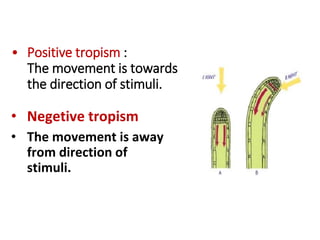
• Positive tropism :
The movement is towards
the direction of stimuli.
• Negetive tropism
• The movement is away
from direction of
stimuli.
• Darwin said that many plant parts ,particularly
leaves ,move in response to a number of
environmental and physiological factors .The
most important environmental factors are light
intensity (phototropic),light direction
• ( heliotropism), water content (hydrotropism)
and temperature (thermotropism).
• Charles Darwin 1st categorize the leaf
movement in year 1880 in his book " THE
POWER OF MOVEMENT"
Work of Charles Darwin
(Darwin et all., 1880)
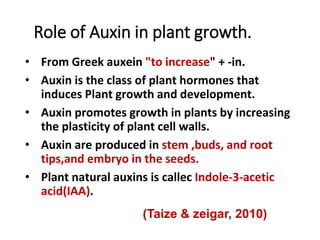
Role of Auxin in plant growth.
• From Greek auxein "to increase" + -in.
• Auxin is the class of plant hormones that
induces Plant growth and development.
• Auxin promotes growth in plants by increasing
the plasticity of plant cell walls.
• Auxin are produced in stem ,buds, and root
tips,and embryo in the seeds.
• Plant natural auxins is callec Indole-3-acetic
acid(IAA).
(Taize & zeigar, 2010)
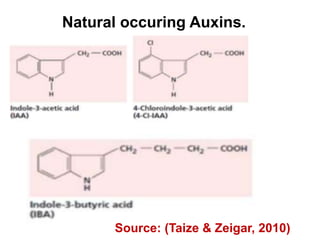
Natural occuring Auxins.
Source: (Taize & Zeigar, 2010)
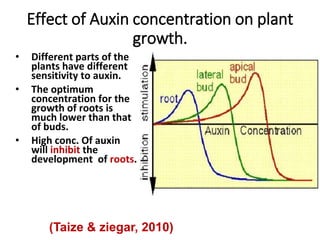
Effect of Auxin concentration on plant
growth.
• Different parts of the
plants have different
sensitivity to auxin.
• The optimum
concentration for the
growth of roots is
much lower than that
of buds.
• High conc. Of auxin
will inhibit the
development of roots.
(Taize & ziegar, 2010)
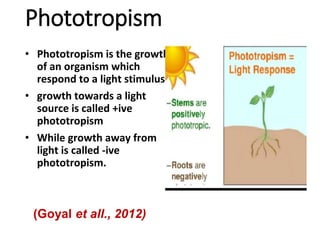
Phototropism
• Phototropism is the growth
of an organism which
respond to a light stimulus.
• growth towards a light
source is called +ive
phototropism
• While growth away from
light is called -ive
phototropism.
(Goyal et all., 2012)
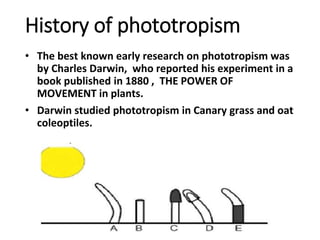
History of phototropism
• The best known early research on phototropism was
by Charles Darwin, who reported his experiment in a
book published in 1880 , THE POWER OF
MOVEMENT in plants.
• Darwin studied phototropism in Canary grass and oat
coleoptiles.
Conclusion of Darwin
• The tip of the coleoptile is the most photosensitive
region.
• The middle of coleoptile is responsible for the most
of bending.
• An influence which cause bending is transmitted
from the top to the middle of coleoptile.
Cholodny- went model
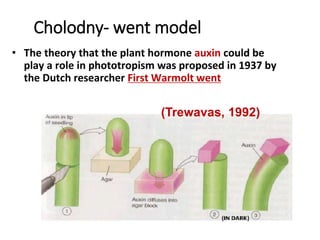
• The theory that the plant hormone auxin could be
play a role in phototropism was proposed in 1937 by
the Dutch researcher First Warmolt went
(Trewavas, 1992)
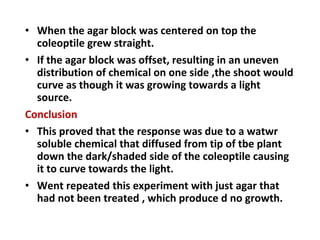
• When the agar block was centered on top the
coleoptile grew straight.
• If the agar block was offset, resulting in an uneven
distribution of chemical on one side ,the shoot would
curve as though it was growing towards a light
source.
Conclusion
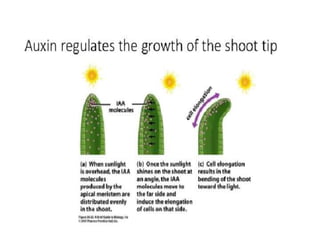
• This proved that the response was due to a watwr
soluble chemical that diffused from tip of tbe plant
down the dark/shaded side of the coleoptile causing
it to curve towards the light.
• Went repeated this experiment with just agar that
had not been treated , which produce d no growth.
Phototropism
vs
photoperiodism
Photoperiodism
• The growth
development and other
responses of plants
according to the length
of day/night.
• Responsible for
inductiom of flowering
in response to the
durtion of light in the
day.
Phototropism
• The movement of plant
towards or away from
light.
• The curvature growth in
the parts of plants
towards or away from
light.
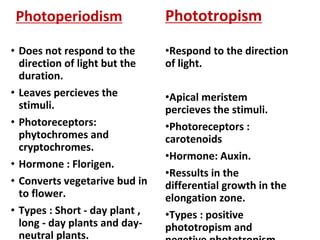
Photoperiodism
• Does not respond to the
direction of light but the
duration.
• Leaves percieves the
stimuli.
• Photoreceptors:
phytochromes and
cryptochromes.
• Hormone : Florigen.
• Converts vegetarive bud in
to flower.
• Types : Short - day plant ,
long - day plants and day-
neutral plants.
Phototropism
•Respond to the direction
of light.
•Apical meristem
percieves the stimuli.
•Photoreceptors :
carotenoids
•Hormone: Auxin.
•Ressults in the
differential growth in the
elongation zone.
•Types : positive
phototropism and
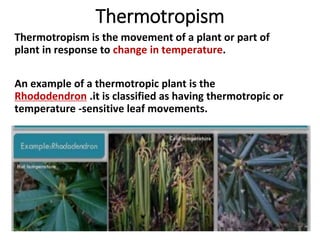
Thermotropism
Thermotropism is the movement of a plant or part of
plant in response to change in temperature.
An example of a thermotropic plant is the
Rhododendron .it is classified as having thermotropic or
temperature -sensitive leaf movements.
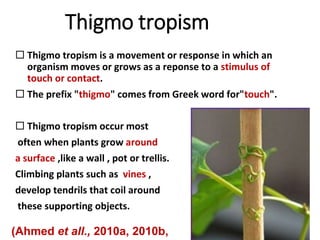
Thigmo tropism
 Thigmo tropism is a movement or response in which an
organism moves or grows as a reponse to a stimulus of
touch or contact.
 The prefix "thigmo" comes from Greek word for"touch".
 Thigmo tropism occur most
often when plants grow around
a surface ,like a wall , pot or trellis.
Climbing plants such as vines ,
develop tendrils that coil around
these supporting objects.
(Ahmed et all., 2010a, 2010b,
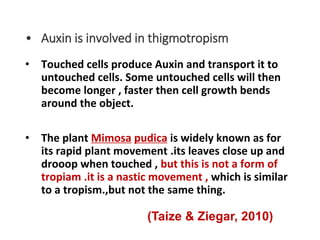
• Auxin is involved in thigmotropism
• Touched cells produce Auxin and transport it to
untouched cells. Some untouched cells will then
become longer , faster then cell growth bends
around the object.
• The plant Mimosa pudica is widely known as for
its rapid plant movement .its leaves close up and
drooop when touched , but this is not a form of
tropiam .it is a nastic movement , which is similar
to a tropism.,but not the same thing.
(Taize & Ziegar, 2010)
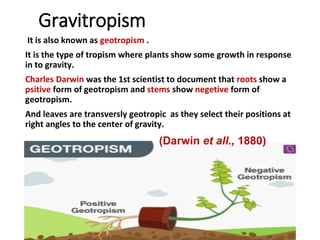
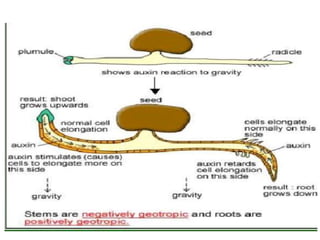
Gravitropism
It is also known as geotropism .
It is the type of tropism where plants show some growth in response
in to gravity.
Charles Darwin was the 1st scientist to document that roots show a
psitive form of geotropism and stems show negetive form of
geotropism.
And leaves are transversly geotropic as they select their positions at
right angles to the center of gravity.
(Darwin et all., 1880)
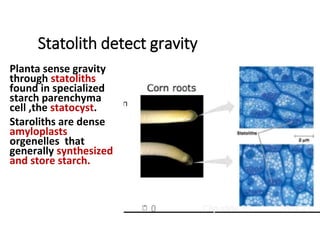
Statolith detect gravity
Planta sense gravity
through statoliths
found in specialized
starch parenchyma
cell ,the statocyst.
Staroliths are dense
amyloplasts
orgenelles that
generally synthesized
and store starch.
Chemotropism
• This is the movement caused by unilateral
stimulus of some chemicals
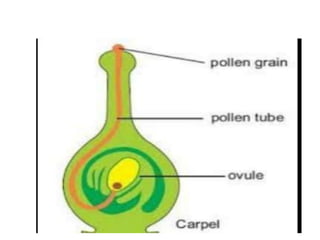
• Movement of pollen tube through the style
towards the ovary is an example of
chemotropism..
• Growth of fungal hyphae towards sugar and
peptones is also an example of
chemotropism.
Hydrotropism
• Growth movement in response to an external
stimulus of water are termed ad hydrotropism.
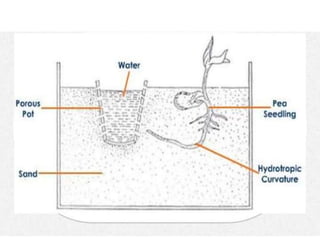
• Roots are positively hrdrotrpoic (i.e., bed
towards the source of water.
• Stems are indifferent or negarively hydrotropic.
• Positive hydrotropism movement of roots is
stronger than geotropic response.
• As if there is scacity of water ,roots bend
towards the sewage pipes and other sources of
water in disregrad of stimulus of gravity.
NASTIC MOVEMENTS
• Nastic movement is a non-direcrional respond to
stimuli.
• Growth may not be involved in nastic movement.
• The movement is generally due to changes in turgor
and is generally reversible.
• They are faster movements when compared to
tropic Movements.
• These are more specialized movementz in fuction
• These movements are shown by specialized plant
and plant organs.
•
• The response of organ is independant of the direction
of stimuli.
• These movements are typically shown in plant organs
having dorsoventral symmetry.
• The direction of movement is determined by the
structure of the plant organ itself , it is not detrmined
by an external stimuli.
• The direction of tropic responses depends on the
stimuli, whereas the direction of Nastic movements are
independant of stimuli.
Types of Nastic movement:
1. Nyctinastic (sleep movement
a. Photonasty
b. Thermonasty
2. Seismonastic movemen
3.Haponastic or thigmonastic movement
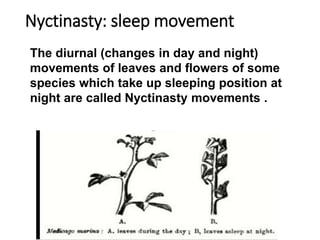
Nyctinasty: sleep movement
The diurnal (changes in day and night)
movements of leaves and flowers of some
species which take up sleeping position at
night are called Nyctinasty movements .
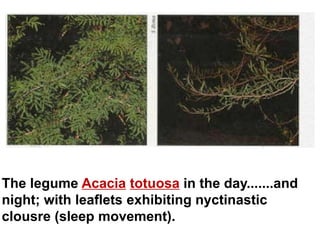
The legume Acacia totuosa in the day.......and
night; with leaflets exhibiting nyctinastic
clousre (sleep movement).
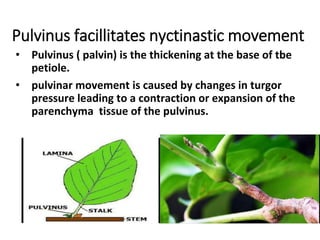
Pulvinus facillitates nyctinastic movement
• Pulvinus ( palvin) is the thickening at the base of tbe
petiole.
• pulvinar movement is caused by changes in turgor
pressure leading to a contraction or expansion of the
parenchyma tissue of the pulvinus.
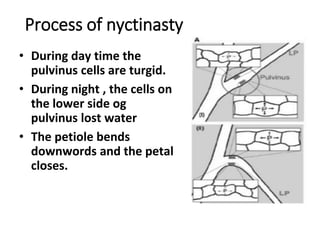
Process of nyctinasty
• During day time the
pulvinus cells are turgid.
• During night , the cells on
the lower side og
pulvinus lost water
• The petiole bends
downwords and the petal
closes.
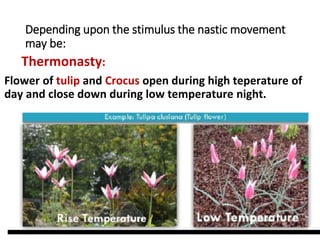
Depending upon the stimulus the nastic movement
may be:
Thermonasty:
Flower of tulip and Crocus open during high teperature of
day and close down during low temperature night.
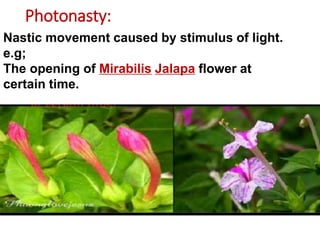
Photonasty:
Nastic movement caused by stimulus of light.
e.g;
The opening of Mirabilis Jalapa flower at
certain time.
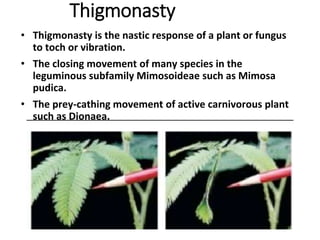
Thigmonasty
• Thigmonasty is the nastic response of a plant or fungus
to toch or vibration.
• The closing movement of many species in the
leguminous subfamily Mimosoideae such as Mimosa
pudica.
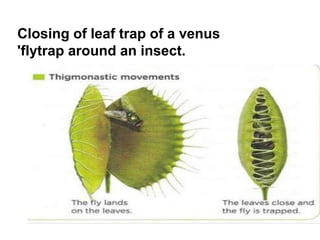
• The prey-cathing movement of active carnivorous plant
such as Dionaea.
Closing of leaf trap of a venus
'flytrap around an insect.
Siesmonasty:
• These movements are brought about by
mechanical stimuli such as contact with a foriegn
body ,fast wind and rain drops etc
• Mimosa pudica (touch me not plant) ,
Biophytum ,Neputunia Oleracea and
Desmanthus are very sensitive to touch rather
generated by touch.
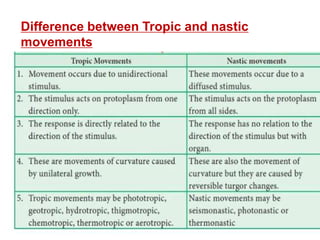
Difference between Tropic and nastic
movements
Conclusion
Various kinds of movements are exhibited by plants and
their organs .smaller palnt organisms are naked
protoplasmic bodies show movememts of locomotion
whereas higher plants being fixed in a position , show
movements of curvature .
References:
• Maria, Stolarz . 2014. Circumnutation as a visible plant
action and reaction.plant signaling &Behaviour. 4(5):
380-387.
• Brown, Allan. H.1992.Circumnutations From
Darwin to Space Flights.plant Physiology. 101(2):
345-348.
• Taiz, L & zeiger, E. 2006. Auxin: The Growth
Hormone. Pant physiology. 4(1): 468- 507.
• Moulia, B, Fournier M. 2009. The power and control
of gravitropic movement in Plants: a biochdmical
and system biology. Pak . J. Bot., 60: 461-480.
• Darwin, C & Darwin, F.1880. The Power of
Movememt in Plants.The movement and
Habits Of Climbing palnts. 1: 3-14.
• Wood, W. M. L. 1953.Thermonasty in Tulip and
Crocus Flowers. Journal of Experimantal Botany. 4(1):
65-77.
• Trewavas, A.j. 1992. What remains of
the Cholondy-went theory?
Introduction. Plant cell Environ. 5(7):
761.
Thank you

Presentation on plant movement

  • 1.
    PLANT MOVEMENTS University ofSargodha Department of Botany
  • 2.
    Plant movement • "Thecapacity of plants to change their position in response to external (environmental ) or internal stimuli is known as plant movement". • Plant movement include movements towards the light ,opening and closing of flowers , growth of developing roots looking for water and nutrients etc.infact inflourescence ,fruits, and shoots are all efficient in moving by picking up modifications in environment, therefore changing their position , function and behaviours accordingly.
  • 3.
    Important terms: • Plantsshow movements in response to a variety of stimuli. • srimulus can be defined as a change in external or internal environment of an organism that elicites response in the organism. • The power or ability of a plant to respond to a stimulus is called sensitivity or reactivity or irritability. • The area which percieves a stimulus is called perception site.
  • 4.
    • While theplant part showing the response is known as responsive region. • The minimum duration or time required for a stimulus to be applied continuously on the perceptive region to produce visible response is called presentation time. • The duratio between the application of stimulus and production of visible response is called latent time or reaction time. Continue......
  • 7.
    Movements of curvature A-mechanical movements or hygroscopic movements • Xerochasy • Hydrochasy B- vital movements • Autonomic movement ( I)Growth movement (Ii) variation movements • Paratonic movement (I) Tropic movements (Ii) nastic movenemts
  • 8.
    A. Hygroscopic movements/mechanical movements • Thesemovements are found only in dead parts of the plants which are hygroscopic in nature and results either due to loss or gain of water by them from atmosphere. • These are mechanical movements which are nothing to do with protoplasm. • E.g; elaters of bryophytes • Peristome teeth in moss capsule • Elaters of Equisetum spores etc. (Pofal et all., 2010)
  • 9.
    Continue....... Xerochasy • This movementoccurs due to the loss of water. • For example : when water is lost from annulus of sporangia of fern , it burst from stomium and spores are librated out. • the explosive movements or catapult actions of certain fruits Like Lupinus perennis and Iris versicolor take place when certain fruits tissue dries up. (Pofal et all., 2010)
  • 10.
    (ll) Hydrochasy: This movementoccurs due to the absorption of water . Example: Ruellia fruit ruptures after absorbing moisture from outside. Equisetum coil and uncoil in the presence or absence of Water. (Pofal et all., 2010)
  • 11.
    B- Vital movements. Irritibilityof protoplasm brings these movements these movements may be of 2 types: a) Autonomic/spontaneous movements • Growth movement • Variation movements a) Paratonic/induced movements • Tropic movement • Nastic movement
  • 12.
    a. Autonomic movements (i)Autonomic growth movements These movementd are due to unequal growth in different parts of an organ and are irreversible . they are independant of surrounding of plants or external stimuli. • Nutation These movements occurs in the growing stem of twiners (pea or bean) .The stem exhibits a kind if noding movements in 2 directions .
  • 13.
    They are furtherdivided into type  Nutation: • The growth of the stem apices occur in a zig - zag manner. • It is because the two sides of the stem apex alternatively grow more.such growth movemets are called nutational movements. • in some plants the nutationL movements allow the shoot apex to grow in helical path in upward direction ( cicumnitation).
  • 14.
    • Circumnutation • Inspirally growing stem and tendrils , the region of greater growth passes gradually around the growing point resulting in the spiral coiling of stem and tendrils . • It is found in the stems of climbers of Cucurbitabitacae. • such movements are called circumnutation. (Stolarz et all., 1992)
  • 15.
    • As, thestem apex shows more growth on one side at one time and a little later there is a greater growth o opposite side. • it is called nutation. • This circular movements of growing stem takes place always in the same direction for same pla t species. • Since , the more rapid growth travels around the tip whuch, as it grows upward must therefore , rotates. (Stolarz et all., 2014)
  • 16.
    Widespread occurance of circumnutation •Circumnutations are wide spread in the plant kingdom. • Charles Darwin was the 1st scientist who describe cicumnutation movements extensively. • In his work, The POWER OF MOVEMNT in plant, Darwin presented circumnutations in numerous plant species and claimed that all other movents, i.e; geotropism or sleep movements are modification of basic circumnutation movements.
  • 17.
    Hyponasty: When growth ismore on lower surface , petals show curvature on upper side and ultimately the flower become closed .such type of movement is called Hyponasty. Epinasty: When growth is more on upper surface , petals show curvature on lower side and ultimately the flower opens. The flower usally opens at high temperature and remains closed at low temperature.
  • 19.
    (ll) Movements ofvariation • They are autonomous curvature movements and are independant of external stimuli. • They are not growth movements hence are reversible • These movements are also known as turgor movements becausr these are brought about by change in tugor pressure of certain sensitive cells of the plant organs.such movements are exhibited by lateral leaflets in Desmodium gyrans ,Mimosa pidica , Telegraph plant.
  • 20.
    Turgor movements Turgor movementsare reversible changes in the position of plant parts due to changes in internal water pressure and are often but no always started by contact with objects. The movement of Mimosa pudica (touch me not plant) leaves when touched s an example of turgor movements .
  • 21.
    Turgor movement byMimosa pudica • The base of petiole is swollen (pulvinus)and similar but smaller pulvinus are present at the bade of each leaflet. • lower half thin walled and upper half thick walled. • If the terminal pinnule is struck a blow or touched , the stimulus is conducted to its base and then other pinnules. • This stimulus causes fall in turgor of lower cells due to loss of water. • Upper half retained turgidity. • Turgid half presses flaccid lower half lower half/leaf droops. • when the touch stimulus is removed regains turgity.
  • 23.
  • 24.
    Definition "Those movements inwhich whole of the plant body or cell or cytoplasm moves from one place to another are called movements of locomotion". These movements are generally very fast. These movements are very common among lower plants and mostly by unicellular organismz. These movents occur either: a) Spontaneously (autonomic). b) Response to certain external stimulus (paratonic or induced)
  • 25.
    Autonomic movements of locomotion i.Ciliary movements ii. Amoebeoid movements iii.Cyclosis
  • 26.
    1- ciliary movements Suchtype of movement takes place due the presence of cilia or flagella e.g; chlamydomonas ,volvox, papramecium , flagellated or ciliated reproductive cells etc.
  • 27.
    2- Amoeboid movements Suchmovements are exhibited by Myxomycetes where the naked plasmodium moves by producing psuedopodia like an Amoeba.
  • 28.
    3- Cyclosis In livingcells of many plants the cytoplasm including various cell organelles moves around the vacuoles. This movement of the cytoplasm is called cytoplasmic streaming or cyclosis. It is of 2 types: A- Rotation It is exhibited by plants like hydrilla, Vallisneria , Elodea etc. The cytoplasm moves either clockwise or anti clock wise around a cetral large vacuole. B- circulation The cytoplasm moves in both clockwise and anticlockwise direction around many smaller vacuoles (Stolarz et all., 2010)
  • 30.
    Paratonic or inducedmovements of locomotion (Tactic movements) 1. Phototactic movements ( phototaxis) 2. Chemotatic movements (chemotaxis) 3. Thermotactic movements ( thermotactic)
  • 31.
    1 - photacticmovement or phototaxis  These movements occur in response to an external stimuli the light and are exhibited by zoospore and gametes of certain algae e.g; Cladophora ,volvox, chlamydomonas, Ulothrix etc.  They show +ive phototactic movement under diffused light .  They show -ive phototactic movements under intense light.
  • 32.
    2- Chemotactic movemet (chemotaxis) •These movements occur in response to an external chemical stimuli. • Such movements exhibited mostly by the antherozoids in bryophytes where archeogonia secretes some chemical substances having peculiar odour towards which the antherozoids are attracted chemotactically.
  • 33.
    Paratonic (induces) movements ofcurvature The movements arising from external stimulus is callec Paratonic movements . They are of 2 types: Tropic movements Nastic movements.
  • 34.
    TROPIC MOVEMENTS (Tropism) The word tropism comes from Greek word "Trope" which means a "turning".  When growth movements occur in response to an external stimulus which is unidirectional they are called as tropical movements called as tropism.  These are the curvature movements brought about by more growth on one side and less growth on opposire side.  Dictionary defined as tropism is an orientation of an organism to an external stimuli.
  • 35.
    Continue....... • They aredirectional movements and direction of influences the orientarion of responding plant organs.stimulus is therefore directional and not diffuse. • They are slow movements unlike nastic movements. • Tropism is typically shown in plant organs having radial symmetry like shoot, root.
  • 36.
    • Positive tropism: The movement is towards the direction of stimuli. • Negetive tropism • The movement is away from direction of stimuli.
  • 37.
    • Darwin saidthat many plant parts ,particularly leaves ,move in response to a number of environmental and physiological factors .The most important environmental factors are light intensity (phototropic),light direction • ( heliotropism), water content (hydrotropism) and temperature (thermotropism). • Charles Darwin 1st categorize the leaf movement in year 1880 in his book " THE POWER OF MOVEMENT" Work of Charles Darwin (Darwin et all., 1880)
  • 38.
    Role of Auxinin plant growth. • From Greek auxein "to increase" + -in. • Auxin is the class of plant hormones that induces Plant growth and development. • Auxin promotes growth in plants by increasing the plasticity of plant cell walls. • Auxin are produced in stem ,buds, and root tips,and embryo in the seeds. • Plant natural auxins is callec Indole-3-acetic acid(IAA). (Taize & zeigar, 2010)
  • 39.
    Natural occuring Auxins. Source:(Taize & Zeigar, 2010)
  • 40.
    Effect of Auxinconcentration on plant growth. • Different parts of the plants have different sensitivity to auxin. • The optimum concentration for the growth of roots is much lower than that of buds. • High conc. Of auxin will inhibit the development of roots. (Taize & ziegar, 2010)
  • 41.
    Phototropism • Phototropism isthe growth of an organism which respond to a light stimulus. • growth towards a light source is called +ive phototropism • While growth away from light is called -ive phototropism. (Goyal et all., 2012)
  • 42.
    History of phototropism •The best known early research on phototropism was by Charles Darwin, who reported his experiment in a book published in 1880 , THE POWER OF MOVEMENT in plants. • Darwin studied phototropism in Canary grass and oat coleoptiles.
  • 43.
    Conclusion of Darwin •The tip of the coleoptile is the most photosensitive region. • The middle of coleoptile is responsible for the most of bending. • An influence which cause bending is transmitted from the top to the middle of coleoptile.
  • 44.
    Cholodny- went model •The theory that the plant hormone auxin could be play a role in phototropism was proposed in 1937 by the Dutch researcher First Warmolt went (Trewavas, 1992)
  • 45.
    • When theagar block was centered on top the coleoptile grew straight. • If the agar block was offset, resulting in an uneven distribution of chemical on one side ,the shoot would curve as though it was growing towards a light source. Conclusion • This proved that the response was due to a watwr soluble chemical that diffused from tip of tbe plant down the dark/shaded side of the coleoptile causing it to curve towards the light. • Went repeated this experiment with just agar that had not been treated , which produce d no growth.
  • 47.
    Phototropism vs photoperiodism Photoperiodism • The growth developmentand other responses of plants according to the length of day/night. • Responsible for inductiom of flowering in response to the durtion of light in the day. Phototropism • The movement of plant towards or away from light. • The curvature growth in the parts of plants towards or away from light.
  • 48.
    Photoperiodism • Does notrespond to the direction of light but the duration. • Leaves percieves the stimuli. • Photoreceptors: phytochromes and cryptochromes. • Hormone : Florigen. • Converts vegetarive bud in to flower. • Types : Short - day plant , long - day plants and day- neutral plants. Phototropism •Respond to the direction of light. •Apical meristem percieves the stimuli. •Photoreceptors : carotenoids •Hormone: Auxin. •Ressults in the differential growth in the elongation zone. •Types : positive phototropism and
  • 49.
    Thermotropism Thermotropism is themovement of a plant or part of plant in response to change in temperature. An example of a thermotropic plant is the Rhododendron .it is classified as having thermotropic or temperature -sensitive leaf movements.
  • 50.
    Thigmo tropism  Thigmotropism is a movement or response in which an organism moves or grows as a reponse to a stimulus of touch or contact.  The prefix "thigmo" comes from Greek word for"touch".  Thigmo tropism occur most often when plants grow around a surface ,like a wall , pot or trellis. Climbing plants such as vines , develop tendrils that coil around these supporting objects. (Ahmed et all., 2010a, 2010b,
  • 51.
    • Auxin isinvolved in thigmotropism • Touched cells produce Auxin and transport it to untouched cells. Some untouched cells will then become longer , faster then cell growth bends around the object. • The plant Mimosa pudica is widely known as for its rapid plant movement .its leaves close up and drooop when touched , but this is not a form of tropiam .it is a nastic movement , which is similar to a tropism.,but not the same thing. (Taize & Ziegar, 2010)
  • 52.
    Gravitropism It is alsoknown as geotropism . It is the type of tropism where plants show some growth in response in to gravity. Charles Darwin was the 1st scientist to document that roots show a psitive form of geotropism and stems show negetive form of geotropism. And leaves are transversly geotropic as they select their positions at right angles to the center of gravity. (Darwin et all., 1880)
  • 54.
    Statolith detect gravity Plantasense gravity through statoliths found in specialized starch parenchyma cell ,the statocyst. Staroliths are dense amyloplasts orgenelles that generally synthesized and store starch.
  • 55.
    Chemotropism • This isthe movement caused by unilateral stimulus of some chemicals • Movement of pollen tube through the style towards the ovary is an example of chemotropism.. • Growth of fungal hyphae towards sugar and peptones is also an example of chemotropism.
  • 57.
    Hydrotropism • Growth movementin response to an external stimulus of water are termed ad hydrotropism. • Roots are positively hrdrotrpoic (i.e., bed towards the source of water. • Stems are indifferent or negarively hydrotropic. • Positive hydrotropism movement of roots is stronger than geotropic response. • As if there is scacity of water ,roots bend towards the sewage pipes and other sources of water in disregrad of stimulus of gravity.
  • 59.
    NASTIC MOVEMENTS • Nasticmovement is a non-direcrional respond to stimuli. • Growth may not be involved in nastic movement. • The movement is generally due to changes in turgor and is generally reversible. • They are faster movements when compared to tropic Movements. • These are more specialized movementz in fuction • These movements are shown by specialized plant and plant organs. •
  • 60.
    • The responseof organ is independant of the direction of stimuli. • These movements are typically shown in plant organs having dorsoventral symmetry. • The direction of movement is determined by the structure of the plant organ itself , it is not detrmined by an external stimuli. • The direction of tropic responses depends on the stimuli, whereas the direction of Nastic movements are independant of stimuli.
  • 61.
    Types of Nasticmovement: 1. Nyctinastic (sleep movement a. Photonasty b. Thermonasty 2. Seismonastic movemen 3.Haponastic or thigmonastic movement
  • 62.
    Nyctinasty: sleep movement Thediurnal (changes in day and night) movements of leaves and flowers of some species which take up sleeping position at night are called Nyctinasty movements .
  • 63.
    The legume Acaciatotuosa in the day.......and night; with leaflets exhibiting nyctinastic clousre (sleep movement).
  • 64.
    Pulvinus facillitates nyctinasticmovement • Pulvinus ( palvin) is the thickening at the base of tbe petiole. • pulvinar movement is caused by changes in turgor pressure leading to a contraction or expansion of the parenchyma tissue of the pulvinus.
  • 65.
    Process of nyctinasty •During day time the pulvinus cells are turgid. • During night , the cells on the lower side og pulvinus lost water • The petiole bends downwords and the petal closes.
  • 66.
    Depending upon thestimulus the nastic movement may be: Thermonasty: Flower of tulip and Crocus open during high teperature of day and close down during low temperature night.
  • 67.
    Photonasty: Nastic movement causedby stimulus of light. e.g; The opening of Mirabilis Jalapa flower at certain time.
  • 68.
    Thigmonasty • Thigmonasty isthe nastic response of a plant or fungus to toch or vibration. • The closing movement of many species in the leguminous subfamily Mimosoideae such as Mimosa pudica. • The prey-cathing movement of active carnivorous plant such as Dionaea.
  • 69.
    Closing of leaftrap of a venus 'flytrap around an insect.
  • 70.
    Siesmonasty: • These movementsare brought about by mechanical stimuli such as contact with a foriegn body ,fast wind and rain drops etc • Mimosa pudica (touch me not plant) , Biophytum ,Neputunia Oleracea and Desmanthus are very sensitive to touch rather generated by touch.
  • 71.
    Difference between Tropicand nastic movements
  • 72.
    Conclusion Various kinds ofmovements are exhibited by plants and their organs .smaller palnt organisms are naked protoplasmic bodies show movememts of locomotion whereas higher plants being fixed in a position , show movements of curvature .
  • 73.
    References: • Maria, Stolarz. 2014. Circumnutation as a visible plant action and reaction.plant signaling &Behaviour. 4(5): 380-387. • Brown, Allan. H.1992.Circumnutations From Darwin to Space Flights.plant Physiology. 101(2): 345-348. • Taiz, L & zeiger, E. 2006. Auxin: The Growth Hormone. Pant physiology. 4(1): 468- 507. • Moulia, B, Fournier M. 2009. The power and control of gravitropic movement in Plants: a biochdmical and system biology. Pak . J. Bot., 60: 461-480. • Darwin, C & Darwin, F.1880. The Power of Movememt in Plants.The movement and Habits Of Climbing palnts. 1: 3-14.
  • 74.
    • Wood, W.M. L. 1953.Thermonasty in Tulip and Crocus Flowers. Journal of Experimantal Botany. 4(1): 65-77. • Trewavas, A.j. 1992. What remains of the Cholondy-went theory? Introduction. Plant cell Environ. 5(7): 761.
  • 75.