GUIDED BY:-
DR. RAAJU MAHOBIA SIR
PRESENTED BY:-
ANITA KURRE
M.SC IVTH SEM
GOVERNMENT D. K COLLEGE, BALODA BAZAR
CHHATTISGARH
CONTENT:-
INTRODUCTION
THE POLLEN GRAIN
MICROSPOROGENESIS
THE OVULE
MEGASPOROGENESIS
GERMINATION OF POLLEN GRAIN
DOUBLE FERTILIZATION
POST FERTILIZATION
REFRENCE
INTRODUCTION
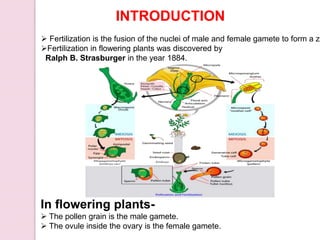
 Fertilization is the fusion of the nuclei of male and female gamete to form a zy
Fertilization in flowering plants was discovered by
Ralph B. Strasburger in the year 1884.
In flowering plants-
 The pollen grain is the male gamete.
 The ovule inside the ovary is the female gamete.
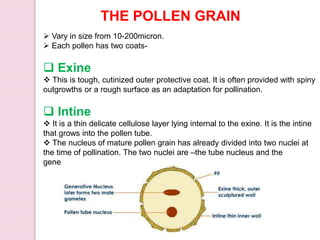
THE POLLEN GRAIN
 Vary in size from 10-200micron.
 Each pollen has two coats-
 Exine
 This is tough, cutinized outer protective coat. It is often provided with spiny
outgrowths or a rough surface as an adaptation for pollination.
 Intine
 It is a thin delicate cellulose layer lying internal to the exine. It is the intine
that grows into the pollen tube.
 The nucleus of mature pollen grain has already divided into two nuclei at
the time of pollination. The two nuclei are –the tube nucleus and the
generative nucleus.
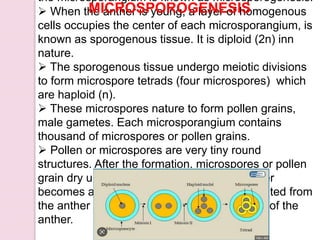
the microsporangium is known as microsporogenesis.
 When the anther is young, a layer of homogenous
cells occupies the center of each microsporangium, is
known as sporogenous tissue. It is diploid (2n) inn
nature.
 The sporogenous tissue undergo meiotic divisions
to form microspore tetrads (four microspores) which
are haploid (n).
 These microspores nature to form pollen grains,
male gametes. Each microsporangium contains
thousand of microspores or pollen grains.
 Pollen or microspores are very tiny round
structures. After the formation, microspores or pollen
grain dry up and become powdery. The anther
becomes a dry structure and pollen are liberated from
the anther to the environment by dehiscence of the
anther.
MICROSPOROGENESIS
THE OVULE
Ovule is the inner part of ovary.
Parts of a mature ovule:
Integuments
Two layers of protective coating.
Micropyle
Minute pore or opening through which
the pollen tube enters.
Nucellus
Nutritive tissue lining the interior of the ovule.
Embryo sac
In the centre of nucleus, it contain seven cells-
Three cells at the micropylar end- one egg cell
and two synergids.
Three cells at opposite end, called antipodal cells.
One large central cell. The central cell is different containing two nuclei
called polar
nuclei.
MEGASPOROGENESIS
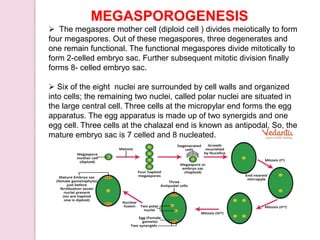
 The megaspore mother cell (diploid cell ) divides meiotically to form
four megaspores. Out of these megaspores, three degenerates and
one remain functional. The functional megaspores divide mitotically to
form 2-celled embryo sac. Further subsequent mitotic division finally
forms 8- celled embryo sac.
 Six of the eight nuclei are surrounded by cell walls and organized
into cells; the remaining two nuclei, called polar nuclei are situated in
the large central cell. Three cells at the micropylar end forms the egg
apparatus. The egg apparatus is made up of two synergids and one
egg cell. Three cells at the chalazal end is known as antipodal. So, the
mature embryo sac is 7 celled and 8 nucleated.
Germination of Pollen Grain
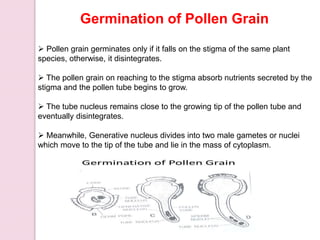
 Pollen grain germinates only if it falls on the stigma of the same plant
species, otherwise, it disintegrates.
 The pollen grain on reaching to the stigma absorb nutrients secreted by the
stigma and the pollen tube begins to grow.
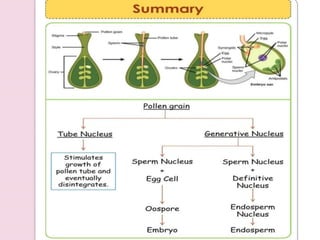
 The tube nucleus remains close to the growing tip of the pollen tube and
eventually disintegrates.
 Meanwhile, Generative nucleus divides into two male gametes or nuclei
which move to the tip of the tube and lie in the mass of cytoplasm.
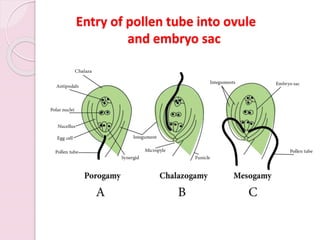
 The tube then turns toward the micropyle, passes inwards through it, and
finally reaches the embryo sac, close to the egg cell.
 After pollen tube penetrates into the tip of the tube dissolve and the male
gametes are set free inside the ovule.
 One male gametes fuses with the egg and forms the fertilized egg and or
the zygote.
 The second male gamete fuses with the secondary nucleus (definitive
nucleus) i.e, the nucleus formed by the fusion of the polar nuclei and forms
the endosperm nucleus. The fusion of male gamete with the two polar nuclei
is often termed as triple fusion.
 The zygote develops into the embryo, while the endosperm nucleus
develops into endosperm of the seed.
Entry of pollen tube into ovule
and embryo sac
Double Fertilization
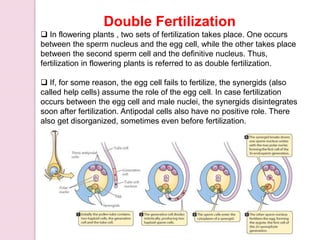
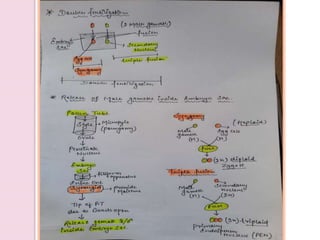
 In flowering plants , two sets of fertilization takes place. One occurs
between the sperm nucleus and the egg cell, while the other takes place
between the second sperm cell and the definitive nucleus. Thus,
fertilization in flowering plants is referred to as double fertilization.
 If, for some reason, the egg cell fails to fertilize, the synergids (also
called help cells) assume the role of the egg cell. In case fertilization
occurs between the egg cell and male nuclei, the synergids disintegrates
soon after fertilization. Antipodal cells also have no positive role. There
also get disorganized, sometimes even before fertilization.
Post fertilization
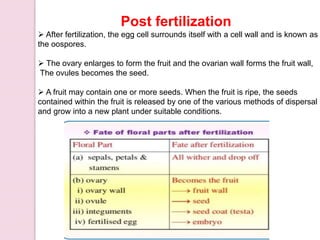
 After fertilization, the egg cell surrounds itself with a cell wall and is known as
the oospores.
 The ovary enlarges to form the fruit and the ovarian wall forms the fruit wall,
The ovules becomes the seed.
 A fruit may contain one or more seeds. When the fruit is ripe, the seeds
contained within the fruit is released by one of the various methods of dispersal
and grow into a new plant under suitable conditions.
REFRENCE:-
 BOTANY (DR. S.B AGRAWAL)
 UNIFIED BOTANY (SHIVLAL
AGARWAL)
 https://uou.ac.in/sites/default/files/s
lm/MSCBOT-509.pdf
Fertilization in plant .ppt

Fertilization in plant .ppt

  • 1.
    GUIDED BY:- DR. RAAJUMAHOBIA SIR PRESENTED BY:- ANITA KURRE M.SC IVTH SEM GOVERNMENT D. K COLLEGE, BALODA BAZAR CHHATTISGARH
  • 2.
    CONTENT:- INTRODUCTION THE POLLEN GRAIN MICROSPOROGENESIS THEOVULE MEGASPOROGENESIS GERMINATION OF POLLEN GRAIN DOUBLE FERTILIZATION POST FERTILIZATION REFRENCE
  • 3.
    INTRODUCTION  Fertilization isthe fusion of the nuclei of male and female gamete to form a zy Fertilization in flowering plants was discovered by Ralph B. Strasburger in the year 1884. In flowering plants-  The pollen grain is the male gamete.  The ovule inside the ovary is the female gamete.
  • 4.
    THE POLLEN GRAIN Vary in size from 10-200micron.  Each pollen has two coats-  Exine  This is tough, cutinized outer protective coat. It is often provided with spiny outgrowths or a rough surface as an adaptation for pollination.  Intine  It is a thin delicate cellulose layer lying internal to the exine. It is the intine that grows into the pollen tube.  The nucleus of mature pollen grain has already divided into two nuclei at the time of pollination. The two nuclei are –the tube nucleus and the generative nucleus.
  • 5.
    the microsporangium isknown as microsporogenesis.  When the anther is young, a layer of homogenous cells occupies the center of each microsporangium, is known as sporogenous tissue. It is diploid (2n) inn nature.  The sporogenous tissue undergo meiotic divisions to form microspore tetrads (four microspores) which are haploid (n).  These microspores nature to form pollen grains, male gametes. Each microsporangium contains thousand of microspores or pollen grains.  Pollen or microspores are very tiny round structures. After the formation, microspores or pollen grain dry up and become powdery. The anther becomes a dry structure and pollen are liberated from the anther to the environment by dehiscence of the anther. MICROSPOROGENESIS
  • 6.
    THE OVULE Ovule isthe inner part of ovary. Parts of a mature ovule: Integuments Two layers of protective coating. Micropyle Minute pore or opening through which the pollen tube enters. Nucellus Nutritive tissue lining the interior of the ovule. Embryo sac In the centre of nucleus, it contain seven cells- Three cells at the micropylar end- one egg cell and two synergids. Three cells at opposite end, called antipodal cells. One large central cell. The central cell is different containing two nuclei called polar nuclei.
  • 7.
    MEGASPOROGENESIS  The megasporemother cell (diploid cell ) divides meiotically to form four megaspores. Out of these megaspores, three degenerates and one remain functional. The functional megaspores divide mitotically to form 2-celled embryo sac. Further subsequent mitotic division finally forms 8- celled embryo sac.  Six of the eight nuclei are surrounded by cell walls and organized into cells; the remaining two nuclei, called polar nuclei are situated in the large central cell. Three cells at the micropylar end forms the egg apparatus. The egg apparatus is made up of two synergids and one egg cell. Three cells at the chalazal end is known as antipodal. So, the mature embryo sac is 7 celled and 8 nucleated.
  • 8.
    Germination of PollenGrain  Pollen grain germinates only if it falls on the stigma of the same plant species, otherwise, it disintegrates.  The pollen grain on reaching to the stigma absorb nutrients secreted by the stigma and the pollen tube begins to grow.  The tube nucleus remains close to the growing tip of the pollen tube and eventually disintegrates.  Meanwhile, Generative nucleus divides into two male gametes or nuclei which move to the tip of the tube and lie in the mass of cytoplasm.
  • 9.
     The tubethen turns toward the micropyle, passes inwards through it, and finally reaches the embryo sac, close to the egg cell.  After pollen tube penetrates into the tip of the tube dissolve and the male gametes are set free inside the ovule.  One male gametes fuses with the egg and forms the fertilized egg and or the zygote.  The second male gamete fuses with the secondary nucleus (definitive nucleus) i.e, the nucleus formed by the fusion of the polar nuclei and forms the endosperm nucleus. The fusion of male gamete with the two polar nuclei is often termed as triple fusion.  The zygote develops into the embryo, while the endosperm nucleus develops into endosperm of the seed.
  • 10.
    Entry of pollentube into ovule and embryo sac
  • 12.
    Double Fertilization  Inflowering plants , two sets of fertilization takes place. One occurs between the sperm nucleus and the egg cell, while the other takes place between the second sperm cell and the definitive nucleus. Thus, fertilization in flowering plants is referred to as double fertilization.  If, for some reason, the egg cell fails to fertilize, the synergids (also called help cells) assume the role of the egg cell. In case fertilization occurs between the egg cell and male nuclei, the synergids disintegrates soon after fertilization. Antipodal cells also have no positive role. There also get disorganized, sometimes even before fertilization.
  • 14.
    Post fertilization  Afterfertilization, the egg cell surrounds itself with a cell wall and is known as the oospores.  The ovary enlarges to form the fruit and the ovarian wall forms the fruit wall, The ovules becomes the seed.  A fruit may contain one or more seeds. When the fruit is ripe, the seeds contained within the fruit is released by one of the various methods of dispersal and grow into a new plant under suitable conditions.
  • 15.
    REFRENCE:-  BOTANY (DR.S.B AGRAWAL)  UNIFIED BOTANY (SHIVLAL AGARWAL)  https://uou.ac.in/sites/default/files/s lm/MSCBOT-509.pdf