




PRESENTATION
ON
BIO-INFORMATICS
DNA SEQUENCING PROCESS
GROUP MEMBER
SAJIBUL HASSAN
NAHIAN AHMED
TARIQUL ISLAM
MONSUR AHMED SHAFIQ
OMAR FARUQ
NAHIAN AHMED
ID- 151-15-5137
DEOXYRIBONUCLEIC ACID
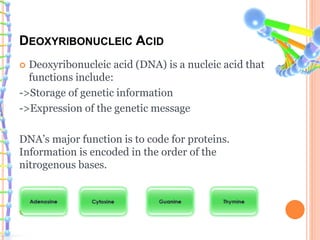
 Deoxyribonucleic acid (DNA) is a nucleic acid that
functions include:
->Storage of genetic information
->Expression of the genetic message
DNA’s major function is to code for proteins.
Information is encoded in the order of the
nitrogenous bases.

DNA SEQUENCING
 Determining the order of bases in a
section of DNA.
 To analyze gene structure and its
relation to gene expression as well as
protein conformation
HISTORY
• Deoxyribonucleic acid (DNA) was first
discovered and isolated by Friedrich
Miescher in 1869
• 1953 structure of DNA established as a
double helix
• 1970 first method of DNA sequencing
involved a location specific primed
extension strategy.
• 1977 Frederick sanger published a method for DNA
sequencing with chain terminating in hibitors.
• 1990 several new methods are developed in the mid to
late90,s
• 2003 complete human genome project
History
SAJIBUL HASSAN
ID-151-15-4986
• Mapping genomes
• Determining gene structure
• Detecting polymorphism
• Analyzing genetic variation
• Predicting the possible product(s)
of DNA fragments
DNA Sequencing is used for:
DNA SEQUENCING METHOD
Methods of DNA sequencing :
1.Maxam-Gilbert sequencing
2.Chain termination method (Sanger method)
Next generation methods:
1.Massively parallel signature sequencing
2.Polony sequencing
3.Pyrosequencing
4.Illumina sequencing
5.Solid sequencing
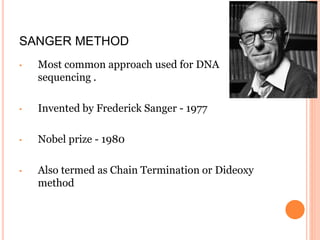
SANGER METHOD
• Most common approach used for DNA
sequencing .
• Invented by Frederick Sanger - 1977
• Nobel prize - 1980
• Also termed as Chain Termination or Dideoxy
method
TARIQUL ISLAM
ID -151-15-5144
STEP - 1
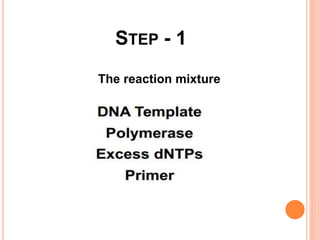
The reaction mixture
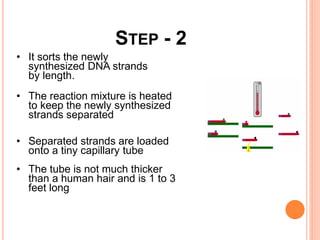
• It sorts the newly
synthesized DNA strands
by length.
• The reaction mixture is heated
to keep the newly synthesized
strands separated
• Separated strands are loaded
onto a tiny capillary tube
• The tube is not much thicker
than a human hair and is 1 to 3
feet long
STEP - 2
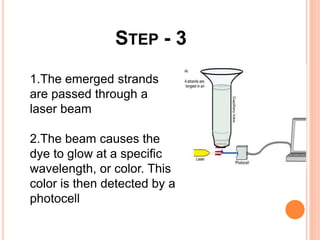
1.The emerged strands
are passed through a
laser beam
2.The beam causes the
dye to glow at a specific
wavelength, or color. This
color is then detected by a
photocell
STEP - 3
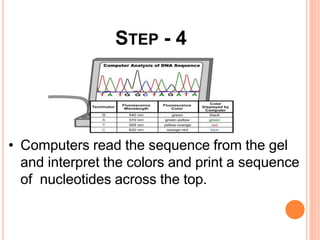
• Computers read the sequence from the gel
and interpret the colors and print a sequence
of nucleotides across the top.
STEP - 4
MONSUR AHMED SHAFIQ
ID-151-15-5439
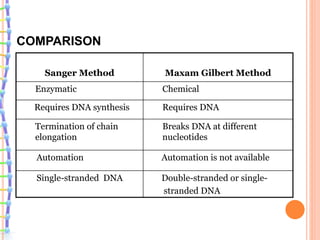
COMPARISON
Sanger Method Maxam Gilbert Method
Enzymatic Chemical
Requires DNA synthesis Requires DNA
Termination of chain
elongation
Breaks DNA at different
nucleotides
Automation Automation is not available
Single-stranded DNA Double-stranded or single-
stranded DNA
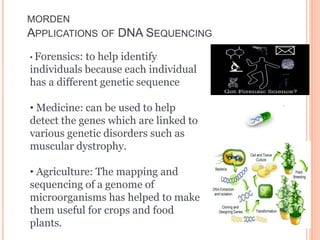
MORDEN
APPLICATIONS OF DNA SEQUENCING
• Forensics: to help identify
individuals because each individual
has a different genetic sequence
• Medicine: can be used to help
detect the genes which are linked to
various genetic disorders such as
muscular dystrophy.
• Agriculture: The mapping and
sequencing of a genome of
microorganisms has helped to make
them useful for crops and food
plants.
OMAR FARUQ
ID-151-15-5444
HUMAN GENOME PROJECT
• The biggest challenge for the life sciences
• 15 years project (NIH, DOE of USA)
• Primary goal  Sequence base pairs of human
beings that form DNA
• Identifying & mapping approx. 20K-25K genes
• Significance  Physical & functional
•standpoint
ADVANTAGES
• Improved diagnosis of disease
• Identify the genes causing genetic diseases
• Identifying crime suspects
DISADVANTAGES
• Whole genome cannot be sequenced at once
• Very slow and time consuming
Thank You!!!

Presentation on DNA Sequencing Process

  • 1.
  • 2.
    GROUP MEMBER SAJIBUL HASSAN NAHIANAHMED TARIQUL ISLAM MONSUR AHMED SHAFIQ OMAR FARUQ
  • 3.
  • 4.
    DEOXYRIBONUCLEIC ACID  Deoxyribonucleicacid (DNA) is a nucleic acid that functions include: ->Storage of genetic information ->Expression of the genetic message DNA’s major function is to code for proteins. Information is encoded in the order of the nitrogenous bases. 
  • 5.
    DNA SEQUENCING  Determiningthe order of bases in a section of DNA.  To analyze gene structure and its relation to gene expression as well as protein conformation
  • 6.
    HISTORY • Deoxyribonucleic acid(DNA) was first discovered and isolated by Friedrich Miescher in 1869 • 1953 structure of DNA established as a double helix • 1970 first method of DNA sequencing involved a location specific primed extension strategy.
  • 7.
    • 1977 Fredericksanger published a method for DNA sequencing with chain terminating in hibitors. • 1990 several new methods are developed in the mid to late90,s • 2003 complete human genome project History
  • 8.
  • 9.
    • Mapping genomes •Determining gene structure • Detecting polymorphism • Analyzing genetic variation • Predicting the possible product(s) of DNA fragments DNA Sequencing is used for:
  • 10.
    DNA SEQUENCING METHOD Methodsof DNA sequencing : 1.Maxam-Gilbert sequencing 2.Chain termination method (Sanger method) Next generation methods: 1.Massively parallel signature sequencing 2.Polony sequencing 3.Pyrosequencing 4.Illumina sequencing 5.Solid sequencing
  • 11.
    SANGER METHOD • Mostcommon approach used for DNA sequencing . • Invented by Frederick Sanger - 1977 • Nobel prize - 1980 • Also termed as Chain Termination or Dideoxy method
  • 12.
  • 13.
    STEP - 1 Thereaction mixture
  • 14.
    • It sortsthe newly synthesized DNA strands by length. • The reaction mixture is heated to keep the newly synthesized strands separated • Separated strands are loaded onto a tiny capillary tube • The tube is not much thicker than a human hair and is 1 to 3 feet long STEP - 2
  • 15.
    1.The emerged strands arepassed through a laser beam 2.The beam causes the dye to glow at a specific wavelength, or color. This color is then detected by a photocell STEP - 3
  • 16.
    • Computers readthe sequence from the gel and interpret the colors and print a sequence of nucleotides across the top. STEP - 4
  • 17.
  • 18.
    COMPARISON Sanger Method MaxamGilbert Method Enzymatic Chemical Requires DNA synthesis Requires DNA Termination of chain elongation Breaks DNA at different nucleotides Automation Automation is not available Single-stranded DNA Double-stranded or single- stranded DNA
  • 19.
    MORDEN APPLICATIONS OF DNASEQUENCING • Forensics: to help identify individuals because each individual has a different genetic sequence • Medicine: can be used to help detect the genes which are linked to various genetic disorders such as muscular dystrophy. • Agriculture: The mapping and sequencing of a genome of microorganisms has helped to make them useful for crops and food plants.
  • 20.
  • 21.
    HUMAN GENOME PROJECT •The biggest challenge for the life sciences • 15 years project (NIH, DOE of USA) • Primary goal  Sequence base pairs of human beings that form DNA • Identifying & mapping approx. 20K-25K genes • Significance  Physical & functional •standpoint
  • 22.
    ADVANTAGES • Improved diagnosisof disease • Identify the genes causing genetic diseases • Identifying crime suspects DISADVANTAGES • Whole genome cannot be sequenced at once • Very slow and time consuming
  • 23.