General Microbiology Unit I
Page 1
DEFINITION AND SCOPE OF MICROBIOLOGY
1.1 INTRODUCTION
Microbiology is a branch of science that deals with microbes. The term
microbiology derives its name from three Greek words mikros [small] bios [life] and
logos [study]. Microbiology focus on the occurrence and distribution of
microorganisms in nature, their structure, physiology, reproduction, metabolism and
classification.
Microbes - Microorganisms are tiny and invisible to naked eye. They can be seen only
by magnifying their image with a microscope. Small subcellular or cellular living beings
with milli-micron or micron in size and are not visible to our naked eyes are called
micro-organisms. Microorganisms include the cellular organisms like bacteria, fungi,
algae and protozoa. Viruses are also included as one of the microorganism but they
are acellular.
The following branches that are concerned with the study of morphology, ecology,
taxonomy, genetics and physiology of specific groups of microbes.
1. Bacteriology-Study of bacteria
2. Phycology- Study of algae
3. Mycology -Study of fungi [molds and yeasts].
4. Virology- Study of viruses
5. Protozoology- Study of protozoa
1.2 DIFFERENCE BETWEEN MICROBIAL CELL AND PLANT/ANIMAL CELL
S. No Microbial cell Plant/Animal cell
(a) A microbial cell can live alone Plant or animal cell exist only as
part of organisms
(b) Growth, energy generation and
reproduction by a microbial cell are
independent
Plant or animal cell depend on
other cells for all processes
General Microbiology Unit I
Page 2
1.3. OCCURRENCE OF MICROORGANISMS
Microbes are widely distributed in the world. They are ubiquitous i.e. present
everywhere in air, water, soil, in living plants, animals, dead matter etc. They are
present on our body, in our body, in the air we breathe, in the food we eat, in the air we
drink, in our mouth and in our intestine. Almost all natural surfaces are colonized by
microbes. Some microorganisms are even adapted to live comfortably in boiling hot
springs and frozen sea ice. Microbes are the dominant form of life in the universe.
More than 50 per cent of the biomass on earth consists of microorganisms compared to
animals which constitute only 15 per cent of the mass of living organisms on earth.
Majority of the microorganisms are not dangerous to humans. In fact, microbes help to
digest our food and protect our bodies from pathogens. Additionally, they are
considered as beneficial ones as they keep the biosphere running by carrying out
essential functions such as decomposition of dead animals and plants, nutrient cycling
which enhances the soil health and crop productivity.
1.4 LEVEL OF ORGANIZATION
The microbes are either unicellular or multicellular or acellular (non-cellular)
forms.
 Unicellular – Bacteria and Protozoa
 Multicellular – Algae and Fungi
 Acellular – Virus
1.5 MEMBERS OF THE MICROBIAL WORLD
Based on the presence or absence of nuclear membrane microorganisms are
basically classified under two groups:
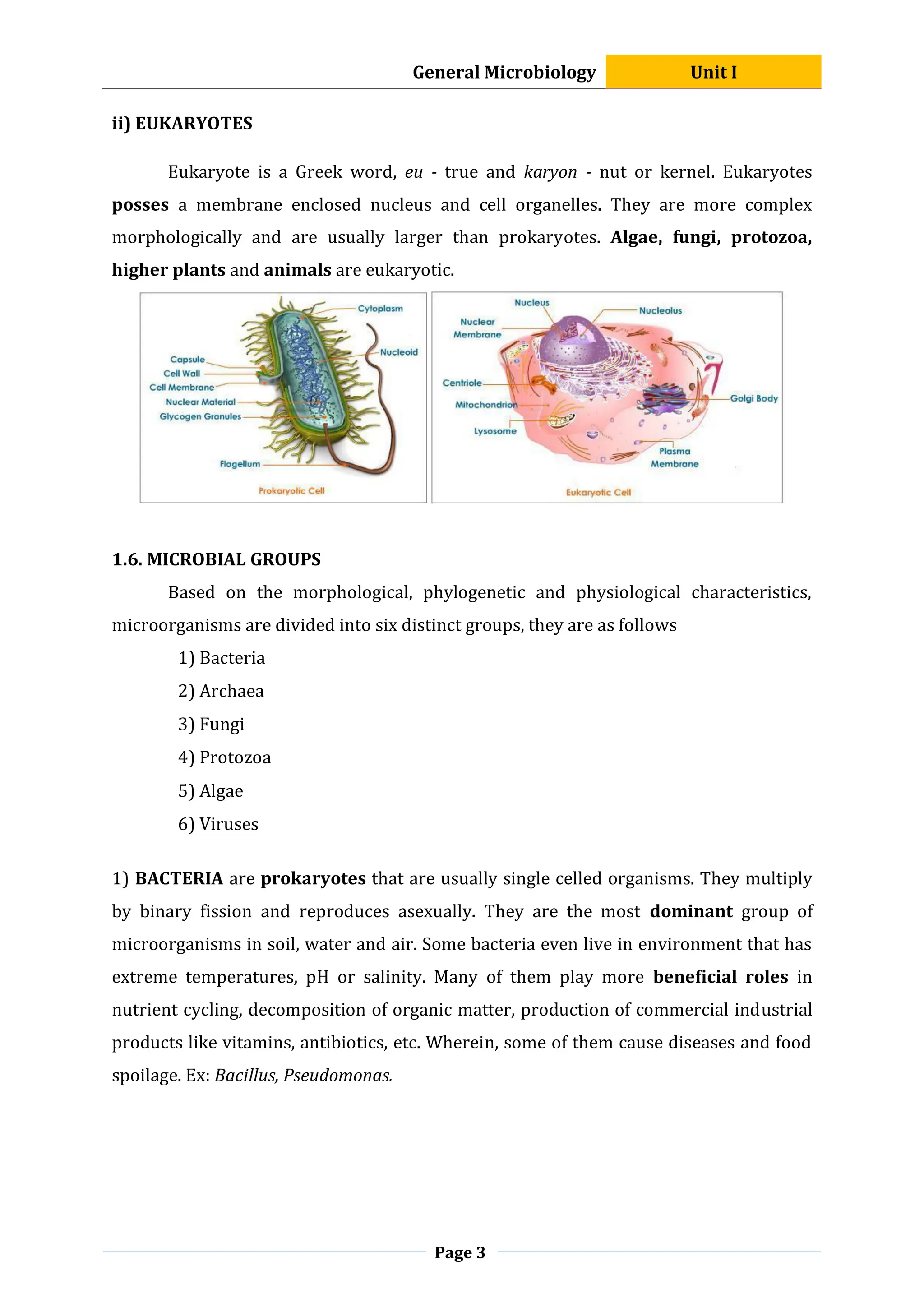
i) PROKARYOTES
Prokayote is a Greek word, pro - before and karyon - nut or kernel. Prokaryotes
are the organism with a primordial nucleus. They have a much simpler morphology
than eukaryotic cells and lack a true membrane bound nucleus and cell organelles like
mitochondria, golgi bodies, endoplasmic reticulum, etc. All bacteria and archaea are
prokaryotic.
General Microbiology Unit I
Page 3
ii) EUKARYOTES
Eukaryote is a Greek word, eu - true and karyon - nut or kernel. Eukaryotes
posses a membrane enclosed nucleus and cell organelles. They are more complex
morphologically and are usually larger than prokaryotes. Algae, fungi, protozoa,
higher plants and animals are eukaryotic.
1.6. MICROBIAL GROUPS
Based on the morphological, phylogenetic and physiological characteristics,
microorganisms are divided into six distinct groups, they are as follows
1) Bacteria
2) Archaea
3) Fungi
4) Protozoa
5) Algae
6) Viruses
1) BACTERIA are prokaryotes that are usually single celled organisms. They multiply
by binary fission and reproduces asexually. They are the most dominant group of
microorganisms in soil, water and air. Some bacteria even live in environment that has
extreme temperatures, pH or salinity. Many of them play more beneficial roles in
nutrient cycling, decomposition of organic matter, production of commercial industrial
products like vitamins, antibiotics, etc. Wherein, some of them cause diseases and food
spoilage. Ex: Bacillus, Pseudomonas.
General Microbiology Unit I
Page 4
2) ARCHAEA are phylogenetically related prokaryotes that are distinguished from
bacteria by many features, most notably their unique ribosomal RNA sequences. Many
archaea are found in extreme environments. Some have unusual metabolic
characteristics, such as the methanogens, which generate methane gas. Ex:
Methanobacterium.
3) ALGAE are eukaryotes that contain chlorophyll and are capable of performing
photosynthesis. Algae are found most commonly in aquatic environments. They
reproduce either sexually or asexually. Mostly they are used as food supplements. They
are mainly used in the preparation of agar. Ex: Spirulina, Gelidium.
4) FUNGI are eukaryotes. Next to bacteria, they are the most dominant organism in the
soil. In general, fungi range in size and shape from single-celled microscopic yeasts to
gaint multicellular mushrooms. They possess filamentous mycelium composed of
individual hyphae and reproduce either sexually or asexually by fission, budding or by
means of spores borne on fruiting structures. Unicellular fungi like yeast are involved
in the production of alcoholic beverages like wine and beer. Multicellular fungi like
molds are useful for industrial production of antibiotics like penicillin. Ex: Mucor,
Rhizopus.
5) PROTOZOA are unicellular eukaryotes that are usually motile and lack cell wall.
Many free living protozoa function as the primary hunters and grazers of the
microbial world. They can be found in many different environments and some are
normal inhabitants of the intestinal tracts of animals, where they aid in digestion of
complex materials such as cellulose. Some of them are parasitic and can cause diseases.
Ex: Amoeba, Paramecium.
6) VIRUSES are acellular (non cellular) organisms that are too small and can be
visualized only using electron microscopes. All are obligate parasites that require a
living cell for reproduction. They are pathogenic to plants, animals and humans. At
most of the cases they cause human diseases. Ex: Cauliflower mosaic virus, Cucumber
mosaic virus.
General Microbiology Unit I
Page 5
1.7. IMPORTANCE AND SCOPE OF MICROBIOLOGY
Microbiology is an applied science that has great impact on genetics,
biochemistry, food sciences, ecology, immunology, agriculture, medicine and many
other disciplines. Despite their small size they form the largest resource for
biotechnology. Various microbial genera have been used to study their genetics and
molecular biology. "Escherichia Coli" is a wonderful colon bacterium that has been
extensively studied by biotechnologists. They used it for cloning and Microbes play a
pivotal role in human welfare majority of the microbes are useful to mankind but some
of them are harmful as they cause infectious diseases in human beings, domestic
animals and agricultural crops.
1. Biotechnology:
a. Microbes produce very important DNA manipulating enzymes like REN
(Restriction Endo Nucleases) and Ligase. These two are used as molecular scissors
and stitches in biotechnology/ Genetic Engineering.
b. Some microbes, for example: E.coli is used as host organism to clone desired
gene for desired product.
2. Agriculture: from the point of agriculture microbes play an important role in the
following aspects.
a. Some microbes can be used as bio-fertilizers to enrich soil fertility.
b. Some bacteria can fix inert atmospheric nitrogen known as nitrogen fixing
bacteria. Ex: rhizobium, Azotobacter, Anabaena etc.
c. Some microbes like viruses and bacteria are used as bio-pesticides to protect
the crop plants from pest and insect eating.
3. Industry: from the point of industry, microbes are extremely useful
a. for the production of industrial chemicals like acetic acid, lactic acid, citric acid
etc. by fermentation process.
b. Microbes also find their importance in food industry and dairy industries to
produce fermented food products.
c. Microbes also play an important role in the production of ethyl alcohol in
brewing industry.
d. Microbes also find their importance in food and dairy industry to produce
fermented food products.
General Microbiology Unit I
Page 6
4. Medicine:
a. From the point of medicine various kinds of antibiotics used to treat pathogenic
diseases of man and animals are derived from microbial group called
actinomycetes.
b. Some heat killed microbes are used as vaccine against various kinds of
pathogenic microbes causing diseases.
5. Environment:
a. Microbes help to clean the environment by degrading all kinds of biodegradable
waste products. Hence, the microbes are regarded as scavengers of nature.
b. Microbes play important role bio-geo chemical cycles.
c. Microbes also play an important role in the production of Bio-gas from the
biological waste products.
6. Bio-remediation:
Is a method of pollution alleviation using microbes. Several bacteria and fungi
are capable of decay the natural waste, toxic chemicals, heavy metals, oil spills etc.
7. Bioleaching:
When the ore contains lower metal content, it is difficult to extract them by
direct smelting, in such cases some microbes (Thiobacillus species) are used to
separate the mineral from crude ores. This process is known as bioleaching or
microbial leaching.
1.8 BRANCHES OF MICROBIOLOGY
With the accumulation of knowledge about various aspects of microbes since the last
century and has spread in to various branches. Thus the various aspects of microbiology
study can be divided basically in to following branches.
1. Industrial Microbiology
 It deals with the exploitation of microbes for industrial production. Here the
microbes can be considered as mini chemical factories, as they are capable of
converting some raw materials into end products which have value for human
use.
 Microbes have been used to produce alcohols, antibiotics and organic acids, in
industrial
General Microbiology Unit I
Page 7
 scale. The study of fermentation by microorganisms has provided booster to
beverage industry.
 Recently with great advances in recombinant DNA technologies, provided a
better route to manipulate microbes genetically to produce new products.
2. Diary Microbiology
 It deals with the study of harmful and beneficial bacteria present in milk and
milk products.
 In diary microbiology the aspects like production of (yogurt) fermented milk
products.
 Pasteurization of milk and milk products can be studied. Many such fermented
milk products are used in treatment of dysentery and gastro enteritis.
3. Environmental Microbiology
 It is one of the important branches of microbiology where the role of microbes in
maintaining quality of environment is studied. Since microbes are found in every
environment the air, water, soil and food, they influence the degradation and
decay of natural wastes (bioremediation) they also influence the energy flow in
ecosystem.
 The study also helps to understand freshwater and marine water and their
microbes. Recently it has been shown that some genetically modified microbes
can help in cleaning oil spills and this gives an added advantage to the study of
environmental microbiology.
4. Food Microbiology
 It is concerned with study of role of microbes in food processing, food
preservation and canning. Extensive study of microbes in relation to food
products lead to characterization of microbes.
 As a result new methods have developed and old methods have been improved.
This branch also provides a platform for the study of food borne microbial
diseases and their control.
5. Agricultural Microbiology
 In this branch, the role of microbial activity in plants and their surroundings is
studied. Many microbes like fungi, bacteria, and viruses cause many diseases in
plants.
General Microbiology Unit I
Page 8
 This branch is concerned with study of nitrogen fixation activity. Use of microbes
as biofertilizers, use of microbes as bio pesticides and many more aspects.
6. Medical Microbiology
 The study of pathogenic microbes, the etiology, their life cycle, physiology.
Genetics, pathogenicity and control are known as medical microbiology. The
integral part of medical microbiology is to understand how immune system of
vertebrate protects themselves from pathogens and shows response to the
pathogen.
 This branch primarily allows the study of morphological and cultural
characteristic resistance nature of microbes, their diagnosis, treatment and
control of infectious diseases.
7. Air Microbiology
 The branch covers the study of dispersal of pathogenic microbes through air,
microbial population in air and control of air borne microbes by chemical agents,
radiations, filtration and laminar air flow methods.
8. Aquatic Microbiology
 It encompass the study of microbes present in fresh water, ocean water and
estuarine. This branch is of great significance that;
o Many aquatic microbes are pathogenic to human beings:
o Most of them are important in food chain in the ecosystem.
o They take part in recycling processes.
o They help in exploration of oils and minerals.
9. Immunology
 It is one of the fastest growing areas that covers the practical health problems
their nature and treatments.
 It is the study of immunity against invading microbes by a host.
10. Biotechnology
 It is the most significant branch that deals with the application of biological
techniques for the benefit of mankind.
 It encompasses the use of microbes for the production of drugs, fermented foods
and treatment of waste.
 It also includes developing techniques for the more efficient production of
specific compounds.
General Microbiology Unit I
Page 9
 It focuses on aspects such as nature of genetic material, regulation, development
and function of a cell, the method of production of new microbial cells by
recombinant DNA technology which are useful in industrial microbiology..
11. Exo-Microbiology
 It is branch still in its infancy, it includes explore and the study of microbes in
outer space and other planets such as moon and mars.
12. Geo-chemical Microbiology
 Study of role of microbes in coal, gas and mineral formation. Exploration of oil,
gas and minerals is known as geochemical microbiology.
As each branch of microbiology have got their own specialization that contribute to
the development of science and technology, always microbiology are crowned as
innovate, ever green branch of biology that have wider scopes for the emerging
scientists to be explored.
Reference:
1. General Microbiology – Sullia and Shantharam
2. Microbiology – Prescott
3. Microbiology – Pelczar

Definition and scope of microbiology.pdf

  • 1.
    General Microbiology UnitI Page 1 DEFINITION AND SCOPE OF MICROBIOLOGY 1.1 INTRODUCTION Microbiology is a branch of science that deals with microbes. The term microbiology derives its name from three Greek words mikros [small] bios [life] and logos [study]. Microbiology focus on the occurrence and distribution of microorganisms in nature, their structure, physiology, reproduction, metabolism and classification. Microbes - Microorganisms are tiny and invisible to naked eye. They can be seen only by magnifying their image with a microscope. Small subcellular or cellular living beings with milli-micron or micron in size and are not visible to our naked eyes are called micro-organisms. Microorganisms include the cellular organisms like bacteria, fungi, algae and protozoa. Viruses are also included as one of the microorganism but they are acellular. The following branches that are concerned with the study of morphology, ecology, taxonomy, genetics and physiology of specific groups of microbes. 1. Bacteriology-Study of bacteria 2. Phycology- Study of algae 3. Mycology -Study of fungi [molds and yeasts]. 4. Virology- Study of viruses 5. Protozoology- Study of protozoa 1.2 DIFFERENCE BETWEEN MICROBIAL CELL AND PLANT/ANIMAL CELL S. No Microbial cell Plant/Animal cell (a) A microbial cell can live alone Plant or animal cell exist only as part of organisms (b) Growth, energy generation and reproduction by a microbial cell are independent Plant or animal cell depend on other cells for all processes
  • 2.
    General Microbiology UnitI Page 2 1.3. OCCURRENCE OF MICROORGANISMS Microbes are widely distributed in the world. They are ubiquitous i.e. present everywhere in air, water, soil, in living plants, animals, dead matter etc. They are present on our body, in our body, in the air we breathe, in the food we eat, in the air we drink, in our mouth and in our intestine. Almost all natural surfaces are colonized by microbes. Some microorganisms are even adapted to live comfortably in boiling hot springs and frozen sea ice. Microbes are the dominant form of life in the universe. More than 50 per cent of the biomass on earth consists of microorganisms compared to animals which constitute only 15 per cent of the mass of living organisms on earth. Majority of the microorganisms are not dangerous to humans. In fact, microbes help to digest our food and protect our bodies from pathogens. Additionally, they are considered as beneficial ones as they keep the biosphere running by carrying out essential functions such as decomposition of dead animals and plants, nutrient cycling which enhances the soil health and crop productivity. 1.4 LEVEL OF ORGANIZATION The microbes are either unicellular or multicellular or acellular (non-cellular) forms.  Unicellular – Bacteria and Protozoa  Multicellular – Algae and Fungi  Acellular – Virus 1.5 MEMBERS OF THE MICROBIAL WORLD Based on the presence or absence of nuclear membrane microorganisms are basically classified under two groups: i) PROKARYOTES Prokayote is a Greek word, pro - before and karyon - nut or kernel. Prokaryotes are the organism with a primordial nucleus. They have a much simpler morphology than eukaryotic cells and lack a true membrane bound nucleus and cell organelles like mitochondria, golgi bodies, endoplasmic reticulum, etc. All bacteria and archaea are prokaryotic.
  • 3.
    General Microbiology UnitI Page 3 ii) EUKARYOTES Eukaryote is a Greek word, eu - true and karyon - nut or kernel. Eukaryotes posses a membrane enclosed nucleus and cell organelles. They are more complex morphologically and are usually larger than prokaryotes. Algae, fungi, protozoa, higher plants and animals are eukaryotic. 1.6. MICROBIAL GROUPS Based on the morphological, phylogenetic and physiological characteristics, microorganisms are divided into six distinct groups, they are as follows 1) Bacteria 2) Archaea 3) Fungi 4) Protozoa 5) Algae 6) Viruses 1) BACTERIA are prokaryotes that are usually single celled organisms. They multiply by binary fission and reproduces asexually. They are the most dominant group of microorganisms in soil, water and air. Some bacteria even live in environment that has extreme temperatures, pH or salinity. Many of them play more beneficial roles in nutrient cycling, decomposition of organic matter, production of commercial industrial products like vitamins, antibiotics, etc. Wherein, some of them cause diseases and food spoilage. Ex: Bacillus, Pseudomonas.
  • 4.
    General Microbiology UnitI Page 4 2) ARCHAEA are phylogenetically related prokaryotes that are distinguished from bacteria by many features, most notably their unique ribosomal RNA sequences. Many archaea are found in extreme environments. Some have unusual metabolic characteristics, such as the methanogens, which generate methane gas. Ex: Methanobacterium. 3) ALGAE are eukaryotes that contain chlorophyll and are capable of performing photosynthesis. Algae are found most commonly in aquatic environments. They reproduce either sexually or asexually. Mostly they are used as food supplements. They are mainly used in the preparation of agar. Ex: Spirulina, Gelidium. 4) FUNGI are eukaryotes. Next to bacteria, they are the most dominant organism in the soil. In general, fungi range in size and shape from single-celled microscopic yeasts to gaint multicellular mushrooms. They possess filamentous mycelium composed of individual hyphae and reproduce either sexually or asexually by fission, budding or by means of spores borne on fruiting structures. Unicellular fungi like yeast are involved in the production of alcoholic beverages like wine and beer. Multicellular fungi like molds are useful for industrial production of antibiotics like penicillin. Ex: Mucor, Rhizopus. 5) PROTOZOA are unicellular eukaryotes that are usually motile and lack cell wall. Many free living protozoa function as the primary hunters and grazers of the microbial world. They can be found in many different environments and some are normal inhabitants of the intestinal tracts of animals, where they aid in digestion of complex materials such as cellulose. Some of them are parasitic and can cause diseases. Ex: Amoeba, Paramecium. 6) VIRUSES are acellular (non cellular) organisms that are too small and can be visualized only using electron microscopes. All are obligate parasites that require a living cell for reproduction. They are pathogenic to plants, animals and humans. At most of the cases they cause human diseases. Ex: Cauliflower mosaic virus, Cucumber mosaic virus.
  • 5.
    General Microbiology UnitI Page 5 1.7. IMPORTANCE AND SCOPE OF MICROBIOLOGY Microbiology is an applied science that has great impact on genetics, biochemistry, food sciences, ecology, immunology, agriculture, medicine and many other disciplines. Despite their small size they form the largest resource for biotechnology. Various microbial genera have been used to study their genetics and molecular biology. "Escherichia Coli" is a wonderful colon bacterium that has been extensively studied by biotechnologists. They used it for cloning and Microbes play a pivotal role in human welfare majority of the microbes are useful to mankind but some of them are harmful as they cause infectious diseases in human beings, domestic animals and agricultural crops. 1. Biotechnology: a. Microbes produce very important DNA manipulating enzymes like REN (Restriction Endo Nucleases) and Ligase. These two are used as molecular scissors and stitches in biotechnology/ Genetic Engineering. b. Some microbes, for example: E.coli is used as host organism to clone desired gene for desired product. 2. Agriculture: from the point of agriculture microbes play an important role in the following aspects. a. Some microbes can be used as bio-fertilizers to enrich soil fertility. b. Some bacteria can fix inert atmospheric nitrogen known as nitrogen fixing bacteria. Ex: rhizobium, Azotobacter, Anabaena etc. c. Some microbes like viruses and bacteria are used as bio-pesticides to protect the crop plants from pest and insect eating. 3. Industry: from the point of industry, microbes are extremely useful a. for the production of industrial chemicals like acetic acid, lactic acid, citric acid etc. by fermentation process. b. Microbes also find their importance in food industry and dairy industries to produce fermented food products. c. Microbes also play an important role in the production of ethyl alcohol in brewing industry. d. Microbes also find their importance in food and dairy industry to produce fermented food products.
  • 6.
    General Microbiology UnitI Page 6 4. Medicine: a. From the point of medicine various kinds of antibiotics used to treat pathogenic diseases of man and animals are derived from microbial group called actinomycetes. b. Some heat killed microbes are used as vaccine against various kinds of pathogenic microbes causing diseases. 5. Environment: a. Microbes help to clean the environment by degrading all kinds of biodegradable waste products. Hence, the microbes are regarded as scavengers of nature. b. Microbes play important role bio-geo chemical cycles. c. Microbes also play an important role in the production of Bio-gas from the biological waste products. 6. Bio-remediation: Is a method of pollution alleviation using microbes. Several bacteria and fungi are capable of decay the natural waste, toxic chemicals, heavy metals, oil spills etc. 7. Bioleaching: When the ore contains lower metal content, it is difficult to extract them by direct smelting, in such cases some microbes (Thiobacillus species) are used to separate the mineral from crude ores. This process is known as bioleaching or microbial leaching. 1.8 BRANCHES OF MICROBIOLOGY With the accumulation of knowledge about various aspects of microbes since the last century and has spread in to various branches. Thus the various aspects of microbiology study can be divided basically in to following branches. 1. Industrial Microbiology  It deals with the exploitation of microbes for industrial production. Here the microbes can be considered as mini chemical factories, as they are capable of converting some raw materials into end products which have value for human use.  Microbes have been used to produce alcohols, antibiotics and organic acids, in industrial
  • 7.
    General Microbiology UnitI Page 7  scale. The study of fermentation by microorganisms has provided booster to beverage industry.  Recently with great advances in recombinant DNA technologies, provided a better route to manipulate microbes genetically to produce new products. 2. Diary Microbiology  It deals with the study of harmful and beneficial bacteria present in milk and milk products.  In diary microbiology the aspects like production of (yogurt) fermented milk products.  Pasteurization of milk and milk products can be studied. Many such fermented milk products are used in treatment of dysentery and gastro enteritis. 3. Environmental Microbiology  It is one of the important branches of microbiology where the role of microbes in maintaining quality of environment is studied. Since microbes are found in every environment the air, water, soil and food, they influence the degradation and decay of natural wastes (bioremediation) they also influence the energy flow in ecosystem.  The study also helps to understand freshwater and marine water and their microbes. Recently it has been shown that some genetically modified microbes can help in cleaning oil spills and this gives an added advantage to the study of environmental microbiology. 4. Food Microbiology  It is concerned with study of role of microbes in food processing, food preservation and canning. Extensive study of microbes in relation to food products lead to characterization of microbes.  As a result new methods have developed and old methods have been improved. This branch also provides a platform for the study of food borne microbial diseases and their control. 5. Agricultural Microbiology  In this branch, the role of microbial activity in plants and their surroundings is studied. Many microbes like fungi, bacteria, and viruses cause many diseases in plants.
  • 8.
    General Microbiology UnitI Page 8  This branch is concerned with study of nitrogen fixation activity. Use of microbes as biofertilizers, use of microbes as bio pesticides and many more aspects. 6. Medical Microbiology  The study of pathogenic microbes, the etiology, their life cycle, physiology. Genetics, pathogenicity and control are known as medical microbiology. The integral part of medical microbiology is to understand how immune system of vertebrate protects themselves from pathogens and shows response to the pathogen.  This branch primarily allows the study of morphological and cultural characteristic resistance nature of microbes, their diagnosis, treatment and control of infectious diseases. 7. Air Microbiology  The branch covers the study of dispersal of pathogenic microbes through air, microbial population in air and control of air borne microbes by chemical agents, radiations, filtration and laminar air flow methods. 8. Aquatic Microbiology  It encompass the study of microbes present in fresh water, ocean water and estuarine. This branch is of great significance that; o Many aquatic microbes are pathogenic to human beings: o Most of them are important in food chain in the ecosystem. o They take part in recycling processes. o They help in exploration of oils and minerals. 9. Immunology  It is one of the fastest growing areas that covers the practical health problems their nature and treatments.  It is the study of immunity against invading microbes by a host. 10. Biotechnology  It is the most significant branch that deals with the application of biological techniques for the benefit of mankind.  It encompasses the use of microbes for the production of drugs, fermented foods and treatment of waste.  It also includes developing techniques for the more efficient production of specific compounds.
  • 9.
    General Microbiology UnitI Page 9  It focuses on aspects such as nature of genetic material, regulation, development and function of a cell, the method of production of new microbial cells by recombinant DNA technology which are useful in industrial microbiology.. 11. Exo-Microbiology  It is branch still in its infancy, it includes explore and the study of microbes in outer space and other planets such as moon and mars. 12. Geo-chemical Microbiology  Study of role of microbes in coal, gas and mineral formation. Exploration of oil, gas and minerals is known as geochemical microbiology. As each branch of microbiology have got their own specialization that contribute to the development of science and technology, always microbiology are crowned as innovate, ever green branch of biology that have wider scopes for the emerging scientists to be explored. Reference: 1. General Microbiology – Sullia and Shantharam 2. Microbiology – Prescott 3. Microbiology – Pelczar