Bacterial Genomic Organization
Presented by Negash Alamin (BSC)
Medical labscientist
Feb,22,2019
Introduction
• Prokaryotic genomes are somewhat different in
organization but not in function from eukaryotic
cells.
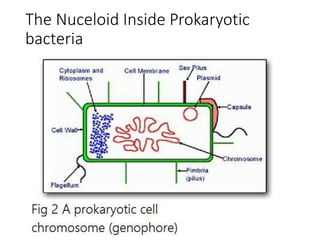
• Most of their genetic material of bacteria is located
in the nucleoid and some genetic material might be
present as plasmid in the cytoplasm.
Introduction cont'...
• The nuceoid is an irregularly shaped region within
the cell.
• The genome of bacteria is generally circular and
double stranded piece of DNA. The size of the DNA
is measured in bits just like binary computer data
calculations and varies in length from bacteria to
bacteria.
Introduction cont'...
• The nucleoid consists of DNA, RNA and nucleoid
proteins which are associated with the supercoiled
structure of the DNA; which are distinct from
histones in eukaryotic cells.
•
Further Details on Prokaryotic cell
organization
• The circular structure of DNA in bacteria replicates
differently from the eukaryotic cells.
• There is a supercoiling which makes the packaging of
data in the tiny cell easier; this coiling puts a strain on
the DNA itself.
• This coiling of DNA can cause disruption to
transcription and even to cell death. The double helix
twists around its axis approximately every 10 bases.
Details....cont'
• The DNA is a molecule composed of nucleotides
guanine and adenine (purines) and cytosine and
thymine (pyramidines). In addition, there are
deoxyribose sugars and phosphate groups.
•
Details...Continued
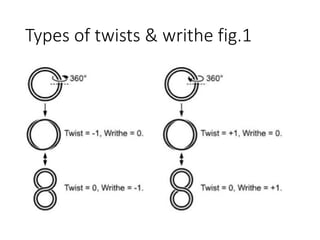
• In general, there are two terms to remember one
is twist: which is the number of turns the ladder of
DNA rotates on itself.
• writhe: the number of times the DNA crosses over
on itself (supercoils) like a circle for example
crossing over to give the figure number eight.
The DNA twisting Positions
• It can twist or writhe to the left or to the right
Types of twists & writhe fig.1
Twists & writhe continued....
Twists & writhe continued
The Nuceloid Inside Prokaryotic
bacteria
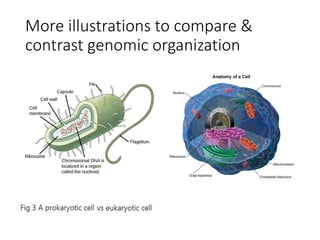
More illustrations to compare &
contrast genomic organization
Organization in Eukaryotes cont'...
More illustrations cont'....
Important points to Remember
1-Positive supercoils: loosening the DNA strand
2-Negative supercoils: tightening the DNA strand
3-Codons: a set of rules by which information
encoded within a gene is translated.
4-Open reading frames (ORF): is a part of the DNA that
contains no stop codons. It is the protein coding region
of the helix.
Important points.....
5-Semiconservative replication: A type of replication
where the daughter strand is made of one parental
strand and one new daughter strand.
6- Nucleotide: The important four molecules ATGC
without the sugar backbone.
7- Base: nucleotide plus the sugar back bone.
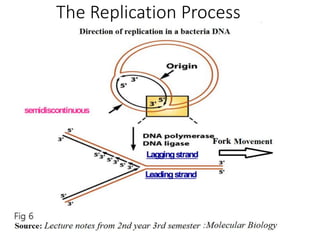
8- Replication fork: The point where the DNA is separated
into single strands, and where new DNA will be
synthesized.
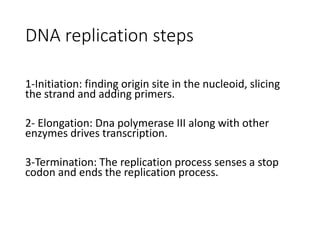
DNA replication steps
1-Initiation: finding origin site in the nucleoid, slicing
the strand and adding primers.
2- Elongation: Dna polymerase III along with other
enzymes drives transcription.
3-Termination: The replication process senses a stop
codon and ends the replication process.
Materials Needed for Replication
1- DNA template
2.dNTPs:dATP,dTTP,dGTP,dCTP (deoxyribonucleoside
5’-triphosphates)
3. DNA polymerase III and I
4. RNA primer
Materials needed cont'...
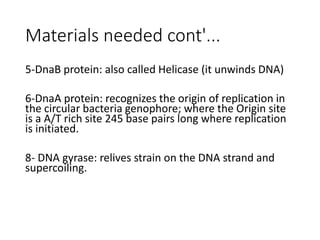
5-DnaB protein: also called Helicase (it unwinds DNA)
6-DnaA protein: recognizes the origin of replication in
the circular bacteria genophore; where the Origin site
is a A/T rich site 245 base pairs long where replication
is initiated.
8- DNA gyrase: relives strain on the DNA strand and
supercoiling.
Materials needed cont'...
9- Primase (DnaG protein): synthesizes RNA primers.
10-DnaC: Binds DnaB (helicase) at origin site.
11- Dna ligase: connects Okazaki fragments.
The Replication Process
Conclusions
Even though prokaryotic bacteria are the first to
evolve in evolutionary history; their mechanism of
storing the DNA is not that different from the
advanced and specialized cells called eukaryotes.
Conclusions cont'...
In this short note we have tried to elaborate the
mechanisms of genomic organization (how DNA is
stored in primitive cells i.e. bacteria) and also we
have added how the replication process moves
ahead so that the reader gets a full picture of the
process.
www.kahnacademy.com
www.lumenlearning.com
www.asm.org
NIH Human Microbiome project
www.hmpdacc.org
Lecture notes from 2nd yr 3rd semester: Molecular
biology
References
End of Presentation
Questions?

Bacterial genomic organization

  • 1.
  • 2.
    Bacterial Genomic Organization Presentedby Negash Alamin (BSC) Medical labscientist Feb,22,2019
  • 3.
    Introduction • Prokaryotic genomesare somewhat different in organization but not in function from eukaryotic cells. • Most of their genetic material of bacteria is located in the nucleoid and some genetic material might be present as plasmid in the cytoplasm.
  • 4.
    Introduction cont'... • Thenuceoid is an irregularly shaped region within the cell. • The genome of bacteria is generally circular and double stranded piece of DNA. The size of the DNA is measured in bits just like binary computer data calculations and varies in length from bacteria to bacteria.
  • 5.
    Introduction cont'... • Thenucleoid consists of DNA, RNA and nucleoid proteins which are associated with the supercoiled structure of the DNA; which are distinct from histones in eukaryotic cells. •
  • 6.
    Further Details onProkaryotic cell organization • The circular structure of DNA in bacteria replicates differently from the eukaryotic cells. • There is a supercoiling which makes the packaging of data in the tiny cell easier; this coiling puts a strain on the DNA itself. • This coiling of DNA can cause disruption to transcription and even to cell death. The double helix twists around its axis approximately every 10 bases.
  • 7.
    Details....cont' • The DNAis a molecule composed of nucleotides guanine and adenine (purines) and cytosine and thymine (pyramidines). In addition, there are deoxyribose sugars and phosphate groups. •
  • 8.
    Details...Continued • In general,there are two terms to remember one is twist: which is the number of turns the ladder of DNA rotates on itself. • writhe: the number of times the DNA crosses over on itself (supercoils) like a circle for example crossing over to give the figure number eight.
  • 9.
    The DNA twistingPositions • It can twist or writhe to the left or to the right
  • 10.
    Types of twists& writhe fig.1
  • 11.
    Twists & writhecontinued....
  • 12.
    Twists & writhecontinued
  • 13.
    The Nuceloid InsideProkaryotic bacteria
  • 14.
    More illustrations tocompare & contrast genomic organization
  • 15.
  • 16.
  • 17.
    Important points toRemember 1-Positive supercoils: loosening the DNA strand 2-Negative supercoils: tightening the DNA strand 3-Codons: a set of rules by which information encoded within a gene is translated. 4-Open reading frames (ORF): is a part of the DNA that contains no stop codons. It is the protein coding region of the helix.
  • 18.
    Important points..... 5-Semiconservative replication:A type of replication where the daughter strand is made of one parental strand and one new daughter strand. 6- Nucleotide: The important four molecules ATGC without the sugar backbone. 7- Base: nucleotide plus the sugar back bone. 8- Replication fork: The point where the DNA is separated into single strands, and where new DNA will be synthesized.
  • 19.
    DNA replication steps 1-Initiation:finding origin site in the nucleoid, slicing the strand and adding primers. 2- Elongation: Dna polymerase III along with other enzymes drives transcription. 3-Termination: The replication process senses a stop codon and ends the replication process.
  • 20.
    Materials Needed forReplication 1- DNA template 2.dNTPs:dATP,dTTP,dGTP,dCTP (deoxyribonucleoside 5’-triphosphates) 3. DNA polymerase III and I 4. RNA primer
  • 21.
    Materials needed cont'... 5-DnaBprotein: also called Helicase (it unwinds DNA) 6-DnaA protein: recognizes the origin of replication in the circular bacteria genophore; where the Origin site is a A/T rich site 245 base pairs long where replication is initiated. 8- DNA gyrase: relives strain on the DNA strand and supercoiling.
  • 22.
    Materials needed cont'... 9-Primase (DnaG protein): synthesizes RNA primers. 10-DnaC: Binds DnaB (helicase) at origin site. 11- Dna ligase: connects Okazaki fragments.
  • 23.
  • 25.
    Conclusions Even though prokaryoticbacteria are the first to evolve in evolutionary history; their mechanism of storing the DNA is not that different from the advanced and specialized cells called eukaryotes.
  • 26.
    Conclusions cont'... In thisshort note we have tried to elaborate the mechanisms of genomic organization (how DNA is stored in primitive cells i.e. bacteria) and also we have added how the replication process moves ahead so that the reader gets a full picture of the process.
  • 27.
    www.kahnacademy.com www.lumenlearning.com www.asm.org NIH Human Microbiomeproject www.hmpdacc.org Lecture notes from 2nd yr 3rd semester: Molecular biology References
  • 28.