Epigenetics
By: Erin Werking
Block 2
Honors Biology
What Is Epigenetics?
   All the genetic modifications excluding
    changes in the actual DNA sequence.

   Modifications include adding molecules, like
    methyl groups, to the DNA. This changes the
    appearance and structure of DNA which
    alters how that gene can interact with the
    transcribing molecules in the cell’s nucleus.
What is Epigenetic
Inheritance?
   The fact that non-genetic variations that are
    obtained during an organism’s life can be
    possibly be passed on to that organism’s
    offspring.

   An example of this would be that brain and skin
    cells have exactly the same DNA, but different
    functions and forms. So, there must be
    something that makes skin cells stay skin cells
    and brain cells stay brain cells when they divide.
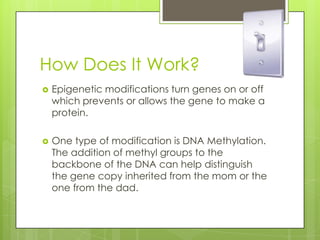
How Does It Work?
   Epigenetic modifications turn genes on or off
    which prevents or allows the gene to make a
    protein.

   One type of modification is DNA Methylation.
    The addition of methyl groups to the
    backbone of the DNA can help distinguish
    the gene copy inherited from the mom or the
    one from the dad.
Experiments With Epigenetics
   When fruit flies are exposed to certain chemicals
    they get rough growths on their eyes and at least 13
    generations after them are born with it too (and
    generations 2-13 weren’t exposed to the drug).

   A pregnant rat was exposed to a chemical that can
    alter reproductive hormones. It had generations of
    sick offspring.

   People who aren’t well-fed as a child are known to
    have children and grandchildren with higher risks for
    diabetes and cardiovascular disease.
Experiments with Epigenetics
 Smoking    and over-eating can make the
  genes for obesity over-express themselves
  and the genes for longevity under-express
  themselves.
 Men who smoke before puberty tend to
  have sons who can’t produce sperm,
  have higher body mass indexes and
  shorter life expectancies.
Experiments with Epigenetics
   The rise in peanut allergies may be because
    of baby lotions containing peanut oil.

   Pregnant women with high maternal
    anxiety are known to have children with
    asthma.

   Little kids who are kept very clean are at
    higher risk for eczema.
Sweden Study
   In Norrbotten, Sweden in the 19th century
    there were very few people. If they had a
    bad harvest, people would starve.

   1800, 1812, 1821, 1836, & 1856 the crops were
    horrible and people suffered.

   1801, 1822, 1828, 1844 & 1863 the crops were
    bountiful and the people had feasts.
Sweden Study
   The study showed that pregnant women who
    ate poorly tended to have children with a
    higher risk for cardiovascular disease when
    they got older.
   Children that went from having a normal
    harvest to a feast the next year were known
    to have children and grandchildren with far
    shorter lives. When certain socioeconomic
    variations were controlled it came out to be
    that the future generations would die 32 years
    before their peers.
Epigenetic Changes
   But throughout all of those studies and
    experiments, the change was not in the DNA
    itself, but the new traits were passed on by
    epigenetic means.

   Epigenetic changes could possibly be
    permanent. The changes represent a response
    to an environmental stressor. The response can
    be inherited, but once the stressor is taken
    away, the marks will fade and the DNA code
    will go back to its original programming.
Contributions to Science Work
and Society
   The new evidence for epigenetic inheritance
    has had great implications for the study of
    evolution. It extends the span of evolutionary
    thinking and is leading to ideas of heredity
    that include development. And it also
    suggests that acquired traits can be heritable,
    so Lamarck wasn’t completely wrong.
The Good News
 Scientists  are learning to manipulate
  epigenetic marks and are making drugs
  that will treat sickness by turning off the
  bad genes and turning on the good ones.
Future Implications
   Scientists are hoping to develop epigenetic
    drugs to help people with diabetes, cancer,
    Alzheimer’s, schizophrenia, autism, etc.

   They are hoping that further research will help
    answer why one identical twin can suffer from
    asthma or bipolar disorder and the other one
    doesn’t. Or why autism is four times more likely in
    a boy than a girl.

Epigenetics

  • 1.
  • 2.
    What Is Epigenetics?  All the genetic modifications excluding changes in the actual DNA sequence.  Modifications include adding molecules, like methyl groups, to the DNA. This changes the appearance and structure of DNA which alters how that gene can interact with the transcribing molecules in the cell’s nucleus.
  • 3.
    What is Epigenetic Inheritance?  The fact that non-genetic variations that are obtained during an organism’s life can be possibly be passed on to that organism’s offspring.  An example of this would be that brain and skin cells have exactly the same DNA, but different functions and forms. So, there must be something that makes skin cells stay skin cells and brain cells stay brain cells when they divide.
  • 4.
    How Does ItWork?  Epigenetic modifications turn genes on or off which prevents or allows the gene to make a protein.  One type of modification is DNA Methylation. The addition of methyl groups to the backbone of the DNA can help distinguish the gene copy inherited from the mom or the one from the dad.
  • 5.
    Experiments With Epigenetics  When fruit flies are exposed to certain chemicals they get rough growths on their eyes and at least 13 generations after them are born with it too (and generations 2-13 weren’t exposed to the drug).  A pregnant rat was exposed to a chemical that can alter reproductive hormones. It had generations of sick offspring.  People who aren’t well-fed as a child are known to have children and grandchildren with higher risks for diabetes and cardiovascular disease.
  • 6.
    Experiments with Epigenetics Smoking and over-eating can make the genes for obesity over-express themselves and the genes for longevity under-express themselves.  Men who smoke before puberty tend to have sons who can’t produce sperm, have higher body mass indexes and shorter life expectancies.
  • 7.
    Experiments with Epigenetics  The rise in peanut allergies may be because of baby lotions containing peanut oil.  Pregnant women with high maternal anxiety are known to have children with asthma.  Little kids who are kept very clean are at higher risk for eczema.
  • 8.
    Sweden Study  In Norrbotten, Sweden in the 19th century there were very few people. If they had a bad harvest, people would starve.  1800, 1812, 1821, 1836, & 1856 the crops were horrible and people suffered.  1801, 1822, 1828, 1844 & 1863 the crops were bountiful and the people had feasts.
  • 9.
    Sweden Study  The study showed that pregnant women who ate poorly tended to have children with a higher risk for cardiovascular disease when they got older.  Children that went from having a normal harvest to a feast the next year were known to have children and grandchildren with far shorter lives. When certain socioeconomic variations were controlled it came out to be that the future generations would die 32 years before their peers.
  • 10.
    Epigenetic Changes  But throughout all of those studies and experiments, the change was not in the DNA itself, but the new traits were passed on by epigenetic means.  Epigenetic changes could possibly be permanent. The changes represent a response to an environmental stressor. The response can be inherited, but once the stressor is taken away, the marks will fade and the DNA code will go back to its original programming.
  • 11.
    Contributions to ScienceWork and Society  The new evidence for epigenetic inheritance has had great implications for the study of evolution. It extends the span of evolutionary thinking and is leading to ideas of heredity that include development. And it also suggests that acquired traits can be heritable, so Lamarck wasn’t completely wrong.
  • 12.
    The Good News Scientists are learning to manipulate epigenetic marks and are making drugs that will treat sickness by turning off the bad genes and turning on the good ones.
  • 13.
    Future Implications  Scientists are hoping to develop epigenetic drugs to help people with diabetes, cancer, Alzheimer’s, schizophrenia, autism, etc.  They are hoping that further research will help answer why one identical twin can suffer from asthma or bipolar disorder and the other one doesn’t. Or why autism is four times more likely in a boy than a girl.