
Summer training report
on
dieSel locomotive workS varanaSi
Submitted to- Submitted by-
MECHANICAL ISHANT GAUTAM
DEPARTMENT B.TECH (M.E) 4th
Year.
TITM, MEERUT ROLLNO-
1232140025
DLW, was founded by Late Railway Minister Mr. Lal Bahadur Shastri on 23
April 1956. It is spread in 300 acres area at Varanasi.
It is a production unit owned by Indian railways , for which it manufactures
diesel–electric locomotives and its spares parts.
To meet the increased transportation needs of the Indian railways it was
established in collaboration with ALCO( American Locomotive Company),
USA in 1961.
 DLW rolled out its first locomotive three years later, on January 3, 1964. It
manufactures locomotives.
introduction

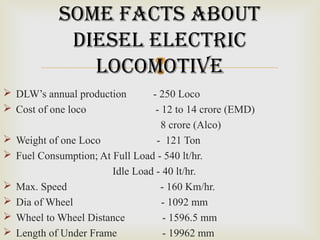
 DLW’s annual production - 250 Loco
 Cost of one loco - 12 to 14 crore (EMD)
8 crore (Alco)
 Weight of one Loco - 121 Ton
 Fuel Consumption; At Full Load - 540 lt/hr.
Idle Load - 40 lt/hr.
 Max. Speed - 160 Km/hr.
 Dia of Wheel - 1092 mm
 Wheel to Wheel Distance - 1596.5 mm
 Length of Under Frame - 19962 mm
Some factS about
dieSel electric
locomotive

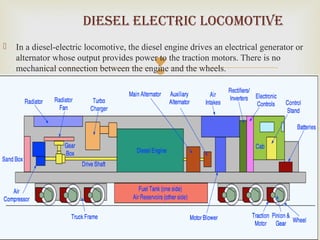
 In a diesel-electric locomotive, the diesel engine drives an electrical generator or
alternator whose output provides power to the traction motors. There is no
mechanical connection between the engine and the wheels.
dieSel electric locomotive
welding Shop
Welding is a process which produces joining of materials
by heating them to suitable temperatures with or
without the application of pressure and with or without
the use of filler material.
Welding is used for making permanent joints.
It is used in the manufacturing of automobile bodies,
aircraft frames, railway wagons, machine frames,
structural works, tanks, furniture, boilers, general repair
work and ship building.
Shielded Metal Arc Welding [SMAW]
Submerged Arc Welding [SAW]
Gas Shielded Metal Arc Welding [MIG]
Flux Cored Arc Welding [FCAW]
Shielded Metal Arc Welding [SMAW]
Submerged Arc Welding [SAW]
Gas Shielded Metal Arc Welding [MIG]
Flux Cored Arc Welding [FCAW]
Types Of Welding Used in dlWTypes Of Welding Used in dlW
bOgie assembly shOp
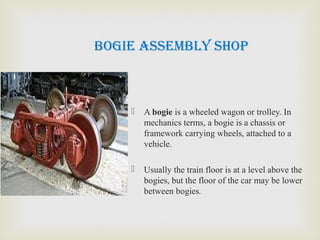
 A bogie is a wheeled wagon or trolley. In
mechanics terms, a bogie is a chassis or
framework carrying wheels, attached to a
vehicle.
 Usually the train floor is at a level above the
bogies, but the floor of the car may be lower
between bogies.
bOgie assembly (emd)
 Wheel and Axle assembly.
 Brake rigging assembly.
 Traction motor & gear case assembly.
 Bearing adopter assembly.
 Final assembly.
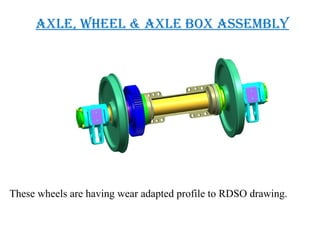
axle, Wheel & axle bOx assembly
These wheels are having wear adapted profile to RDSO drawing.
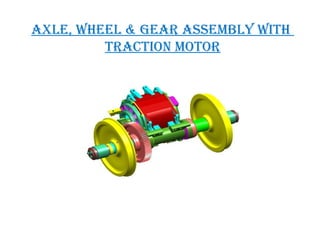
axle, Wheel & gear assembly WiTh
TracTiOn mOTOr
 PRESS BULL GEAR ON AXLE.
 SHIFT ABOVE ASSEMBLY AT BEARING HOUSING
FITTING STAND.
 FIT THE BEARING HOUSING AND BOLTING .
 ASSEMBLE SEAL , CAP AND TAPER ROLLER BEARING
 BOLTING .
 NOW, SHIFT THIS ASSEMBLY ON WHEEL & AXLE PRESS
MACHINE.
assembly prOcess:
Break down of machine can occur due to the following two reasons:
Due to unpredictable failure of component which cannot be prevented.
Due to gradual wear and tear of the parts of the machine which can be prevented by
regular inspection known as preventive maintenance.
prevenTive mainTenance
Also termed as “planned maintenance” or “systematic maintenance” .
An extremely important function for the reduction of the maintenance cost and to
keep the good operational condition of equipment.
breakdOWn mainTenance
mainTainance area

To obtain maximum availability of the plant by avoiding break down and
by reducing shut down period to a maximum.
To keep the machine in proper condition so as to maintain the quality of the
product.
To ensure the safety of the workers.
To keep the plant at the maximum production efficiency.
To achieve the above objectives with most economical combination.
objective of preventive maintenance

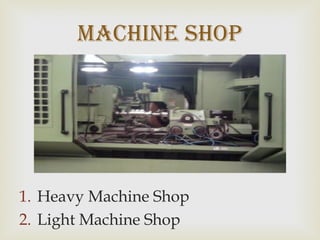
1. Heavy Machine Shop
2. Light Machine Shop
macHine SHop
1. Conventional machine
2. NC machine
3. CNC machine
1. conventional macHine:
It is a simple machine which is now an old technique.
2. numerical control macHine:
Numerical control is defined as a system in which the actions of the machines
are controlled by the insertion of the numerical data. In other words number
controls the action.
typeS of macHineS
cnc milling macHineS
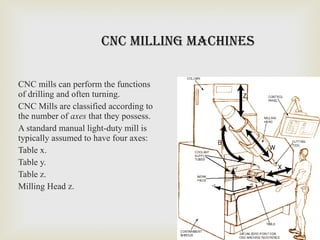
CNC mills can perform the functions
of drilling and often turning.
CNC Mills are classified according to
the number of axes that they possess.
A standard manual light-duty mill is
typically assumed to have four axes:
Table x.
Table y.
Table z.
Milling Head z.

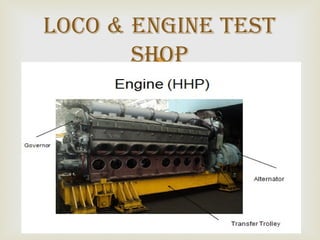
loco & engine teSt
SHop

lubricating oil teSting
 Lubrication is done for better performance of the engine parts.
 testing is done by checking the circulation of lubricant oil.
 For rotating parts checking is done by seeing the returning path of the oil
i.e. checking not only the forward path but also the returning path.
 RR40 is used as lubricating oil.
typeS of teSting

 Water acts as a coolant for moving part of the engine because constant
movement or rotation causes various parts to heat up and water
working as coolant cooled down the concerned part.
load teSting
For load testing electrical load is provided to the engine. If there is
any abnormal sound then the engine is again tested for lubrication so
that any flaw which is there can be removed.
water teSting
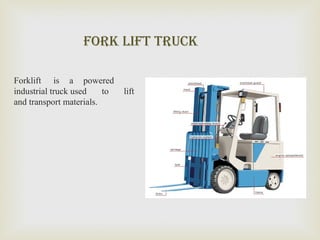
Fork liFt truck
Forklift   is  a  powered     
industrial truck used  to  lift 
and transport materials. 

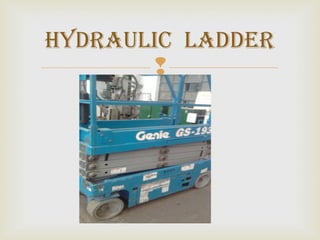
HYDrAulic lADDEr
crAnEs
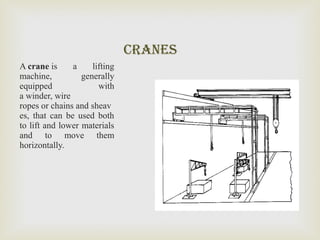
A crane is  a  lifting 
machine,  generally 
equipped  with 
a winder, wire 
ropes or chains and sheav
es,  that  can  be  used  both 
to lift and lower materials 
and  to  move  them 
horizontally.
Dlw varanasi

Dlw varanasi

  • 1.
     Summer training report on dieSellocomotive workS varanaSi Submitted to- Submitted by- MECHANICAL ISHANT GAUTAM DEPARTMENT B.TECH (M.E) 4th Year. TITM, MEERUT ROLLNO- 1232140025
  • 2.
    DLW, was foundedby Late Railway Minister Mr. Lal Bahadur Shastri on 23 April 1956. It is spread in 300 acres area at Varanasi. It is a production unit owned by Indian railways , for which it manufactures diesel–electric locomotives and its spares parts. To meet the increased transportation needs of the Indian railways it was established in collaboration with ALCO( American Locomotive Company), USA in 1961.  DLW rolled out its first locomotive three years later, on January 3, 1964. It manufactures locomotives. introduction
  • 3.
      DLW’s annualproduction - 250 Loco  Cost of one loco - 12 to 14 crore (EMD) 8 crore (Alco)  Weight of one Loco - 121 Ton  Fuel Consumption; At Full Load - 540 lt/hr. Idle Load - 40 lt/hr.  Max. Speed - 160 Km/hr.  Dia of Wheel - 1092 mm  Wheel to Wheel Distance - 1596.5 mm  Length of Under Frame - 19962 mm Some factS about dieSel electric locomotive
  • 4.
      In adiesel-electric locomotive, the diesel engine drives an electrical generator or alternator whose output provides power to the traction motors. There is no mechanical connection between the engine and the wheels. dieSel electric locomotive
  • 7.
    welding Shop Welding isa process which produces joining of materials by heating them to suitable temperatures with or without the application of pressure and with or without the use of filler material. Welding is used for making permanent joints. It is used in the manufacturing of automobile bodies, aircraft frames, railway wagons, machine frames, structural works, tanks, furniture, boilers, general repair work and ship building.
  • 8.
    Shielded Metal ArcWelding [SMAW] Submerged Arc Welding [SAW] Gas Shielded Metal Arc Welding [MIG] Flux Cored Arc Welding [FCAW] Shielded Metal Arc Welding [SMAW] Submerged Arc Welding [SAW] Gas Shielded Metal Arc Welding [MIG] Flux Cored Arc Welding [FCAW] Types Of Welding Used in dlWTypes Of Welding Used in dlW
  • 9.
    bOgie assembly shOp A bogie is a wheeled wagon or trolley. In mechanics terms, a bogie is a chassis or framework carrying wheels, attached to a vehicle.  Usually the train floor is at a level above the bogies, but the floor of the car may be lower between bogies.
  • 10.
    bOgie assembly (emd) Wheel and Axle assembly.  Brake rigging assembly.  Traction motor & gear case assembly.  Bearing adopter assembly.  Final assembly.
  • 11.
    axle, Wheel &axle bOx assembly These wheels are having wear adapted profile to RDSO drawing.
  • 12.
    axle, Wheel &gear assembly WiTh TracTiOn mOTOr
  • 13.
     PRESS BULLGEAR ON AXLE.  SHIFT ABOVE ASSEMBLY AT BEARING HOUSING FITTING STAND.  FIT THE BEARING HOUSING AND BOLTING .  ASSEMBLE SEAL , CAP AND TAPER ROLLER BEARING  BOLTING .  NOW, SHIFT THIS ASSEMBLY ON WHEEL & AXLE PRESS MACHINE. assembly prOcess:
  • 14.
    Break down ofmachine can occur due to the following two reasons: Due to unpredictable failure of component which cannot be prevented. Due to gradual wear and tear of the parts of the machine which can be prevented by regular inspection known as preventive maintenance. prevenTive mainTenance Also termed as “planned maintenance” or “systematic maintenance” . An extremely important function for the reduction of the maintenance cost and to keep the good operational condition of equipment. breakdOWn mainTenance mainTainance area
  • 15.
     To obtain maximumavailability of the plant by avoiding break down and by reducing shut down period to a maximum. To keep the machine in proper condition so as to maintain the quality of the product. To ensure the safety of the workers. To keep the plant at the maximum production efficiency. To achieve the above objectives with most economical combination. objective of preventive maintenance
  • 16.
     1. Heavy MachineShop 2. Light Machine Shop macHine SHop
  • 17.
    1. Conventional machine 2.NC machine 3. CNC machine 1. conventional macHine: It is a simple machine which is now an old technique. 2. numerical control macHine: Numerical control is defined as a system in which the actions of the machines are controlled by the insertion of the numerical data. In other words number controls the action. typeS of macHineS
  • 18.
    cnc milling macHineS CNCmills can perform the functions of drilling and often turning. CNC Mills are classified according to the number of axes that they possess. A standard manual light-duty mill is typically assumed to have four axes: Table x. Table y. Table z. Milling Head z.
  • 19.
  • 20.
     lubricating oil teSting Lubrication is done for better performance of the engine parts.  testing is done by checking the circulation of lubricant oil.  For rotating parts checking is done by seeing the returning path of the oil i.e. checking not only the forward path but also the returning path.  RR40 is used as lubricating oil. typeS of teSting
  • 21.
      Water actsas a coolant for moving part of the engine because constant movement or rotation causes various parts to heat up and water working as coolant cooled down the concerned part. load teSting For load testing electrical load is provided to the engine. If there is any abnormal sound then the engine is again tested for lubrication so that any flaw which is there can be removed. water teSting
  • 22.
    Fork liFt truck Forklift  is  a  powered      industrial truck used  to  lift  and transport materials. 
  • 23.
  • 24.
    crAnEs A crane is  a  lifting  machine, generally  equipped  with  a winder, wire  ropes or chains and sheav es,  that  can  be  used  both  to lift and lower materials  and  to  move  them  horizontally.